

What Is a Consent Order in Brampton Family Law?
A consent order is a powerful legal document that takes a private agreement you’ve made with your ex-partner and turns it into an official, legally binding court order. It's the final, crucial step that gives your mutual decisions on parenting or property the full weight and enforcement power of the Ontario court system, creating a clear and secure path forward for families in Bramton.
Understanding a Consent Order in Brampton Family Law

When a relationship ends, the road ahead can feel uncertain. For many families in Brampton, the thought of resolving issues like parenting arrangements, support, and property division in court feels intimidating and adversarial. Thankfully, there’s a cooperative, efficient, and far less stressful alternative to a drawn-out court battle: the consent order.
Think of it this way: you and your former partner are the co-authors of a new rulebook for your family’s future. Together, you negotiate the terms, write them down, and agree on every detail. A consent order is what happens when you take that rulebook to a judge. The judge reviews it to make sure it’s fair and lawful under Ontario's Family Law Act, then gives it an official stamp of approval. That stamp transforms your private agreement into a document with the same legal force as if a judge had made the decisions after a full trial.
Why Is This Transformation So Important?
The main advantage of a consent order is enforceability. A handshake deal or an informal written agreement relies entirely on goodwill. A court order, on the other hand, is backed by the full power of the law in Ontario.
If one person fails to follow the terms—for example, by missing child support payments—the other person has immediate and direct legal options. This provides a critical layer of security and predictability that informal agreements just can't offer.
This legal tool is incredibly valuable because it can cover nearly every aspect of a separation, including:
-
Parenting Arrangements: Clearly defines who makes major decisions for the children (decision-making responsibility) and sets out the specific parenting time schedule.
-
Child and Spousal Support: Formalizes the amount and duration of support payments. Once it’s in an order, it can be enforced by the Family Responsibility Office (FRO).
-
Division of Property: Finalizes how assets like the family home and pensions, as well as debts, are to be divided according to Ontario's equalization rules.
A consent order isn’t about one person winning and the other losing. It’s a testament to two people choosing to resolve their differences collaboratively, creating a stable and legally secure foundation for the next chapter of their lives.
Your Path to a Final Resolution
For residents of Brampton and the surrounding Peel Region, understanding what a consent order is represents the first step toward a more amicable separation. It allows you to stay in control of the outcome while gaining the certainty that only a court order can provide.
By working together to create the terms, you save time, reduce legal costs, and minimize the emotional strain on your family. Ultimately, it ensures a smoother transition for everyone involved.
Consent Order vs. Separation Agreement: What Brampton Families Should Know
When you're navigating a separation in Brampton, you'll hear about two key legal documents: the separation agreement and the consent order. They both lay out the terms of your split, but they work in very different ways and offer completely different levels of security. Understanding this difference is critical to protecting your family's future.
Think of a separation agreement as a private contract between you and your former partner, governed by Ontario's family law. You work it out together, often with the help of your family lawyers, and detail all your decisions on everything from parenting schedules to who gets the house. It's negotiated and signed by both of you, and it stays private.
A consent order, on the other hand, is what happens when you take that private agreement and give it the power of the court. You submit your signed agreement to a judge, who reviews and approves it. Once signed by the judge, its terms become an official, legally binding court directive.
The Power of Enforceability
The biggest difference between the two comes down to enforcement. A separation agreement is a contract. If your ex-partner breaks the rules, you have to go back to court to enforce it—just like with any other broken contract. That means filing a new application, gathering evidence, and asking a judge to force them to follow through.
This process can be slow, stressful, and expensive. For example, if your spousal support payments suddenly stop, you’d have to start a whole new court case just to get the money you’re owed under the separation agreement.
A consent order changes the game completely. Because it’s already a court order, its terms are immediately enforceable.
In Ontario, support payments outlined in a court order can be automatically filed with the Family Responsibility Office (FRO). The FRO is a provincial agency with serious power—they can garnish wages, suspend driver's licences, and even seize assets to make sure payments are made. These are actions you simply can't take on your own with just a separation agreement.
This direct line to enforcement is a huge safety net, especially when it comes to child and spousal support. It takes the burden off you to chase down missed payments through the courts.
Privacy Versus Public Record
While a consent order offers rock-solid enforcement, a separation agreement gives you more privacy. A separation agreement is a confidential document shared only between you, your ex-partner, and your lawyers. It never becomes part of the public court record.
Once your agreement becomes a consent order, however, it’s filed with the court and becomes a public document. For some families in Brampton who prefer to keep the specific details of their finances or parenting arrangements completely private, this is a major factor. The desire for confidentiality is a key reason why some couples decide to stick with a separation agreement alone.
Separation Agreement vs. Consent Order At a Glance
To make it even clearer, here's a quick comparison to help you understand the key differences in legal power, how they are enforced, and the process for creating them in Ontario.
| Feature | Separation Agreement | Consent Order |
|---|---|---|
| Legal Status | A private contract between two people. | An official court order, signed by a judge. |
| Enforcement | Must sue for breach of contract in court. | Immediately enforceable by the court & agencies like the FRO. |
| Privacy | Completely private and confidential. | Becomes part of the public court record. |
| Creation Process | Negotiated and signed by both parties. | A signed agreement is submitted to the court for approval. |
| Best For… | Situations with high trust and a strong desire for privacy. | Situations where support payments need guaranteed enforcement. |
This table shows that your choice really depends on what you value more: the absolute privacy of an agreement or the guaranteed security of a court order.
How They Can Work Together
It’s crucial to know that these documents aren't an "either/or" choice. In fact, they often work hand-in-hand. The most effective approach for many Brampton families is to first negotiate and sign a detailed separation agreement. This lets you sort through everything privately and on your own timeline.
Once you’re both happy with the terms, you can submit the signed agreement to the court with the right forms to turn it into a consent order. This two-step process gives you the best of both worlds: the privacy and control of a negotiated settlement, followed by the iron-clad security of a court order.
Deciding whether to leave your terms in a private agreement or get the finality of a consent order depends on your unique situation. Key factors include the level of trust between you and your ex-partner and the nature of the terms you’ve agreed upon. Speaking with an experienced Brampton family lawyer can help you figure out which path best protects your interests and gives you peace of mind.
The Step-by-Step Process To Get A Consent Order In Ontario
Transforming a private agreement into a formal court order might feel intimidating, but Ontario’s family law system lays out a straightforward path. For couples in Brampton, knowing these stages brings clarity and control.
You’ll move from a mutual understanding to a written separation agreement, then ask the court to give it legal force. Think of it as turning your negotiated terms into an official document the judge can sign off on.
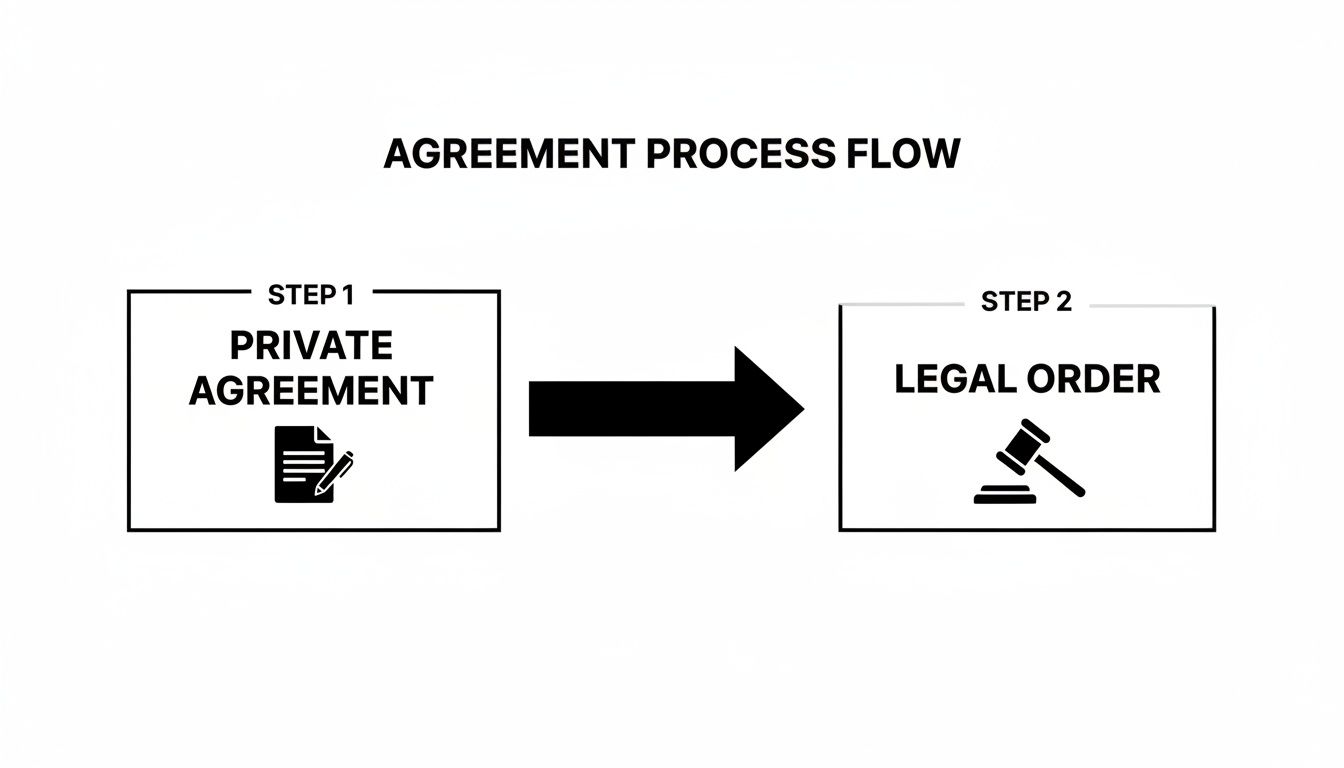
This visual sums up how your private deal becomes a legally enforceable order once it passes through the court’s doors.
Step 1 Reaching A Mutual Agreement
Before any paperwork lands on the judge’s desk, you and your former partner must reach a full consensus on every issue you want in the order, such as parenting time, child support, or property division.
Most couples in Brampton reach these terms through direct talks, mediation, or with the guidance of family lawyers. The crucial point is that both sides agree freely, without pressure or coercion.
Step 2 Drafting The Formal Terms
Once you’ve agreed on the details, a family lawyer translates those discussions into precise legal language compliant with Ontario’s Family Law Act. This step turns your verbal agreements into a solid separation agreement ready for court.
Every clause must be clear and unambiguous—any vague wording can spark future disputes. Your lawyer’s job is to ensure the document reflects exactly what you both intended and is legally sound.
By working with an experienced lawyer in Brampton, you’re not just putting words on paper; you’re creating a robust legal framework a judge can confidently approve. This foresight prevents arguments over interpretation down the road.
Step 3 Preparing The Court Forms
With your signed separation agreement in hand, it’s time to assemble the court package. In Ontario, you request a consent order through a motion on consent, which often doesn't require a court appearance.
You’ll need to include:
-
Form 14B (Motion Form): Your formal request for a court order based on your agreed terms.
-
Draft Consent Order: A proposed order that exactly matches your separation agreement.
-
Signed Separation Agreement: Proof that both parties consented to the terms.
-
Financial Statements: Sworn statements if your order covers support or property matters.
Every detail on these forms must be accurate—mistakes will only cause delays.
Step 4 Filing With The Court And Awaiting Approval
Once everything is ready, you file your documents at the Superior Court of Justice in Brampton. The court clerk performs an initial check for completeness before passing the package to a judge.
The judge’s review focuses on:
-
Compliance With The Law: Ensuring terms follow the Federal Child Support Guidelines and prioritize the children’s best interests.
-
Voluntary Consent: Confirming that both parties entered the agreement willingly, often evidenced by independent legal advice.
-
Clarity And Completeness: Making sure the order is straightforward and leaves no room for confusion.
If the judge is satisfied, they’ll sign the draft order—and just like that, your private arrangement becomes a binding consent order. You’ll then receive the final, signed document, giving you the confidence that your agreement is enforceable in Ontario’s courts.
What Your Family Law Consent Order Can Cover

When you and your former partner agree on how to move forward, a consent order turns that understanding into an official rulebook. For families in Brampton, it’s the legal tool that locks down every major decision, making sure there are no loose ends or confusion down the road.
This is a powerful document. It can tackle the full spectrum of issues that come with a separation, from your children’s well-being to the final split of your shared home and assets, all under the framework of Canadian family law.
Parenting, Decision-Making, and Schedules
One of the most important jobs of a consent order is to lay out a clear, predictable plan for your children. In Ontario, the Family Law Act makes it clear that a child’s best interests always come first, and your consent order must reflect that. It will detail two key aspects of parenting.
First is decision-making responsibility, formerly known as custody. This part states who makes major decisions for your child—such as their education, significant health care choices, and religious upbringing. It can be held solely by one parent or shared jointly.
Second, it details the parenting time schedule, formerly known as access. This is the day-to-day calendar that specifies when the children will be with each parent. A well-drafted order is specific, covering the regular weekly routine, holidays, summer vacation, and birthdays to prevent future arguments.
Child and Spousal Support
Financial stability is essential for everyone to move on after a separation. A consent order brings certainty to money matters by formalizing both child and spousal support, making the terms fully enforceable through the Family Responsibility Office (FRO).
-
Child Support: This is not negotiable; it's calculated using the mandatory Federal Child Support Guidelines. Your order will lock in the monthly amount, who pays it, and how you’ll share special and extraordinary expenses like orthodontics or post-secondary education.
-
Spousal Support: This has more flexibility. The order will define the support amount, how long it will be paid (duration), and the basis for the payments (e.g., to compensate a spouse for career sacrifices). It can also include triggers for when support might be reviewed or terminated, such as retirement or remarriage.
Turning support promises into a consent order means you’re creating a legally enforceable obligation. This ensures your children receive consistent financial support and gives both partners predictability.
Splitting Up Property and Debts
Finalizing your finances is key to a clean break. In Ontario, the law is based on the equalization of net family property. This process involves calculating the value of assets acquired during the marriage (minus debts), and the spouse with the higher net worth typically makes a payment to the other to equalize their financial positions.
Your consent order will map this entire process out. It will clearly state:
-
The official valuation date for all assets and debts.
-
A complete list of what’s being divided, such as the matrimonial home, pensions, RRSPs, and investments.
-
The final equalization payment amount and a firm deadline for payment.
-
The mechanics of asset transfers—for instance, who keeps the home and how the other spouse’s share is bought out.
By covering these three core areas—parenting, support, and property—a consent order delivers a complete and final resolution. It transforms your private agreements into clear, court-backed clauses, giving your family the legal certainty needed to close one chapter and confidently start the next.
Enforcing or Changing Your Brampton Consent Order
Getting a consent order signed provides peace of mind, but its real power is in its enforceability. Once a judge signs off, it’s no longer just a promise—it’s the law. This section explains what you can do if your ex-partner doesn’t follow the rules and how to adapt the order when life changes.
For anyone in Brampton, understanding these processes is crucial for ensuring your agreement remains fair and effective. Think of a consent order as a living document; Ontario's family law provides clear paths to both enforce and change it.
When Your Ex-Partner Ignores the Order
What happens if your former partner violates the terms—say, by missing support payments or ignoring the parenting schedule? A consent order provides powerful legal tools without having to start a new lawsuit. You can move straight to enforcement.
Your options in Ontario include:
-
Family Responsibility Office (FRO): For any support-related orders, the FRO is your most powerful ally. This provincial agency has significant authority to collect unpaid child and spousal support. They can garnish wages, seize bank accounts, suspend driver's licences, and report the debt to credit bureaus.
-
Motion for Contempt: For non-financial violations, like being repeatedly denied your agreed-upon parenting time, you can file a motion for contempt. This is a serious step where you ask the court to declare that your ex-partner is deliberately defying the order. This could lead to fines or, in extreme cases, imprisonment, as outlined in the Criminal Code of Canada.
The straightforward nature of enforcement is one of the biggest reasons people in Brampton choose a consent order over a simple separation agreement.
The purpose of a consent order is to prevent you from having to drag your ex back to court to enforce something you both already agreed to. It gives you a built-in, structured path to ensure compliance.
How to Formally Change a Consent Order
Life is always changing. What worked for your family after separation might not be suitable years later. Incomes fluctuate, children's needs shift, and people might need to move. The law acknowledges this. You cannot just informally agree to change the terms. To legally modify a consent order, you must apply to the court for a **Variation Order**. The key to success is proving a **"material change in circumstances."** A material change must be a significant, unforeseen, and lasting change from the situation that existed when the original order was made. Common examples that might qualify in Brampton include: – A significant and ongoing increase or decrease in one parent's income. – A child developing new medical needs with much higher expenses. – One parent receiving a job offer requiring a move out of the Peel Region. – A child finishing post-secondary school, which could be a reason to end child support. The process for varying an order is similar to getting one. If you both agree on the new terms, you can file another motion on consent. If you can’t agree, one of you will have to file a motion to change, and a judge will make the final decision. Consent-based resolutions are effective, as seen in other legal fields where many cases are settled through similar mechanisms instead of full trials. Ensuring your order reflects your current reality is just as important as being able to enforce it. A family lawyer in Brampton can help you determine if your situation qualifies as a material change and guide you through the variation process.
How to Avoid Common Pitfalls When Drafting a Consent Order
Getting a consent order is your opportunity to set the terms for your family’s future—clearly, fairly, and definitively. But if not drafted correctly, it can create more confusion and conflict. For families in Brampton, knowing what can go wrong is the first step to ensuring your agreement is truly ironclad.
One of the most common mistakes is using vague or ambiguous language. Terms like "reasonable parenting time" or "contribute to expenses as able" sound agreeable but are a recipe for future arguments. What one person considers "reasonable" can be completely different from what the other expects.
A strong consent order leaves no room for interpretation. Instead of "the father will have access on weekends," a precise clause would state: "The father’s parenting time shall commence every second Friday at 6:00 PM and conclude on the following Sunday at 6:00 PM." This level of detail prevents disputes before they start.
The Critical Need for Full Financial Disclosure
Another major pitfall is failing to be completely open about your finances. Under Ontario's Family Law Act, both you and your ex-partner are legally required to provide a full and honest disclosure of your assets, debts, and income. Hiding property or under-reporting income can have severe consequences.
If a judge later discovers that one person was not truthful, they have the power to set aside the entire consent order. This means all the time, effort, and money spent reaching an agreement could be wasted. You could find yourself back at square one, facing expensive court battles and even penalties.
Independent legal advice isn't just a formality; it's your most important safeguard. Having your own lawyer in Brampton review the terms ensures you fully understand your rights and obligations and protects you from signing an unfair agreement.
Planning for the Future
It's easy to focus on solving today's problems and forget to plan for tomorrow. A good consent order should be a forward-looking document that anticipates life's changes. Consider adding clauses that address future possibilities.
-
Relocation: What happens if one parent needs to move out of Brampton or the GTA?
-
Income Changes: How will support be adjusted if someone gets a significant raise or loses their job?
-
New Partners: Does cohabitation with a new partner impact spousal support obligations?
Building clear processes for these scenarios into your order now will save you immense stress and legal fees later. It’s about creating a roadmap that works for your family today and in the future.
Your Questions About Consent Orders, Answered
Family law in Ontario can feel complex. To help Brampton residents navigate this process, we've answered some of the most common questions about consent orders.
Can We Get a Consent Order Without Going to Court?
Yes, absolutely. This is one of its biggest benefits. If you and your ex-partner have resolved all issues and signed a separation agreement, you typically do not need to appear in a courtroom in Brampton.
Your lawyer can file the required paperwork with the court (such as a Form 14B Motion on Consent). A judge will review the documents, and if everything complies with the law, they will sign the order. It’s a much more efficient and less stressful path to a legally binding outcome.
Is a Consent Order Final and Unchangeable?
A consent order provides finality, but with flexibility where needed. When it comes to property division, the order is almost always final. The goal under the Family Law Act is to create a clean financial break so everyone can move forward.
However, issues involving children and support can be modified because circumstances change. Child support, spousal support, and parenting time can be varied later on, but only if you can prove a “material change in circumstances”—a significant, unforeseen, and lasting shift since the original order was made.
A consent order is like the foundation of a house. The property division is the concrete—solid and permanent. The parenting and support terms are the interior walls; they can be adjusted as your family's needs evolve, but the core structure remains intact.
What Happens If My Ex-Partner Does Not Sign the Agreement?
A consent order requires consent. It is a voluntary process built on mutual agreement. If your former partner refuses to sign off on the terms, you cannot get a consent order.
At that point, your path forward shifts to the traditional court process. You will need to file an Application with the court, and a judge will ultimately make the decisions for you. This highlights the value of cooperation—it keeps you and your ex-partner in control of the outcome.
How Long Does It Take to Get a Consent Order?
Once you have a signed separation agreement, the process is relatively quick. After your lawyer files all the necessary documents with the court in Brampton, you must wait for a judge to review and sign off.
Depending on the court's backlog, this can take anywhere from a few weeks to a couple of months. This is significantly faster than a contested court case, which can easily take many months or even years to resolve.
Every family's situation is unique, and getting these details right is crucial for building a stable future. If you're navigating a separation in Brampton or the GTA and need clear, practical advice, Badesha Law is here to help. We can guide you in drafting a solid agreement and ensure it becomes an enforceable consent order that protects your interests under Canadian law. Contact us today to secure a fair resolution.