

Exploring the Difference Between Legal Separation and Divorce in Ontario
The biggest difference between a legal separation and a divorce comes down to one simple fact: when you're legally separated, you live apart and sort out all your financial and parenting issues, but you're still technically married. A divorce, on the other hand, is the official, court-ordered end of that marriage.
Think of it this way: separation draws the lines for your new, separate lives. Divorce legally erases the marriage itself.
Understanding Legal Separation vs Divorce in Ontario
When a marriage breaks down in Ontario, many people think divorce is the automatic next step. But that's not the case. The law actually gives you two very different options, and the one you choose has big consequences for your legal status, your finances, and your future. Figuring out the difference between a legal separation and a divorce is the first, most important step you can take.
A legal separation isn’t something a court grants you; it's a state of being that starts the moment you and your spouse begin living "separate and apart." You can even be separated while still living in the same house. This new reality is then usually cemented in a Separation Agreement—a private, legally binding contract that tackles all the tough questions:
- Parenting time (custody) and decision-making for the kids.
- Who pays child and spousal support, and how much.
- How you'll divide property and debts, including what happens to the matrimonial home.
A divorce, however, is a formal court order that officially dissolves your marriage. Under Canada's federal Divorce Act, you have to be separated for at least one full year before a judge can grant a divorce. While you can—and should—settle everything in a Separation Agreement first, the divorce is the final legal action that changes your marital status and lets you remarry.
Legal Separation and Divorce at a Glance
The following chart breaks down the essential differences between being legally separated and officially divorced in Ontario.
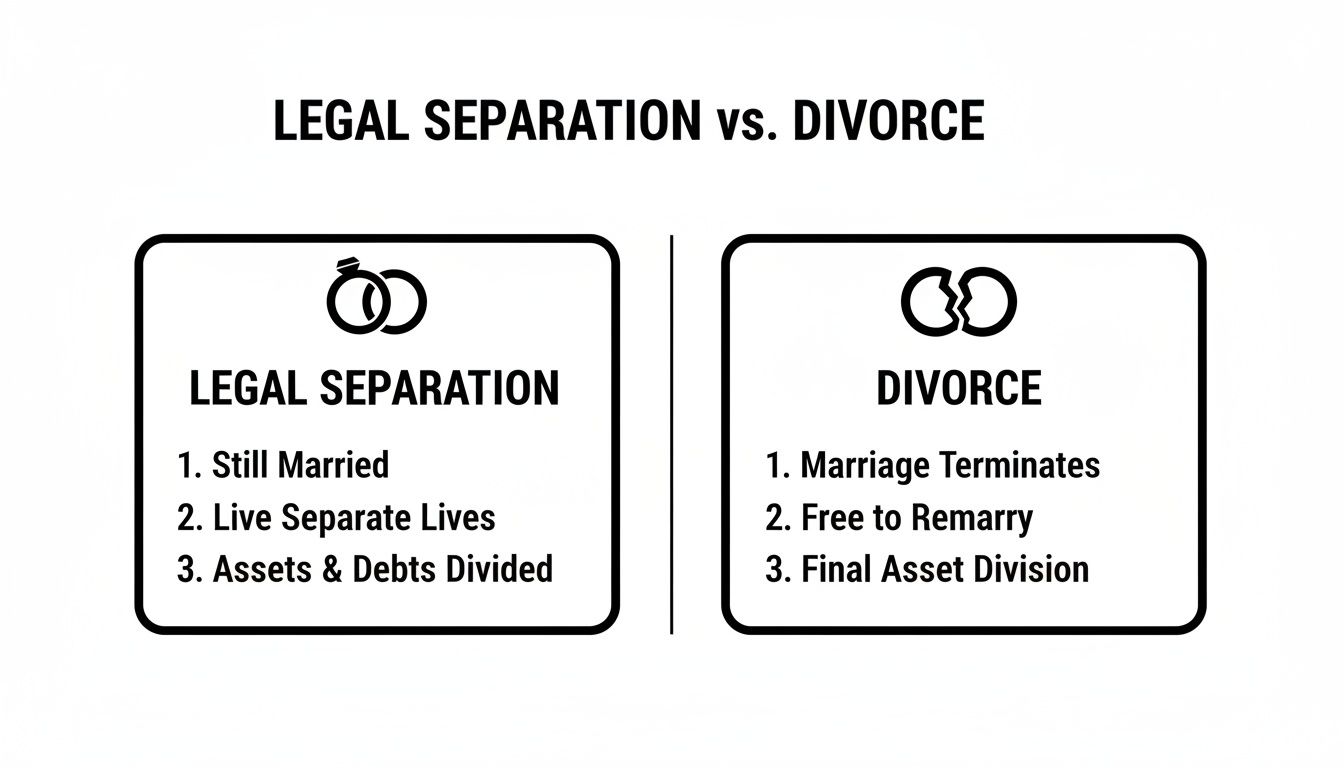
As you can see, most of the heavy lifting—like sorting out finances and parenting—happens during the separation phase. Only a divorce can legally cut the marital tie for good.
To make these distinctions even clearer, here’s a direct comparison table. It's a good idea to understand your family's rights and responsibilities under Canadian law as you think about which path is right for you.
Key Distinctions Legal Separation vs Divorce
| Aspect | Legal Separation | Divorce |
|---|---|---|
| Marital Status | You are still legally married to your spouse. | A court order has legally terminated your marriage. |
| Ability to Remarry | No. You cannot legally marry someone else. | Yes. You are legally single and free to remarry. |
| Legal Process | Starts when you live apart; formalized with a private Separation Agreement. | A formal court application filed after one year of separation. |
| Shared Benefits | You might be able to stay on your spouse's health or dental insurance plans. | Shared benefits (like insurance coverage) are almost always terminated. |
| Reconciliation | It’s much easier to get back together. You can just void the agreement and resume your marriage. | If you reconcile after the divorce is final, you have to get remarried. |
Ultimately, the table shows that a Separation Agreement handles the practical details of your split, while a divorce is the legal finality that changes your status from “married” to “single.”
When a marriage breaks down in Ontario, you’ll find yourself navigating one of two distinct legal pathways. Each serves a completely different purpose. Understanding the fundamental difference between a legal separation and a divorce is the first critical step—one is a private agreement that settles all your affairs, while the other is the formal court action that legally ends your marriage.
Establishing a Legal Separation
Contrary to what many people think, you don’t go to court to become “legally separated.” In Canada, a legal separation starts the moment you and your spouse begin living “separate and apart” with the intent to end your marriage. This can even happen while you’re both still under the same roof, often for financial reasons or to maintain stability for the kids.
The key to making this official is the Separation Agreement. This is a private, legally binding contract that you and your spouse negotiate, usually with lawyers guiding the process. Think of it as the comprehensive rulebook for your new, separate lives.
A solid Separation Agreement will nail down all the big issues:
- Parenting Arrangements: A detailed plan for parenting time and who makes the major decisions for your children.
- Child and Spousal Support: Clear calculations and payment schedules for any financial support, based on established guidelines.
- Division of Property: The equalization of your net family property, outlining exactly how assets and debts from the marriage will be split.
- The Matrimonial Home: A clear decision on who stays in the home, whether it will be sold, and how the money will be divided.
This document gives you certainty and legal muscle without ever needing to step inside a courtroom, making it the foundational step for nearly every couple.
Key Takeaway: The Separation Agreement is the cornerstone of the entire process. It resolves every major issue privately, turning a messy, emotional split into a structured and manageable transition. This is the document that governs your rights and obligations from the moment you part ways.
The Formal Divorce Process
While your Separation Agreement settles the terms of your split, only a divorce can legally end your marriage. This process is governed by Canada’s federal Divorce Act and requires a formal application to the court. The main ground for divorce in Canada is marriage breakdown, which is most often proven by living separate and apart for at least one full year.
Once that one-year clock has run out, one or both spouses can file an Application for Divorce (Form 8A) with the Ontario Superior Court of Justice. If you already have a comprehensive Separation Agreement signed and sealed, the divorce is considered “uncontested,” making the court process mostly an administrative exercise. A clerk and then a judge review the file, and if all the boxes are ticked, they issue a Divorce Order.
This order is the final, official document that legally dissolves your marriage. It officially changes your marital status back to “single” and gives you the legal right to remarry. Getting the steps right is crucial, and you can get the full breakdown in our guide on how to file for divorce in Ontario. For anyone digging deep into the nuances of family law, using a tool like an AI Legal Case Researcher can be a huge help for understanding legal precedents and specific statutes.
Comparing Financial Outcomes: Property and Support
When a marriage ends, one of the biggest sources of anxiety is money. How will everything be divided? How will we manage? The real difference between a legal separation and a divorce becomes crystal clear when you look at how property division and support obligations are handled under Ontario’s Family Law Act.
While both processes use your date of separation as the official starting line for all financial calculations, they offer very different levels of control and finality.

Think of it this way: a Separation Agreement gives you immediate control and certainty over your finances, while a divorce is the legal step that makes those agreements permanent and court-enforceable.
Property Division and the Matrimonial Home
In Ontario, both separation and divorce kick off the same process for dividing assets and debts, known as the equalization of net family property. The most important date in this entire calculation is your valuation date—the day you and your spouse officially separated. Everything is valued as of that day.
The key difference, however, is how and when this division gets finalized.
- During Legal Separation: You and your spouse hammer out all the details of who gets what—assets, debts, everything—and lock it down in a private, legally binding Separation Agreement. This contract gives you legal certainty long before a divorce is even on the table.
- During Divorce: The property division terms you already agreed to in your Separation Agreement get formally incorporated into the final Divorce Order from the court. If you skipped the agreement, the court decides for you, which is almost always a longer, more expensive, and more stressful path.
The matrimonial home is often the most significant and emotionally charged asset you own together. One of the huge advantages of a Separation Agreement is the flexibility it gives you here. It can grant one spouse exclusive possession of the home for a specific period, which is a fantastic way to keep the children in a stable environment without being forced to sell right away.
Divorce, on the other hand, usually forces the issue, often leading to the sale of the home so that the finances can be split for good.
Key Insight: A well-drafted Separation Agreement is your financial roadmap. It empowers you to settle complex property issues, especially the fate of your home, on your own terms and timeline. This provides critical stability while you wait out the mandatory one-year separation period required for a divorce.
Child and Spousal Support Obligations
Just like with property, your obligations for child and spousal support start from the date you separate, not the date you get divorced. The amounts are calculated using established guidelines and are typically set in stone within your Separation Agreement.
This agreement lays out the payment terms, ensuring that financial responsibilities are clear and being met from day one of your separation. Later, when you file for divorce, these support terms are simply included in the final Divorce Order, making them fully enforceable by the court. While support amounts can always be revisited if someone’s financial situation changes significantly, the initial framework is built during the separation phase.
Getting the property division right is a critical step, and you can dive deeper into this topic in our detailed guide on the division of property in an Ontario divorce.
For our Brampton and GTA clients at Badesha Law, it’s important to understand how Ontario’s rules provide a structured and equitable process for asset division. This contrasts with other jurisdictions, which might use different models. Our province’s focus on equalization ensures a fair split based on the value accumulated during the marriage, and a Separation Agreement is the most effective tool to manage this process smoothly and with legal certainty.
The Impact on Children and Co-Parenting Structures
For parents going through a separation, the biggest worry is always the kids. There’s a common myth that you have to wait for the final divorce papers to create stability and routine. But under Ontario family law, that’s just not true. All the critical decisions about parenting are made right when you separate, not a year later when the divorce is granted.

This is a crucial distinction. It means you can build a stable co-parenting framework immediately, giving your children the consistency they desperately need during a tough time. The difference between separation and divorce here isn’t what gets decided, but how—either collaboratively in an agreement or contentiously in court.
Establishing Parenting Plans and Decision-Making
From the day you officially separate, you and your co-parent need to sort out two fundamental things. These are formalized in a parenting plan, which becomes a core part of your Separation Agreement:
- Parenting Time: This is the schedule. It outlines exactly when the children will be in each parent’s care, from the weekly routine down to specific plans for holidays and summer vacation.
- Decision-Making Responsibility: This covers who makes the big calls about a child’s health, education, religion, and major extracurriculars. You can share this responsibility or assign certain areas to one parent.
The huge advantage of doing this during separation is control. When you negotiate a Separation Agreement, you create a customized plan that actually fits your family’s reality. If you leave these issues to be fought over in a contested divorce, a judge who knows nothing about your family will be the one making these personal decisions for you.
A Proactive Approach Benefits Children: Establishing a clear and predictable parenting structure in a Separation Agreement from the outset is one of the most effective ways to minimize conflict and reduce the emotional strain on children. Stability is paramount, and separation provides the opportunity to build that foundation immediately.
Child Support Obligations Begin at Separation
Just like parenting arrangements, the legal obligation to financially support your children kicks in on the date of separation. Child support doesn’t wait for a divorce. In Canada, the amount is calculated using the Federal Child Support Guidelines, a standardized formula based on the paying parent’s income and the number of children.
The process is refreshingly straightforward, and the core calculation isn’t up for debate:
- Determine the paying parent’s gross annual income.
- Look up that income on the federal table for your province to find the base monthly amount.
- Add in any special or extraordinary expenses, like costs for competitive sports, orthodontics, or specialized tutoring.
By calculating and documenting these payments in your Separation Agreement, you guarantee financial consistency for your children from day one. Later, when you file for an uncontested divorce, the court simply confirms that your support arrangements follow the federal guidelines. The divorce itself doesn’t restart the calculation; it just formalizes the agreement you already made. This really shows how vital a Separation Agreement is for securing your child’s financial well-being right away. For a deeper look, you can learn more by understanding child custody in Ontario and how these principles are applied.
Timelines, Costs, and Future Goals: Choosing Your Path
When you’re standing at a crossroads, you need a clear map. Choosing between legal separation and divorce isn’t just a legal question—it’s a practical one that will shape your timeline, your finances, and what you can do next in life. Each path comes with its own schedule, price tag, and long-term consequences that need to line up with where you want to go.
One of the biggest practical differences is the timeline. You can negotiate and sign a Separation Agreement relatively quickly, often within a few months, depending on how complex things are and how willing you both are to cooperate. That agreement gives you immediate legal certainty on things like parenting, support, and property.
A divorce, on the other hand, comes with a mandatory waiting period. Under Canada’s Divorce Act, you have to live separate and apart for a minimum of one full year before a court can legally grant your divorce. This means separation is always the first step; divorce is the final one.
Comparing the Financial Investment
Cost is a huge concern for most people, and this is where the two paths really diverge. The most expensive part of ending a marriage isn’t the divorce application itself—it’s the fighting over property, support, and parenting.
A legal separation, finalized with a negotiated Separation Agreement, is by far the most cost-effective route. It lets you and your spouse settle every single issue privately with your lawyers, steering clear of expensive court battles.
Once you have that agreement locked in, filing for an uncontested divorce becomes a simple administrative task with predictable, minimal legal fees. In sharp contrast, a contested divorce where you litigate every issue in court can lead to unpredictable and massive costs. You can get a clearer picture of the expenses involved by reading our guide on understanding Ontario divorce costs.
Strategic Insight: Investing in a comprehensive Separation Agreement upfront is the single best way to control costs. It transforms the divorce from a potentially contentious legal battle into a simple, affordable administrative step, saving you thousands of dollars and immense stress.
Planning for Your Future
What you want for your future is probably the most important factor in this decision. While a Separation Agreement settles your day-to-day life and finances, only a divorce can change your fundamental legal status from “married” to “single.”
This difference has major real-world consequences:
- Remarriage: You absolutely cannot remarry while you are legally separated. You’re still legally married to your spouse until a final Divorce Order is granted.
- Immigration: If you plan to sponsor a new partner to immigrate to Canada, a separation isn’t enough. You must be officially divorced.
- Estate Planning: Being separated can create a messy situation for inheritance rights. A divorce cleanly severs those ties, which makes drafting a new will and planning your estate much simpler.
For newcomers to Canada, these issues can get even more complicated. If you were divorced in another country, you might need a foreign divorce opinion letter to confirm that your divorce is recognized in Ontario before you can remarry here. A family lawyer can sort this out and help you take the right steps.
Common Questions About Separation and Divorce in Ontario
The end of a marriage brings a storm of questions and uncertainty. While the line between legal separation and divorce can seem blurry at first, getting a handle on the key differences is the first step toward making clear, confident decisions for your future.
This section tackles the most frequent questions we hear from clients across Ontario, providing practical answers grounded in Ontario’s Family Law Act and Canada’s Divorce Act.
Do I Need a Separation Agreement Before Getting a Divorce?
While it’s not a legal requirement to have a Separation Agreement before you file for divorce, it is the single most important thing you can do to ensure the process is smooth, predictable, and cost-effective. Think of it as creating the blueprint for your divorce first.
This legally binding contract is where you and your spouse privately settle all the major issues—property division, support, and parenting plans—on your own terms. Once that agreement is signed, the divorce itself becomes a simple, administrative step. It provides immediate certainty and a clear rulebook for your separate lives.
Without an agreement, you’re walking into a contested divorce. That means every unresolved issue will be decided by a judge in a courtroom, a process that is guaranteed to be more expensive, take far longer, and be emotionally draining for everyone involved. A family lawyer can help you draft a solid agreement that protects your interests and turns the divorce into a straightforward formality.
Can We Be Legally Separated and Live in the Same House?
Yes, absolutely. Under Canadian law, a couple can be “separate and apart” while still living under the same roof. This is a very common arrangement, often done for financial reasons or to provide stability for children while one spouse figures out their next move.
The key isn’t your mailing address; it’s the clear and final end of your marital relationship. To prove you’re separated while cohabiting, you need to show a fundamental shift in how you live.
Evidence of living separate and apart in the same home includes:
- Sleeping in separate bedrooms.
- No longer presenting as a couple at social events.
- Managing your finances and bank accounts independently.
- Splitting household chores like roommates, not a couple.
- Telling family and friends that you have separated.
Critical Tip: It is absolutely crucial to document your date of separation, even when you’re still in the same house. This date is the official “valuation date” for dividing property and starts the clock on the one-year waiting period required to finalize a divorce.
How Does Separation Affect My Immigration Status?
A legal separation won’t automatically cancel your immigration status if it was tied to your spouse, but it’s a major life event that will absolutely impact any future immigration applications. Getting this wrong can have serious consequences, so it’s vital to tread carefully.
For example, you cannot sponsor a new partner for permanent residence in Canada until you are officially divorced. Just being separated isn’t enough. If your spouse sponsored you for your own permanent residency, a separation could be a factor that immigration authorities look at when you apply to renew your residency or for citizenship down the road.
The situation gets even more complicated if you have a divorce from a previous marriage that took place outside of Canada. You may need a foreign divorce opinion letter to prove that your prior divorce is recognized here before you can legally remarry in Canada. Given how deeply family and immigration law can intersect, the smartest move is to get advice from both a family lawyer and an immigration lawyer to protect your status and keep your options open.
What if My Spouse Refuses to Sign the Separation Agreement?
A Separation Agreement is a voluntary contract, meaning you can’t force your spouse to sign it. If they’re refusing to negotiate or sign on the dotted line, it can feel like you’ve hit a brick wall. But you still have clear options to move forward.
The first step is usually to try alternative dispute resolution methods, which are designed to help you find a resolution without heading straight to court.
Common next steps include:
- Mediation: You and your spouse sit down with a neutral third-party mediator who helps guide the conversation and find common ground on the sticking points. The mediator doesn’t make decisions for you; they help you build your own solution.
- Collaborative Family Law: You and your spouse each hire a specially trained collaborative lawyer and commit to resolving everything outside of court. The process involves a series of focused meetings aimed at open communication and creative problem-solving.
If these cooperative approaches don’t work, your final option is to start a formal court application. This means a judge will make the final decisions on property, support, and parenting. This litigation path is more adversarial, takes much longer, and is significantly more expensive. Getting legal advice early can help you build a negotiation strategy that encourages your spouse to cooperate and avoid a drawn-out court battle.
Navigating the complexities of separation and divorce requires clear, compassionate, and precise legal guidance. At Badesha Law, we provide step-by-step support to clients in Brampton and the GTA, ensuring you understand your rights and can move forward with confidence. Whether you need a comprehensive Separation Agreement, representation in a divorce, or a foreign divorce opinion letter, our team is here to help. To discuss your situation and learn how we can assist you, book your free consultation today at https://badeshalaw.ca.