How to Prepare for Divorce: Ontario & GTA Guide

If you're reading this late at night, switching between bank statements, school emails, and search results about divorce, you're probably not looking for theory. You're looking for a way to steady yourself. People in Brampton and across the GTA often reach this point before they've spoken to a lawyer, before they've decided whether the separation will be calm or combative, and before they know what matters legally.

That uncertainty is normal. It also creates risk. People make avoidable mistakes when they act from panic, move money without advice, leave the matrimonial home without understanding the consequences, or rely on verbal promises that never become enforceable terms.

The better approach is preparation. If you want to know how to prepare for divorce, start with the parts you can control. Get your documents together. Build a child-focused routine if you have children. Learn how Ontario treats the matrimonial home, support, and separation agreements under the Family Law Act. Then choose the right path for your situation, whether that's an uncontested resolution or court.

Table of Contents

Your First Step Before the First Step

Before any form is filed, before anyone talks about court dates, take one step back. Ask a simple question: What do I need to protect and clarify right now? For some people, that's access to money for groceries and rent. For others, it's a parenting routine that doesn't throw the children into chaos. For many, it's understanding whether the home, pension, or support situation is going to become a fight.

The first practical step is to stop treating divorce preparation like one giant task. Break it into four separate jobs:

  1. Collect facts about income, property, debt, and family records.
  2. Stabilise parenting if children are involved.
  3. Understand the Ontario rules that will shape outcomes.
  4. Choose a process that matches the level of conflict.

That shift matters. People often think preparing for divorce means preparing for war. Usually, it means preparing for clarity. Clear records reduce arguments. Clear parenting plans reduce confusion. Clear legal advice reduces expensive mistakes.

Practical rule: Don't start by asking, "How do I win?" Start by asking, "What will I need to prove, disclose, and decide?"

In Brampton, Mississauga, and the wider GTA, one of the biggest problems isn't lack of rights. It's lack of organisation. A spouse may have a valid claim, but if their records are scattered across email, paper files, CRA downloads, banking apps, and text messages, the process becomes slower, more stressful, and harder to settle.

If you're overwhelmed, keep your timeline short. Focus on the next seven days, not the next seven months. Make a document list. Save copies. Write down key dates. Note any urgent concerns involving the children, the house, or joint money. That's how people regain control.

Gathering Your Financial and Personal Documents

The fastest way to lose an advantage in a divorce is to show up unprepared. In Ontario, financial disclosure isn't a side issue. It's the backbone of property division, support, and settlement. If your records are incomplete, your case can stall even before the main issues are discussed.

Ontario requires financial disclosure through the Financial Statement (Form 13.1) in cases involving property or support. In Peel Region, 68% of contested divorce cases face delays over 12 months due to disclosure failures, and organising documents within 90 days of starting can reduce court-ordered sanctions by 45%, as discussed in this review of the Ontario Form 13.1 financial statement process.

A checklist infographic listing essential documents to organize when preparing for a legal divorce process.

Start with a full paper trail

Don't wait until someone asks for records. Pull them now and save them in a dedicated folder, both digitally and in hard copy if possible.

Gather these first:

  • Tax records: The last three years of tax returns, Notices of Assessment, T4 slips, and any self-employment income records.
  • Banking documents: Statements for chequing, savings, joint accounts, lines of credit, and credit cards.
  • Property records: Deeds, mortgage statements, property tax bills, appraisal documents, and records of major renovations.
  • Investments and retirement assets: RRSP, TFSA, pension statements, RESPs, and brokerage accounts.
  • Employment and business records: Pay stubs, employment contracts, bonus information, and, if applicable, corporate ledgers and shareholder documents.
  • Insurance and estate documents: Life insurance, benefits booklets, wills, powers of attorney, and beneficiary designations.
  • Children's records: Birth certificates, school records, daycare invoices, and medical insurance information.
  • Digital assets: Records of online payment platforms, cryptocurrency holdings, digital businesses, and important account access details.

How to organise what you collect

A messy box of papers is better than nothing, but it still causes problems. Organise by category and date. Create folders such as Income, Debt, Assets, Property, and Children's Expenses. Name files so another person can understand them quickly, such as "RBC Joint Account Jan 2024" or "Mortgage Statement Date of Separation".

Use one master list to track what's missing. That list should show what you have, what you're waiting for, and where each document came from. If a statement is only available online, download it right away. Access can disappear when passwords change or accounts are closed.

The person with the better records usually negotiates from the stronger position.

This stage isn't about arguing over values yet. It's about preserving evidence. People often think they'll remember balances, dates, and account details later. They usually don't. Good preparation means you won't have to reconstruct years of financial history when emotions are high and deadlines are tight.

Creating a Stable Plan for Your Children

When children are involved, divorce preparation changes immediately. The legal focus in Ontario is the best interests of the child under the Children's Law Reform Act. That sounds broad, but in practice it comes down to something very concrete: who has been doing what for the child, what routine is realistic, and whether the adults can propose a stable plan.

A caring mother reads a bedtime storybook to her young daughter while they sit together on a sofa.

A lot of parents make the mistake of speaking only in general terms. They say they want fairness, shared parenting, or regular contact. Courts and mediators need detail. In the GTA Region, 74% of contested custody cases hinge on the lack of a documented Parenting Log, and parents who pre-file a detailed Proposed Parenting Schedule are 82% more likely to reach a mediated agreement without a judicial hearing, as noted in this overview of Ontario child support laws and related parenting issues.

Build a parenting record before conflict builds

A Parenting Log is one of the most useful preparation tools available. It doesn't need legal language. It needs accuracy.

Track things such as:

  • Daily care: School drop-offs, pick-ups, meals, homework, bedtime, and supervision.
  • Health involvement: Doctor visits, medication management, therapy appointments, and communication with healthcare providers.
  • School participation: Parent-teacher meetings, permission forms, attendance issues, tutoring, and extracurricular coordination.
  • Communication patterns: How the parents exchange information, how often conflict arises, and whether urgent issues are handled reasonably.

Keep the tone factual. Don't use the log to editorialise or insult the other parent. A short entry like "Picked up child from school at 3:25 p.m., attended dental appointment at 5:00 p.m." is useful. A paragraph attacking the other parent usually isn't.

Talk to your child with care and structure

Children need calm, simple explanations. They don't need adult grievances. If you're preparing for separation, decide in advance what you will say and what you will not say.

A useful approach is:

  • Keep the message brief: Tell the child the adults have decided to live separately.
  • Reassure consistently: Make clear that the separation is not the child's fault.
  • Avoid false promises: Don't promise living arrangements or holiday schedules that haven't been decided.
  • Protect the child from the case: Don't ask the child to report on the other parent or carry messages.

A stable parenting plan should also deal with routine details that many parents ignore at first and then fight about later. Think about school mornings, transitions, holiday rotations, birthdays, religious events, extracurriculars, and communication rules. If the plan includes shared decision-making, it should also state how disputes will be handled.

Children cope better when parents reduce uncertainty, not when parents win arguments.

If support is also in issue, keep your expense records. Base child support in Ontario follows the Federal Child Support Guidelines and uses the payer's gross annual income and the number of children. The rules are mechanical. For example, the verified 2024 figures provided for Toronto indicate that $30,000 in income results in $0 base support, while $60,000 results in approximately $337 per month for one child, with additional Section 7 expenses shared proportionally when properly documented.

Understanding Property Division and Support in Ontario

People often assume divorce means splitting everything in half in a rough, common-sense way. Ontario law is more specific than that. The broad framework is the equalization of net family property, but some assets are treated differently, and the matrimonial home is the most common source of surprise.

An infographic titled Ontario Divorce Finances outlining the key concepts of property division and support payments.

Why the matrimonial home surprises people

Under Ontario's Family Law Act, the matrimonial home's value is treated differently from other assets. Its full value is shared 50/50 and cannot be deducted against pre-marriage assets by the person who owned it before the marriage, which is a rule explained in this guide to matrimonial home rights in Ontario.

That matters because many spouses assume title decides everything. It doesn't. Others assume that if they bought the house before the marriage, they can deduct that value the way they might with another asset. In many cases involving the matrimonial home, they can't. The home occupies a special place in Ontario family law.

A realistic preparation checklist for the home includes:

  • Get the ownership documents and confirm whose names appear on title.
  • Pull mortgage statements and any secured line of credit documents.
  • Identify the date of marriage and date of separation because both dates matter in property analysis.
  • Collect valuation evidence if there is disagreement about fair market value.
  • Do not move out or sign anything casually without understanding how possession, value, and settlement strategy may be affected.

Support is about rules first and negotiation second

Spousal support and child support are often discussed together, but they are not the same. Child support is driven by legislative guidelines. Spousal support depends on entitlement, need, means, and the history of the relationship.

If you've been out of the workforce, relocated for your spouse's career, or carried a disproportionate share of child care, support may become a significant issue. If both spouses are financially independent and the marriage was shorter, the analysis can look very different. The point isn't to guess the answer from social media or a friend's experience. The point is to prepare the facts that drive the analysis.

Key distinction: collecting statements tells you what exists. Understanding Ontario property and support rules tells you what those statements mean.

For longer marriages, financial planning becomes even more important. Verified background data notes that divorce among people aged 50 and older has doubled since the 1990s across North America, and the median length of marriages ending in divorce increased from 10 years in 2008 to 12 years in 2023. In practical terms, later-life divorces in the GTA often involve older pensions, long-held homes, and retirement planning that can't be treated casually.

Choosing Your Path Uncontested vs Contested Divorce

Once your information is organised and the main family issues are identified, the next decision is strategic. Are you trying to complete a negotiated divorce, or are you heading into a contested process because key issues can't be resolved?

In Ontario, 75% of divorces are resolved through uncontested agreements. In the GTA, an uncontested divorce averages 4 to 6 months and costs approximately $1,500 to $2,500, while a contested case can take 12 to 18 months and cost $10,000 to $20,000 or more, as described in this practical guide on how to file for divorce in Ontario.

Uncontested vs. Contested Divorce in Ontario at a Glance

Factor Uncontested Divorce (Collaborative Path) Contested Divorce (Court-Involved Path)
Core requirement Both spouses agree on all issues, usually through a separation agreement One or more issues remain disputed
Timeline 4 to 6 months 12 to 18 months
Typical cost $1,500 to $2,500 $10,000 to $20,000 or more
Control over outcome Higher. The spouses shape the terms Lower. A judge may decide unresolved issues
Stress level Usually lower if disclosure is complete and communication is workable Usually higher because of motions, deadlines, and hearings
Best fit Couples who can exchange information and negotiate in good faith Cases involving concealment, high conflict, parenting disputes, or urgent relief

Uncontested doesn't mean casual. It means complete agreement. If even one issue remains unresolved, such as property, parenting time, child support, or spousal support, the matter may move into contested territory.

What makes an agreement legally reliable

A separation agreement only helps if it is valid and enforceable. Under Section 56 of the Family Law Act, an agreement must be signed in the presence of a witness who is not a party and has no financial interest in the outcome. The Act also allows agreements to be set aside in some circumstances, including where a party did not understand the nature or consequences of what they signed.

That is why rushed kitchen-table settlements often fail. People focus on getting something signed, but ignore disclosure, legal advice, or proper drafting. A weak agreement can create more litigation, not less.

If you're deciding between paths, ask yourself:

  • Can both of us exchange full financial disclosure?
  • Can we discuss parenting without using the children to gain an advantage?
  • Is there trust enough to negotiate safely?
  • Do I understand the legal effect of the terms being proposed?

If the answer to those questions is mostly yes, an uncontested route may be sensible. If the answer is no, pretending the case is amicable won't save money for long.

When to Get Legal Help from a Brampton Lawyer

Many people wait too long to get legal advice because they think calling a lawyer means declaring war. It doesn't. Early advice often prevents conflict. It helps you understand the rules before you make moves that are hard to undo.

A professional lawyer consults with a client in an office while reviewing legal documents together.

Call early if any issue is unclear

In Ontario, this isn't just about convenience. Under Section 56(4) of the Family Law Act, a separation agreement can be set aside if a party signs it without understanding its consequences or without proper legal disclosure. That's one reason a step-by-step divorce lawyer guide for Ontario is often useful even for people who hope to settle.

You should seek advice early if any of these apply:

  • The home is in dispute
  • One spouse controls the finances
  • A business, corporation, or pension is involved
  • There are children and no stable schedule yet
  • You were presented with an agreement to sign quickly
  • A foreign divorce may need recognition for remarriage or immigration purposes in Ontario

What a first consultation should do

A good first meeting should reduce confusion, not increase it. You should leave knowing the likely legal issues, what documents still need to be gathered, whether your matter looks uncontested or contested, and what immediate risks need attention.

You should also get a plain-language explanation of trade-offs. For example, settling quickly may reduce cost, but not if the proposed terms ignore the matrimonial home rule, support obligations, or proper disclosure. On the other hand, fighting every issue on principle can damage children, drain savings, and delay closure.

A lawyer's job isn't only to argue. It's to filter noise, identify risk, and turn a stressful situation into a sequence of manageable decisions.

Common Pitfalls to Avoid During Your Preparation

Some divorce mistakes are expensive. Others are avoidable and still end up shaping the whole case.

Watch for these problems:

  • Hiding or moving assets: This usually backfires. Missing disclosure damages credibility and can derail settlement.
  • Using children as messengers: It harms the child and weakens your position in any parenting dispute.
  • Making verbal side deals: If it isn't properly documented and enforceable, it may not protect you.
  • Leaving the matrimonial home without advice: Sometimes it's the right decision. Sometimes it creates complications you didn't anticipate.
  • Signing an agreement you don't fully understand: A rushed signature can trigger bigger legal problems later.
  • Ignoring overseas divorce issues: Newcomers sometimes discover too late that an overseas divorce needs proper validation in Ontario before remarriage or related legal steps.
  • Forgetting related updates: Wills, beneficiary designations, insurance instructions, and emergency contacts often need review after separation.

If you remember one thing, make it this: preparation isn't about escalating conflict. It's about reducing uncertainty. People who prepare carefully usually make better decisions, negotiate from firmer ground, and protect their children more effectively.


If you're separating in Brampton, Mississauga, Toronto, or elsewhere in the GTA, Badesha Law helps clients move through divorce with clear advice, careful drafting, and practical next steps. Whether you need help with an uncontested divorce, a contested family court matter, a separation agreement, parenting issues, support, property division, or a foreign divorce opinion letter, the firm offers compassionate guidance rooted in Ontario family law.


Contested vs Uncontested Divorce: Which Path Is Right for You in Ontario?

When you're facing the end of a marriage in Ontario, the first and most important choice you'll make is whether to pursue a contested vs uncontested divorce. This isn't just a legal distinction; it's a decision that sets the entire tone for your future, impacting everything from your finances to your emotional well-being.

An uncontested divorce is the collaborative route. It’s possible only when both you and your spouse agree on every single issue, making it a faster, more private, and far less expensive process. A contested divorce, on the other hand, is what happens when even one issue remains unresolved. At that point, the court system has to step in to make the final decisions for you. Understanding the implications of each path is critical, and the guidance of an experienced Brampton divorce lawyer from a firm like Badesha Law can be invaluable.

Defining Your Path: Contested vs Uncontested Divorce

Navigating the end of a marriage is a journey, and that first choice between a contested or uncontested divorce determines the map you'll follow. It’s a decision between two profoundly different paths, each with its own timeline, emotional toll, and financial cost.

A divorce is much more than just the legal end of a marriage. Under Canada's federal Divorce Act and Ontario’s provincial Family Law Act, it requires you to formally resolve several deeply personal and interconnected issues:

  • Parenting Time and Decision-Making Responsibility: This is what used to be called custody. It lays out how you'll divide your children's time and who will make the major decisions about their health, education, and well-being.

  • Child and Spousal Support: These are the financial obligations one spouse might have to the other, both for themselves and for the children, calculated according to federal and provincial guidelines.

  • Property Division: This involves the equal division of all assets and debts you both accumulated during the marriage, including the family's matrimonial home, as mandated by the Family Law Act.

The path you take hinges entirely on whether you and your spouse can settle these matters yourselves, without a judge needing to intervene. An experienced Brampton divorce lawyer can provide the strategic guidance you need, whether that means skilled negotiation to find common ground or strong advocacy in a courtroom.

Before we go deeper, it’s also useful to understand the difference between legal separation and divorce, as they are two distinct legal concepts.

At a Glance: Comparing Divorce Paths in Ontario

When you're trying to figure out which path makes sense for your family, seeing the core differences side-by-side can make things much clearer.

This table cuts through the legal jargon to give you a straightforward summary of what to expect from each process.

Factor Uncontested Divorce Contested Divorce
Agreement Level Full agreement on all issues (property, support, parenting). Disagreement on at least one major issue.
Court Involvement Minimal; primarily for administrative approval of the divorce order. Extensive; involves conferences, motions, and possibly a trial.
Key Document A signed Separation Agreement is the foundation. Court Application (Form 8) initiates the process.
Control Over Outcome Spouses retain full control over the final terms. A judge makes the final, binding decisions.
Typical Timeline Usually 4-6 months after filing, pending court processing. Can take 1.5 to 3+ years to resolve through the court system.
Emotional Stress Significantly lower due to the cooperative nature of the process. High, as the process is adversarial and often prolonged.

Ultimately, the choice comes down to control. The uncontested path keeps the power in your hands, but it requires cooperation. The contested route provides a formal structure for resolving conflict, but it comes at a much higher price—financially, emotionally, and in terms of time.

The Uncontested Divorce Process in Ontario

The uncontested divorce is all about reaching an agreement and choosing an efficient, peaceful path forward. While it’s far simpler than a contested divorce, it’s still a formal legal process that demands careful attention to meet the court’s strict requirements. The goal is to take your mutual understanding and turn it into legally solid documents the court will accept.

Two people review and sign a 'Separation Agreement' document with a lawyer's guidance.

This entire process hinges on one single document: the Separation Agreement. This isn't just a handshake deal; it's a comprehensive, legally binding contract that spells out exactly how you and your spouse have settled every issue. It has to be drafted with precision to be enforceable under Ontario's Family Law Act.

At Badesha Law, this is often where our work begins. We help clients negotiate and draft Separation Agreements that are clear, fair, and legally sound. This crucial step makes sure all the terms you’ve agreed on—from property division to parenting plans—are formally documented, leaving no room for future fights.

Key Steps in the Uncontested Process

Once the Separation Agreement is signed and witnessed, the court filing can begin. This part of the journey is mostly administrative, following a clear set of steps designed to prove to the court that all legal boxes have been ticked. Having a lawyer’s oversight here is invaluable to avoid common mistakes that can cause major delays.

The main steps look like this:

  1. Drafting and Filing the Application: The process kicks off by preparing a Form 8A: Application (Divorce). This document officially asks the court to grant your divorce and is filed along with your original marriage certificate.

  2. Completing the Affidavit for Divorce: Both spouses (in a joint application) or just the filing spouse (in a sole application) must complete a Form 36: Affidavit for Divorce. This is a sworn statement confirming details about the marriage, separation, and any children, proving all issues are resolved.

  3. Preparing the Draft Divorce Order: Your lawyer will prepare a Form 25A: Divorce Order, which is the final document a judge will sign to officially end your marriage.

  4. Clerk’s Certificate and Court Review: The court clerk checks all your documents to make sure they're complete and correct. If everything is in order, they issue a certificate, and the file goes to a judge for a final review and signature.

The whole point of an uncontested divorce is to show the court there's nothing left for a judge to decide. A well-drafted Separation Agreement and accurately completed court forms provide that proof, turning a complicated legal matter into a predictable, administrative task.

Avoiding Common Filing Pitfalls

A lot of people ask about getting a divorce without a lawyer. While it's technically possible, the administrative hurdles can be surprisingly tough. Simple mistakes on forms, incorrect filing procedures, or a poorly written Separation Agreement can cause the court to reject your application, forcing you to start all over again.

A lawyer ensures all your paperwork is filed correctly the first time. That professional oversight is what keeps the uncontested process smooth and efficient, giving you peace of mind and letting you focus on moving forward with your life.

Navigating the Contested Divorce Court System

When communication breaks down and a mutual agreement is completely off the table, your divorce moves out of your hands and into the formal court system. This path, known as a contested divorce, is a world away from the simple administrative process of an uncontested case. Instead of working together to decide your own future, you’re asking a judge to make legally binding decisions for you and your family.

Two lawyers, a distressed woman and a man, discuss documents outside Judge's Chambers in a court hallway.

The journey doesn't start with a collaborative Separation Agreement. It kicks off with filing a Form 8: Application with the court, a document that officially launches the litigation process. This form lays out your claims on everything from parenting and support to how you want to divide your property. From this moment on, the process is structured, adversarial, and dictated by strict court rules and deadlines.

This is precisely where having an experienced Brampton divorce lawyer becomes non-negotiable. At Badesha Law, our job is to protect your rights at every turn, manage the complex procedures, and advocate fiercely for your best interests in a formal court setting.

The Stages of Litigation in Ontario

A contested divorce isn't a single event; it's a series of mandatory steps designed to organize information, push for a settlement, and, if all else fails, get the case ready for a judge’s final decision. Each step has a very specific purpose in moving your case along the court’s conveyor belt.

Here are the key court appearances you'll go through:

  • First Appearance: This is a brief, administrative meeting to set dates and make sure all the initial documents have been filed correctly. It's more about logistics than anything else.

  • Case Conference: This is the first major step where you, your lawyers, and a judge sit down to discuss the unresolved issues. The judge's role here is to see where you agree, narrow down the points of conflict, and give both sides some frank feedback on the strengths and weaknesses of their positions. The real goal is to get you to settle before the costs spiral out of control.

  • Settlement Conference: If you still can't agree after the Case Conference, you'll head to a Settlement Conference with a different judge. This is a much more intensive push to resolve the case without a trial. The judge will be more direct, often giving a strong opinion on how the case would likely end at trial to encourage both of you to find a middle ground.

  • Trial Management Conference: If a settlement is still out of reach, this conference is all about planning the trial itself. You’ll deal with the logistics—who the witnesses will be, what evidence will be presented, and how the schedule will run.

The Critical Role of Financial Disclosure

At the heart of almost every contested divorce is the process of financial disclosure. Under Ontario's Family Law Rules, both you and your spouse have an absolute legal duty to provide complete and honest information about your income, assets, and debts. This is done by completing a detailed Financial Statement (Form 13 or 13.1).

This stage is often where things get heated. Disputes explode when one spouse suspects the other is hiding assets, deliberately undervaluing a business, or not being truthful about their income. These fights can lead to formal requests for more documents, questioning under oath (called examinations), and motions asking the court to force the other side to hand over information.

In a contested divorce, financial transparency isn’t optional—it’s a legal command. Failing to provide full and frank disclosure can lead to serious penalties from the court, including being ordered to pay the other party's legal costs.

This is exactly why the process takes so much longer and costs so much more. Every single disagreement chews up lawyer time, requires court filings, and might even need expensive expert reports, all of which get added to the final bill. The adversarial nature of litigation can also poison any future co-parenting relationship, making it incredibly difficult to work together down the road. For more insights, you can explore some strategies for managing conflict in a contested divorce.

A skilled lawyer can help you navigate these high-stakes conflicts while never losing sight of the main goal: reaching a fair and final resolution.

Comparing Timelines: How Long Each Divorce Takes

One of the first, most urgent questions people ask when they start this process is, "How long is this all going to take?" The answer hinges almost entirely on whether your divorce is contested or uncontested. This timeline isn't just about patience; it directly hits your finances and your emotional health as you wait to move on with your life.

An uncontested divorce in Ontario moves along a fairly predictable track. Once you’ve signed a Separation Agreement and all the right paperwork is filed, the process is mostly administrative. You can generally expect the final Divorce Order in about 4 to 6 months. The biggest variable is simply how backed up the court is at that moment.

A contested divorce, on the other hand, isn't measured in months—it's measured in years. The journey through the Ontario court system is a long haul, filled with mandatory steps that create huge delays. A contested case can easily stretch from 1.5 to over 3 years from the day you file to the day you get a final resolution.

Factors That Extend Contested Divorce Timelines

The dramatic difference in timing is baked right into the court system itself. These long delays aren't just a possibility in litigation; they're an expected part of the process.

Here are the key sources of delay:

  • Court Backlogs: Ontario's family courts are overloaded. This means you can be left waiting for months just to get your next scheduled date, whether it's for a Case Conference or a Settlement Conference.

  • Scheduling Conflicts: Trying to line up the calendars of two lawyers, both spouses, and a judge for multiple court dates is a logistical nightmare that can add months of waiting.

  • The Lengthy Discovery Process: The process of gathering and exchanging financial documents is a major bottleneck. If one person is being uncooperative or is suspected of hiding assets, motions have to be filed to force them to produce the information, adding even more delays and legal fees.

  • Expert Valuations: When you’re dealing with assets like a family business or complex investment portfolios, getting professional valuations can take many months to complete.

The timeline is a direct reflection of conflict. In an uncontested divorce, the work is done upfront through negotiation. In a contested divorce, the work unfolds over years of court procedures, with each disagreement acting as another roadblock.

A Look at Timelines Elsewhere

This massive time gap isn't unique to Ontario. Take California, for instance, where contested divorces take dramatically longer than uncontested ones—averaging 12-18 months versus 6-8 months. This is due to mandatory waiting periods plus the time it takes to fight over custody, property, or support. If you add in a complex child custody battle, you can tack on another 6-12 months, pushing some cases to last 1-3 years.

Understanding these realistic timeframes is crucial. A Brampton divorce lawyer can give you a more personalized estimate based on the specifics of your situation. For a deeper dive into what affects timelines in our province, check out our guide on how long a divorce takes in Ontario. At Badesha Law, we make sure our clients understand these timelines from the start so they can weigh their priorities and make informed decisions.

The Financial Reality: A Detailed Cost Analysis

For most people starting the divorce process, the biggest question is simple: what’s this going to cost? It's the most pressing concern, and the answer depends almost entirely on the path you choose. Deciding between a contested and an uncontested divorce isn't just a legal choice—it's a financial one with radically different consequences for your bank account.

The route you take will determine whether your costs are predictable and manageable, or a source of constant, escalating stress.

An uncontested divorce is all about financial clarity. Because you and your spouse resolve every single issue in a Separation Agreement before anything is filed with the court, the legal work is precise and contained. This allows a Brampton divorce lawyer to handle the entire process for a flat-rate fee, covering the expert drafting of your agreement and the filing of all the necessary court forms.

This approach gives you certainty from day one. At Badesha Law, we believe in that transparency. Our clients know the full cost upfront, turning a potentially stressful legal process into a smart, efficient investment in a peaceful resolution.

The Predictable Costs of an Uncontested Divorce

With an uncontested divorce, you can actually budget for the end of your marriage. There are no surprise invoices or spiralling legal bills from drawn-out court battles.

Your main expenses are straightforward and known from the start:

  • Lawyer's Fees: Usually a flat rate to draft a rock-solid Separation Agreement and manage the court filing process from start to finish. This fee covers the legal expertise needed to ensure your agreement is airtight and your paperwork is perfect.

  • Court Filing Fees: These are standard administrative fees charged by the Ontario court system to process your divorce application.

  • Disbursements: These are minor out-of-pocket costs for things like couriers or postage.

Think of it this way: an uncontested divorce lets you purchase a result—a finalized divorce for a known price. A contested divorce means you’re purchasing a process—a series of legal battles with no guaranteed outcome and an unknown final cost.

The Escalating Costs of a Contested Divorce

The financial world of a contested divorce is the polar opposite: it's built on unpredictability. The costs aren't fixed because they’re tied directly to the amount of conflict and the time it takes to resolve it. Legal services are billed by the hour, which means every single phone call, email, and court appearance adds to your final bill.

These costs can spiral out of control, and fast. While every case is unique to Ontario, data from other jurisdictions shows a stark contrast. In California, for example, an uncontested divorce might cost under $10,000, while litigated battles frequently soar to $20,000, $50,000, or much more. The driver is simple: minimal court time and lawyer hours are needed when a settlement is reached without a fight. You can read more about these cost comparisons on westcoastdivorce.com.

In a contested Ontario case, the sources of these high costs are numerous and they compound over time. Prolonged litigation introduces expenses that simply don’t exist in an uncontested file, like fees for financial experts, property appraisers, and bringing motions for temporary court orders.

For a comprehensive breakdown of what to expect financially, take a look at our detailed guide on understanding Ontario divorce costs. Choosing the uncontested path isn't just about saving money in the short term; it’s about protecting your entire financial future from the immense risks of a court battle.

How to Choose the Right Path for Your Situation

Deciding between a contested and an uncontested divorce is the first, and most significant, choice you'll make on this journey. The right path isn't about which one is "better"—it's about which one is right for your specific circumstances, your communication style, and your family's future.

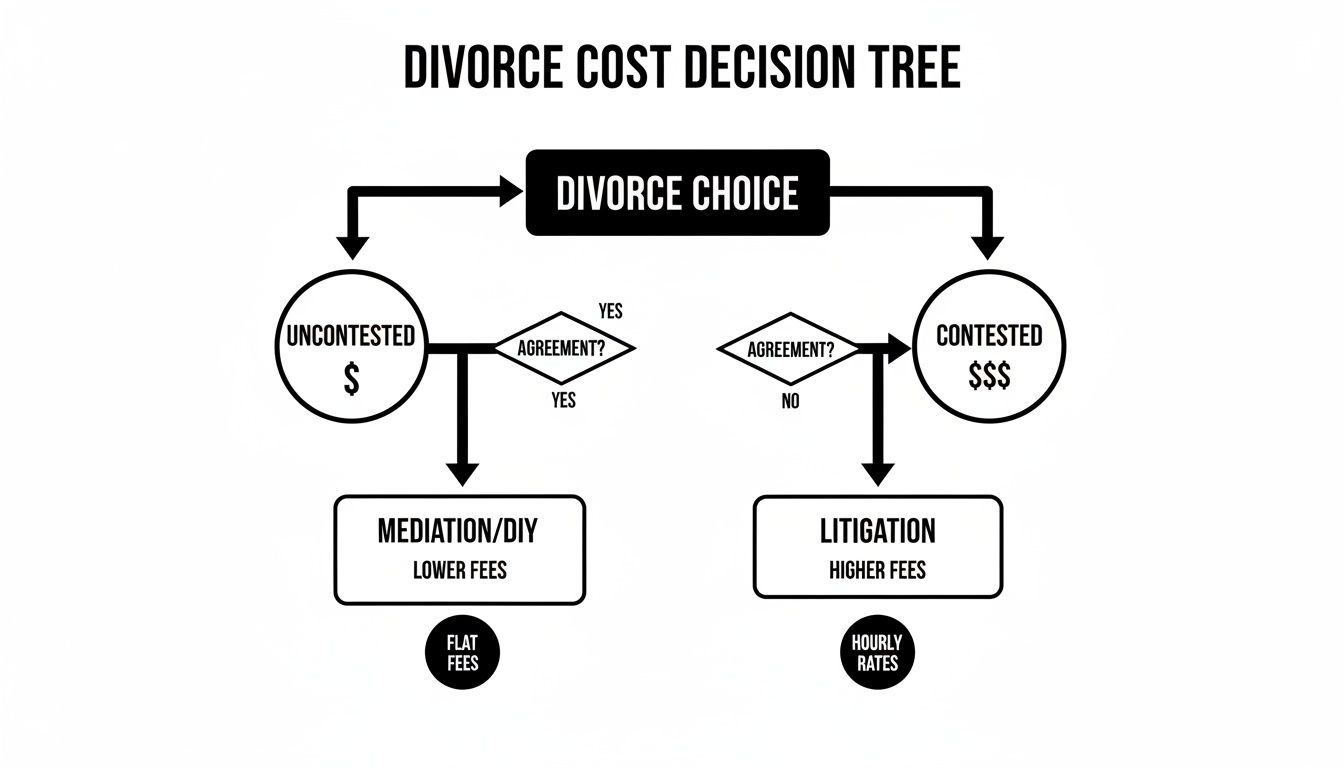
The decision tree below maps out the primary trade-off, showing how your choice will directly impact your financial reality.

Decision tree flow chart outlining divorce choices, costs, and processes for uncontested versus contested cases.

As the chart makes clear, the uncontested path gives you financial predictability. The contested route, on the other hand, introduces significant and often escalating costs. This financial truth should be a central factor in your decision.

When an Uncontested Divorce Is the Best Fit

An uncontested divorce is the ideal path forward when you and your spouse can still operate from a foundation of mutual respect and a genuine commitment to fairness. This approach works best when:

  • You can communicate effectively: You are both capable of having productive, even if difficult, conversations about your finances and children.

  • There is mutual trust: You both believe the other will provide full and honest financial disclosure without being forced to by a court.

  • You agree on the major issues: While you may need to negotiate the fine print, you are aligned on the big picture for property division, support, and a co-parenting plan.

In Ontario, there is a strong preference for resolving matters amicably. Although specific data for Ontario is collected, experiences from places like California reveal that almost 90% of divorces end up being uncontested. This indicates that many couples manage to reach an agreement without enduring a lengthy court dispute, helping to preserve assets and protect children from extended conflict.

When a Contested Divorce Is Unavoidable

Sometimes, collaboration just isn't possible or safe. A contested divorce then becomes a necessary measure to protect your rights and ensure a just outcome under the law. This path is often required in situations involving:

  • A refusal to negotiate: One spouse is completely unwilling to communicate, compromise, or participate in the process in good faith.

  • Significant power imbalances or abuse: If there is a history of domestic violence, coercion, or financial control, the formal structure of the court system provides essential protection.

  • Hidden assets or financial dishonesty: If you suspect your spouse is hiding money or misrepresenting their income, the formal discovery process in a contested divorce is the only tool to uncover the truth.

Pursuing a fair settlement should always be the starting point. However, when faced with a spouse who refuses to be reasonable or transparent, litigation becomes your tool for ensuring fairness under the law.

At Badesha Law, we provide the strategic advice you need to make this crucial choice. As your Brampton divorce lawyer, we can act as skilled negotiators to secure a peaceful settlement or as determined litigators to fight for your rights in court. We are fully equipped to guide you down the path that best protects your future. Schedule a consultation today to create a clear, strategic plan.

Frequently Asked Questions

When you're trying to figure out the difference between a contested vs. uncontested divorce, a lot of specific questions come up. Here are some clear, straightforward answers to the queries we hear most often, grounded in the realities of Ontario's family law system.

Can a Contested Divorce Become Uncontested?

Yes, absolutely. In fact, this is a very common and welcome outcome. A divorce might kick off as contested because of some initial, heated disagreements, but it can settle through negotiation at any point before you find yourself in a trial.

The court system actually encourages this. Steps like Case Conferences are specifically designed to push both sides toward a resolution. A sharp Brampton divorce lawyer knows how to use these mandatory meetings to bring a reluctant spouse to the table. When you successfully resolve those sticking points mid-process, you can switch gears and finalize everything as an uncontested divorce, saving an enormous amount of time and money.

What if We Only Disagree on One Issue?

Even if you and your spouse are stuck on just one significant point—like the final number for spousal support or a particular detail in the parenting schedule—your divorce is technically considered contested.

But that doesn't automatically mean you're doomed to a long, drawn-out court battle. Instead, you can use targeted strategies like mediation or focused lawyer-to-lawyer negotiations to attack that single issue. Once you reach an agreement and get it down in writing, the rest of the divorce can move forward on a simple, uncontested basis. It’s all about containing the conflict and the costs.

The goal is to isolate the disagreement and resolve it efficiently. A single dispute doesn't have to derail the entire process if handled strategically.

Is a Lawyer Necessary for an Uncontested Divorce?

While it’s not legally mandatory in Ontario, trying to handle an uncontested divorce without a lawyer is a risky move. A family lawyer’s real value is in drafting a Separation Agreement that is ironclad, legally binding, and fully protects your rights under the Family Law Act.

Beyond that, a lawyer manages the entire court filing process. It’s a minefield of technical rules, and simple errors on the forms can get your application rejected or cause months of delays. A firm like Badesha Law handles these details efficiently—often for a transparent flat fee—which gives you invaluable peace of mind.

What Is a Separation Agreement and Why Do I Need One?

Think of a Separation Agreement as the master blueprint for your post-marriage life. It’s a comprehensive, legally binding contract that spells out exactly how you and your spouse have agreed to untangle your lives. It covers everything:

  • Division of property and debts

  • Child and spousal support arrangements

  • Parenting time and decision-making responsibility

In Ontario, having a signed Separation Agreement is the absolute cornerstone of an uncontested divorce. It acts as definitive proof for the court that all issues are settled, which allows a judge to grant the divorce order without getting involved in your personal affairs.


Understanding the nuances of a contested vs. uncontested divorce is the first step toward a resolution that protects your future. The experienced team at Badesha Law is ready to provide the clear, strategic guidance you need, whether you are aiming for an amicable agreement or require strong advocacy in court. Contact us for a consultation to discuss your situation and create a plan to move forward with confidence.