

Yes, you absolutely can get a divorce without a lawyer in Ontario. But let’s be very clear: this path, often called a "DIY divorce," is only advisable for truly uncontested cases where you and your spouse are in complete agreement on every single issue. This approach means you’ll handle all the court filings and paperwork yourself, which can save a significant amount on legal fees.
Under Canada's Divorce Act, the grounds for divorce are straightforward, but the process of resolving finances and parenting requires careful attention to Ontario's Family Law Act.
Is a DIY Divorce the Right Path for You?
Choosing to handle your own divorce is a major decision. The cost savings are tempting, no question. But the process demands meticulous attention to detail and, most importantly, zero conflict between you and your spouse. One mistake on a form or a single overlooked financial detail can snowball into major headaches and far greater expenses down the road.
This section is a reality check. It’s here to help you honestly assess if your situation is a good fit for the DIY route.
Key Factors for a Successful DIY Divorce
The entire foundation of a successful divorce without lawyers is mutual agreement. If you and your spouse can communicate productively and are truly on the same page, the process becomes manageable.
Here’s what that looks like in practice:
- Total Agreement: You must agree on everything. This includes parenting time, decision-making for the kids, child and spousal support, and how every last asset and debt will be divided. There can be no "we'll figure it out later" items.
- Full Financial Transparency: Both of you must lay all your financial cards on the table. Hiding assets or debts isn’t just unethical; it can completely invalidate the agreement you worked so hard to create.
- Amicable Communication: You need to be able to talk through sensitive topics without the conversation devolving into a fight. High-conflict dynamics and DIY divorce are a recipe for disaster.
- Confidence with Paperwork: You have to be comfortable navigating official court forms, tracking deadlines, and making sense of legal terminology on your own.
Remember, you aren’t just ending a marriage—you are creating a legally binding blueprint for your separate futures. Even if you do it all yourself, every detail must comply with Ontario’s Family Law Act.
To figure out where you stand, use this checklist as a quick assessment tool.
Your DIY Divorce Suitability Checklist
| Key Issue | Required Agreement for DIY Divorce | When to Seek Legal Advice |
|---|---|---|
| Parenting & Custody | You have a detailed, agreed-upon parenting plan covering schedules and decision-making. | Any disagreement over custody, access, or how major decisions for the children will be made. |
| Financial Support | You have agreed on child and spousal support amounts (or have agreed none is payable) based on full financial disclosure. | You can't agree on support amounts, one spouse is hiding income, or there are complex self-employment finances. |
| Property Division | You have a complete list of all assets and debts and have agreed on how everything will be split. | You disagree on the value of an asset (like a house or business), or there are pensions or investments to divide. |
| Communication | You can have calm, productive conversations about these sensitive issues. | Communication is hostile, there's a history of domestic violence, or there is a significant power imbalance. |
This checklist should give you a clearer picture. If you found yourself in the "When to Seek Legal Advice" column for any of these issues, a DIY divorce is likely not the right fit and could cause serious problems.
The Financial and Legal Realities
The "no-fault" ground for divorce (separation for one year) has made self-representation more common. On average, a DIY approach can save thousands in legal fees. But there are real risks involved.
Without legal guidance, parenting plans can fail, often because of vague terms that lead to unequal decision-making power later on. The legal system empowers you to handle things yourself, but it also underscores the need for extreme caution, especially if your situation is anything less than 100% amicable.
Before you go any further, it’s crucial to understand that getting the divorce order is just one piece of the puzzle. You must also formally resolve all your issues in a separation agreement first. If you’re fuzzy on how these two things connect, our guide on the difference between legal separation and divorce can clear things up.
And if you start the process and realize it’s more than you can handle? That's okay. You can bring in a professional at any point. Badesha Law offers consultations and uncontested divorce packages, whether you just need an expert to review your paperwork or want us to take over the filing to ensure it's done right.
Building a Bulletproof Separation Agreement
Before you even touch a court form, your entire focus needs to be on the Separation Agreement. This isn't just a piece of paper; it's the single most critical document in your entire uncontested divorce. Think of it as the legal blueprint for your new reality, defining the terms of your split so you both can move forward without any confusion or future conflict.
A well-crafted Separation Agreement is what makes a divorce without a lawyer even possible. It takes what could be a messy court battle and turns it into a straightforward administrative filing. Without one, you simply don't have an uncontested divorce.
The Core Components of Your Agreement
Under Ontario's Family Law Act, your agreement needs to be rock-solid, covering every issue that stems from your marriage. If you leave things out or use vague language, you're setting yourself up for serious legal and financial headaches down the road.
Your agreement must clearly map out:
- Parenting Time and Decision-Making Responsibility: These are the modern terms for "custody" and "access." You need a detailed schedule spelling out exactly where the children will live and when. It also has to state how big decisions about their health, education, and religious upbringing will be made—either together or by one parent.
- Child Support: This is calculated using the Federal Child Support Guidelines, and it’s not negotiable. The amount is determined by the paying parent's income and how many children you have.
- Spousal Support: Will one of you pay support to the other? If so, the agreement needs to specify how much and for how long. If no support is being paid, you must include a clear waiver to prevent future claims.
- Division of Property: This is where you handle the equalization of your Net Family Property. Every asset and debt you both acquired during the marriage has to be listed, valued, and divided. This includes the house, pensions, investments, and even business assets.
Your Separation Agreement isn’t just a private deal between you two. It’s a legally binding contract a judge will review. If it doesn't meet the legal standards for fairness and full financial disclosure, it could be thrown out, blowing up your entire divorce settlement.
A Real-World Brampton Example
Let's picture a Brampton couple, Priya and Raj, who agree to handle their divorce themselves. They own a home, Priya has a pension from her job, Raj has an RRSP, and they have two kids.
Their Separation Agreement would need to lock down these specifics:
- Parenting: They agree on a week-on/week-off schedule and will make major decisions for the kids jointly.
- Child Support: As the higher earner, Raj will pay Priya the mandatory table amount of child support each month based on his income.
- Property: They decide to sell the matrimonial home and split the profit 50/50 after the mortgage is paid off.
- Equalization: They'll get Priya's pension and Raj's RRSP professionally valued. After calculating their Net Family Property, one will make a payment to the other to make sure the division is perfectly equal.
This level of detail is non-negotiable for the court to accept the agreement. To get a feel for the structure and necessary clauses, it's a good idea to look over a professionally drafted Separation Agreement template for Ontario.
Financial Disclosure and Independent Legal Advice
Two things are absolutely essential to making your agreement "bulletproof": full financial disclosure and Independent Legal Advice (ILA).
Full financial disclosure means you and your spouse must provide complete, honest documentation of everything you own and owe. Trying to hide an asset or lowball the value of a business is a rookie mistake that can invalidate the entire agreement if it's discovered later.
Independent Legal Advice (ILA) is when each of you takes the finished agreement to your own lawyer for a final review. That lawyer's job is to make sure you fully understand your rights and obligations and are signing the document without being pressured. While it sounds strange for a "divorce without a lawyer," getting ILA is the best insurance policy you can buy. It proves to the court that the agreement was fair and that you both entered into it knowingly, making your divorce truly final.
Decoding the Ontario Court Forms and Process
Once your Separation Agreement is signed and sealed, you’re ready to tackle the official court paperwork. This is where your private agreement gets its legal legs, transforming it into a formal reality recognized by the court. The process can feel a bit intimidating, but it’s really just a detailed to-do list where getting the small things right makes all the difference for a smooth divorce without a lawyer.
Before we dive into the forms, it's helpful to see how this fits into the bigger picture. The court filing stage only begins after you've done the foundational work.
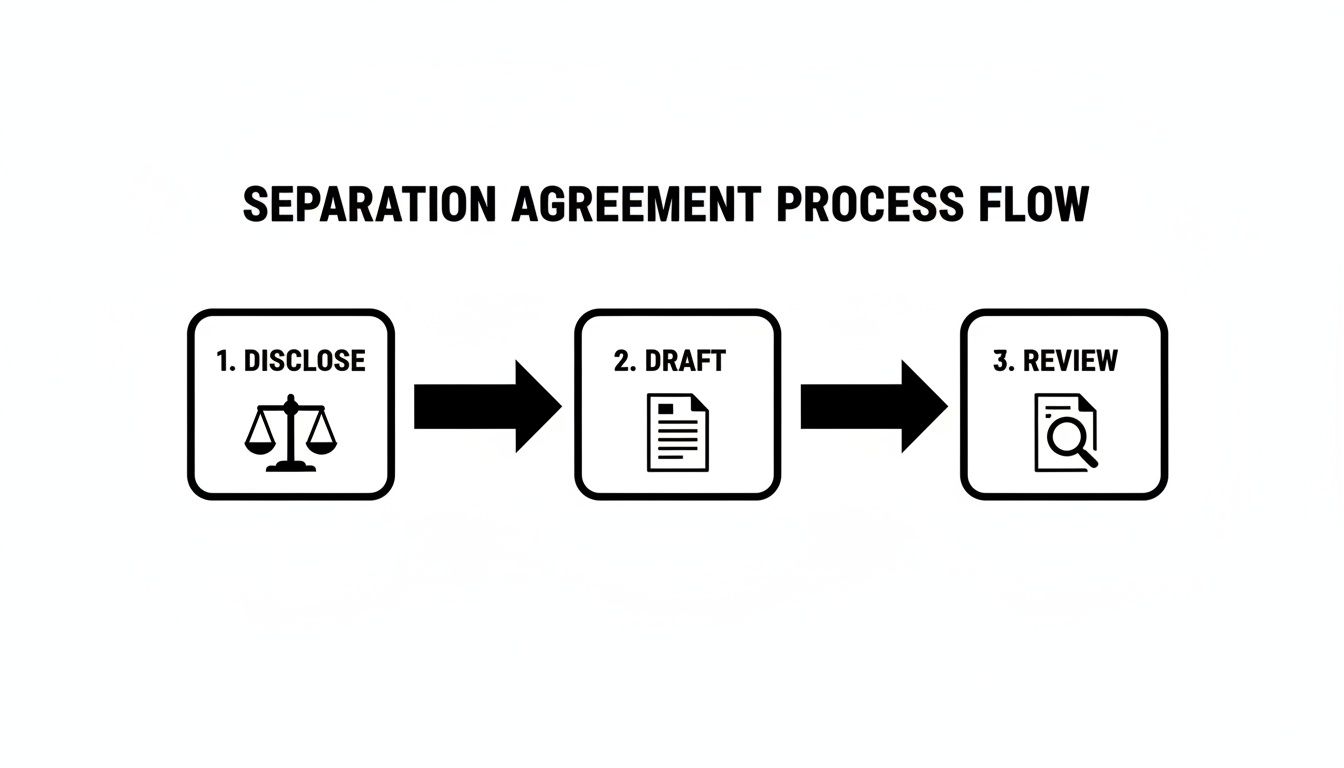
This flowchart nails it: you need to successfully navigate financial disclosure, draft the agreement, and get a final review before you even think about court forms.
Sole vs. Joint Application: The First Big Decision
Before you download a single thing, you need to decide how you’re going to file: together (jointly) or on your own (sole). This choice dictates the specific forms you'll use and the steps that follow.
- Joint Application: This is the most cooperative path forward. You and your spouse fill out and sign everything together as co-applicants. It’s simpler, uses less paperwork, and completely skips the formal step of "serving" documents on the other person. This route is perfect for couples who are truly on the same page and can tackle administrative tasks together.
- Sole Application: One person (the Applicant) files the divorce paperwork, and the other person (the Respondent) is formally served. This is the more common approach, even in friendly separations, because it doesn't demand direct cooperation on the paperwork itself. Your spouse doesn’t have to sign anything for you to get started, but they must be properly notified.
For most people navigating this on their own, a Sole Application is often the most practical choice. It lets one person drive the process without needing the other’s signature at every turn, which can prevent frustrating delays.
The Essential Forms for an Uncontested Divorce
Trying to find the right forms on the court’s website can feel like a maze. For a simple, uncontested divorce in Ontario, you’ll really only need to work with a core set of documents.
The single biggest mistake people make is using outdated forms or giving incomplete answers. Always, always double-check the official Ontario government website for the latest versions before you start filling anything out.
Here are the main forms you’ll be working with:
- Form 8A Application (Divorce): This is the official starting gun for your divorce. It gives the court the basic who, what, when, and where about you, your spouse, your marriage, and your separation.
- Form 36 Affidavit for Divorce: This is a sworn statement. You are confirming under oath that everything in your application is true, that you’ve met the one-year separation requirement, and that proper arrangements are in place for any children.
- Form 25A Divorce Order: Think of this as the finish line. It's the draft order that you prepare for the judge to sign. When a judge’s signature hits this page, your divorce is legally granted.
- Marriage Certificate: You have to submit the original, government-issued marriage certificate. A photocopy won't cut it. If you were married outside Canada, you’ll likely need to get it officially translated.
Avoiding Common and Costly Paperwork Errors
Going through a divorce without a lawyer is absolutely doable, but the administrative details can trip you up. Incomplete or incorrect forms are the number one reason applications get rejected, sometimes pushing timelines back by months.
To keep your application on track and avoid getting bogged down, pay laser-focused attention to these details:
- Exact Names: The names on your Form 8A must be an exact match to what's on your marriage certificate. A missing middle name or a slight misspelling is enough to get the whole thing sent back.
- Complete Information: Don't leave sections blank unless the form specifically tells you to. If a question doesn’t apply to your situation, just write "N/A."
- Financial Details: Even if everything is settled, you might still need to file financial statements if you're asking the court to make an order for support as part of the divorce. To get a better handle on this, check out our guide on completing a Form 13.1 Financial Statement.
- Proper Signatures: Make sure every form is signed, dated, and witnessed (or "commissioned") where it’s required. An Affidavit, for instance, isn't legally valid until you swear to its contents in front of a Commissioner for Taking Affidavits.
Treating the paperwork with the seriousness it deserves is the best way to increase your odds of getting your divorce finalized without any frustrating and unnecessary delays.
How to File and Finalize Your Divorce
You’ve done the hard work of preparing your paperwork, and now you’re at the courthouse door, ready to officially start the final chapter. This stage is all about logistics—getting the forms filed, making sure your spouse is properly notified, and understanding the court's timeline. It’s the last major hurdle on your journey.
Submitting Your Application
In Ontario, you have two main options for filing your divorce application: online or in person. The government's online portal is designed for convenience, letting you upload your documents and pay the fees right from home. It's often the quickest way to get your file into the system.
Alternatively, you can go old-school and file in person at the Superior Court of Justice. For anyone in Peel Region, that means heading to the courthouse in Brampton. The big advantage of filing in person is that a court clerk can give your documents a quick once-over, catching any obvious errors that might cause delays down the road. It’s a valuable safety net.
No matter which method you choose, you'll have to pay the mandatory court fees. Heads up: there are two separate fees. The first is paid when you file the application, and the second is due later, right before the court reviews your file to grant the divorce.
The Critical Step of Serving Your Spouse
If you filed a Sole Application, you have a crucial legal duty to formally notify your spouse that you've started the divorce. This is called "serving" the documents. A Joint Application, on the other hand, skips this step entirely since you both signed off on everything from the get-go.
For a Sole Application, someone else has to physically give your spouse a copy of the filed Form 8A (Application for Divorce). You cannot do this yourself. The papers must be delivered by another person over the age of 18—a friend, a family member, or a professional process server will do.
After your spouse has been served, the person who delivered the documents must complete Form 6B (Affidavit of Service). This is a sworn statement that proves to the court your spouse was properly notified. You must file this affidavit to keep your case moving.
Without a properly filed Affidavit of Service, your divorce application will stall indefinitely. The court cannot proceed until it has proof that the other party is aware of the case.
Understanding the Timeline and Waiting Periods
Once all your initial documents are filed and service is complete, the waiting game begins. The timeline for a simple, uncontested divorce in Ontario is fairly predictable, but it’s not instant. A few things have to happen first, including mandatory waiting periods and the court’s own processing times.
A judge can't legally grant your divorce until you and your spouse have been separated for at least one full year.
On top of that, if you filed a Sole Application, your spouse gets 30 days to file a response (or 60 days if they were served outside Canada or the US). Only after this response period passes without any objection can your file move to a judge's desk for review.
Estimated Timeline and Costs for an Uncontested Divorce
Here's a quick look at the typical timeline and the non-negotiable court fees you'll encounter during an uncontested divorce in Ontario.
| Step | Estimated Timeline | Associated Costs (Mandatory Fees) |
|---|---|---|
| Initial Filing of Application | Day 1 | $224 to file Form 8A |
| Spouse's Response Period | 30 days (if served in Canada/US) | N/A |
| Final Document Filing | After response period ends | $445 to file Form 36 and other final forms |
| Clerk and Judge Review | 2-4 months | N/A |
| Divorce Order Appeal Period | 31 days after order is granted | N/A |
| Applying for Certificate of Divorce | After appeal period ends | $25 to get the final certificate |
Keep in mind that these timelines are estimates and can vary based on the courthouse's workload, especially in busy jurisdictions like Brampton.
From Divorce Order to Final Certificate
Once the 31-day appeal period is over, your divorce is legally final. But here's a detail many people miss: the Divorce Order itself isn't the document you need if you plan to remarry. For that, you need one last piece of paper: the Certificate of Divorce.
The court doesn't automatically send this to you. You have to apply for it by submitting a specific form and paying a small fee. This certificate is the official, government-issued proof that your marriage has been legally dissolved.
We walk you through this final step in our detailed guide on how to get your Divorce Certificate in Ontario. Think of this document as your official key to moving forward.
Common Mistakes and When to Get Legal Help
Going through a divorce without a lawyer can feel empowering, but even the simplest cases have hidden traps. The path is littered with small mistakes that can create huge financial and emotional problems years down the road. Knowing what these mistakes look like is the best way to steer clear of them.
This isn't to scare you off the DIY path. It's about flagging the red lines. Recognizing when your situation has become too complex to handle on your own is a sign of strength, not failure. It’s about protecting yourself from costly errors that are a lot harder and more expensive to fix later.
Miscalculating Property and Pensions
One of the most frequent and damaging mistakes is messing up property division, especially when it comes to the matrimonial home and pensions. It’s easy to make assumptions that seem fair on the surface but don’t hold up under Ontario's Family Law Act.
Imagine a couple where one spouse keeps the house and the other takes the cash from a joint savings account, believing it's an equal trade. The problem? They never got the house formally appraised and forgot to account for the $50,000 mortgage still attached to it. The spouse who kept the home actually received far less in net value, throwing the whole equalization payment way off.
Pensions are an even bigger blind spot. They are incredibly complex assets that have to be professionally valued as of the date you separated. Simply guessing what a pension is worth or trading it for another asset without a proper valuation is a recipe for disaster. It leaves your agreement wide open to a legal challenge that could unravel the entire thing.
Creating Unenforceable Parenting Plans
When kids are involved, the temptation is to create a parenting plan based on goodwill and vague verbal understandings. While the spirit is right, these agreements often crumble under the pressure of real-life co-parenting, leaving everyone confused and back in conflict.
Here’s a real-world scenario we see all the time: a separation agreement simply says, "The parents will have reasonable and generous parenting time as they may agree." For the first few months, it works. Then a fight over a holiday schedule causes a total communication breakdown. Because the agreement has no specific schedule, no process for resolving disputes, and no clear rules for decision-making, neither parent knows what to do next. This often lands them right back in court—the very thing they wanted to avoid.
A legally sound parenting plan is detailed and specific. It anticipates future disagreements over things like travel, extracurriculars, and medical decisions, and it builds in a clear process for how to resolve them before they blow up.
Forgetting About Independent Legal Advice
Perhaps the single biggest mistake is skipping Independent Legal Advice (ILA). Many people think, "We agree on everything, so why pay a lawyer just to look it over?" This completely misunderstands what ILA is for. It isn't about looking for a fight; it's about preventing one down the road.
Here’s what happens without it: Years after the divorce, one spouse feels the agreement was unfair. They hire a lawyer who argues their client signed the document under duress or without fully understanding their legal rights—especially their right to spousal support or their share of a complex asset.
Without a certificate of ILA from each party's lawyer, the agreement is vulnerable. A judge might set aside parts of it, or even the whole thing, forcing you to start negotiating all over again. This can create absolute financial chaos, undoing years of settled plans.
When to Call in a Professional
Knowing when you’re in over your head is key. If any of the following situations sound familiar, it’s time to pause the DIY process and get some professional guidance:
- A Power Imbalance: One of you has always handled the finances, leaving the other feeling intimidated or completely in the dark.
- Complex Assets: There is a business, stock options, or a pension plan that needs to be divided.
- Refusal of Disclosure: Your spouse is dragging their feet or refusing to provide full financial information.
- High Conflict: You simply cannot have a productive conversation about the divorce issues without it turning into a fight.
- Special Needs Children: You need a highly customized and detailed parenting plan that addresses unique future needs.
If you've hit a roadblock or just want an expert to review your work before you file, Badesha Law can help. A single consultation can clarify your rights, spot potential errors in your paperwork, and give you the confidence to move forward the right way.
Your Ontario Divorce Questions Answered
Even with the clearest instructions, real-life questions always come up when you're navigating the divorce process. Let's tackle some of the most common ones we hear from people handling their own divorce without a lawyer in Ontario, with practical answers grounded in the Family Law Act.
How Long Must We Be Separated to Get Divorced?
The magic number in Ontario is one full year. You and your spouse must have lived separate and apart for a continuous 12-month period before a judge can legally grant your divorce order. This is the primary "no-fault" ground for divorce under Canada's Divorce Act.
But here’s a pro tip: you don’t have to sit on your hands for that year. You can get a huge head start by preparing your Separation Agreement and filing your Form 8A (Application for Divorce) with the court before the one-year mark officially passes. It’s a smart way to get the administrative work done so you’re ready to go, but the final divorce won't be granted until after that one-year anniversary.
What if My Spouse Refuses to Sign the Papers?
This is a common fear, but it's usually based on a misunderstanding of the process. Your spouse's signature is only an absolute requirement if you are filing a Joint Application for Divorce.
If you file a Sole Application, your spouse doesn't actually need to sign anything for you to move forward. Your legal duty is simply to "serve" them with the filed court documents. Once you’ve done that, they have 30 days to file a response with the court. If they do nothing, your case can proceed as an uncontested divorce. If they decide to contest it, your file becomes more complex, and that's the point where you should get legal advice.
A Sole Application puts the power back in your hands. It lets you drive the process forward, whether your spouse is cooperative or not. Their signature isn't a roadblock to starting the divorce proceedings in court.
Can I Get Divorced Here if We Married Elsewhere?
Yes, absolutely. Where you got married doesn’t matter—it’s where you live now that counts. To file for divorce in Ontario, either you or your spouse must have been ordinarily resident in the province for at least one year immediately before starting the divorce application.
The main complication that comes up is with your marriage certificate. If you were married in another country, you have to provide the original certificate. If it isn't in English or French, you'll also need to get it professionally translated and submit both the translation and the original to the court. For anyone navigating complex international custody issues, it's also wise to review your options for shared or joint custody arrangements.
In some situations, the court may also ask for a foreign divorce opinion letter from a lawyer. This is a specialized letter that confirms your foreign marriage is considered valid in Canada, giving the court the legal assurance it needs to grant your Ontario divorce.