

If you've started a family law case in Ontario, you've likely heard the term "case conference." The paperwork is filed, emotions are high, and this meeting is often the first formal step. So, what is a case conference, and what should you expect?
Think of it as the first official sit-down meeting in the court process. It is a mandatory gathering where you, your ex-partner, both of your lawyers, and a judge come together to discuss the case. This is not a dramatic trial you'd see on television; it's a practical, less formal meeting designed to get everyone on the same page and establish a path forward.
A case conference is not a trial, but it is a critically important step. In line with the Family Law Act in Canada, the goal is to see if you can resolve some issues, narrow down the ones you can't, and create a clear plan for what comes next.
Your First Step Inside Family Court

The family court system can feel overwhelming. The legal terminology, strict deadlines, and emotional weight of it all can be incredibly stressful. A case conference is the court's first attempt to cut through that complexity.
It’s designed to bring everyone to the table for a productive, structured conversation. It is less like a battle and more like a guided negotiation, with a judge acting as a neutral referee. The primary goal isn’t to declare a winner and a loser—it’s to make tangible progress.
Understanding the Conference's Role
Under Ontario's Family Law Rules, the case conference serves several key functions at the beginning of your case. It is a required step because it is meant to prevent cases from getting stuck in legal limbo and to push for a resolution before they escalate into a costly and emotionally draining trial. For a family lawyer in Brampton, like our team at Badesha Law, this meeting is a key strategic opportunity to advocate for your position while also exploring potential common ground.
Here’s a quick summary of what a case conference aims to accomplish.
Case Conference at a Glance
This table breaks down the main objectives of that first important meeting.
| Key Aspect | Purpose and Function |
|---|---|
| Identifying Common Ground | The judge helps you and your ex-partner determine what you already agree on, so you can stop arguing about those points. |
| Defining the Disagreements | For the issues you still can't agree on, the conference clarifies what the core conflict is really about. |
| Reality-Checking Positions | A judge will provide frank feedback on each side's position, helping everyone see their case more realistically and encouraging settlement. |
| Creating a Clear Roadmap | The judge makes procedural orders to keep the case moving, such as setting deadlines for financial disclosure or scheduling the next court date. |
| Exploring Settlement | It is a structured opportunity to negotiate and potentially resolve some or all issues without needing further court intervention. |
Think of it as a crucial first chance to make a good impression on the court and show that you’re being reasonable.
What It Is—And What It Isn't
It's easy to get the wrong idea about this meeting. Let's clear up a common misconception.
A case conference is not a hearing where a judge makes final decisions on your contested issues, like who gets the house or a final custody schedule. Instead, it’s a management meeting to organize the case, make sure everyone has the information they need, and see if a resolution is possible.
Essentially, this first meeting sets the tone for your entire case. It’s your opportunity to show the court you’re focused on finding a fair outcome, not just on fighting. To better understand your legal standing, you can learn more about your rights and responsibilities in Canadian family law to feel even more prepared. By understanding what a case conference is all about, you can walk in feeling more confident and ready for the journey ahead.
The True Purpose of a Case Conference
So, why does the Ontario court system insist on a case conference before you get anywhere near a trial? It’s not just another piece of legal red tape. The real goal is to make the entire family law process more efficient, less adversarial, and focused on finding solutions instead of fuelling conflict.
Think of it as the legal system's way of hitting the pause button. It forces you and your ex-partner to sit down for a structured, productive conversation about the real issues. This meeting is a fundamental part of how the Family Law Rules are designed to prevent cases from spiralling into those endless, wallet-draining court battles everyone dreads.
Exploring Settlement and Narrowing Issues
One of the most valuable functions of a case conference is exploring settlement. The judge isn't there to declare a winner; they act more like a neutral facilitator, helping both of you see where you might actually agree. It’s not about forcing anyone into a deal, but about creating an environment where negotiation is possible.
Even if you can't solve everything, the conference is a win if you can simply narrow the list of issues you're fighting about. For example, maybe you both agree on the value of the family home but still disagree on who keeps it. By getting the value locked in, you’ve just made your case simpler and more focused, saving time and legal fees down the line.
At its core, a case conference is about progress, not perfection. The judge’s goal is to help you take a step forward—no matter how small—by clarifying what is truly in dispute and what can be agreed upon without further argument.
Ensuring Fairness and Establishing Timelines
Another critical role of the case conference is to ensure everyone is playing fair, starting with full financial disclosure. A judge will look closely to confirm that both you and your ex-partner have exchanged all necessary financial documents. This transparency isn't optional; it's the bedrock of any fair conversation about support or property division, as mandated by family law in Canada.
The conference also creates a clear roadmap for your case. The judge will make procedural orders setting deadlines for filing documents, scheduling your next court date, or ordering specific actions like a business valuation. This keeps your case from getting stuck and ensures it moves forward.
It's also important to know that any agreements you reach can be turned into a binding court order. To understand how that works, you can learn more about what a consent order is in family law.
Ultimately, a case conference gives the judge a first impression of your case and, just as importantly, of you. By showing up prepared and willing to be reasonable, you demonstrate a cooperative attitude that can positively shape how the rest of your file unfolds. The guidance of an experienced family lawyer in Brampton from Badesha Law is invaluable in helping you present your position effectively and make a strong first impression.
Navigating the Process from Start to Finish
Knowing the sequence of events in a case conference is key to feeling in control. This isn’t just a one-off meeting; it's a highly structured process with strict rules and deadlines, all designed to keep your family law case moving forward. From getting the date on the calendar to filing the right documents, every step has a clear purpose.
The process kicks off the moment a date for the conference is set. In Ontario’s busy family courts, especially in places like Brampton, keeping cases on track is a massive priority. Delays are strongly discouraged to prevent backlogs and ensure families receive timely attention.
Scheduling and Strict Timelines
The court system has specific rules to prevent cases from stalling. In Ontario's Central West Region, which includes the Brampton courthouse where Badesha Law regularly represents clients, a case conference is the mandatory first step in almost every family law file.
Once a conference is scheduled, getting it postponed (an adjournment) is rare. The system is built for efficiency, especially given the volume of cases from Peel's large population and the significant number of intimate partner violence situations that often land in family court.
The regional practice directions are clear: adjournments are only allowed once, and only if both sides agree at least 10 days before the scheduled date. This highlights the court's commitment to moving cases forward. You can review the official guidelines for the Central West Region family courts to see just how strict these rules are.
Preparing Your Essential Documents
Well before you see the inside of a courtroom, you and your lawyer must prepare and serve a Case Conference Brief (Form 17A). This is, without a doubt, the single most important document for this meeting. It's your first formal chance to tell the judge your side of the story in writing.
Your brief must clearly lay out:
- Your Family's Details: Information about you, your ex-partner, and any children involved.
- The Key Issues: A straightforward list of what you can't agree on (like parenting time, decision-making, or spousal support).
- Your Position: What you're asking the court for and why your proposed solution is reasonable.
- A Settlement Proposal: A formal, written offer to settle some or all of the outstanding issues.
This infographic neatly sums up the three main goals of the conference—goals your brief needs to address head-on.
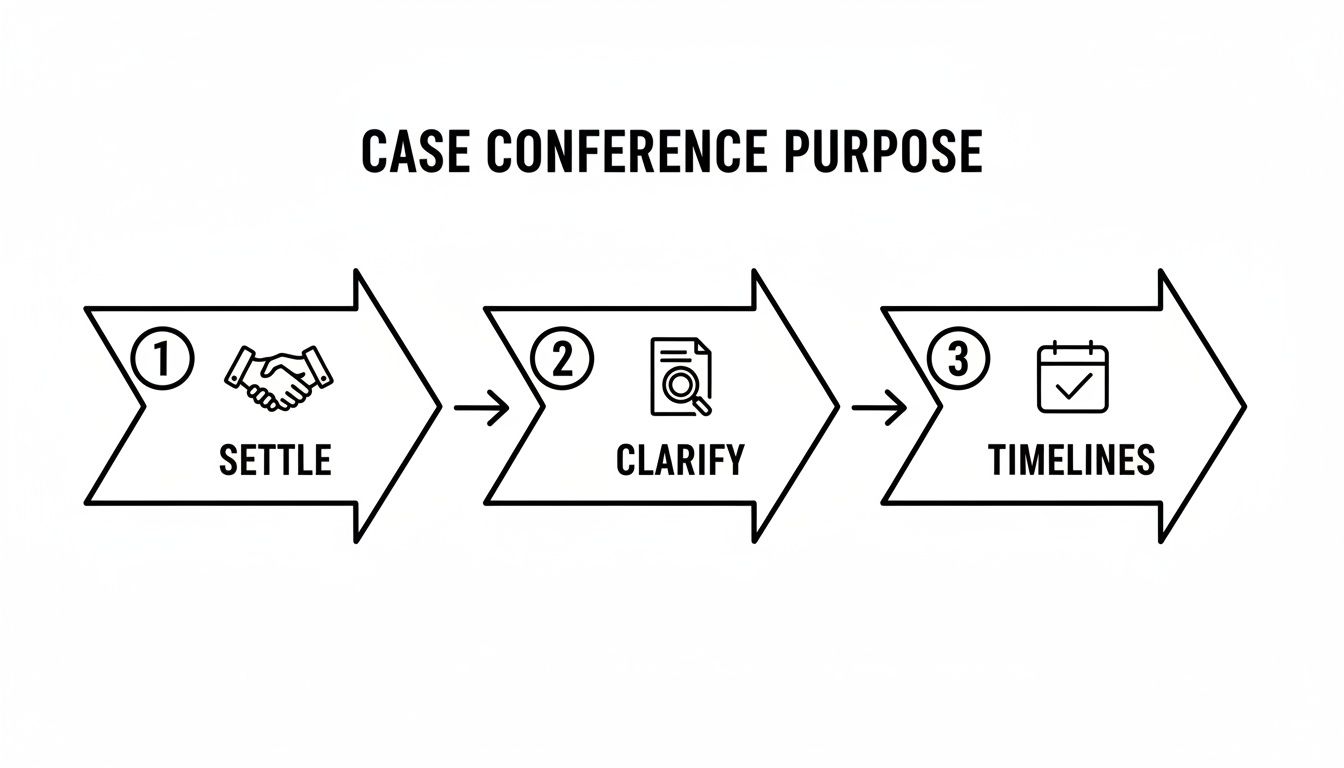
As you can see, the whole process is geared toward encouraging settlement, clarifying the real problems, and setting timelines. A well-drafted brief is the foundation for all three.
What to Expect on the Day
On the day of the conference—whether it’s virtual or in person at the Brampton courthouse—the judge is in charge of the discussion. Your family lawyer will do almost all of the talking, presenting the key arguments laid out in your brief.
The judge's role isn't to make a final ruling but to act more like a mediator with a gavel. They will ask pointed questions, give candid feedback on each person's position, and probe for areas where you might find common ground. The entire goal is to steer the conversation toward a productive outcome.
Based on that discussion, the judge will make procedural orders. These are not final decisions on custody or property division. Instead, they are instructions designed to move the case to the next stage, like setting deadlines for exchanging financial documents or scheduling the next step. This structured approach is essential for managing the complexities of the divorce process in Ontario.
How to Strategically Prepare for Your Conference

Success in a case conference doesn't just happen. It's the direct result of thoughtful, strategic preparation. Think of it like getting ready for a major business meeting—the more organized you are, the better you can articulate your position and protect your interests.
Walking into that meeting prepared and confident can make all the difference. This prep work starts long before the conference date and involves working closely with your family lawyer to get your documents in order, clarify your goals, and anticipate what the other side might say. A proactive approach is essential.
Assembling Your Essential Documents
The bedrock of any solid family law case is transparent and organized financial disclosure. Before a judge can make any recommendations, they need a crystal-clear picture of your family's finances. This isn't just about ticking boxes; it's about building your credibility from the start.
Before your conference, you and your lawyer will need to pull together several key documents:
- Proof of Income: Your last three years of income tax returns and their corresponding Notices of Assessment are non-negotiable.
- Current Pay Stubs: You’ll need recent pay stubs to show your current, year-to-date income.
- Financial Statements: A properly completed and sworn Financial Statement (Form 13 or 13.1) is one of the most important documents you'll file. For a complete guide, see our breakdown of the Form 13.1 Financial Statement.
- Property Valuations: Gather any appraisals or statements that show the value of major assets like your home, pensions, or investments.
Having everything organized and filed on time sends a powerful message to the judge: you're taking this seriously and are ready to move forward in good faith.
Defining Your Positions and Goals
Beyond the paperwork, the most crucial preparation you'll do is with your lawyer. Together, you need to establish a clear, reasonable, and legally sound position on every issue at stake—whether it’s the parenting schedule, spousal support, or property division.
Your family lawyer in Brampton is there to help you translate your personal goals into a persuasive legal argument. At a firm like Badesha Law, we specialize in drafting a compelling Case Conference Brief that tells your story effectively while meeting all the court’s strict rules. This document is the judge’s first real introduction to your case, so we make it count.
A well-prepared client is an empowered client. The aim is to walk into that conference knowing your best-case outcome, your acceptable compromises, and your absolute non-negotiables. That clarity lets your lawyer advocate for you with precision and strength.
Before the conference, it's a good idea to run through a checklist of key discussion points with your lawyer. This ensures you're both on the same page and ready for any questions from the judge.
Your Case Conference Preparation Checklist
To make sure nothing gets missed, we've put together a simple checklist. Reviewing these items with your lawyer will ensure you are completely aligned and ready for a productive conference.
| Preparation Task | Why It Matters |
|---|---|
| Complete Financial Disclosure | The court can't make decisions without a full financial picture. Missing documents cause delays and hurt your credibility. |
| Identify Key Issues | You need to clearly list what's agreed upon and what's still in dispute (e.g., parenting time, child support). |
| Define Your Ideal Outcome | What does a "win" look like for you on each issue? Be specific. This gives your lawyer a clear target. |
| Discuss Potential Compromises | Where are you willing to be flexible? Knowing your settlement range helps your lawyer negotiate effectively. |
| List Your Non-Negotiables | What are your absolute bottom lines? Your lawyer needs to know which positions are firm. |
| Review the Case Conference Brief | Read the brief your lawyer prepared. Does it tell your story accurately? Make sure you're comfortable with it. |
This focused preparation is what turns a potentially stressful court date into a productive step toward resolving your family law matter and moving on with your life.
When a Case Conference Involves Child Protection
While many people associate a case conference with divorce or separation, its role becomes far more critical when a child's safety is on the line. If the Children's Aid Society (CAS) gets involved, the conference takes on a new level of urgency. It’s no longer just a meeting; it's a specialized forum designed to protect the most vulnerable members of a family.
These conferences bring CAS workers and other professionals to the table to make coordinated decisions about a child's immediate well-being. The focus shifts dramatically from dividing assets to managing risk and building a concrete plan to keep a child safe from harm.
The High Stakes of CAS Involvement
When a Children's Aid Society steps in, it’s a clear signal that the concerns are serious. These are situations where a child's safety or welfare may be genuinely at risk. In this context, a case conference is the court’s primary tool for getting everyone in the same room to address the issues head-on, quickly and collaboratively.
The main goal is to get a clear picture of the situation, hear from the parents, and fully understand the CAS's protection concerns. A judge will guide the discussion to see if a safety plan can be agreed upon—one that keeps the child protected while giving the family a chance to work through its challenges. Navigating this process requires skilled legal counsel that understands the intersection of family and child protection law. A family lawyer in Brampton from Badesha Law is equipped to handle these sensitive, high-stakes matters with the necessary expertise and care.
A Look at the Reality in Peel Region
Here in the Peel Region, where Badesha Law serves families, these conferences are pivotal in matters handled by the Peel Children's Aid Society. The numbers tell a stark story. A recent Peel Police report detailed 275 C.A.S. consultations, which included 119 joint investigations into physical assault and 33 joint investigations into sexual assault. Many of these serious situations lead directly to case conferences, where urgent, coordinated decisions must be made to protect children. You can explore the full report on at-risk persons to grasp the scale of these challenges.
In child protection matters, a case conference is the frontline of decision-making. The judge, lawyers, and CAS workers collaborate to create a plan that addresses immediate risks and sets out clear steps for parents to follow to ensure their child's safety.
When a child’s well-being is on the line, every single decision matters. If you find yourself in a situation where you need to protect your child immediately, it is critical to understand your options. You might find our guide on how to get an emergency child custody order helpful. Understanding this process is vital for any parent facing CAS involvement.
Common Questions About Case Conferences
Even with a roadmap, it’s normal to have questions about what a case conference means for you. This is a major step in your family law case, and the unknown can be unsettling.
Let’s break down some of the most common questions we hear from clients to give you direct answers so you can walk in feeling prepared.
Can a Final Decision Be Made at a Case Conference?
Generally, no. A judge at a case conference cannot impose a final, binding order on contested issues like your parenting schedule or property division. Their role is procedural—they make orders to keep the case moving forward, such as setting deadlines or ordering financial disclosure.
The one major exception is if you and your ex-partner reach an agreement on an issue during the conference. If that happens, the judge can turn your mutual agreement into a formal, legally binding consent order.
What Happens If We Disagree on Everything?
It happens. Walking out of a case conference without resolving every issue—or any of them—does not mean it was a failure. If you and your ex-partner can’t find common ground, the judge’s role shifts to creating a clear path forward.
They will still make important procedural orders. For instance, a judge might order a strict timeline for swapping financial documents or schedule the next step, which is often a settlement conference. The meeting is still a success because it forces both sides to put their positions on the record, define what they’re fighting about, and get a structured plan to tackle those disagreements.
The purpose of a case conference is progress, not perfection. Even if you don't settle, clarifying the issues and getting a clear roadmap for your case is a significant step forward.
Do I Have to Speak Directly to the Judge?
Not usually. Your lawyer will do almost all of the talking. An experienced family lawyer in Brampton from Badesha Law is trained to present your case, articulate your position on key issues, and handle the legal dialogue with the judge and the other lawyer.
The judge might occasionally ask you a direct question to clarify a point, but this is rare and it’s not an interrogation. It is nothing like the cross-examination you see in courtroom dramas. We ensure you’re thoroughly prepared for what to expect, so you feel comfortable and well-represented.
Why Is the Case Conference Brief So Important?
The Case Conference Brief (Form 17A) is, without a doubt, the most critical piece of preparation for this meeting. Think of it as your first and best chance to tell the judge your side of the story before you even enter the room.
This document is more than just a list of facts; it frames the entire narrative of your case. A well-written brief, prepared by your lawyer, will:
- Clearly summarize your family’s situation.
- Outline the specific issues in dispute.
- State exactly what you are asking the court for and explain why it’s a reasonable solution.
- Attach key documents that support your position.
A persuasive brief shows the judge you’re organized, reasonable, and serious about resolving the matter fairly. It can have a huge, positive influence on the judge’s first impression, setting a productive tone for the conference and everything that follows.
Navigating a case conference is a pivotal moment, and having the right legal partner makes all the difference. Badesha Law provides clear, compassionate, and expert guidance to clients in Brampton and across the GTA. To ensure you are fully prepared and your rights are protected, schedule your free consultation with us today. Find out how we can help you move forward with confidence by visiting badeshalaw.ca.