Ontario Family Law: Mediation vs Litigation

You may be reading this late at night, after another tense conversation about the house, the children, or money. One of you wants to “keep it civil.” The other says court is the only way anything will get done. In Ontario family law, that fork in the road matters more than is commonly understood.

The choice between mediation and litigation shapes nearly everything that follows. It affects how much control you keep, how quickly issues get resolved, how much pressure lands on your finances, and whether future co-parenting becomes more workable or more strained. For many separating spouses in Brampton, Mississauga, and across the GTA, the legal terms are familiar but the practical consequences are not.

Ontario law gives families more than one path forward. The right path depends less on what sounds nicer and more on what your facts are. If you need focused help on only part of your case, a limited scope retainer in family law can also be part of a practical strategy.

Table of Contents

The Crossroads of Separation Choosing Your Legal Path

Separation rarely begins in a lawyer's office. It usually starts in a kitchen, a driveway, or over text messages that become shorter and colder over time. Then the practical questions arrive all at once. Who stays in the matrimonial home. What happens with parenting time. How are support and property handled. Who decides if no one agrees.

Under Ontario's legal framework, including the Family Law Act and the federal Divorce Act, those questions can be addressed through negotiated processes or through court. The two paths commonly compared are mediation and litigation. They aren't interchangeable. They ask very different things of you.

What most families are actually deciding

For many people, the question isn't “Which process sounds better?” It's this:

  • Can we still exchange information openly
  • Can we discuss parenting and money without pressure or fear
  • Do we need a judge to make orders because one person won't cooperate
  • Is speed more important, or is enforceability the priority

A family that can still sit in the same room and work through options may be a good fit for mediation. A family dealing with intimidation, hidden finances, or urgent parenting risk usually needs the structure of court.

The best legal path is the one that fits the facts you're living with, not the one that sounds most peaceful in theory.

Ontario law still expects serious efforts to resolve matters

The law doesn't treat court as the first answer in every case. It also doesn't assume mediation is suitable in every case. That balance matters. Family law in Ontario is built around disclosure, fairness, and the best interests of children. Those principles matter whether you settle in a boardroom or appear before a judge.

Understanding Family Mediation in Ontario

Family mediation is a structured settlement process where a neutral third party helps separating spouses identify issues, exchange positions, and work toward an agreement. The mediator does not act as a judge and does not impose a result. The purpose is to help both people reach their own terms on parenting, support, and property.

In Ontario family law, mediation is voluntary. A party can choose to start, pause, or end the process, and a mediator can also stop if the process is no longer appropriate. The Ontario Women's Justice Network explains that family mediation in Ontario is strictly voluntary. That matters because real agreement isn't possible if one person is being pushed through a process that isn't safe or workable.

Why mediation matters under the Divorce Act

The federal government has made out-of-court resolution a serious part of modern family law practice. The Department of Justice states that under the Divorce Act, in force as of March 1, 2021, parties are legally required to attempt family dispute resolution processes if it is appropriate. That includes mediation, negotiation, and collaborative law.

This does not mean every case must go to mediation. It means separating spouses should consider dispute resolution where it is suitable. If there are safety concerns, severe imbalance, or refusal to disclose finances, mediation may not be appropriate.

What the process usually looks like

Most mediations focus on a manageable set of issues:

  1. Parenting arrangements such as decision-making responsibility, parenting time, holiday schedules, and communication rules.
  2. Support questions involving child support and, where applicable, spousal support.
  3. Property issues such as equalisation, debts, the matrimonial home, and treatment of joint accounts.

The practical goal is usually a written settlement framework, often leading to a separation agreement. Before signing, each party should get legal advice. If you want a fuller look at the process, this guide to legal separation mediation in Ontario is a useful starting point.

Practical rule: Mediation works best when both people are willing to disclose, listen, and compromise. It works poorly when one person treats it as a delay tactic.

Understanding Family Law Litigation in Ontario

Litigation is the court-based process for resolving family law disputes when agreement can't be reached or shouldn't be relied on. In this route, the parties don't control the final outcome. A judge does.

Court proceedings in Ontario family law follow the Family Law Rules. Those rules govern how documents are served and filed, when conferences happen, what financial disclosure must be produced, and how motions and trials proceed. The process is formal because the court is being asked to make enforceable decisions that affect parenting, support, and property rights.

What usually happens in a litigated family case

Most family court cases move through a series of steps rather than going straight to trial:

  • Starting the case by filing an Application or Answer that sets out the orders being requested.
  • Financial disclosure so both sides produce the records needed to address support and property issues.
  • Case conferences and settlement conferences where the court reviews the issues and pushes the matter toward resolution.
  • Motions when temporary orders are needed before final resolution.
  • Trial if the issues remain contested and a judge must decide them.

A case conference is often one of the first meaningful court events, and understanding its role can reduce a lot of anxiety. This overview of what a case conference is in Ontario family court explains what parties can expect.

What litigation gives you that mediation does not

Litigation is slower and more demanding, but it provides things mediation cannot always provide:

  • Binding court orders
  • Judicial enforcement tools
  • Compelled procedural steps
  • A decision even when one person refuses to cooperate

That last point is often why litigation becomes necessary. If one spouse won't produce records, won't negotiate, or keeps changing positions, a private process may stall.

The trade-off

Court can protect rights when negotiation has broken down. It can also deepen conflict. Hearings, affidavits, cross-allegations, and rigid deadlines create pressure. That pressure sometimes helps a case move. It also often increases emotional strain, especially where children are already caught in the middle.

Key Differences A Side-by-Side Comparison

When people compare mediation vs litigation, they usually start with cost. That matters, but it isn't the whole story. Control, privacy, pace, and emotional impact often shape the better choice.

Mediation vs Litigation At a Glance

Factor Mediation Litigation
Control over outcome The parties negotiate their own terms A judge makes the final decision if no settlement is reached
Cost Usually lower because the process is narrower and more collaborative Usually higher because of court steps, preparation, and ongoing advocacy
Timeline Often faster and more flexible Often slower because it depends on court scheduling and procedural steps
Privacy Private process Court process is more public
Emotional impact Can reduce hostility where both people participate in good faith More adversarial and often harder on co-parenting relationships

Cost and speed are often the first visible difference

Ontario data on family mediation is stark. According to Ontario divorce mediation guidance, family mediation achieves an 87% success rate, with private mediation costs between $2,500 and $3,500 per couple. The same source states this represents 70% to 80% savings compared to litigation costs that can reach $15,000 to $50,000 per spouse, and that mediation usually finishes in days or weeks, while litigation can take months or years.

In practice, people often feel the difference before they fully understand it. One process asks, “What can both of you live with?” The other asks, “What order should the court impose?”

Control is not a small issue

In mediation, the parties can shape details a court might not have time to craft with the same nuance. Parenting exchanges, holiday schedules, sale timelines for a home, communication protocols, and review dates can all be adjusted with greater precision.

In litigation, flexibility narrows. The court must apply legal principles and manage a busy docket. Judges can and do make practical orders, but the process is constrained by evidence, procedure, and the limits of what either side has formally asked for.

Privacy and emotional wear matter too

Mediation is generally private. That can matter where finances, health concerns, or parenting disagreements are personal in nature. Litigation places those issues into a formal court record and often in a more adversarial format.

This doesn't mean mediation is always gentler. In the wrong case, it can become another place where one spouse dominates the conversation. Suitability matters more than branding.

A Deeper Dive Into Cost and Timelines

A separating couple can agree on the big issues, then still lose months and thousands of dollars to the wrong process. In Ontario family law, cost is rarely just about the final bill. It is about how long two households stay under strain, how long support remains unsettled, and how much conflict the process creates while the case is pending.

A comparison chart showing that mediation is more cost-effective and faster than traditional legal litigation.

Why litigation gets expensive fast

Litigation costs rise because every step has rules, deadlines, and paperwork attached to it. A court case may require an application or answer, sworn financial statements, affidavits, case conference briefs, settlement conference briefs, motion materials, updated disclosure, and trial preparation if settlement does not happen earlier. Clients also pay for lawyer time spent reviewing the other side's materials, preparing responses, attending court, and dealing with adjournments or urgent issues.

That work is sometimes necessary. Under Ontario's Family Law Act and the Divorce Act, support, property, and parenting disputes still have to be decided on proper facts and legal principles. But if the case is headed to court too early, legal fees often go toward procedure before they go toward resolution.

Mediation is usually narrower. The parties still need financial disclosure and legal advice, but they often use their lawyers for targeted help instead of full court representation from start to finish. That difference matters.

The cheaper process is not always the better one

I regularly tell clients not to choose mediation just because the hourly rate looks lower. A low-cost mediation becomes expensive if one spouse is withholding bank records, refusing to discuss support, or using sessions to delay a decision. In those cases, paying for a motion, disclosure order, or temporary support order may save money over the life of the file because it forces the matter into a structure with deadlines and consequences.

Ontario courts also expect parties to consider settlement options where appropriate. The Divorce Act places a duty on legal advisers to discuss dispute resolution with clients unless it would be clearly inappropriate. That does not mean every family should mediate. It means the process should fit the facts.

Ontario options families often overlook

Many families assume the only choices are full private mediation or full litigation. The options are more varied.

Some matters are suitable for private mediation with both parties getting independent legal advice in the background. Some qualify for subsidized or court-connected services. In Brampton, shorter issues may sometimes be addressed through courthouse mediation services if the case is appropriate and both sides are prepared to participate in good faith.

There are also community-based options. Peel Family Mediation Services may assist eligible families in Brampton and Orangeville, which can make early resolution more realistic for people under financial pressure.

If budget is the main concern, compare likely scenarios instead of guessing. This overview of Ontario divorce costs and legal fees gives a more practical starting point than broad averages.

Time affects legal outcomes, not just stress levels

Delay has consequences. A temporary parenting schedule can harden into the status quo. Support arrears can build. A home sale can stall while carrying costs continue. Business records and account statements get older and harder to interpret. The longer a case drifts, the more expensive it often becomes to sort out what should have been addressed early.

Mediation can move quickly if both people are organized, honest, and ready to make decisions. Litigation depends on court dates, judicial availability, disclosure fights, and whether one side brings motions along the way. In Peel Region, families often feel this most sharply when they expected one or two appearances and instead spend many months working through interim issues before a final resolution is even in sight.

Speed matters because family life does not pause while a case is waiting for the next date.

When Litigation Is Unavoidable Red Flags for Mediation

Mediation is often presented as the sensible, mature option. Sometimes it is. Sometimes it is absolutely the wrong process.

A checklist infographic outlining five red flags indicating that litigation may be more appropriate than mediation.

Green flags that support mediation

Mediation is often suitable where both spouses can still behave like problem-solvers even if they are angry or hurt. The strongest signs include:

  • Functional communication so each person can speak, respond, and make proposals without intimidation.
  • Reliable disclosure because support and property discussions are useless if income, assets, or debts are being hidden.
  • A co-parenting focus where the parties want a workable plan rather than a symbolic win.
  • Room for compromise on process, timing, and practical details.

Where those conditions exist, mediation can protect time, money, and a future parenting relationship.

Red flags that usually push the case toward court

Some facts should make you very cautious about mediation:

  • Domestic violence or safety concerns
  • Major power imbalance, especially where one spouse controls money, housing, or access to information
  • Bad-faith participation, such as using mediation to delay support or avoid disclosure
  • Suspected hidden assets or manipulated income
  • Urgency, where a child's safety, access, or immediate financial stability needs a court order now

If the situation is urgent, an emergency motion in family court may be the more appropriate tool.

High-conflict cases are where theory often breaks down

This is the part many online guides skip. Mediation does not automatically preserve relationships. In some high-conflict cases, it produces weak agreements that fall apart quickly.

Recent Ontario data described in a discussion of under-addressed risks reports that in 34% of high-conflict Ontario divorce cases, mediation led to unenforceable agreements or renewed court filings within six months, particularly where one party had greater financial or emotional control. That does not mean mediation fails generally. It means screening matters.

A process is only as fair as the conditions inside it. If one person cannot negotiate freely, the appearance of cooperation can hide a very unfair result.

The legal point many people overlook

Ontario family law still requires full financial disclosure whether you settle or litigate. You do not avoid that obligation by choosing mediation. The Family Law Act framework, together with Ontario family law procedure, depends on informed decision-making. If one party won't disclose, the problem is not solved by changing the room you are sitting in. It usually requires stronger enforcement.

How Badesha Law Helps You Navigate Your Path

The right answer is rarely “always mediate” or “always go to court.” Good family law advice starts with a sharper question. Is this a case that can be resolved safely and fairly through negotiation, or does it need the authority and structure of litigation?

Screenshot from https://badeshalaw.ca

A Brampton family lawyer should be able to help with both. That includes representing clients in contested divorce litigation, but also advising people who are already in mediation and need independent legal advice before signing a separation agreement. That review matters. A negotiated agreement still has to protect your rights, reflect proper disclosure, and fit Ontario family law principles under the Family Law Act and the Divorce Act.

For many families, the most useful legal service is not force. It is clarity. Once the facts are properly assessed, the better path usually becomes much easier to see.

Frequently Asked Questions

What happens if mediation fails

A failed mediation does not automatically hurt your case. Refusing to engage at all can be a different story. A 2023 Canadian study on Ontario family court decision-making found that 38% of Ontario family court judges cited mediation participation or refusal as a factor in final custody decisions, and refusal was linked to lower cooperativeness scores in 29% of contested cases. Courts generally understand the difference between trying mediation in good faith and refusing reasonable dispute resolution without a sound reason.

Is a mediated agreement legally binding

The mediation itself is non-binding. The parties negotiate terms, usually recorded in a separation agreement if settlement is reached. That agreement becomes far stronger once each side receives independent legal advice and the document is properly drafted and signed. In some cases, terms can also be incorporated into a court order for easier enforcement.

Can I still have my own lawyer during mediation

Yes. You should. A mediator is neutral and cannot protect only your interests. Your own lawyer can explain support rights, property implications, parenting clauses, and whether the proposed settlement is one you should sign.

When should I skip mediation and go straight to court

If there are safety concerns, intimidation, hidden assets, refusal to disclose finances, or urgent issues involving children or support, court may be the safer and more effective route. Mediation is a tool, not a moral test. You are allowed to choose the process that protects you and your children.


If you're deciding between mediation and court, Badesha Law can help you assess the facts clearly and choose the right path under Ontario family law. The firm assists clients across Brampton, Mississauga, and the GTA with contested divorce litigation, separation agreements, parenting disputes, support issues, and independent legal advice for mediated settlements. A focused consultation can save time, reduce mistakes, and give you a plan you can act on.


What Is a Case Conference in Ontario Family Law?

If you've started a family law case in Ontario, you've likely heard the term "case conference." The paperwork is filed, emotions are high, and this meeting is often the first formal step. So, what is a case conference, and what should you expect?

Think of it as the first official sit-down meeting in the court process. It is a mandatory gathering where you, your ex-partner, both of your lawyers, and a judge come together to discuss the case. This is not a dramatic trial you'd see on television; it's a practical, less formal meeting designed to get everyone on the same page and establish a path forward.

A case conference is not a trial, but it is a critically important step. In line with the Family Law Act in Canada, the goal is to see if you can resolve some issues, narrow down the ones you can't, and create a clear plan for what comes next.

Your First Step Inside Family Court

A man in a suit walks through a modern courthouse lobby carrying documents.

The family court system can feel overwhelming. The legal terminology, strict deadlines, and emotional weight of it all can be incredibly stressful. A case conference is the court's first attempt to cut through that complexity.

It’s designed to bring everyone to the table for a productive, structured conversation. It is less like a battle and more like a guided negotiation, with a judge acting as a neutral referee. The primary goal isn’t to declare a winner and a loser—it’s to make tangible progress.

Understanding the Conference's Role

Under Ontario's Family Law Rules, the case conference serves several key functions at the beginning of your case. It is a required step because it is meant to prevent cases from getting stuck in legal limbo and to push for a resolution before they escalate into a costly and emotionally draining trial. For a family lawyer in Brampton, like our team at Badesha Law, this meeting is a key strategic opportunity to advocate for your position while also exploring potential common ground.

Here’s a quick summary of what a case conference aims to accomplish.

Case Conference at a Glance

This table breaks down the main objectives of that first important meeting.

Key Aspect Purpose and Function
Identifying Common Ground The judge helps you and your ex-partner determine what you already agree on, so you can stop arguing about those points.
Defining the Disagreements For the issues you still can't agree on, the conference clarifies what the core conflict is really about.
Reality-Checking Positions A judge will provide frank feedback on each side's position, helping everyone see their case more realistically and encouraging settlement.
Creating a Clear Roadmap The judge makes procedural orders to keep the case moving, such as setting deadlines for financial disclosure or scheduling the next court date.
Exploring Settlement It is a structured opportunity to negotiate and potentially resolve some or all issues without needing further court intervention.

Think of it as a crucial first chance to make a good impression on the court and show that you’re being reasonable.

What It Is—And What It Isn't

It's easy to get the wrong idea about this meeting. Let's clear up a common misconception.

A case conference is not a hearing where a judge makes final decisions on your contested issues, like who gets the house or a final custody schedule. Instead, it’s a management meeting to organize the case, make sure everyone has the information they need, and see if a resolution is possible.

Essentially, this first meeting sets the tone for your entire case. It’s your opportunity to show the court you’re focused on finding a fair outcome, not just on fighting. To better understand your legal standing, you can learn more about your rights and responsibilities in Canadian family law to feel even more prepared. By understanding what a case conference is all about, you can walk in feeling more confident and ready for the journey ahead.

The True Purpose of a Case Conference

So, why does the Ontario court system insist on a case conference before you get anywhere near a trial? It’s not just another piece of legal red tape. The real goal is to make the entire family law process more efficient, less adversarial, and focused on finding solutions instead of fuelling conflict.

Think of it as the legal system's way of hitting the pause button. It forces you and your ex-partner to sit down for a structured, productive conversation about the real issues. This meeting is a fundamental part of how the Family Law Rules are designed to prevent cases from spiralling into those endless, wallet-draining court battles everyone dreads.

Exploring Settlement and Narrowing Issues

One of the most valuable functions of a case conference is exploring settlement. The judge isn't there to declare a winner; they act more like a neutral facilitator, helping both of you see where you might actually agree. It’s not about forcing anyone into a deal, but about creating an environment where negotiation is possible.

Even if you can't solve everything, the conference is a win if you can simply narrow the list of issues you're fighting about. For example, maybe you both agree on the value of the family home but still disagree on who keeps it. By getting the value locked in, you’ve just made your case simpler and more focused, saving time and legal fees down the line.

At its core, a case conference is about progress, not perfection. The judge’s goal is to help you take a step forward—no matter how small—by clarifying what is truly in dispute and what can be agreed upon without further argument.

Ensuring Fairness and Establishing Timelines

Another critical role of the case conference is to ensure everyone is playing fair, starting with full financial disclosure. A judge will look closely to confirm that both you and your ex-partner have exchanged all necessary financial documents. This transparency isn't optional; it's the bedrock of any fair conversation about support or property division, as mandated by family law in Canada.

The conference also creates a clear roadmap for your case. The judge will make procedural orders setting deadlines for filing documents, scheduling your next court date, or ordering specific actions like a business valuation. This keeps your case from getting stuck and ensures it moves forward.

It's also important to know that any agreements you reach can be turned into a binding court order. To understand how that works, you can learn more about what a consent order is in family law.

Ultimately, a case conference gives the judge a first impression of your case and, just as importantly, of you. By showing up prepared and willing to be reasonable, you demonstrate a cooperative attitude that can positively shape how the rest of your file unfolds. The guidance of an experienced family lawyer in Brampton from Badesha Law is invaluable in helping you present your position effectively and make a strong first impression.

Navigating the Process from Start to Finish

Knowing the sequence of events in a case conference is key to feeling in control. This isn’t just a one-off meeting; it's a highly structured process with strict rules and deadlines, all designed to keep your family law case moving forward. From getting the date on the calendar to filing the right documents, every step has a clear purpose.

The process kicks off the moment a date for the conference is set. In Ontario’s busy family courts, especially in places like Brampton, keeping cases on track is a massive priority. Delays are strongly discouraged to prevent backlogs and ensure families receive timely attention.

Scheduling and Strict Timelines

The court system has specific rules to prevent cases from stalling. In Ontario's Central West Region, which includes the Brampton courthouse where Badesha Law regularly represents clients, a case conference is the mandatory first step in almost every family law file.

Once a conference is scheduled, getting it postponed (an adjournment) is rare. The system is built for efficiency, especially given the volume of cases from Peel's large population and the significant number of intimate partner violence situations that often land in family court.

The regional practice directions are clear: adjournments are only allowed once, and only if both sides agree at least 10 days before the scheduled date. This highlights the court's commitment to moving cases forward. You can review the official guidelines for the Central West Region family courts to see just how strict these rules are.

Preparing Your Essential Documents

Well before you see the inside of a courtroom, you and your lawyer must prepare and serve a Case Conference Brief (Form 17A). This is, without a doubt, the single most important document for this meeting. It's your first formal chance to tell the judge your side of the story in writing.

Your brief must clearly lay out:

  • Your Family's Details: Information about you, your ex-partner, and any children involved.
  • The Key Issues: A straightforward list of what you can't agree on (like parenting time, decision-making, or spousal support).
  • Your Position: What you're asking the court for and why your proposed solution is reasonable.
  • A Settlement Proposal: A formal, written offer to settle some or all of the outstanding issues.

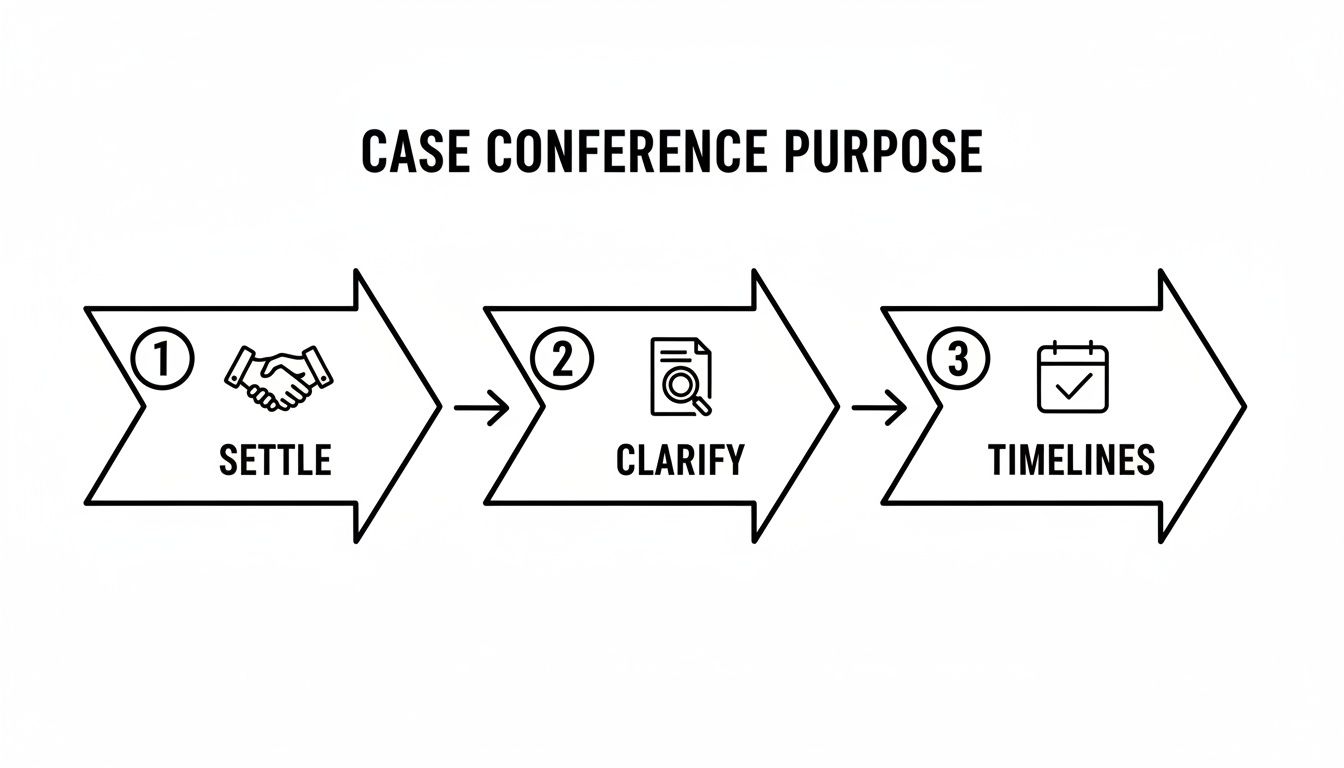
This infographic neatly sums up the three main goals of the conference—goals your brief needs to address head-on.

A diagram illustrating the three main purposes of a case conference: settle, clarify, and timelines.

As you can see, the whole process is geared toward encouraging settlement, clarifying the real problems, and setting timelines. A well-drafted brief is the foundation for all three.

What to Expect on the Day

On the day of the conference—whether it’s virtual or in person at the Brampton courthouse—the judge is in charge of the discussion. Your family lawyer will do almost all of the talking, presenting the key arguments laid out in your brief.

The judge's role isn't to make a final ruling but to act more like a mediator with a gavel. They will ask pointed questions, give candid feedback on each person's position, and probe for areas where you might find common ground. The entire goal is to steer the conversation toward a productive outcome.

Based on that discussion, the judge will make procedural orders. These are not final decisions on custody or property division. Instead, they are instructions designed to move the case to the next stage, like setting deadlines for exchanging financial documents or scheduling the next step. This structured approach is essential for managing the complexities of the divorce process in Ontario.

How to Strategically Prepare for Your Conference

Two professionals and a client review documents and material samples at a business meeting.

Success in a case conference doesn't just happen. It's the direct result of thoughtful, strategic preparation. Think of it like getting ready for a major business meeting—the more organized you are, the better you can articulate your position and protect your interests.

Walking into that meeting prepared and confident can make all the difference. This prep work starts long before the conference date and involves working closely with your family lawyer to get your documents in order, clarify your goals, and anticipate what the other side might say. A proactive approach is essential.

Assembling Your Essential Documents

The bedrock of any solid family law case is transparent and organized financial disclosure. Before a judge can make any recommendations, they need a crystal-clear picture of your family's finances. This isn't just about ticking boxes; it's about building your credibility from the start.

Before your conference, you and your lawyer will need to pull together several key documents:

  • Proof of Income: Your last three years of income tax returns and their corresponding Notices of Assessment are non-negotiable.
  • Current Pay Stubs: You’ll need recent pay stubs to show your current, year-to-date income.
  • Financial Statements: A properly completed and sworn Financial Statement (Form 13 or 13.1) is one of the most important documents you'll file. For a complete guide, see our breakdown of the Form 13.1 Financial Statement.
  • Property Valuations: Gather any appraisals or statements that show the value of major assets like your home, pensions, or investments.

Having everything organized and filed on time sends a powerful message to the judge: you're taking this seriously and are ready to move forward in good faith.

Defining Your Positions and Goals

Beyond the paperwork, the most crucial preparation you'll do is with your lawyer. Together, you need to establish a clear, reasonable, and legally sound position on every issue at stake—whether it’s the parenting schedule, spousal support, or property division.

Your family lawyer in Brampton is there to help you translate your personal goals into a persuasive legal argument. At a firm like Badesha Law, we specialize in drafting a compelling Case Conference Brief that tells your story effectively while meeting all the court’s strict rules. This document is the judge’s first real introduction to your case, so we make it count.

A well-prepared client is an empowered client. The aim is to walk into that conference knowing your best-case outcome, your acceptable compromises, and your absolute non-negotiables. That clarity lets your lawyer advocate for you with precision and strength.

Before the conference, it's a good idea to run through a checklist of key discussion points with your lawyer. This ensures you're both on the same page and ready for any questions from the judge.

Your Case Conference Preparation Checklist

To make sure nothing gets missed, we've put together a simple checklist. Reviewing these items with your lawyer will ensure you are completely aligned and ready for a productive conference.

Preparation Task Why It Matters
Complete Financial Disclosure The court can't make decisions without a full financial picture. Missing documents cause delays and hurt your credibility.
Identify Key Issues You need to clearly list what's agreed upon and what's still in dispute (e.g., parenting time, child support).
Define Your Ideal Outcome What does a "win" look like for you on each issue? Be specific. This gives your lawyer a clear target.
Discuss Potential Compromises Where are you willing to be flexible? Knowing your settlement range helps your lawyer negotiate effectively.
List Your Non-Negotiables What are your absolute bottom lines? Your lawyer needs to know which positions are firm.
Review the Case Conference Brief Read the brief your lawyer prepared. Does it tell your story accurately? Make sure you're comfortable with it.

This focused preparation is what turns a potentially stressful court date into a productive step toward resolving your family law matter and moving on with your life.

When a Case Conference Involves Child Protection

While many people associate a case conference with divorce or separation, its role becomes far more critical when a child's safety is on the line. If the Children's Aid Society (CAS) gets involved, the conference takes on a new level of urgency. It’s no longer just a meeting; it's a specialized forum designed to protect the most vulnerable members of a family.

These conferences bring CAS workers and other professionals to the table to make coordinated decisions about a child's immediate well-being. The focus shifts dramatically from dividing assets to managing risk and building a concrete plan to keep a child safe from harm.

The High Stakes of CAS Involvement

When a Children's Aid Society steps in, it’s a clear signal that the concerns are serious. These are situations where a child's safety or welfare may be genuinely at risk. In this context, a case conference is the court’s primary tool for getting everyone in the same room to address the issues head-on, quickly and collaboratively.

The main goal is to get a clear picture of the situation, hear from the parents, and fully understand the CAS's protection concerns. A judge will guide the discussion to see if a safety plan can be agreed upon—one that keeps the child protected while giving the family a chance to work through its challenges. Navigating this process requires skilled legal counsel that understands the intersection of family and child protection law. A family lawyer in Brampton from Badesha Law is equipped to handle these sensitive, high-stakes matters with the necessary expertise and care.

A Look at the Reality in Peel Region

Here in the Peel Region, where Badesha Law serves families, these conferences are pivotal in matters handled by the Peel Children's Aid Society. The numbers tell a stark story. A recent Peel Police report detailed 275 C.A.S. consultations, which included 119 joint investigations into physical assault and 33 joint investigations into sexual assault. Many of these serious situations lead directly to case conferences, where urgent, coordinated decisions must be made to protect children. You can explore the full report on at-risk persons to grasp the scale of these challenges.

In child protection matters, a case conference is the frontline of decision-making. The judge, lawyers, and CAS workers collaborate to create a plan that addresses immediate risks and sets out clear steps for parents to follow to ensure their child's safety.

When a child’s well-being is on the line, every single decision matters. If you find yourself in a situation where you need to protect your child immediately, it is critical to understand your options. You might find our guide on how to get an emergency child custody order helpful. Understanding this process is vital for any parent facing CAS involvement.

Common Questions About Case Conferences

Even with a roadmap, it’s normal to have questions about what a case conference means for you. This is a major step in your family law case, and the unknown can be unsettling.

Let’s break down some of the most common questions we hear from clients to give you direct answers so you can walk in feeling prepared.

Can a Final Decision Be Made at a Case Conference?

Generally, no. A judge at a case conference cannot impose a final, binding order on contested issues like your parenting schedule or property division. Their role is procedural—they make orders to keep the case moving forward, such as setting deadlines or ordering financial disclosure.

The one major exception is if you and your ex-partner reach an agreement on an issue during the conference. If that happens, the judge can turn your mutual agreement into a formal, legally binding consent order.

What Happens If We Disagree on Everything?

It happens. Walking out of a case conference without resolving every issue—or any of them—does not mean it was a failure. If you and your ex-partner can’t find common ground, the judge’s role shifts to creating a clear path forward.

They will still make important procedural orders. For instance, a judge might order a strict timeline for swapping financial documents or schedule the next step, which is often a settlement conference. The meeting is still a success because it forces both sides to put their positions on the record, define what they’re fighting about, and get a structured plan to tackle those disagreements.

The purpose of a case conference is progress, not perfection. Even if you don't settle, clarifying the issues and getting a clear roadmap for your case is a significant step forward.

Do I Have to Speak Directly to the Judge?

Not usually. Your lawyer will do almost all of the talking. An experienced family lawyer in Brampton from Badesha Law is trained to present your case, articulate your position on key issues, and handle the legal dialogue with the judge and the other lawyer.

The judge might occasionally ask you a direct question to clarify a point, but this is rare and it’s not an interrogation. It is nothing like the cross-examination you see in courtroom dramas. We ensure you’re thoroughly prepared for what to expect, so you feel comfortable and well-represented.

Why Is the Case Conference Brief So Important?

The Case Conference Brief (Form 17A) is, without a doubt, the most critical piece of preparation for this meeting. Think of it as your first and best chance to tell the judge your side of the story before you even enter the room.

This document is more than just a list of facts; it frames the entire narrative of your case. A well-written brief, prepared by your lawyer, will:

  • Clearly summarize your family’s situation.
  • Outline the specific issues in dispute.
  • State exactly what you are asking the court for and explain why it’s a reasonable solution.
  • Attach key documents that support your position.

A persuasive brief shows the judge you’re organized, reasonable, and serious about resolving the matter fairly. It can have a huge, positive influence on the judge’s first impression, setting a productive tone for the conference and everything that follows.


Navigating a case conference is a pivotal moment, and having the right legal partner makes all the difference. Badesha Law provides clear, compassionate, and expert guidance to clients in Brampton and across the GTA. To ensure you are fully prepared and your rights are protected, schedule your free consultation with us today. Find out how we can help you move forward with confidence by visiting badeshalaw.ca.