

How to Get Criminal Charges Dropped in Ontario: A Brampton Guide
Being charged with a criminal offence can feel overwhelming, but it is crucial to understand that a charge is not a conviction. In Ontario, many cases are resolved without a trial and without a criminal record, thanks to the strategic and early intervention of a skilled legal professional. Your most powerful ally in this process is an experienced Brampton criminal defence lawyer whose primary goal is to achieve the best possible outcome for you—ideally, a complete withdrawal of the charges.
Your Guide to Getting Criminal Charges Withdrawn in Brampton
Facing a criminal charge in Brampton initiates a legal process governed by Canada's Criminal Code, but this journey has several potential exits before a trial becomes necessary. The Canadian justice system provides multiple avenues for resolving a case without a guilty plea. The ultimate goal is to demonstrate to the Crown Attorney that proceeding with the prosecution is not in the public interest, or that their case is too weak to secure a conviction.
Getting charges dropped isn't about finding a secret loophole; it's about building a methodical, professional defence from the very beginning. From the moment of your arrest, every detail matters. A diligent Brampton criminal defence lawyer begins by meticulously reviewing the police evidence—known as "disclosure"—to identify weaknesses, procedural errors, or violations of your rights under the Canadian Charter of Rights and Freedoms. This initial analysis is the foundation of a successful withdrawal strategy.
Key Pathways to a Favourable Resolution
For many individuals, especially first-time offenders facing less serious allegations, the path to a withdrawal often involves alternative measures. These options acknowledge that a full prosecution is not always the most just or effective solution. The most common routes include:
-
Direct Negotiations with the Crown: Your lawyer engages directly with the prosecutor, presenting legal arguments that highlight flaws in the case and advocate for a withdrawal.
-
Diversion Programs: For minor offences, the Crown may agree to drop the charges if you complete specific conditions, such as counselling, community service, or making a charitable donation.
-
Peace Bonds: In cases involving interpersonal conflicts (such as minor assaults or threats), you might agree to specific conditions—like having no contact with the complainant—for a set period. In exchange, the charge is withdrawn. This is not an admission of guilt.
A common misconception is that the person who called the police can simply "drop the charges." In Canada, only the Crown Attorney has the authority to withdraw a criminal charge. However, the complainant's wishes are a significant factor, and your lawyer can leverage their position to strengthen negotiations.
The legal system offers several ways to resolve a case while protecting your future. Here is a brief overview of the most common methods a Brampton criminal defence lawyer will explore to keep a conviction off your record.
| Resolution Method | What It Involves | Best For | Final Outcome |
|---|---|---|---|
| Crown Withdrawal | Your lawyer convinces the prosecutor that the case is weak or not in the public interest to pursue. | Cases with legal/factual flaws, Charter breaches, or uncooperative complainants. | Charges are completely dropped. No criminal record. |
| Diversion | Completing agreed-upon tasks (e.g., counselling, community service) in exchange for withdrawal. | Minor, non-violent offences, especially for first-time offenders. | Charges are withdrawn upon completion. No criminal record. |
| Peace Bond | Agreeing to court-ordered conditions (e.g., no-contact, stay away) for up to 12 months. | Interpersonal disputes like minor assaults or threats. | Charges are withdrawn. No criminal record, but the bond is public. |
| Absolute Discharge | The court finds you guilty but doesn't register a conviction. | Cases where guilt is clear but a record would be overly harsh. | No conviction is registered. Your record remains clear after one year. |
Choosing the right path requires a unique strategy tailored to the specific details of your case. Ultimately, getting charges dropped in Brampton depends on a proactive and intelligent defence strategy. An experienced Brampton criminal defence lawyer understands how to navigate these options to protect your record and your future. Acting quickly and seeking professional legal advice from the outset is key.
The First 48 Hours: Your Critical Next Steps
The moments immediately following an arrest are often a blur of confusion and stress. However, the actions you take within these first 48 hours can significantly influence the trajectory of your case. This is a critical time to act strategically, not to try and explain your side of the story to the police. Your best defence begins now.
Your most powerful tool is guaranteed by the Canadian Charter of Rights and Freedoms: the right to remain silent. Police are trained investigators, and anything you say can be used to build a case against you. Your only obligation is to politely state that you wish to remain silent and want to speak with your lawyer.
Securing Legal Counsel from Custody
Upon arrest, police must provide you with a reasonable opportunity to contact a lawyer. When you make that crucial call to a Brampton criminal defence lawyer, be prepared to provide key details clearly and concisely:
-
Your full name and the police station where you are being held.
-
The specific charges you are facing, as you understand them.
-
The arresting officer’s name or badge number, if you have it.
-
Whether you have a prior criminal record.
This essential information allows your lawyer to start protecting your rights immediately, provide crucial advice on handling further police questioning, and begin working on your release.
The Immediate Goal: Securing Your Release
Your lawyer's first priority is preparing for your bail hearing, which typically occurs within 24 hours of your arrest. The objective is to convince the court that you can be trusted to attend future court dates and do not pose a danger to the public. This is where having a lawyer who is intimately familiar with the Brampton court system provides a significant advantage.
The courthouses in Peel Region are notoriously busy. A local Brampton criminal defence lawyer navigates this environment daily, handling urgent bail hearings for a wide range of offences. This constant exposure means they understand what the Brampton Crown and judiciary look for when considering bail. They know how to act quickly, review initial evidence, and start early discussions with the Crown. You can find more Brampton criminal defence insights on local legal trends.
This flowchart illustrates the primary paths your lawyer will explore to get your charges dropped after you are released.
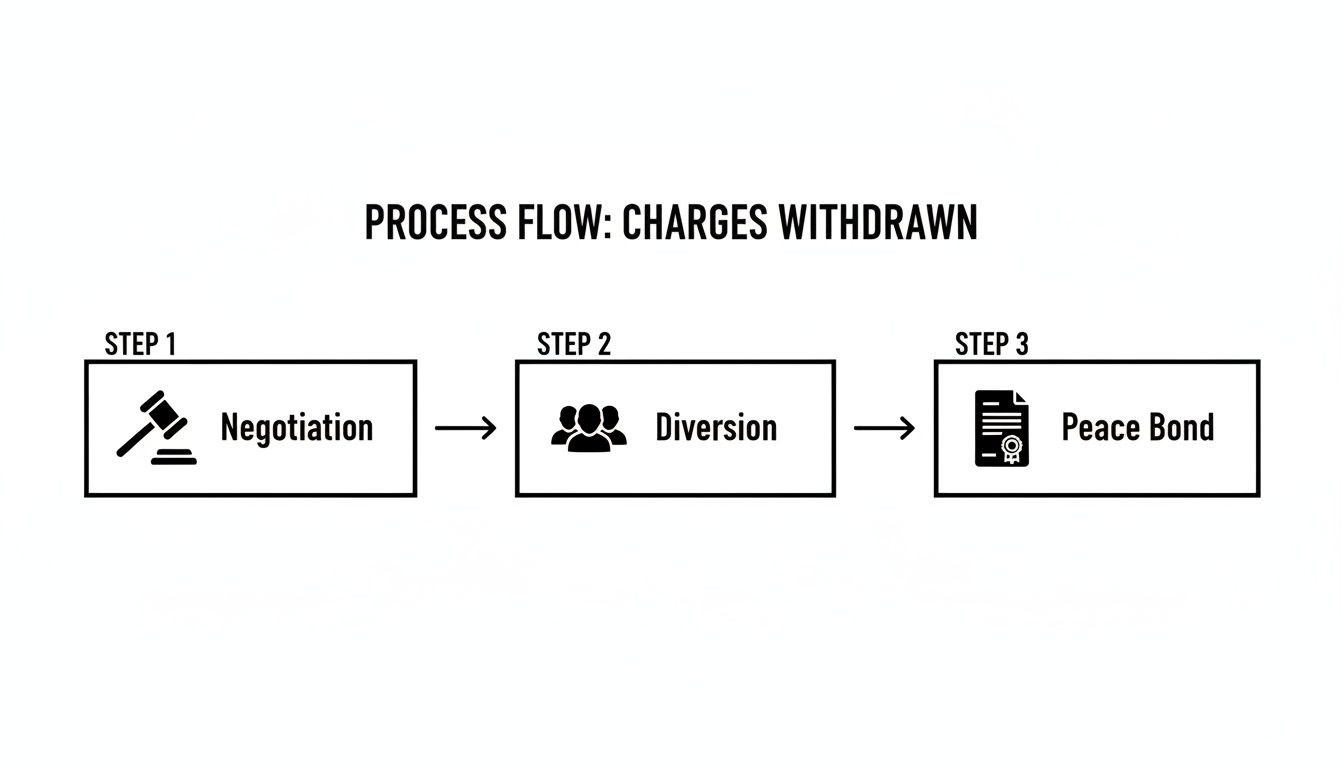
As you can see, a trial is not the only outcome. Often, the best results are achieved through strategic negotiation or alternative programs long before a case reaches a courtroom.
Remember, a bail hearing is not about proving your innocence. It is solely about determining whether you can be released back into the community while your case proceeds. A solid release plan, often involving a surety (a friend or family member who agrees to supervise you), is key to securing your release and fighting your charges from home.
By staying silent, calling your lawyer immediately, and focusing on a strong bail plan, you protect your rights and position yourself for the best possible outcome.
Negotiating a Withdrawal with the Crown
While many people associate criminal law with dramatic courtroom battles, the reality is that a significant number of cases in Brampton are resolved through quiet, strategic negotiation between a defence lawyer and the Crown Attorney. This behind-the-scenes work is where a skilled Brampton criminal defence lawyer can often secure the best possible result: a complete withdrawal of the charges.
This process begins with a fundamental legal principle: the Crown bears the burden of proof. It is their responsibility to prove every element of the alleged offence beyond a reasonable doubt, and it is your lawyer's job to show them precisely why they cannot meet this high standard.
The Two Pillars of Crown Discretion
In Ontario, every Crown Attorney must apply a two-part test before proceeding with a prosecution. A charge only moves forward if the answer to both of these questions is "yes":
-
Is there a Reasonable Prospect of Conviction (RPC)? Based on the available evidence, is there a realistic chance that a judge or jury would convict? This isn't about mere possibility, but a genuine likelihood of success at trial.
-
Is a Prosecution in the Public Interest? Even with a strong case, the Crown must consider if pursuing a trial is the right course of action. They weigh factors like the seriousness of the offence, the harm caused, and whether an alternative resolution might better serve the community.
Your lawyer's entire negotiation strategy is designed to convince the Crown that the answer to one or both of these questions is "no."
Finding the Cracks in the Crown’s Case
After your first court appearance, your lawyer receives the "disclosure" package—all the evidence the police have gathered against you. This may include police notes, witness statements, videos, breathalyzer results, and photographs.
A detail-oriented Brampton criminal defence lawyer meticulously analyzes this disclosure, searching for weaknesses that undermine the Crown's case. They look for issues such as:
-
Charter Rights Violations: Did police conduct an illegal search of your person or vehicle? Did they fail to inform you of your right to counsel upon arrest? Any breach of your rights under the Canadian Charter of Rights and Freedoms can lead to crucial evidence being excluded.
-
Unreliable Witnesses: Do witness statements contradict one another? Does a key witness have a motive to lie? A case built on shaky testimony is inherently weak.
-
Procedural Errors: Did the police make critical mistakes when collecting evidence? For example, in a DUI case, were there issues with how breath samples were administered, or was the testing device properly calibrated?
By methodically identifying these flaws and presenting them to the prosecutor in a persuasive legal argument, your lawyer can shift the negotiation from discussing a plea deal to questioning the viability of the case itself.
The unique legal landscape in Peel Region also plays a role. Brampton's rapid growth has led to a high volume of cases, and local legal professionals understand the specific pressures and dynamics of the courthouse. For more information on local trends, you can explore resources like toronto-criminallawyer.ca.
Ultimately, convincing the Crown to withdraw a charge is a blend of legal reasoning, evidence analysis, and strategic negotiation. When your lawyer demonstrates that the evidence is flimsy, police conduct was improper, or a prosecution simply does not serve the public interest, a withdrawal becomes the most logical and just outcome.
What About Diversion or a Peace Bond? Your Path Away from a Criminal Record
The primary objective is not always to go to trial. For many individuals, the most strategic path is an alternative resolution that prevents a criminal conviction from ever appearing on their record. A skilled Brampton criminal defence lawyer has two powerful tools to achieve this: diversion programs and peace bonds.
These options serve as strategic off-ramps from the formal court system, protecting your future while avoiding the risk and stress of a trial. While negotiations often focus on demonstrating the weakness of the Crown's case, these alternatives provide a practical solution when the Crown has a viable case but agrees that a trial is not in the public interest.
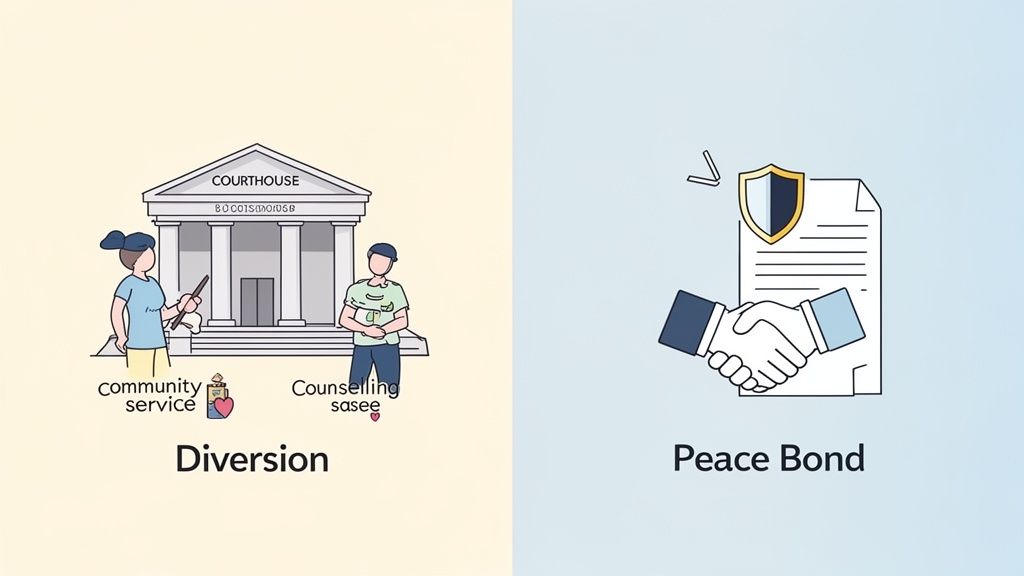
Understanding Diversion Programs
Diversion diverts your case out of the formal court process and towards a more constructive resolution. In Ontario, this is often handled through the Direct Accountability Program (DAP), also known as "alternative measures." This program is typically reserved for individuals with no prior criminal record who are facing minor charges.
The concept is simple: instead of prosecuting you, the Crown Attorney agrees to withdraw the charge entirely once you complete specific tasks. This is not a punishment, but an opportunity to take responsibility and demonstrate an understanding of the situation.
Common diversion conditions include:
-
Making a donation to an approved local charity.
-
Completing a set number of community service hours.
-
Writing a letter of apology to the affected party.
-
Attending counselling or an educational program, such as anger management or substance abuse awareness.
Upon successful completion and proof of compliance, the charge is formally withdrawn. The result is no criminal record and no finding of guilt.
The Strategic Value of a Peace Bond
Another powerful tool is the peace bond, outlined in Section 810 of the Criminal Code. A peace bond is a promise made to a judge to "keep the peace and be of good behaviour" for a specified period, usually 12 months. It is most commonly used to resolve cases involving interpersonal conflict, such as minor domestic assaults, uttering threats, or criminal harassment.
Crucially, agreeing to a peace bond is not an admission of guilt. You are not pleading guilty. You are simply acknowledging that another person has a reasonable fear of you and agreeing to follow certain rules to alleviate that fear.
When your Brampton criminal defence lawyer negotiates a peace bond, it represents a significant strategic victory. In exchange for your agreement to the bond's conditions, the Crown withdraws the criminal charge. Your case is concluded, and you avoid a criminal record. This is particularly relevant in domestic cases that may also involve proceedings under Ontario's Family Law Act, as it resolves the criminal matter without a finding of guilt that could impact family court decisions.
Typical peace bond conditions may include:
-
No Contact: You cannot communicate, directly or indirectly, with the complainant.
-
Stay Away: You must maintain a certain distance from their home, workplace, or other specified locations.
-
Weapons Ban: You may be required to surrender any firearms and are prohibited from possessing weapons.
-
Counselling: You might be required to attend counselling for relevant issues.
For anyone facing charges that could impact their family, employment, or immigration status, a peace bond is often an excellent outcome. While it is a public court order, it is far preferable to a criminal record.
Challenging the Evidence to Force a Withdrawal
While negotiation is often a prudent strategy, sometimes the most effective defence is an aggressive one. The most direct way to get charges dropped is often to dismantle the Crown’s case by exposing its flaws. When your Brampton criminal defence lawyer can demonstrate that the case is unwinnable, a withdrawal becomes the Crown's only logical option.
The objective is to expose fatal weaknesses in the evidence so early in the process that the Crown Attorney recognizes there is no reasonable prospect of conviction. The Crown has a duty to avoid wasting judicial resources on a case they cannot prove. This strategy involves placing the police investigation under a legal microscope, where every action and every piece of evidence is scrutinized.
A Case Study in Evidence Challenges: Impaired Driving
Impaired driving cases provide a clear example of this approach. Evidence like a breathalyzer reading may seem conclusive, but a lawyer specializing in these complex cases knows where to look for vulnerabilities.
An entire impaired driving case can collapse when the right questions are asked:
-
The Legality of the Traffic Stop: Did the police have a lawful reason to pull you over? If the stop was based on a hunch or was discriminatory, it constitutes a violation of your Charter rights, and all subsequent evidence may be excluded.
-
Breath Demand Procedures: Did the officer have the "reasonable suspicion" legally required to demand a roadside breath sample? Crucially, were you informed of your right to speak with a lawyer before providing evidential breath samples at the station? Police must follow these procedures perfectly; any mistake can render the breath readings inadmissible.
-
Instrument Maintenance and Operation: Was the breathalyzer (the "Approved Instrument") properly calibrated and maintained? Your lawyer will demand maintenance logs to identify any issues that could make the readings unreliable.
This deep dive into procedural and technical details can completely change the outcome of a seemingly open-and-shut case.
The stakes are incredibly high in these cases. Impaired driving charges are common in Peel Region and carry severe consequences, including an immediate 90-day administrative licence suspension in Ontario, on top of Criminal Code penalties. You can find more information on local trends at masstsang.com.
Applying the Same Strategy to Other Charges
This forensic, evidence-first approach applies to all criminal charges. A skilled Brampton criminal defence lawyer will always seek to find the weak link in the Crown's evidence.
Consider how this strategy works in other common scenarios:
-
Theft or Shoplifting: A case may hinge on grainy security footage. Your lawyer will challenge its quality and ask: Can the person be identified beyond a reasonable doubt? Does the video show all the necessary elements of a theft?
-
Fraud Charges: These cases are often built on a complex paper trail. An experienced lawyer will meticulously review financial records, emails, and contracts to find errors, inconsistencies, or innocent explanations that undermine the Crown's theory of deceit.
-
Assault Charges: These cases frequently come down to one person's word against another's. Your lawyer will dissect every statement, searching for contradictions, biases, or motives that challenge the credibility of the Crown's witnesses.
By systematically exposing these weaknesses, your lawyer builds a compelling argument that there is no "reasonable prospect of conviction." Faced with a case likely to fail in court, the Crown is often compelled to withdraw the charge.
Why a Local Brampton Lawyer is Your Greatest Asset
When you are facing criminal charges, the lawyer you choose can make all the difference. While any qualified lawyer can represent you, one who is deeply embedded in the local legal community brings a powerful strategic advantage. Hiring a Brampton criminal defence lawyer is not just about convenience; it is about leveraging insider knowledge that can directly impact the outcome of your case.
The Brampton courthouse has its own unique ecosystem, with its own procedures, personalities, and unwritten rules. A local lawyer navigates this environment daily. They have established professional relationships with the Crown Attorneys who are prosecuting your case and understand the judicial philosophies of the judges who may preside over it.
This familiarity fosters efficiency and insight. A local lawyer knows how specific Crown prosecutors prefer to negotiate and which legal arguments are most persuasive with particular judges. This makes critical discussions about withdrawals, peace bonds, and diversion programs far more effective from the outset.
The Home Court Advantage
A lawyer who is a regular presence at the Brampton courthouse understands the local nuances that can make or break a defence. They know which alternative programs in Peel Region are most suitable for specific offences and how to best position a client as an ideal candidate. This home-court advantage translates directly into a more intelligent and targeted defence strategy for you.
Your case is not just a file number; it is a local matter being handled by local justice system participants. A lawyer who understands the Brampton context can navigate your case with a level of foresight that an outsider cannot provide.
This deep local expertise allows your lawyer to anticipate the Crown’s moves and build a proactive defence tailored to the realities of the Brampton court. It is this intimate knowledge of the people and processes that elevates a standard defence into a highly effective one.
At Badesha Law, our team is immersed in the Brampton legal system. We are dedicated to using our deep local experience to protect your rights and secure the best possible outcome. If you are facing charges, do not leave your future to chance. Contact our Brampton office today for a confidential consultation and let our local expertise become your greatest asset.
Got Questions About Your Brampton Criminal Charges?
Facing the justice system in Brampton can be confusing and overwhelming. Here are straightforward answers to some of the most common questions we hear.
If The Victim Wants to Drop The Charges, Does The Case Go Away?
This is one of the biggest misconceptions in criminal law. In Canada, once charges are laid, the decision to proceed rests solely with the Crown Attorney, not the complainant (the person who made the complaint). Therefore, a complainant cannot "drop the charges," even if they wish to.
However, a reluctant complainant significantly weakens the Crown's case. An experienced Brampton criminal defence lawyer can leverage this situation by arguing to the Crown that there is no longer a reasonable prospect of conviction, which often leads to the charge being withdrawn.
Will My Charges Be Dropped Automatically If The Police Didn't Read Me My Rights?
Not automatically, but it is a serious issue. A failure to inform you of your right to speak with a lawyer upon arrest is a significant violation of your rights under the Canadian Charter of Rights and Freedoms. While this does not make the charge disappear on its own, it provides your lawyer with a powerful tool.
Your lawyer can file a Charter application arguing that your rights were breached. If successful, a judge can exclude any evidence obtained after the violation, such as a statement you made or the results of a breathalyzer test. If this excluded evidence was central to their case, the Crown may be forced to withdraw the charge.
A Charter violation provides one of the strongest grounds for a defence. A successful Charter application can dismantle the Crown's entire case before a trial even begins.
How Long Does It Take to Get Criminal Charges Dropped in Brampton?
There is no single timeline, as every case is unique. For simpler matters, a charge may be withdrawn at the first or second court appearance, which could be within a few weeks or months.
More complex cases, however, take longer. They require in-depth evidence review, legal research, and careful negotiation with the Crown. A proactive Brampton criminal defence lawyer who knows the local system can help move things along, but building a strong, thorough defence takes time.
Is Resolving My Case Without a Trial Cheaper?
Yes, almost always. Securing a withdrawal, negotiating a peace bond, or entering a diversion program is far more cost-effective than preparing for a full trial. Trials are expensive due to the extensive preparation, witness interviews, and multiple days required in court, all of which contribute to higher legal fees.
By investing in an experienced lawyer to negotiate a favourable resolution early on, you can save a significant amount of money and stress while protecting your criminal record.
When you’re facing the uncertainty of a criminal charge, getting clear answers is the first step toward taking back control. The team at Badesha Law has the local knowledge and strategic skill to guide you through the Brampton court system and fight for the best possible outcome. To talk about your specific situation in a confidential consultation, contact our Brampton office today.