How to Get Criminal Charges Dropped in Ontario: A Brampton Guide

Being charged with a criminal offence can feel overwhelming, but it is crucial to understand that a charge is not a conviction. In Ontario, many cases are resolved without a trial and without a criminal record, thanks to the strategic and early intervention of a skilled legal professional. Your most powerful ally in this process is an experienced Brampton criminal defence lawyer whose primary goal is to achieve the best possible outcome for you—ideally, a complete withdrawal of the charges.

Your Guide to Getting Criminal Charges Withdrawn in Brampton

Facing a criminal charge in Brampton initiates a legal process governed by Canada's Criminal Code, but this journey has several potential exits before a trial becomes necessary. The Canadian justice system provides multiple avenues for resolving a case without a guilty plea. The ultimate goal is to demonstrate to the Crown Attorney that proceeding with the prosecution is not in the public interest, or that their case is too weak to secure a conviction.

Getting charges dropped isn't about finding a secret loophole; it's about building a methodical, professional defence from the very beginning. From the moment of your arrest, every detail matters. A diligent Brampton criminal defence lawyer begins by meticulously reviewing the police evidence—known as "disclosure"—to identify weaknesses, procedural errors, or violations of your rights under the Canadian Charter of Rights and Freedoms. This initial analysis is the foundation of a successful withdrawal strategy.

Key Pathways to a Favourable Resolution

For many individuals, especially first-time offenders facing less serious allegations, the path to a withdrawal often involves alternative measures. These options acknowledge that a full prosecution is not always the most just or effective solution. The most common routes include:

  • Direct Negotiations with the Crown: Your lawyer engages directly with the prosecutor, presenting legal arguments that highlight flaws in the case and advocate for a withdrawal.

  • Diversion Programs: For minor offences, the Crown may agree to drop the charges if you complete specific conditions, such as counselling, community service, or making a charitable donation.

  • Peace Bonds: In cases involving interpersonal conflicts (such as minor assaults or threats), you might agree to specific conditions—like having no contact with the complainant—for a set period. In exchange, the charge is withdrawn. This is not an admission of guilt.

A common misconception is that the person who called the police can simply "drop the charges." In Canada, only the Crown Attorney has the authority to withdraw a criminal charge. However, the complainant's wishes are a significant factor, and your lawyer can leverage their position to strengthen negotiations.

The legal system offers several ways to resolve a case while protecting your future. Here is a brief overview of the most common methods a Brampton criminal defence lawyer will explore to keep a conviction off your record.

Resolution Method What It Involves Best For Final Outcome
Crown Withdrawal Your lawyer convinces the prosecutor that the case is weak or not in the public interest to pursue. Cases with legal/factual flaws, Charter breaches, or uncooperative complainants. Charges are completely dropped. No criminal record.
Diversion Completing agreed-upon tasks (e.g., counselling, community service) in exchange for withdrawal. Minor, non-violent offences, especially for first-time offenders. Charges are withdrawn upon completion. No criminal record.
Peace Bond Agreeing to court-ordered conditions (e.g., no-contact, stay away) for up to 12 months. Interpersonal disputes like minor assaults or threats. Charges are withdrawn. No criminal record, but the bond is public.
Absolute Discharge The court finds you guilty but doesn't register a conviction. Cases where guilt is clear but a record would be overly harsh. No conviction is registered. Your record remains clear after one year.

Choosing the right path requires a unique strategy tailored to the specific details of your case. Ultimately, getting charges dropped in Brampton depends on a proactive and intelligent defence strategy. An experienced Brampton criminal defence lawyer understands how to navigate these options to protect your record and your future. Acting quickly and seeking professional legal advice from the outset is key.

The First 48 Hours: Your Critical Next Steps

The moments immediately following an arrest are often a blur of confusion and stress. However, the actions you take within these first 48 hours can significantly influence the trajectory of your case. This is a critical time to act strategically, not to try and explain your side of the story to the police. Your best defence begins now.

Your most powerful tool is guaranteed by the Canadian Charter of Rights and Freedoms: the right to remain silent. Police are trained investigators, and anything you say can be used to build a case against you. Your only obligation is to politely state that you wish to remain silent and want to speak with your lawyer.

Securing Legal Counsel from Custody

Upon arrest, police must provide you with a reasonable opportunity to contact a lawyer. When you make that crucial call to a Brampton criminal defence lawyer, be prepared to provide key details clearly and concisely:

  • Your full name and the police station where you are being held.

  • The specific charges you are facing, as you understand them.

  • The arresting officer’s name or badge number, if you have it.

  • Whether you have a prior criminal record.

This essential information allows your lawyer to start protecting your rights immediately, provide crucial advice on handling further police questioning, and begin working on your release.

The Immediate Goal: Securing Your Release

Your lawyer's first priority is preparing for your bail hearing, which typically occurs within 24 hours of your arrest. The objective is to convince the court that you can be trusted to attend future court dates and do not pose a danger to the public. This is where having a lawyer who is intimately familiar with the Brampton court system provides a significant advantage.

The courthouses in Peel Region are notoriously busy. A local Brampton criminal defence lawyer navigates this environment daily, handling urgent bail hearings for a wide range of offences. This constant exposure means they understand what the Brampton Crown and judiciary look for when considering bail. They know how to act quickly, review initial evidence, and start early discussions with the Crown. You can find more Brampton criminal defence insights on local legal trends.

This flowchart illustrates the primary paths your lawyer will explore to get your charges dropped after you are released.
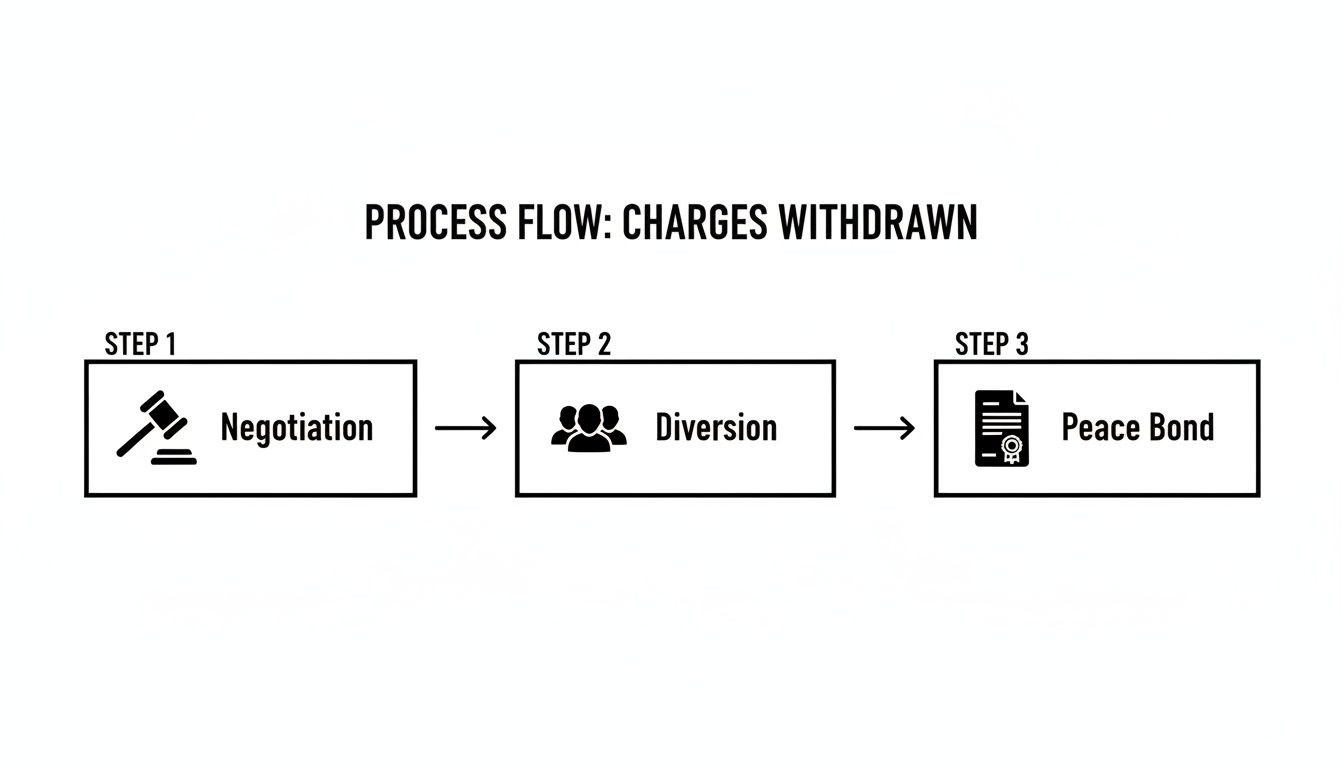
A flowchart illustrates the process for charges being withdrawn: Negotiation, Diversion, Peace Bond.

As you can see, a trial is not the only outcome. Often, the best results are achieved through strategic negotiation or alternative programs long before a case reaches a courtroom.

Remember, a bail hearing is not about proving your innocence. It is solely about determining whether you can be released back into the community while your case proceeds. A solid release plan, often involving a surety (a friend or family member who agrees to supervise you), is key to securing your release and fighting your charges from home.

By staying silent, calling your lawyer immediately, and focusing on a strong bail plan, you protect your rights and position yourself for the best possible outcome.

Negotiating a Withdrawal with the Crown

While many people associate criminal law with dramatic courtroom battles, the reality is that a significant number of cases in Brampton are resolved through quiet, strategic negotiation between a defence lawyer and the Crown Attorney. This behind-the-scenes work is where a skilled Brampton criminal defence lawyer can often secure the best possible result: a complete withdrawal of the charges.
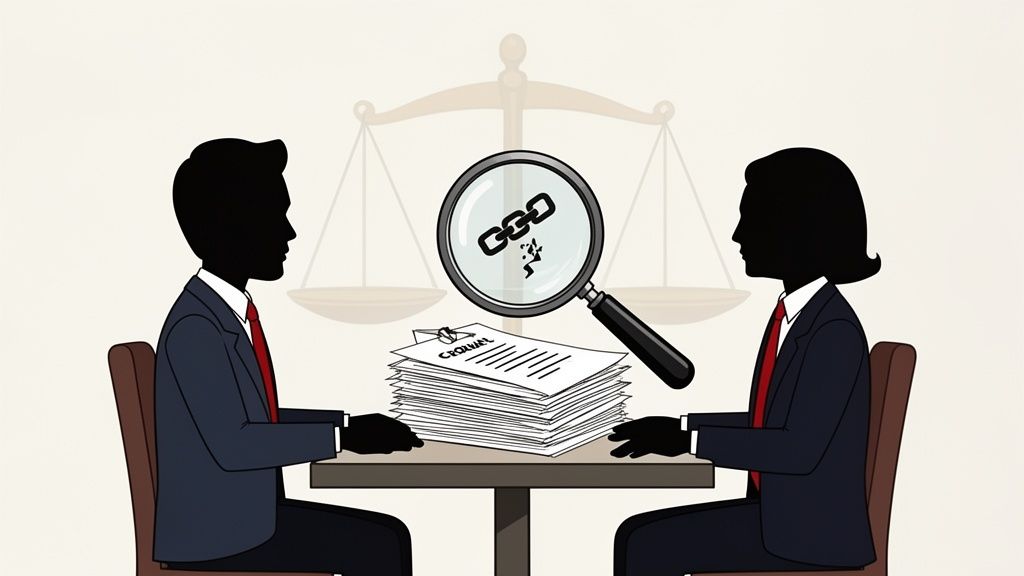
Two lawyers reviewing criminal documents, with a magnifying glass highlighting a broken chain link and scales of justice.

This process begins with a fundamental legal principle: the Crown bears the burden of proof. It is their responsibility to prove every element of the alleged offence beyond a reasonable doubt, and it is your lawyer's job to show them precisely why they cannot meet this high standard.

The Two Pillars of Crown Discretion

In Ontario, every Crown Attorney must apply a two-part test before proceeding with a prosecution. A charge only moves forward if the answer to both of these questions is "yes":

  1. Is there a Reasonable Prospect of Conviction (RPC)? Based on the available evidence, is there a realistic chance that a judge or jury would convict? This isn't about mere possibility, but a genuine likelihood of success at trial.

  2. Is a Prosecution in the Public Interest? Even with a strong case, the Crown must consider if pursuing a trial is the right course of action. They weigh factors like the seriousness of the offence, the harm caused, and whether an alternative resolution might better serve the community.

Your lawyer's entire negotiation strategy is designed to convince the Crown that the answer to one or both of these questions is "no."

Finding the Cracks in the Crown’s Case

After your first court appearance, your lawyer receives the "disclosure" package—all the evidence the police have gathered against you. This may include police notes, witness statements, videos, breathalyzer results, and photographs.

A detail-oriented Brampton criminal defence lawyer meticulously analyzes this disclosure, searching for weaknesses that undermine the Crown's case. They look for issues such as:

  • Charter Rights Violations: Did police conduct an illegal search of your person or vehicle? Did they fail to inform you of your right to counsel upon arrest? Any breach of your rights under the Canadian Charter of Rights and Freedoms can lead to crucial evidence being excluded.

  • Unreliable Witnesses: Do witness statements contradict one another? Does a key witness have a motive to lie? A case built on shaky testimony is inherently weak.

  • Procedural Errors: Did the police make critical mistakes when collecting evidence? For example, in a DUI case, were there issues with how breath samples were administered, or was the testing device properly calibrated?

By methodically identifying these flaws and presenting them to the prosecutor in a persuasive legal argument, your lawyer can shift the negotiation from discussing a plea deal to questioning the viability of the case itself.

The unique legal landscape in Peel Region also plays a role. Brampton's rapid growth has led to a high volume of cases, and local legal professionals understand the specific pressures and dynamics of the courthouse. For more information on local trends, you can explore resources like toronto-criminallawyer.ca.

Ultimately, convincing the Crown to withdraw a charge is a blend of legal reasoning, evidence analysis, and strategic negotiation. When your lawyer demonstrates that the evidence is flimsy, police conduct was improper, or a prosecution simply does not serve the public interest, a withdrawal becomes the most logical and just outcome.

What About Diversion or a Peace Bond? Your Path Away from a Criminal Record

The primary objective is not always to go to trial. For many individuals, the most strategic path is an alternative resolution that prevents a criminal conviction from ever appearing on their record. A skilled Brampton criminal defence lawyer has two powerful tools to achieve this: diversion programs and peace bonds.

These options serve as strategic off-ramps from the formal court system, protecting your future while avoiding the risk and stress of a trial. While negotiations often focus on demonstrating the weakness of the Crown's case, these alternatives provide a practical solution when the Crown has a viable case but agrees that a trial is not in the public interest.
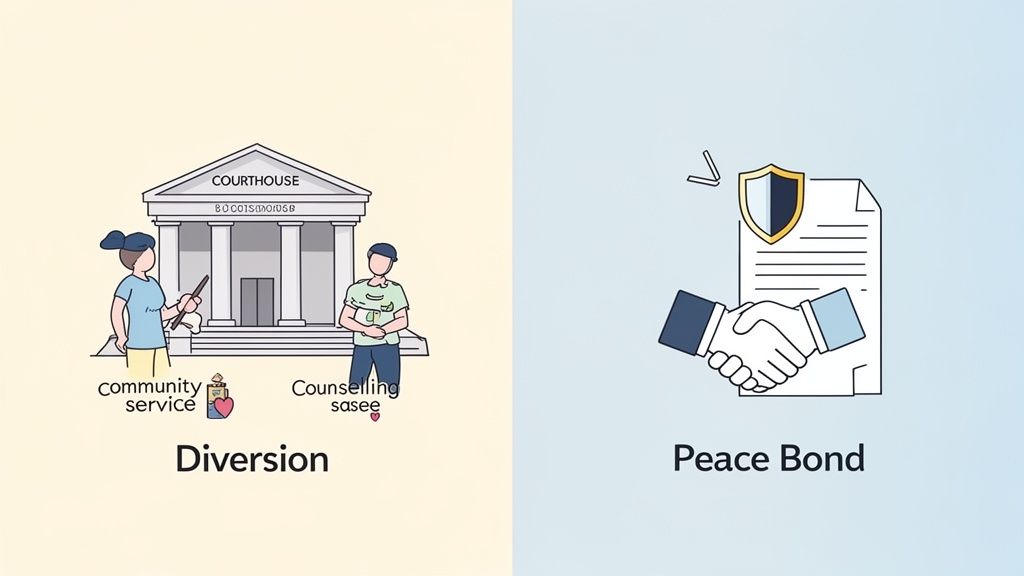
Illustration comparing criminal diversion programs like community service and counselling with peace bonds.

Understanding Diversion Programs

Diversion diverts your case out of the formal court process and towards a more constructive resolution. In Ontario, this is often handled through the Direct Accountability Program (DAP), also known as "alternative measures." This program is typically reserved for individuals with no prior criminal record who are facing minor charges.

The concept is simple: instead of prosecuting you, the Crown Attorney agrees to withdraw the charge entirely once you complete specific tasks. This is not a punishment, but an opportunity to take responsibility and demonstrate an understanding of the situation.

Common diversion conditions include:

  • Making a donation to an approved local charity.

  • Completing a set number of community service hours.

  • Writing a letter of apology to the affected party.

  • Attending counselling or an educational program, such as anger management or substance abuse awareness.

Upon successful completion and proof of compliance, the charge is formally withdrawn. The result is no criminal record and no finding of guilt.

The Strategic Value of a Peace Bond

Another powerful tool is the peace bond, outlined in Section 810 of the Criminal Code. A peace bond is a promise made to a judge to "keep the peace and be of good behaviour" for a specified period, usually 12 months. It is most commonly used to resolve cases involving interpersonal conflict, such as minor domestic assaults, uttering threats, or criminal harassment.

Crucially, agreeing to a peace bond is not an admission of guilt. You are not pleading guilty. You are simply acknowledging that another person has a reasonable fear of you and agreeing to follow certain rules to alleviate that fear.

When your Brampton criminal defence lawyer negotiates a peace bond, it represents a significant strategic victory. In exchange for your agreement to the bond's conditions, the Crown withdraws the criminal charge. Your case is concluded, and you avoid a criminal record. This is particularly relevant in domestic cases that may also involve proceedings under Ontario's Family Law Act, as it resolves the criminal matter without a finding of guilt that could impact family court decisions.

Typical peace bond conditions may include:

  • No Contact: You cannot communicate, directly or indirectly, with the complainant.

  • Stay Away: You must maintain a certain distance from their home, workplace, or other specified locations.

  • Weapons Ban: You may be required to surrender any firearms and are prohibited from possessing weapons.

  • Counselling: You might be required to attend counselling for relevant issues.

For anyone facing charges that could impact their family, employment, or immigration status, a peace bond is often an excellent outcome. While it is a public court order, it is far preferable to a criminal record.

Challenging the Evidence to Force a Withdrawal

While negotiation is often a prudent strategy, sometimes the most effective defence is an aggressive one. The most direct way to get charges dropped is often to dismantle the Crown’s case by exposing its flaws. When your Brampton criminal defence lawyer can demonstrate that the case is unwinnable, a withdrawal becomes the Crown's only logical option.

The objective is to expose fatal weaknesses in the evidence so early in the process that the Crown Attorney recognizes there is no reasonable prospect of conviction. The Crown has a duty to avoid wasting judicial resources on a case they cannot prove. This strategy involves placing the police investigation under a legal microscope, where every action and every piece of evidence is scrutinized.

A Case Study in Evidence Challenges: Impaired Driving

Impaired driving cases provide a clear example of this approach. Evidence like a breathalyzer reading may seem conclusive, but a lawyer specializing in these complex cases knows where to look for vulnerabilities.

An entire impaired driving case can collapse when the right questions are asked:

  • The Legality of the Traffic Stop: Did the police have a lawful reason to pull you over? If the stop was based on a hunch or was discriminatory, it constitutes a violation of your Charter rights, and all subsequent evidence may be excluded.

  • Breath Demand Procedures: Did the officer have the "reasonable suspicion" legally required to demand a roadside breath sample? Crucially, were you informed of your right to speak with a lawyer before providing evidential breath samples at the station? Police must follow these procedures perfectly; any mistake can render the breath readings inadmissible.

  • Instrument Maintenance and Operation: Was the breathalyzer (the "Approved Instrument") properly calibrated and maintained? Your lawyer will demand maintenance logs to identify any issues that could make the readings unreliable.

This deep dive into procedural and technical details can completely change the outcome of a seemingly open-and-shut case.

The stakes are incredibly high in these cases. Impaired driving charges are common in Peel Region and carry severe consequences, including an immediate 90-day administrative licence suspension in Ontario, on top of Criminal Code penalties. You can find more information on local trends at masstsang.com.

Applying the Same Strategy to Other Charges

This forensic, evidence-first approach applies to all criminal charges. A skilled Brampton criminal defence lawyer will always seek to find the weak link in the Crown's evidence.

Consider how this strategy works in other common scenarios:

  • Theft or Shoplifting: A case may hinge on grainy security footage. Your lawyer will challenge its quality and ask: Can the person be identified beyond a reasonable doubt? Does the video show all the necessary elements of a theft?

  • Fraud Charges: These cases are often built on a complex paper trail. An experienced lawyer will meticulously review financial records, emails, and contracts to find errors, inconsistencies, or innocent explanations that undermine the Crown's theory of deceit.

  • Assault Charges: These cases frequently come down to one person's word against another's. Your lawyer will dissect every statement, searching for contradictions, biases, or motives that challenge the credibility of the Crown's witnesses.

By systematically exposing these weaknesses, your lawyer builds a compelling argument that there is no "reasonable prospect of conviction." Faced with a case likely to fail in court, the Crown is often compelled to withdraw the charge.

Why a Local Brampton Lawyer is Your Greatest Asset

When you are facing criminal charges, the lawyer you choose can make all the difference. While any qualified lawyer can represent you, one who is deeply embedded in the local legal community brings a powerful strategic advantage. Hiring a Brampton criminal defence lawyer is not just about convenience; it is about leveraging insider knowledge that can directly impact the outcome of your case.

The Brampton courthouse has its own unique ecosystem, with its own procedures, personalities, and unwritten rules. A local lawyer navigates this environment daily. They have established professional relationships with the Crown Attorneys who are prosecuting your case and understand the judicial philosophies of the judges who may preside over it.

This familiarity fosters efficiency and insight. A local lawyer knows how specific Crown prosecutors prefer to negotiate and which legal arguments are most persuasive with particular judges. This makes critical discussions about withdrawals, peace bonds, and diversion programs far more effective from the outset.

The Home Court Advantage

A lawyer who is a regular presence at the Brampton courthouse understands the local nuances that can make or break a defence. They know which alternative programs in Peel Region are most suitable for specific offences and how to best position a client as an ideal candidate. This home-court advantage translates directly into a more intelligent and targeted defence strategy for you.

Your case is not just a file number; it is a local matter being handled by local justice system participants. A lawyer who understands the Brampton context can navigate your case with a level of foresight that an outsider cannot provide.

This deep local expertise allows your lawyer to anticipate the Crown’s moves and build a proactive defence tailored to the realities of the Brampton court. It is this intimate knowledge of the people and processes that elevates a standard defence into a highly effective one.

At Badesha Law, our team is immersed in the Brampton legal system. We are dedicated to using our deep local experience to protect your rights and secure the best possible outcome. If you are facing charges, do not leave your future to chance. Contact our Brampton office today for a confidential consultation and let our local expertise become your greatest asset.

Got Questions About Your Brampton Criminal Charges?

Facing the justice system in Brampton can be confusing and overwhelming. Here are straightforward answers to some of the most common questions we hear.

If The Victim Wants to Drop The Charges, Does The Case Go Away?

This is one of the biggest misconceptions in criminal law. In Canada, once charges are laid, the decision to proceed rests solely with the Crown Attorney, not the complainant (the person who made the complaint). Therefore, a complainant cannot "drop the charges," even if they wish to.

However, a reluctant complainant significantly weakens the Crown's case. An experienced Brampton criminal defence lawyer can leverage this situation by arguing to the Crown that there is no longer a reasonable prospect of conviction, which often leads to the charge being withdrawn.

Will My Charges Be Dropped Automatically If The Police Didn't Read Me My Rights?

Not automatically, but it is a serious issue. A failure to inform you of your right to speak with a lawyer upon arrest is a significant violation of your rights under the Canadian Charter of Rights and Freedoms. While this does not make the charge disappear on its own, it provides your lawyer with a powerful tool.

Your lawyer can file a Charter application arguing that your rights were breached. If successful, a judge can exclude any evidence obtained after the violation, such as a statement you made or the results of a breathalyzer test. If this excluded evidence was central to their case, the Crown may be forced to withdraw the charge.

A Charter violation provides one of the strongest grounds for a defence. A successful Charter application can dismantle the Crown's entire case before a trial even begins.

How Long Does It Take to Get Criminal Charges Dropped in Brampton?

There is no single timeline, as every case is unique. For simpler matters, a charge may be withdrawn at the first or second court appearance, which could be within a few weeks or months.

More complex cases, however, take longer. They require in-depth evidence review, legal research, and careful negotiation with the Crown. A proactive Brampton criminal defence lawyer who knows the local system can help move things along, but building a strong, thorough defence takes time.

Is Resolving My Case Without a Trial Cheaper?

Yes, almost always. Securing a withdrawal, negotiating a peace bond, or entering a diversion program is far more cost-effective than preparing for a full trial. Trials are expensive due to the extensive preparation, witness interviews, and multiple days required in court, all of which contribute to higher legal fees.

By investing in an experienced lawyer to negotiate a favourable resolution early on, you can save a significant amount of money and stress while protecting your criminal record.


When you’re facing the uncertainty of a criminal charge, getting clear answers is the first step toward taking back control. The team at Badesha Law has the local knowledge and strategic skill to guide you through the Brampton court system and fight for the best possible outcome. To talk about your specific situation in a confidential consultation, contact our Brampton office today.

Best Criminal Defense Law Firms in Brampton

When arrested in Brampton, having a criminal lawyer is essential as they serve as your immediate protector and strategic advisor. Their role begins the moment you contact them from custody, not just at a future court date. They ensure your rights are safeguarded, manage all communications with the police, and start building the foundation for your defence and release. **Badesha Law** is a firm that offers the necessary insights, focusing on your needs within the Brampton legal framework.

Your First Call After an Arrest in Brampton

Being arrested can be one of the most stressful and disorienting experiences of your life. The moments right after an arrest are chaotic, and the choices you make under pressure can have consequences that follow you for years. This is exactly what a criminal lawyer in Brampton from Badesha Law does—they step into that chaos to bring immediate clarity, direction, and protection, all while abiding by the Criminal Code of Canada.

The single most important piece of advice any lawyer will give you is to use your right to remain silent. Police are trained to gather information, and anything you say can—and often will—be used against you. Your lawyer acts as a necessary barrier, handling all communication with law enforcement for you. This simple step prevents you from accidentally weakening your case before it even gets off the ground.

Securing Your Release and Protecting Your Rights

From that very first phone call, a firm like Badesha Law starts advocating for you. Their immediate actions are laser-focused on two things: getting you out of custody and making sure your rights under the Canadian Charter of Rights and Freedoms are not being violated.

Here's what starts happening right away:

  • Bail Hearing Preparation: Your lawyer will immediately start gathering the information needed to build a strong release plan for a bail hearing. This means contacting potential sureties (people who can supervise you) and preparing arguments to convince the court that you are not a flight risk or a danger to the public.

  • Legal Counsel During Interrogation: If the police want to question you, your lawyer will be there to advise you. They make sure the questions are fair and that you don't say anything that could incriminate you.

  • Evidence Preservation: Your lawyer will put the police on notice about their duty to preserve all evidence, like surveillance video or witness statements, which could be critical to your defence down the road.

Your lawyer's first moves are often the most important. They take control of a situation that feels uncontrollable and ensure every action taken is a calculated step toward protecting you. Here’s a quick look at what those initial, critical steps involve when working with Badesha Law.

A Criminal Lawyer's Immediate Actions After Your Arrest

Action Why It's Critical for Your Defence
Assert Your Right to Silence Prevents you from making accidental admissions or statements that could be misinterpreted and used against you later.
Take Over Police Communication Acts as a professional buffer, ensuring all interactions are legally sound and protecting you from leading questions or pressure.
Start Bail Planning Gathers information on sureties and your community ties to argue for your release at the earliest opportunity, avoiding unnecessary time in custody.
Demand Disclosure Formally requests all evidence the police have against you, which is the first step in identifying weaknesses in the Crown's case.
Protect Evidence Instructs police to preserve crucial evidence (like security footage) that could prove your innocence but might otherwise be lost.

These initial actions are about damage control and strategy. By getting involved right away, your lawyer sets the tone for the entire case and ensures your rights are protected from the very beginning.

A criminal lawyer’s role begins long before they ever step into a courtroom. Their immediate intervention after an arrest is designed to control the narrative, protect your constitutional rights, and set the stage for a successful defence. This early engagement is often the difference between a quick release and prolonged custody.

Ultimately, that first call is to an advocate who knows the system inside and out. They make sure that from minute one, you are not alone, your voice is heard correctly, and every step taken is a strategic one aimed at achieving the best possible result for your case under both the Criminal Code of Canada and Ontario's laws.

How a Lawyer Guides You Through the Justice System

Trying to navigate the Canadian criminal justice system on your own is like being dropped into a foreign country without a map or a translator. Every turn is confusing, and a simple mistake can have massive consequences. This is exactly what a criminal lawyer in Brampton from Badesha Law does—they act as your expert guide, translating the complex legal landscape into a clear path forward for Brampton residents.

From the moment you hire them, they take control of the process. They make sure every deadline is met and every strategic opportunity is seized. Their job is to manage the legal chaos so you can focus on your life, bringing a sense of direction to a situation that feels completely out of your hands.

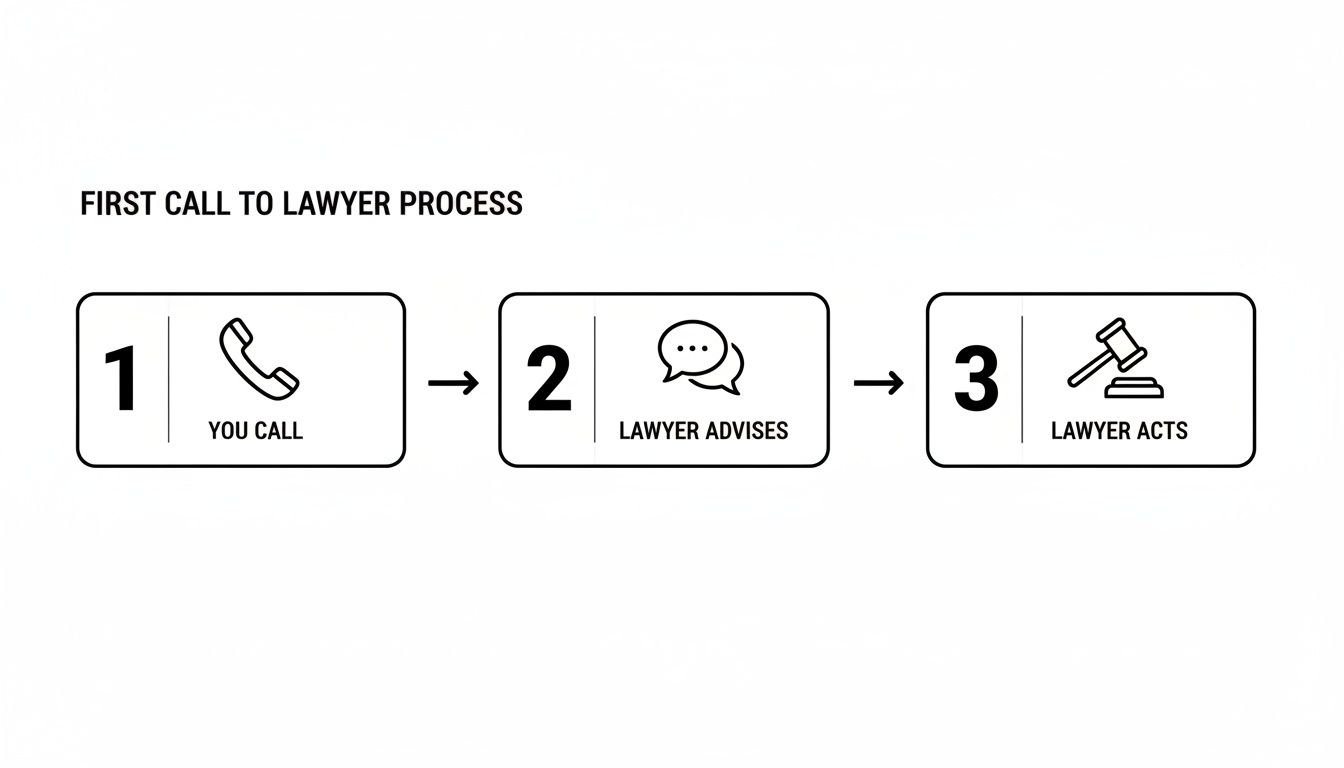
This simple diagram shows the powerful chain of events that your first call for help sets in motion.

A three-step process diagram illustrating the first call to a lawyer: you call, lawyer advises, lawyer acts.

As you can see, your one action—making that call—triggers a professional response designed to protect and defend you immediately.

Securing Your Freedom at a Bail Hearing

For most people facing charges in Brampton, the first and most urgent goal is getting out of jail. The bail hearing is your first formal court appearance, and its outcome is absolutely critical. Think of it as the first major hurdle in your legal marathon; getting you released is the top priority.

A lawyer's role here is to craft a compelling release plan for the court. This means:

  • Finding a Surety: They help identify a reliable friend or family member who can promise to supervise you and make sure you follow your bail conditions.

  • Arguing for Your Release: They present strong arguments that you are not a flight risk and pose no danger to the public, which are the main concerns under the Criminal Code of Canada.

Firms like Badesha Law have extensive experience putting these plans together quickly and effectively, which can dramatically increase your chances of being released while your case moves forward.

Uncovering the Case Against You Through Disclosure

Once you're out on bail, the next phase is the disclosure review. The Crown prosecutor is legally required to give your lawyer all the evidence they have against you. This "disclosure package" can include everything from police reports and witness statements to videos and forensic evidence.

Your lawyer then meticulously combs through every single page. They are hunting for inconsistencies, weaknesses in the evidence, or any violations of your Charter rights. This isn't just passive reading; it's a full-blown investigation. This evidence is the raw material from which your entire defence strategy is built.

Understanding the Crown’s case is the bedrock of any solid defence. Your lawyer’s detailed analysis of the disclosure is where they find the holes in the prosecution's story and build the leverage needed to negotiate a better outcome or win at trial.

Strategic Negotiations in Crown Pre-Trials

Not every criminal case ends up in a trial. In fact, many are resolved much earlier through negotiations during Crown Pre-Trials or Judicial Pre-Trials. These are private meetings where your lawyer sits down with the Crown prosecutor (and sometimes a judge) to discuss the case.

During these meetings, your lawyer uses the weaknesses they found in the disclosure to push for a better result. What does a criminal lawyer do here? They advocate for:

  • Withdrawing the charges entirely if the evidence is flimsy.

  • Resolving the matter with a peace bond, which is not a criminal conviction.

  • Getting the Crown to agree to a lesser charge with a more lenient sentence.

This negotiation stage is where a lawyer's experience and reputation can make all the difference. An experienced criminal lawyer in Brampton from Badesha Law who is familiar with the local Crown prosecutors is often in a much better position to achieve a favourable deal, saving you the stress and expense of a trial. Your lawyer turns confusing legal procedures into a series of clear choices, guiding you toward the best possible outcome at every step.

The Core Responsibilities of Your Defence Counsel

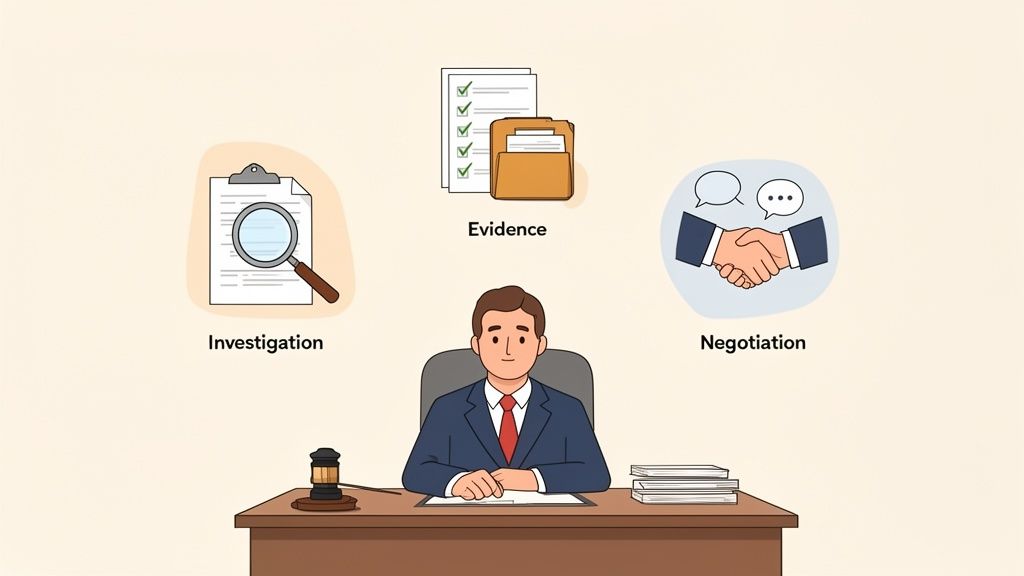
A cartoon showing a criminal lawyer at a desk with icons representing investigation, evidence, and negotiation.

Sure, a criminal lawyer shows up in court. But the real work—the stuff that wins cases—happens long before we ever see a judge. Think of it as the engine room of your defence, where meticulous preparation and sharp legal strategy are forged behind the scenes at a firm like Badesha Law.

In this stage, your lawyer wears many hats: investigator, strategist, and negotiator. Every role is dedicated to one thing: dismantling the Crown’s case piece by piece while building a rock-solid foundation for your defence. It’s this intense, behind-the-scenes effort that often gets charges withdrawn or reduced without ever needing to go to trial.

The Strategist Meticulously Analyzing Evidence

Once the Crown turns over its evidence, known as the "disclosure package," your lawyer gets to work. This isn't just about reading police reports; it’s about a deep-dive analysis, scrutinizing every detail for weaknesses, inconsistencies, and procedural mistakes. This is a critical part of the job.

A good defence lawyer is always asking tough questions:

  • Was the evidence legally obtained? We’re hunting for any violations of your rights under the Canadian Charter of Rights and Freedoms, like an unlawful search or an improper arrest.

  • Do witness statements contradict each other? Inconsistencies can destroy the credibility of the Crown’s most important witnesses.

  • Can we trust the physical evidence? We examine how evidence was collected and handled to see if there were breaks in the chain of custody that could compromise its integrity.

Every crack we find in the prosecution's case becomes a powerful tool—leverage we can use in negotiations or at trial.

The Investigator Building Your Defence

Your lawyer also acts as your personal investigator. We don't just take the police's version of events as fact. Instead, we actively work to uncover evidence that supports your side of the story.

This investigative work might include:

  • Interviewing witnesses who the police may have overlooked or who saw things differently.

  • Visiting the scene of the alleged incident to get a firsthand feel for the environment and context.

  • Hiring experts, like forensic specialists or toxicologists, to challenge the scientific evidence presented by the Crown.

At a firm like Badesha Law, this proactive approach is standard. Our criminal lawyers in Brampton know that a strong defence isn't just about reacting to the Crown—it’s about building an independent, thorough case that puts you in the best possible position.

The real work of a defence lawyer is often done long before a trial begins. It's in the careful review of disclosure, the strategic legal arguments, and the skillful negotiations that the most impactful victories are won. This diligent preparation is the cornerstone of effective representation.

The Negotiator Seeking a Favourable Resolution

In Canada, a huge number of criminal cases get resolved through negotiations, not a full-blown trial. This is where your lawyer's skill as a negotiator really shines. Armed with the weaknesses they’ve exposed in the Crown's case, they sit down with the prosecutor to push for a better outcome for you.

The intensity of a criminal lawyer's job, balancing investigation, court appearances, and constant negotiation, is immense. For example, a study on public defenders in California revealed they managed an average of 282 felony cases per year, far exceeding the recommended standard of 150. This highlights how skilled lawyers must be at managing high-stakes negotiations under extreme pressure to protect their clients' interests. You can learn more about the demanding caseloads criminal lawyers manage by reviewing the findings from the Deason Criminal Justice Reform Center.

A skilled negotiator from Badesha Law might seek resolutions such as:

  • Charge Withdrawal: Convincing the Crown to drop the charges entirely because their case is too weak.

  • Peace Bond: Agreeing to certain conditions (like "keeping the peace") for a set period, after which the charge is withdrawn, leaving you with no criminal record.

  • Plea to a Lesser Offence: Negotiating a guilty plea to a less serious charge that comes with a much lighter penalty.

This negotiation phase is proof that what a criminal lawyer in Brampton Badesha Law provides is so much more than arguing in a courtroom. They are strategists and problem-solvers, working tirelessly to secure the best resolution possible to protect your future and your freedom.

How Badesha Law Defends Your Rights in Brampton

Understanding what a criminal lawyer does is one thing. But when you’re facing charges in Brampton, you need more than a textbook definition—you need a local expert. Someone who knows the Brampton courthouse, the local Crown prosecutors, and the specific challenges of defending clients under Ontario's laws. This is where Badesha Law’s focused expertise becomes your greatest asset.

A local firm doesn’t just know the law; they know the local legal culture. They understand which arguments land best in certain courtrooms and how to navigate the system with a precision that only comes from experience. For anyone searching for the "best criminal defense law firms near me in Brampton," this on-the-ground knowledge is a powerful advantage that can genuinely change the outcome of a case.

Specialized Defence for Common Brampton Charges

At Badesha Law, our team provides dedicated, strategic defence across a range of charges common in the Peel Region. We know that every charge carries its own unique set of consequences and demands a specific, tailored approach. This is exactly what a great criminal lawyer does: they adapt their strategy to the exact circumstances you’re facing.

Let’s break down how Badesha Law provides specialized representation for some common charges.

  • DUI / Impaired Driving: Charges for impaired driving, "Over 80," or refusing to provide a sample come with severe penalties in Ontario, including mandatory licence suspensions and potential jail time under the Criminal Code. Our team meticulously scrutinizes every detail, from the legality of the traffic stop to the calibration records of the breathalyzer, searching for procedural errors or Charter violations that could lead to a dismissal.

  • Domestic and Simple Assault: These charges are often deeply personal and complicated by family dynamics, touching on both the Criminal Code and Ontario's Family Law Act. Badesha Law handles these sensitive cases with the care they require, challenging the complainant's credibility, investigating the full context of the incident, and often negotiating for resolutions like peace bonds to help clients avoid a criminal record.

  • Theft and Fraud: Whether it’s a shoplifting charge or a complex fraud allegation, the defence often hinges on the Crown's ability to prove intent beyond a reasonable doubt. Our lawyers dig deep into the evidence, questioning witness accounts and financial records to create that doubt and protect clients from convictions that can permanently damage their careers and reputations.

This focused approach ensures that no matter what you're charged with, your defence is in the hands of a professional who has deep experience in that specific area of criminal law.

Your Local Advocate at the Brampton Courthouse

The value of having a criminal lawyer in Brampton who is a regular at the A. Grenville and William Davis Courthouse simply can't be overstated. This familiarity translates into real, practical benefits for you. Lawyers who work in the same courthouse daily build professional relationships with Crown attorneys and court staff, which can lead to smoother and more effective negotiations on your behalf.

A lawyer's deep understanding of the local legal environment is a critical, yet often overlooked, asset. Knowing the tendencies of specific judges and the priorities of the local Crown's office provides a strategic edge that can lead to more favourable resolutions for the client.

The criminal justice system can feel cold and overwhelming. Having a local advocate by your side changes that dynamic completely. It means your lawyer isn’t just another face in the crowd—they are a known and respected professional fighting for you.

From Bail Hearings to Trial Defence

Badesha Law offers comprehensive support at every single stage. If you or a loved one is in custody, our first priority is securing release through a well-prepared bail hearing. We understand the urgency and act fast to craft a strong release plan that satisfies the court’s concerns.

Throughout the process, we handle all the complex tasks that a criminal lawyer does. From dissecting disclosure from the Crown to filing Charter applications and preparing for trial, every step is managed with an eye for detail. We aim to protect your rights from the moment you call us until your case is resolved.

We have a proven track record of defending clients against a variety of charges. Here’s a quick look at some of our core areas of expertise.

Badesha Law's Areas of Criminal Defence Expertise

A look at common charges in Brampton and how Badesha Law provides specialized defence.

Charge Type How Badesha Law Can Help
DUI / Over 80 Scrutinizing police procedure, challenging breathalyzer results, and fighting to protect your licence under Ontario's strict Highway Traffic Act and Bill C-46 implications.
Assault Charges Investigating the context of the incident, cross-examining witnesses to expose inconsistencies, and negotiating for resolutions like peace bonds or withdrawals, with full awareness of Family Law Act implications.
Theft & Fraud Analyzing financial records and evidence to dismantle the Crown’s case on the essential element of intent, aiming to prevent a conviction that impacts future employment.
Traffic Offences Defending against serious charges like stunt or careless driving to protect your driving record, avoid massive insurance hikes, and prevent licence suspension.

Our focus is on delivering a robust, strategic defence tailored to the specifics of your situation and the local Brampton legal landscape.

The legal field is always changing, and different jurisdictions see different trends. For instance, criminal justice fields in California are forecasted to expand by 12% between 2023 and 2033, driven by a high volume of cases. While Ontario's system has its own unique dynamics, this growth highlights a universal truth: the need for skilled legal defenders is constant. You can discover more insights about lawyer statistics on MyCase.com. This ongoing demand is precisely why choosing an experienced and dedicated firm like Badesha Law in Brampton is so crucial for your defence. We provide the focused, client-first representation you need to navigate the local justice system and secure the best possible future.

Choosing the Right Criminal Defence Firm in Brampton

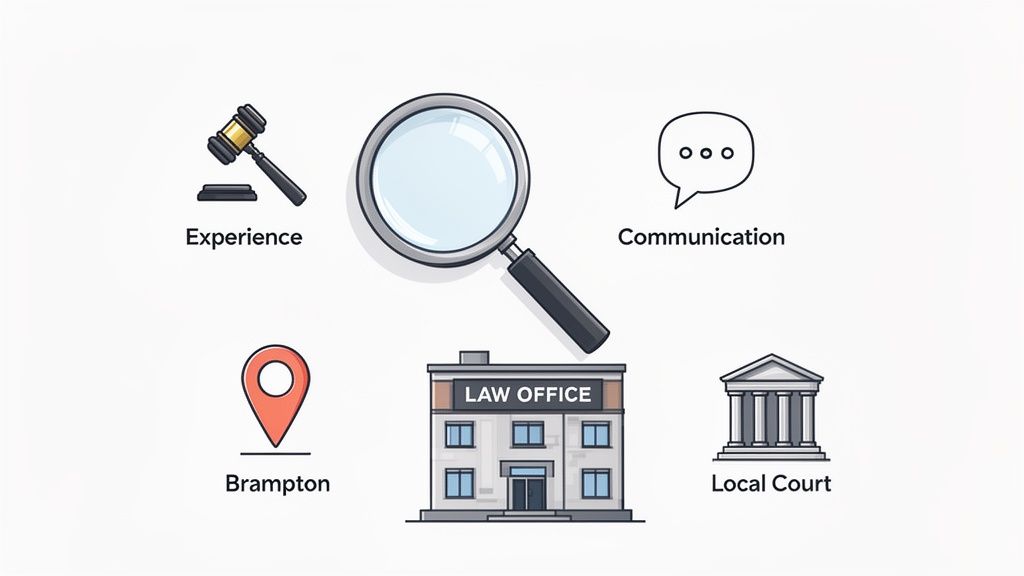
Illustration showing a magnifying glass over a law office, with icons for experience, communication, Brampton, and local court.

If you've typed "best criminal defence law firms near me in Brampton" into a search bar, you know how overwhelming the results can be. Your future is on the line, so how do you cut through the noise and find the right person to fight for you? The key is to look past the flashy websites and pinpoint the qualities that actually win cases.

Choosing a lawyer isn't just about hiring someone to stand beside you in court. It's about finding a strategic partner—someone who lives and breathes the local legal system, communicates without confusing jargon, and has a real track record defending charges just like yours. This decision will define everything that comes next, from your bail hearing to the final outcome.

Proven Experience at the Brampton Courthouse

One of the biggest advantages you can have is a lawyer who is a regular, respected face at the A. Grenville and William Davis Courthouse. A criminal lawyer in Brampton who is in those halls every day knows the local court procedures, understands how different Crown attorneys operate, and can read the room with judges.

This isn’t a small detail; it's a massive strategic edge. It means your lawyer can navigate the system efficiently, build arguments that resonate, and negotiate from a position of true strength. A firm like Badesha Law brings this on-the-ground experience to every case, giving clients the kind of insight you only get from years of dedicated practice in Peel Region.

A Practice Focused Exclusively on Criminal Law

The law is a vast and complex world. Criminal law is its own unique universe, governed by the Criminal Code of Canada and an ever-changing landscape of court rulings. A lawyer who splits their time between real estate, family law, and criminal defence simply can't offer the same depth of expertise as a dedicated specialist.

When you're meeting with potential lawyers, don't be afraid to ask direct questions:

  • What percentage of your work is actually criminal defence?

  • How many cases like mine have you handled in the last year?

  • How do you keep up with new laws and court decisions that could affect my case?

A firm that is 100% focused on criminal law will spot the subtle weaknesses in the Crown’s case that others might miss. That’s how a robust defence strategy is built.

The right lawyer doesn’t just know the law—they know how it’s applied every day in your specific courthouse. This combination of legal knowledge and local experience is the foundation of a powerful and effective criminal defence.

Clear Communication and a Transparent Strategy

One of the worst feelings is being left in the dark, confused about what’s happening with your own case. A great criminal lawyer knows how to translate complicated legal speak into plain English. Their job is to make sure you always understand what’s going on, what your options are, and what the next move will be.

Pay close attention to communication style during your first meeting. Does the lawyer actually listen to your side of the story? Do they explain their plan in a way that makes sense to you? A good lawyer empowers you by keeping you in the loop and making you a part of the key decisions.

This commitment to clarity is a core principle at Badesha Law. We believe every client deserves to feel confident and fully understand the path their defence is taking.

The journey to becoming a lawyer is designed to be tough, setting a high bar for anyone entering the profession. For example, the State Bar of California holds one of the most difficult exams in the United States, with pass rates often sitting around 55%. This rigorous process ensures that licensed lawyers have a deep, proven understanding of legal principles—a standard of excellence that’s absolutely critical when someone’s freedom is at stake. To see just how demanding these exams are, you can learn more about recent exam results and statistics.

Ultimately, choosing the right firm comes down to finding that perfect mix of specialized skill, local court savvy, and a genuine client-first approach. These are the qualities that transform legal representation into a true partnership—one aimed at protecting your future.

Common Questions About Working With a Criminal Lawyer

Deciding to hire legal help is a huge step, and it’s completely normal to have a million practical questions running through your mind. This section gives you straight answers to some of the most common concerns people have when they first think about hiring a criminal lawyer in Brampton. Our goal is to give you clarity and transparency, helping you feel more confident about protecting your future.

Getting tangled up in the legal system is stressful, but understanding how things work and what your relationship with your lawyer will look like can make a world of difference. We'll cover the big questions about costs, confidentiality, and what really happens in that first meeting.

How Much Do Criminal Defence Lawyers Cost?

This is usually the first question on anyone’s mind, and for good reason. The cost of hiring a criminal lawyer can vary a lot, depending on how complex your case is, how serious the charges are, and the sheer amount of time needed to build a powerful defence.

Most criminal law firms, including Badesha Law, work on a "block fee" or "flat fee" basis for different stages of your case. What this means is you’ll get a set price for a specific service, like running a bail hearing or handling everything right up to the trial. This approach gives you cost certainty, so you can budget without worrying about hourly bills piling up.

During your initial consultation, we lay out a clear, transparent breakdown of the fees you can expect. You should never be in the dark about the cost of your own defence.

Is Everything I Tell My Lawyer Confidential?

Absolutely. Solicitor-client privilege is one of the most sacred duties in the entire legal profession. It means that everything you discuss with your criminal lawyer is strictly confidential and cannot be shared with anyone—not the police, not the Crown prosecutor, and not even a judge—without your direct permission.

This protection is iron-clad and legally binding, designed to create a space of complete trust. It allows you to speak openly and honestly about every single detail of your situation, which is critical for your lawyer to build the strongest possible defence for you. You can and should feel secure knowing your conversations are protected by law.

What Should I Expect During My First Meeting?

Think of your first meeting, or initial consultation, as a critical first step. It's your chance to share your side of the story and for the lawyer to give you a preliminary take on your case. At Badesha Law, we use this time to listen carefully to what happened and then explain the legal road ahead in plain, understandable language.

During this meeting, you can expect us to:

  1. Go over the allegations and any paperwork you have, like your charging documents or release papers.

  2. Explain your rights and the immediate steps we need to take to protect them.

  3. Outline a potential defence strategy and talk about the possible outcomes for your case.

  4. Answer all your questions about the process, our experience, and the legal fees involved.

This meeting is a two-way street. It’s just as much about you feeling comfortable and confident in us as it is about us understanding your case.

A successful defence is built on a partnership of trust and open communication. Your lawyer's job is not only to fight for you in court but also to ensure you feel heard, understood, and confident in the strategy every step of the way.

How Involved Do I Need to Be in My Own Defence?

While your lawyer does the legal heavy lifting—filing court documents, negotiating with the Crown, and making arguments in court—your involvement is absolutely critical. You are the single most important source of information for your own case.

Your role is to give your lawyer all the facts as you know them, help point out potential witnesses, and make the final call on major strategic decisions, like whether to accept a plea offer or take the case to trial. A good lawyer will keep you informed and empowered, making sure you are an active partner in your own defence. At Badesha Law, we work side-by-side with our clients, because we know the best results happen when we work as a team.


When you're facing criminal charges, having the right legal partner can change everything. The team at Badesha Law is committed to providing expert, client-focused defence for people in Brampton and the GTA. If you need a trusted advocate to protect your rights and your future, contact us today for a confidential consultation. Learn more about how our Brampton criminal lawyers can help you.

What Happens After a DUI in Brampton, Ontario? A Guide to the Penalties

Being stopped and charged with impaired driving (DUI) in Brampton is a disorienting and stressful experience. From the moment you see flashing lights in your rearview mirror, a complex legal process begins, governed by Canada’s Criminal Code and Ontario’s Highway Traffic Act. The consequences are immediate, severe, and can impact every aspect of your life long after the initial arrest.

So, what happens after a DUI? It is not a single event but a cascade of administrative and criminal hurdles. You face an immediate licence suspension, vehicle impoundment, and the start of a challenging journey through the justice system. For Brampton residents, navigating this process requires a clear understanding of your rights and the steps ahead.

This guide provides the actionable insights you need. We will break down the critical stages you will face, from the roadside breathalyzer to the courtroom in Brampton, insurance hikes, and potential criminal records. Understanding these steps is the first and most crucial move toward protecting your rights, your licence, and your future. The aftermath of a DUI charge is confusing and intimidating, which is why the guidance of an experienced criminal lawyer in Brampton is not just recommended, it is essential for mounting a proper defence. This article will explain exactly what happens in a DUI case and how to prepare for the road ahead, whether this is your first offence or a second offence.

1. Immediate Licence Suspension

One of the most immediate and impactful consequences of a DUI charge in Ontario is an automatic administrative licence suspension. This is not a criminal penalty decided by a judge at the Brampton courthouse but an immediate administrative action taken by the Ministry of Transportation (MTO) under the authority of the Highway Traffic Act.

This suspension is separate from any potential suspension you might face later if convicted in court. It is designed to remove potentially impaired drivers from the road immediately, prioritizing public safety. If you are charged with an impaired driving offence in Brampton, the police will seize your physical driver’s licence at the roadside or at the station.

How it Works in Ontario

The moment you are charged with having a blood alcohol concentration (BAC) of 80 milligrams or more per 100 millilitres of blood (“Over 80”), or for refusing to provide a breath or fluid sample, you are subject to an Administrative Driver’s Licence Suspension (ADLS).

  • Duration: This is a firm 90-day suspension.
  • Vehicle Impoundment: Your vehicle will also be impounded for 7 days. You are responsible for all towing and storage fees.

This initial 90-day suspension is a critical period. You cannot drive under any circumstances; there are no hardship or work-related exceptions for an ADLS. Driving while under this suspension is a serious offence that can lead to further criminal charges, significant fines, and even jail time. For anyone searching for a “DUI lawyer in Brampton,” understanding this immediate consequence is the first step in navigating the complex process ahead. This administrative action underscores the seriousness of the charge before you even step into a courtroom.

2. Criminal Charges and Court Proceedings in Brampton

Separate from the immediate administrative penalties, a DUI charge invariably involves the formal criminal justice process. Once you are charged by Peel Regional Police, a legal case is opened against you by the Crown, and you are required to navigate the complexities of the Canadian criminal court system at the Brampton courthouse. This journey is often lengthy and stressful, underscoring the importance of securing expert legal representation from a local criminal lawyer from the outset.

A courtroom interior with a judge's bench, a microphone, and large windows, with text 'COURT APPEARANCE'.

This process determines your guilt or innocence under the Criminal Code of Canada. It involves several key stages, from your first appearance to a potential trial, and the outcome will have a profound and lasting impact on your future. For anyone needing a criminal lawyer in Brampton, understanding these steps is crucial to mounting a proper defence.

How it Works in Ontario

After being charged and released, you will be given a date for your first court appearance at the Brampton Court of Justice. This is not your trial date but the start of the court proceedings, where the Crown will provide the initial evidence against you (known as “disclosure”) to your legal counsel.

  • First Appearance: Your lawyer typically attends this on your behalf to obtain disclosure and set a date for the next step.
  • Crown Pre-Trial: Your lawyer meets with the Crown prosecutor to discuss the case. This is where strengths and weaknesses are debated, and potential resolutions, such as a plea bargain to a lesser charge, might be explored.
  • Judicial Pre-Trial: If no resolution is reached, a meeting with a judge and the Crown may occur to discuss legal issues and trial timelines.
  • Trial: If the case proceeds, a trial is held where the Crown must prove your guilt beyond a reasonable doubt.

Each step requires strategic legal navigation. An experienced DUI lawyer in Brampton will meticulously review the evidence, identify police errors or charter rights violations, and build the strongest possible defence tailored to the specifics of your Brampton case. A conviction can lead to a criminal record, significant fines, further licence suspensions, and even jail time, especially for a second offence.

3. Fines and Financial Penalties

Beyond the administrative penalties and potential for jail time, a DUI conviction in Ontario brings significant mandatory fines and financial penalties. These are not merely administrative fees; they are criminal sentences imposed by a judge and are a core part of what happens after a DUI. The total cost is often much higher than the base fine, as it includes a mandatory victim fine surcharge.

This monetary punishment is a direct consequence of being found guilty in court. It is designed to act as a deterrent and to hold the offender financially accountable for their actions. The amount varies based on the specifics of your case, including your blood alcohol concentration and whether it is a first or subsequent offence. For anyone facing charges in Brampton, understanding these financial implications is crucial for preparing for the road ahead.

How it Works in Ontario

Under the Criminal Code of Canada, the fines for impaired driving are mandatory minimums, meaning a judge cannot impose a lesser amount upon conviction. These fines escalate sharply for repeat offenders.

  • First Offence: A mandatory minimum fine of $1,000. If your BAC was particularly high (120-159 mg), the fine increases to a minimum of $1,500. For a BAC of 160 mg or more, or for a refusal to provide a sample, the minimum fine is $2,000.
  • Second Offence: Mandatory minimum of 30 days in jail.
  • Third and Subsequent Offences: Mandatory minimum of 120 days in jail.

On top of the base fine, the court will add a victim fine surcharge, which is typically 30% of the fine amount. For a base $1,000 fine, this adds another $300. These financial penalties are just one aspect of the overall cost of a DUI, which also includes legal fees, increased insurance premiums, and program costs. Consulting with a criminal lawyer in Brampton can help you understand the full scope of potential financial penalties you may be facing.

4. Jail or Prison Sentences

While fines and licence suspensions are common, one of the most severe consequences of a DUI conviction in Ontario is the potential for incarceration. A jail sentence is a very real possibility, particularly for repeat offenders or in cases where the impaired driving incident caused bodily harm or death. The court’s decision to impose jail time reflects the gravity of the offence and serves as a significant deterrent.

This penalty is handed down by a judge as part of the criminal sentencing process and is separate from any immediate administrative consequences. Understanding the circumstances that can lead to jail time is crucial for anyone facing an impaired driving charge. For those seeking a “criminal lawyer in Brampton,” comprehending these potential outcomes is a vital part of preparing a strong defence.

How it Works in Ontario

Under the Criminal Code of Canada, mandatory minimum sentences are in place for certain impaired driving convictions. These minimums increase substantially with each subsequent offence, highlighting the system’s focus on escalating penalties for repeat offenders.

  • First Offence: While there is no mandatory minimum jail sentence for a standard first-time DUI, a judge can impose imprisonment up to a maximum of two years less a day for a summary conviction, or up to 10 years for an indictable offence.
  • Second Offence: A conviction for a second impaired driving offence carries a mandatory minimum of 30 days in jail.
  • Third and Subsequent Offences: For a third or any subsequent offence, the mandatory minimum sentence increases to 120 days in jail.

It is important to note that these are minimums; the actual sentence can be much longer depending on the aggravating factors of your case. Factors such as a very high BAC reading, having a child in the vehicle, or causing an accident can all lead a judge to impose a sentence far exceeding the mandatory minimum, even for a first offence. This demonstrates the critical need for an experienced DUI lawyer in Brampton to navigate the complexities of your case.

5. Mandatory DUI Education and Treatment Programs

Beyond court-imposed fines and licence suspensions, another critical step in resolving what happens after a DUI conviction in Ontario is the completion of a mandatory remedial measures program. This is not optional; it is a provincially mandated requirement designed to educate offenders on the risks of impaired driving and address underlying issues with substance use. Successful completion is a prerequisite for having your driver’s licence reinstated.

These programs are administered under Ontario’s Ministry of Transportation (MTO) and are separate from any criminal sentence. The goal is to reduce recidivism by tackling the behavioural and health aspects of impaired driving, ensuring that drivers understand the serious consequences of their actions before they are permitted to operate a vehicle again. Anyone convicted will receive instructions from the MTO on how to register.

How it Works in Ontario

If convicted of an impaired driving offence in Brampton or elsewhere in the province, you will be required to complete the “Back on Track” program. This is Ontario’s official remedial program for alcohol and drug-related driving offences.

  • Assessment: The program begins with an assessment of your substance use to determine the appropriate program stream.
  • Program Components: Depending on the assessment, you will be required to complete either an 8-hour educational workshop or a 16-hour treatment workshop. A follow-up interview is also required six months after completion.
  • Cost: You are responsible for the full cost of the program, which can be several hundred dollars.

It is crucial to enrol and complete this program as directed. Failure to do so will prevent the MTO from reinstating your driver’s licence, even if you have served your entire court-ordered suspension and paid all your fines. For anyone seeking advice from a criminal lawyer in Brampton, understanding this mandatory administrative requirement is essential for planning a clear path back to legal driving.

6. Probation and Supervised Release

If convicted, one of the key elements of what happens after a DUI sentence is often a period of probation. This is a court-ordered term of community supervision that can be imposed either in addition to, or sometimes in place of, a jail sentence. The primary purpose of probation is to rehabilitate the offender while allowing them to remain in the community, all under a set of strict, legally binding conditions.

Probation is designed to ensure public safety and to help prevent the individual from reoffending. A probation order is a formal contract with the court; any breach of its terms is a separate criminal offence that can lead to new charges and potentially imprisonment. For anyone convicted of a DUI in Brampton, understanding and adhering to a probation order is absolutely critical to moving past the charge.

How it Works in Ontario

When a judge imposes a sentence that includes probation, they will issue a probation order outlining specific conditions that you must follow for a set period, which can last up to three years. These conditions are tailored to the circumstances of the offence and the offender.

  • Mandatory Conditions: Every probation order in Canada includes mandatory conditions, such as keeping the peace, being of good behaviour, and appearing in court when required.
  • Optional Conditions: The judge can also add specific conditions relevant to your DUI case. These often include reporting to a probation officer, abstaining from alcohol, completing substance abuse counselling or treatment (like the “Back on Track” program), and not operating a motor vehicle.

Navigating these conditions requires diligence and a clear understanding of your obligations. Failing to report to your probation officer or being caught consuming alcohol can result in a charge for “Breach of Probation,” which carries its own serious penalties. A criminal lawyer in Brampton can help you understand the full scope of your probation order and the severe consequences of non-compliance.

7. Ignition Interlock Device (IID) Installation

Following a DUI conviction in Ontario, one of the most significant requirements you may face is the mandatory installation of an Ignition Interlock Device (IID). This is a court-ordered or ministry-mandated condition for licence reinstatement, designed to ensure public safety by preventing a vehicle from starting if the driver has consumed alcohol.

Inside a car with an ignition interlock device on the dashboard, looking out onto a road.

The device is an in-car breathalyzer connected to your vehicle’s ignition system. Before you can start the engine, you must provide a breath sample into the device. If your Blood Alcohol Concentration (BAC) is above a pre-set low limit (typically .02 or lower), the vehicle will not start. The IID will also require random re-tests while you are driving to ensure continued sobriety.

How it Works in Ontario

Under Ontario’s Highway Traffic Act, the Ignition Interlock Program is mandatory for drivers convicted of impaired driving offences. The length of the required installation period depends on the number of prior convictions.

  • First Offence: Mandatory installation for a minimum of one year.
  • Second Offence: Mandatory installation for a minimum of three years.
  • Third Offence: A potential lifetime licence suspension, with the possibility of reinstatement after 10 years, which would require an IID for life.

All costs associated with the device, including installation, monthly monitoring fees, and removal, are the sole responsibility of the driver. These costs can be substantial, often exceeding a thousand dollars per year. Failing to comply with the program’s rules, such as a failed test or attempting to tamper with the device, results in a program violation. These violations can extend the time you are required to have the device installed, adding significant time and expense to what happens after a DUI. For anyone facing a conviction, discussing the IID program with a criminal lawyer in Brampton is essential to understanding the full scope of long-term consequences.

8. Criminal Record and Background Check Consequences

Beyond the immediate penalties like fines and licence suspensions, one of the most lasting and serious consequences of a DUI conviction in Ontario is the creation of a permanent criminal record. This isn’t a temporary mark; it’s a formal record of a criminal conviction that follows you for life unless it is formally suspended (pardoned), impacting numerous aspects of your personal and professional life.

This criminal record is accessible through background checks, which are now standard procedure for many of life’s important applications. A DUI conviction can therefore create significant and long-term barriers, turning what started as a single incident on the road into a persistent obstacle. For anyone charged in Brampton or the GTA, understanding these far-reaching effects is crucial.

Desk setup with laptop, documents, pen, and books, highlighting 'CRIMINAL RECORD' text.

How it Works in Ontario

A conviction for a criminal driving offence, such as Impaired Driving or Over 80, is registered in the Canadian Police Information Centre (CPIC) database. This makes the conviction visible on nearly any type of criminal background check, from basic employment screenings to more in-depth vulnerable sector checks.

  • Employment: Many Brampton employers require a clean criminal record. A DUI can disqualify you from jobs in fields like education, healthcare, finance, or any role that requires driving or a high level of trust. A teacher, for instance, could face review by the Ontario College of Teachers.
  • Professional Licences: Regulated professions, such as nursing, law, or engineering, may review, deny, or revoke a licence following a criminal conviction.
  • Travel and Immigration: A DUI conviction can render you criminally inadmissible to other countries, most notably the United States. It can also severely complicate immigration, permanent residency, and citizenship applications in Canada.

Successfully navigating these challenges often requires the expertise of a criminal lawyer in Brampton. They can advise on the record suspension (pardon) process and help mitigate the damage by presenting your case in the best possible light. A conviction has consequences that extend far beyond the courthouse.

9. Enhanced Penalties for a Second Offence and Aggravating Factors

The consequences of a DUI conviction are not uniform; they are significantly influenced by your prior record and the specific details of the incident. The Criminal Code of Canada mandates increasingly severe punishments for individuals with previous impaired driving convictions. Furthermore, certain circumstances surrounding the charge, known as aggravating factors, can lead a judge to impose a harsher sentence even for a first-time offence.

This system is designed to deter repeat behaviour and to reflect the increased danger posed by certain situations. If you are facing a second or subsequent DUI charge, or if your case involves aggravating factors, the potential penalties escalate dramatically. Understanding these enhancements is crucial when facing the legal system, especially for those seeking a criminal lawyer in Brampton who can navigate these complex cases.

How it Works in Ontario

Penalties are enhanced based on a “lookback” period for prior convictions. Additionally, aggravating factors are specific elements of the offence that the Crown prosecutor will highlight during sentencing to argue for a more severe penalty.

  • Second Offence: For a second offence, there is a mandatory minimum of 30 days in jail. A third or subsequent offence carries a mandatory minimum of 120 days in jail. The Crown can look back at convictions over the last 10 years, and sometimes even longer, to establish a prior record.
  • Aggravating Factors: These can include a particularly high blood alcohol concentration (BAC), causing an accident that resulted in bodily harm or death, having a child under 16 in the vehicle, or driving recklessly at high speeds while impaired.

The presence of any of these factors removes the possibility of a minimum sentence. The judge is required to impose a penalty that is more significant than the mandatory minimums, which could mean longer jail sentences, higher fines, and extended driving prohibitions. For anyone facing a DUI, particularly a second offence, it is critical to understand that the stakes are substantially higher from the very beginning.

10. Insurance Consequences and High-Risk Designation

A significant financial consequence of a DUI conviction in Ontario is the dramatic impact on your car insurance. Once convicted, your insurance provider will classify you as a “high-risk” driver. This designation leads to a steep and often long-lasting increase in your insurance premiums, making it much more expensive to legally operate a vehicle in Brampton.

This financial penalty is separate from any court-imposed fines or other costs associated with a DUI. Insurance companies view a conviction as a major indicator of risky behaviour, and they adjust your rates to reflect this increased liability. For many, the cumulative cost of these higher premiums over several years can be one of the most substantial financial burdens resulting from an impaired driving charge.

How it Works in Ontario

In Ontario, a DUI conviction obligates you to seek coverage through “high-risk” or “facility” insurance markets. Your current provider may cancel your policy altogether, forcing you to find a new insurer specializing in high-risk drivers.

  • Premium Increases: It is not uncommon for insurance premiums to double, triple, or even increase by more, costing thousands of extra dollars per year. This increase typically remains in effect for three to six years after the conviction date.
  • Proof of Insurance: You must maintain this high-risk insurance continuously. Any lapse in coverage could lead to a further licence suspension and additional penalties.

The financial strain of these insurance consequences underscores the importance of a strong defence. For those searching for a “DUI lawyer in Brampton,” mitigating these long-term financial impacts is a crucial goal. An experienced criminal lawyer in Brampton can explore every avenue to fight the charges, as an acquittal is the only way to completely avoid the high-risk insurance designation and its severe financial fallout.

10-Point Comparison of Post-DUI Consequences

Penalty / Action Implementation complexity Resource requirements Expected outcomes Ideal use cases Key advantages
License Suspension or Revocation Low–medium; administrative process with strict timelines MTO hearings, legal representation, alternative transport Immediate loss of driving privileges for a set period Immediate post-arrest administrative sanction Rapid removal of driving privileges; challengeable via appeal
Criminal Charges and Court Proceedings High; formal court procedures, discovery, trial phases Defense attorney, prosecutor, court time, evidence management Possible conviction or acquittal; fines, jail, criminal record Formal prosecution of DUI cases in Brampton Enables evidentiary challenges and plea negotiations
Fines and Financial Penalties Low; court-imposed monetary sanctions Significant cash payments, payment plans, higher insurance costs Financial burden and deterrence; contributions to fees/programs Most convicted DUI cases, first-time or repeat Deterrent effect; funds victim/program services; sometimes reducible
Jail or Prison Sentences Medium–high; sentencing and custody logistics Correctional facility capacity, supervision, legal defense Incarceration, loss of liberty, criminal record Serious offenses, repeat offenders, injury/death cases Incapacitates dangerous drivers; strong public-safety deterrent
Mandatory DUI Education & Treatment Programs Medium; enrollment, attendance tracking, completion proof Program fees, time commitment, qualified treatment providers Behavior change, reduced recidivism; certificate for reinstatement Court/MTO-ordered rehabilitation and reinstatement conditions Supports rehabilitation; can reduce future risk and penalties
Probation and Supervised Release Medium; supervision, reporting, testing requirements Probation officer oversight, drug/alcohol testing, compliance costs Community supervision with conditions; avoid immediate incarceration Alternative to incarceration or post-release supervision Allows continued employment and reintegration; lower cost than jail
Ignition Interlock Device (IID) Installation Medium; installation, calibration, and reporting systems Installation fees, monthly monitoring, maintenance appointments Prevents vehicle start if alcohol detected; compliance logs License reinstatement conditions; repeat offenders Significantly reduces repeat DUI risk while permitting driving
Criminal Record & Background Check Consequences Low; creation and public indexing of conviction records Minimal admin; potential record suspension legal fees Long-term public record affecting jobs, housing, licenses Result of conviction across jurisdictions Public accountability; possible record suspension options
Enhanced Penalties for Repeat Offenses & Aggravators High; compounded sentencing and statutory enhancements Greater legal defense needs, longer incarceration, higher fines Substantially increased sanctions, mandatory jail time Second offence, high BAC, injury, minors involved, refusals Strong deterrent effect; increased protection for public safety
Insurance Consequences Low–medium; insurer filings and policy adjustments Higher premiums, limited insurer options Significantly higher insurance costs; mandatory proof of continuous coverage Post-conviction licensing and high-risk driver monitoring Ensures continuous insurance coverage; enforces financial accountability

Your Next Step: Taking Control After a DUI Charge in Brampton

Navigating the aftermath of an impaired driving charge in Ontario is a complex and daunting experience. As we have detailed, the consequences are not a single event but a cascade of interconnected penalties that affect every aspect of your life. Understanding what happens after a DUI is the crucial first step, but what you do with that knowledge is what truly defines your outcome.

From the immediate administrative licence suspension and vehicle impoundment to the intricate and often intimidating criminal court process in Brampton, the system is designed to be severe. The financial burden alone is staggering, encompassing hefty fines, mandatory program fees for “Back on Track,” ignition interlock costs, and dramatically increased insurance premiums. Beyond the monetary penalties, a conviction leaves a permanent stain on your record, potentially closing doors to employment opportunities, restricting international travel, and altering your future in ways you may not yet anticipate.

Strategic Recap: Your Key Takeaways

Mastering the information in this guide is about more than just knowing the penalties; it’s about understanding the strategic pressure points where a strong defence can make a difference. The moments following a Brampton DUI arrest are critical. Your right to counsel, the procedures for breath or blood samples, and the details of your release are not just formalities—they are the foundational elements of your defence.

Here is a summary of the most critical insights to remember:

  • Two Parallel Processes: A DUI charge triggers both an immediate administrative penalty from the Ministry of Transportation (the 90-day licence suspension) and a separate, more severe criminal proceeding in the Brampton court. Winning in criminal court is the only way to reverse the long-term consequences.
  • Evidence is Paramount: The Crown’s case often hinges on technical evidence, such as the approved screening device readings, the Intoxilyzer results, and the arresting officer’s observations. Every piece of this evidence can and should be scrutinized by a skilled DUI lawyer for procedural errors or Charter rights violations.
  • Penalties Escalate: While a first-time offence carries significant penalties, the consequences for a second offence are exponentially more severe, involving mandatory minimum jail sentences. Aggravating factors like an accident or a high blood alcohol concentration can also lead to harsher outcomes even for a first offence.
  • Proactivity is Your Best Defence: The worst thing you can do after being charged is wait. Key evidence can be lost, and crucial deadlines can be missed. Engaging a criminal lawyer in Brampton immediately allows for the preservation of evidence, a thorough review of disclosure, and the development of a tailored defence strategy from the very beginning.

Your Actionable Path Forward in Brampton

The overwhelming nature of what happens after a DUI can lead to paralysis, but taking decisive action is your most powerful tool. The path to a successful resolution begins with a clear, strategic plan. Rather than being a passive participant in the process, you must become an active agent in your own defence.

Your immediate priorities should be to:

  1. Document Everything: Write down every detail you can recall about the traffic stop, the arrest, the questions you were asked, and the tests you performed. No detail is too small.
  2. Preserve Evidence: Secure any relevant documents, such as your release papers, the notice of suspension, and any tickets you were issued. If there were witnesses, get their contact information.
  3. Seek Expert Legal Counsel: This is the single most important step. A criminal lawyer in Brampton who specializes in DUI cases understands the local courts, the Crown prosecutors, and the specific defence strategies that are most effective. They are your guide and your advocate, translating complex legal procedures into a clear plan of action.

Ultimately, the goal is to protect your future. A DUI charge is a serious crossroads, but it does not have to be a dead end. With the right knowledge and the right professional guidance, you can navigate this challenge, fight the allegations against you, and work towards the best possible outcome—securing your licence, your freedom, and your peace of mind.


Facing an impaired driving charge is not a journey you should take alone. The complexities of the Criminal Code and the specific procedures at the Brampton courthouse demand expert representation. At Badesha Law, we specialize in mounting a strategic and vigorous defence for individuals charged with DUI, providing the critical guidance needed from the moment of arrest to the final verdict. Contact Badesha Law today to protect your rights and start building your defence.

What is Stunt Driving in Ontario? Brampton Criminal Lawyer Explains

A stunt driving charge in Ontario, particularly in Brampton, is far more serious than a standard speeding ticket. It triggers immediate, severe consequences like a 30-day licence suspension and a 14-day vehicle impoundment right at the roadside, even before you see a judge. For Brampton drivers, this means navigating not just the legal maze of the Highway Traffic Act, but also the practical nightmare of losing your transportation and facing immense fines, demerit points, and crippling insurance hikes. Understanding exactly what is stunt driving in Ontario is the first actionable step to building a proper defence.

This resource list is designed to provide clarity during a stressful time. We will break down precisely what stunt driving entails under provincial law, outlining the specific offences from excessive speeding to street racing. You will learn about the court process you’re about to face in Brampton, from the initial roadside charge to potential trial outcomes. Most importantly, we will connect you with the essential resources you need to protect your rights and your future.

This guide moves beyond generic advice, offering a curated list of the most critical online tools and legal information sources. From the official government statutes that define the charge to the Law Society of Ontario’s referral service and the websites of experienced Brampton legal professionals who handle these cases daily. Each resource includes a direct link and a clear explanation of how it can help you build your defence strategy. If you’ve been charged in Brampton, understanding these 12 resources is your critical first step toward a favourable resolution.

Criminal Lawyer Brampton Badesha Law

Badesha Law provides a robust and client-focused online resource for individuals in Brampton seeking urgent legal guidance on stunt driving charges. The firm’s website serves as a direct portal to experienced criminal defence lawyers who practice extensively in Brampton and across the Greater Toronto Area. It stands out by offering clear, actionable information that addresses the immediate, real-world consequences a driver faces, which is a key client need.

For anyone trying to understand what is stunt driving in Ontario, the website offers a critical first step: direct access to a legal team that can demystify the complex court process at the Brampton courthouse. It is particularly effective for those needing an immediate response, such as securing a client’s release from custody at a bail hearing or navigating the mandatory 14-day vehicle impoundment. The firm’s integrated approach to criminal and family law is a significant advantage, allowing them to holistically manage cases where a stunt driving charge could impact family court matters like child custody or access, a critical consideration under Ontario’s Family Law Act.

Why You Need a Criminal Lawyer in Brampton for a Stunt Driving Charge?

Badesha Law’s online presence is designed for action. It guides users toward a consultation where they can receive a tailored defence strategy. This is crucial, as the firm’s approach focuses on achieving the best possible outcome, whether it is a charge withdrawal, a peace bond, diversion, or a full acquittal at the Brampton courthouse.

  • Strength: The firm’s emphasis on meticulous preparation and responsive advocacy is a clear benefit for clients in Brampton who need a local lawyer familiar with local courts and Crown policies.
  • Limitation: The website does not provide fixed-fee pricing for services. Prospective clients must contact the firm directly to receive a quote based on their specific case details.

Key Takeaway: Badesha Law’s platform is an excellent starting point for individuals in Brampton who need immediate, practical legal advice for stunt driving charges. Their focus on actionable next steps makes them a leading choice for navigating the complexities of the Highway Traffic Act and the Canadian Criminal Code.

Website: badeshalaw.ca/brampton-criminal-lawyer

Ontario.ca – Speeding and Aggressive Driving (official overview)

For anyone trying to understand what is stunt driving in Ontario, the official government source should be your first stop. The Province of Ontario’s webpage on Speeding and Aggressive Driving provides a clear, authoritative, and up-to-date summary directly from the source of the law. It’s a free, public resource designed to educate drivers on the severe consequences of these offences.

Ontario.ca – Speeding and Aggressive Driving (official overview)

This platform excels at translating complex legal language from the Highway Traffic Act into plain English. It clearly lists the specific actions that constitute stunt driving, such as excessive speed thresholds (40 km/h or more in zones under 80 km/h), tailgating, and intentionally blocking other vehicles. The site provides a straightforward breakdown of both the immediate roadside penalties and the potential court-imposed consequences.

Why It’s a Go-To Resource

This site stands out because it is the official, definitive source of information. Unlike forums or blogs, the content here is legally accurate and reflects the current laws in Ontario. It offers direct links to the primary legislation for those who want to delve deeper.

Practical Tip: Use this page to confirm the details of the law as it applies to your situation. For example, if you were charged on a Brampton road with a 70 km/h speed limit, you can instantly verify that the 40 km/h over limit applies, not the 50 km/h over limit.

Key Features and Limitations

FeatureAnalysis
Official DefinitionsClearly outlines speed limits and specific driving manoeuvres that lead to a stunt charge.
Penalty SummariesBreaks down immediate roadside penalties (30-day licence suspension, 14-day vehicle impoundment) and court penalties (fines, further suspension, etc.).
AccessibilityAs a government website, access is free and available to everyone. The user interface is simple and easy to navigate.

While this site is an invaluable educational tool, its main limitation is that it provides general information. It cannot offer personalized legal advice tailored to the specifics of your case, such as potential defences for a charge laid in Brampton or how a prosecutor in that specific jurisdiction might handle your matter.

Website: https://www.ontario.ca/page/speeding-and-aggressive-driving

3. Ontario e-Laws – Highway Traffic Act, s.172 (primary law)

While the Ontario.ca overview provides a summary, the e-Laws website gives you direct access to the exact legal text that police, prosecutors, and judges use. This free government resource is the definitive source for the Highway Traffic Act, specifically Section 172, which defines what is stunt driving in Ontario. It is the primary law itself, not a summary or interpretation.

Ontario e-Laws – Highway Traffic Act, s.172 (primary law)

This platform allows you to read the precise wording of the offence, including the specific definitions of “race,” “contest,” and “stunt.” It’s an indispensable tool for understanding the legal foundation of a charge. The site also includes the amendment history, showing you how the law has evolved, which can be critical for understanding how your specific charge is being treated under the current legal framework.

Why It’s a Go-To Resource

This site stands out because it is the ultimate authority. Legal arguments in a Brampton courtroom are built upon the exact phrasing found in this statute. Having access to it means you can see the precise legal elements the Crown prosecutor must prove to secure a conviction, without any paraphrasing or simplification.

Practical Tip: Use the search function (Ctrl+F) to quickly find “172” within the Highway Traffic Act. This allows you to jump directly to the relevant section and review the specific definitions of actions that constitute a stunt, such as lifting tires off the surface or driving with a person in the trunk.

Key Features and Limitations

FeatureAnalysis
Primary Legal TextProvides the complete, official text of Section 172 of the Highway Traffic Act, the core stunt driving law.
Statutory DefinitionsContains the exact legal definitions of actions considered a stunt, which is what courts in Brampton and across Ontario rely on.
Amendment HistoryShows when the law was last updated, ensuring you are reading the current version that applies to your charge.

The primary limitation of e-Laws is its complexity. The dense, technical legal language is not written for the average person and can be difficult to interpret. It provides the “what” of the law but offers no explanation of the “how” – it won’t explain court processes, potential defence strategies, or how a specific charge might be handled in practice in Brampton.

Website: https://www.ontario.ca/laws/statute/90h08

Ontario e-Laws – O. Reg. 455/07: Races, Contests and Stunts

For those who need to understand the granular details of what is stunt driving in Ontario, the actual regulation, O. Reg. 455/07, is the primary legal document. Hosted on the Ontario e-Laws website, this free resource provides the specific, enumerated list of actions that legally constitute a “stunt” beyond just excessive speed. It is the text that police, prosecutors in Brampton, and judges rely on.

Ontario e-Laws – O. Reg. 455/07: Races, Contests and Stunts

This platform isn’t a summary; it’s the law itself. It meticulously details manoeuvres like lifting tires off the surface (a “wheelie”), drifting, spinning the vehicle, driving too close to another vehicle, and intentionally preventing another driver from passing. Reading this regulation helps you see precisely how the law defines these dangerous behaviours.

Why It’s a Go-To Resource

This is the definitive, citable source for the non-speed-related definitions of stunt driving. While the Highway Traffic Act sets the penalties, this regulation provides the “what.” It is essential for building a legal defence, as the Crown prosecutor in Brampton must prove that your specific actions fit one of these definitions.

Practical Tip: If your charge is for something other than speed, like “driving with a person in the trunk,” you can use this regulation to see the exact legal wording. This level of detail is critical when discussing your case with a lawyer in Brampton.

Key Features and Limitations

FeatureAnalysis
Enumerated ListProvides a precise, itemized list of every driving behaviour legally defined as a stunt.
Official & CitableAs the official regulation, this text can be referenced directly in legal arguments and court proceedings.
Version HistoryAllows users to track changes to the law over time, which can be relevant depending on when the charge was laid.

The main limitation of this resource is its dense legal language. It is not written in plain English and must be interpreted alongside Section 172 of the Highway Traffic Act to understand the full scope of charges and penalties. It provides the “what,” but not the “so what” in terms of consequences or defence strategies for a case in Brampton.

Website: https://www.ontario.ca/laws/regulation/070455

Ontario Court of Justice – Provincial Offences (how your case runs)

After being charged, understanding what is stunt driving in Ontario shifts from defining the offence to navigating the court system. The Ontario Court of Justice’s official notices page for Provincial Offences Act (POA) matters is an essential, free resource that explains the procedural journey your case will take. It details how the court system operates, which is crucial for anyone in Brampton who has received a summons.

Ontario Court of Justice – Provincial Offences (how your case runs)

This platform provides authoritative guidance on the summons-based court process (known as Part III under the POA), which is used for serious charges like stunt driving. It outlines practical logistics, such as how to attend court (in-person or virtually via Zoom) and what to expect during your first appearance in Brampton. It is the best place to find province-wide updates and procedural changes that could affect your case.

Why It’s a Go-To Resource

This site stands out because it provides procedural information directly from the court system itself. While legal counsel explains your defence strategy, this page sets the practical expectations for what happens inside the Brampton courthouse. It demystifies the steps between being charged and having your matter heard, reducing the anxiety of the unknown for defendants.

Practical Tip: Check this page before your Brampton court date. It often contains updates on virtual appearance links or changes in courthouse procedures, ensuring you don’t miss a critical step.

Key Features and Limitations

FeatureAnalysis
Summons Process ExplainedDetails the Part III court procedure used for stunt driving, so you know what to expect after receiving a summons.
Courtroom LogisticsDescribes attendance options like Zoom or in-person appearances and provides links and instructions for virtual hearings.
Official NoticesActs as a central hub for province-wide procedural updates directly from the Ontario Court of Justice.

The primary limitation of this resource is its scope. It is strictly procedural and offers no legal advice, defence strategies, or information on penalties like fines or insurance consequences. It tells you how the court process works but cannot advise you on how to win your case or mitigate the penalties.

Website: https://www.ontariocourts.ca/ocj/notices/provincial-offences-act-matters/

Law Society of Ontario – Lawyer and Paralegal Directory + Referral Service

After understanding what is stunt driving in Ontario, the next logical step for anyone charged is to find qualified legal representation. The Law Society of Ontario (LSO), the body that regulates lawyers and paralegals in the province, provides an essential and trustworthy resource. Their directory is a free tool designed to connect the public with licensed, insured, and regulated legal professionals in cities like Brampton.

Law Society of Ontario – Lawyer and Paralegal Directory + Referral Service

This platform is the official starting point for vetting legal help. You can search specifically for a criminal lawyer in Brampton who handles Highway Traffic Act offences like stunt driving. The directory confirms each professional’s status, ensuring they are in good standing and legally permitted to practise law in Ontario. This eliminates the risk of dealing with unqualified or fraudulent advisors.

Why It’s a Go-To Resource

The LSO’s directory stands out for its authority and reliability. It is the definitive list of all licensed legal professionals in Ontario. Furthermore, the associated Law Society Referral Service (LSRS) can provide a free 30-minute consultation with a lawyer or paralegal, which is an invaluable first step for those unsure of their options or financial commitment.

Practical Tip: When using the directory, search for professionals who list “Criminal Law” and “Provincial Offences” as their practice areas. When you contact them, specifically ask about their experience with stunt driving charges at the Brampton courthouse.

Key Features and Limitations

FeatureAnalysis
Verified ProfessionalsAll listed lawyers and paralegals have verified licenses and are in good standing with regulatory bodies.
Directory SearchUsers can filter by location, name, and practice area to find suitable professionals.
Referral Service (LSRS)Provides a 30-minute free consultation, making initial legal advice accessible.

The directory primarily offers contact information and lacks detailed insights into a professional’s experience, success, or fees. The LSRS can serve as an initial point of contact, but further research is needed to find a suitable criminal lawyer. For individuals seeking a criminal lawyer in Brampton, consider further research or consult with Badesha Law.

Understanding Stunt Driving in Ontario

Stunt driving in Ontario is governed by the Criminal Code of Canada and the Highway Traffic Act. These laws outline severe penalties for offences such as excessive speeding and dangerous driving behaviors. Being charged with stunt driving can lead to significant fines, licence suspensions, and other legal consequences. A thorough understanding of these regulations is essential for anyone facing charges.

For those charged in areas like Brampton, seeking specialized legal assistance is crucial. Hiring an experienced law firm such as Badesha Law can provide guidance through the complexities of these legal matters, ensuring that you are well-informed and prepared for any legal proceedings.

Ontario.ca – Raising Speed Limits on Certain Highways (context for stunt rules)

To fully grasp what is stunt driving in Ontario, you must understand how the rules adapt to different speed limits. This official Government of Ontario page clarifies a crucial exception to the standard stunt driving thresholds. It details the specific highway corridors where the speed limit has been permanently raised to 110 km/h and explains how the stunt driving laws are applied in these faster zones. This resource is free and essential for any Brampton driver frequently travelling on major Ontario highways.

Ontario.ca – Raising Speed Limits on Certain Highways (context for stunt rules)

The platform’s primary value lies in its specific, actionable information. It explicitly states that in a 110 km/h zone, the stunt driving threshold is 40 km/h over the limit (driving 150 km/h or more), not the 50 km/h that applies to other 80 km/h+ zones. This distinction is critical for drivers in Brampton who use sections of Highway 401, 403, 410, and the QEW where these higher limits are in effect.

Why It’s a Go-To Resource

This page is a must-read because it provides official clarification on a nuanced aspect of the Highway Traffic Act. Misunderstanding these rules can lead to a severe stunt driving charge even when a driver believes they are within the usual 50 km/h-over buffer. It is the definitive source for identifying which specific highway segments have the adjusted speed limit and corresponding stunt driving criteria.

Practical Tip: Before a long-distance drive from Brampton on highways like the 410 or 401, check this page to confirm which sections are 110 km/h zones. Knowing the exact stunt driving threshold for your route can prevent a costly and serious charge.

Key Features and Limitations

FeatureAnalysis
Corridor ListingsProvides a clear list of all highways, including parts of the 401, 403, and 410, with the permanent 110 km/h speed limit.
Stunt Driving ClarificationDirectly states the adjusted stunt driving threshold (40 km/h over) for these specific higher-speed zones.
Enforcement DetailsExplains the signage and how police enforce the rules in these corridors, ensuring drivers are officially informed.

The main limitation of this resource is its narrow focus. It is purely informational and offers no guidance on how to defend against a charge. It will not provide legal strategies or insights into how a prosecutor in a Brampton court might view a case originating from one of these zones.

Website: https://www.ontario.ca/page/raising-speed-limits-ontario-highways

12. Ontario.ca – Vehicle Impoundment (roadside consequence details)

One of the most immediate and stressful consequences of a stunt driving charge is the automatic 14-day vehicle impoundment. For anyone wondering what is stunt driving in Ontario and what happens right after being charged in Brampton, this official government page offers crucial, practical information. It explains the vehicle impoundment process in detail, covering your rights and responsibilities as the vehicle owner.

Ontario.ca – Vehicle Impoundment (roadside consequence details)

This free resource details the procedures for when a vehicle is seized, clarifying that the owner is responsible for all towing and storage fees regardless of who was driving. It covers the rules for owned, leased, and even rented vehicles, providing a clear reference point in a confusing time. Understanding these immediate financial and logistical burdens is a key part of grasping the full scope of stunt driving penalties.

Why It’s a Go-To Resource

This site is invaluable because it provides an actionable guide for retrieving your vehicle. It moves beyond the theoretical penalties and addresses the practical steps you must take immediately following a charge. The information is official, ensuring you are following the correct procedures without relying on hearsay.

Practical Tip: Bookmark this page immediately if your vehicle has been impounded in Brampton. It will help you prepare the necessary documents and understand the costs you are legally required to pay to get your car back.

Key Features and Limitations

FeatureAnalysis
Impound TimelinesClearly states the 14-day impoundment period for stunt driving, distinguishing it from other offences.
Owner ResponsibilitiesOutlines the owner’s legal obligation to pay all towing and storage fees, even if they were not the driver.
Retrieval ProcessProvides basic guidance on the steps required to retrieve a vehicle after the impoundment period ends.

The main limitation of this page is its scope. It does not provide legal advice on how to fight the stunt driving charge itself or offer strategies for court. Furthermore, it cannot provide exact towing and storage costs, as these are set by private companies and can vary significantly by location within Brampton and the GTA.

Website: https://www.ontario.ca/page/vehicle-impoundment-suspended-drivers-licence

Stunt Driving in Ontario — 12-Source Comparison

ProviderCore focus & scopeKey featuresQuality ★ · Value 💰Target audience 👥Unique / Why choose ✨/🏆
Badesha Law 🏆Criminal Lawyer; Brampton focusRapid bail plans, integrated crim+family, plain‑language advice★★★★☆ · 💰Transparent fees — contact for quote👥 Brampton/GTA clients facing criminal or family matters✨Fast custody response, licence/record protection, Brampton expertise — Recommended 🏆
Ontario.ca – Speeding & Aggressive DrivingOfficial plain‑language overview of stunt drivingDefinitions, roadside consequences, links to laws★★★★★ · 💰Free official guidance👥 General public needing a clear intro✨Authoritative first stop; easy to understand
Ontario e‑Laws – Highway Traffic Act, s.172Primary statute creating stunt driving offenceConsolidated statute text, s.172 wording, amendment history★★★★★ · 💰Free (legal source)👥 Lawyers, judges, researchers✨Definitive legal wording relied on by courts
Ontario e‑Laws – O. Reg. 455/07Regulation listing behaviours that count as stuntsEnumerated stunt behaviours, exceptions, version history★★★★★ · 💰Free👥 Defence counsel & analysts✨Granular conduct list for charge analysis
Ontario Court of Justice – Provincial OffencesCourt procedure for Part III offences (stunt cases)Process overview, attendance options, procedural notices★★★★☆ · 💰Free👥 Charged persons preparing for court✨Practical expectations for first appearances
Law Society of Ontario – Directory & LSRSDirectory + referral service for licensed lawyers/paralegalsSearch by location/practice, licence verification, LSRS consult★★★★★ · 💰Free directory + possible 30‑min referral consult👥 Anyone seeking regulated legal help✨Regulator‑verified matches; free initial referral
X‑Copper Legal ServicesProvince‑wide stunt/traffic defence teamStunt page, multiple offices, text‑photo free quote intake★★★★☆ · 💰Quote required; often block/flat fees👥 Ontario drivers needing ticket defence✨Quick text intake; broad provincial coverage
OTT Legal (OntarioTrafficTickets.com)Traffic‑defence firm with regional officesStunt FAQs, penalty/insurance info, regional pages★★★★☆ · 💰Quote required👥 Regional traffic ticket clients✨25+ years traffic court experience; local offices
OTD Legal (Ontario Ticket Defenders)Stunt driving practice with free reviewsPenalty breakdowns (MOMS Act), FAQs, free consults★★★★☆ · 💰Free confidential review; quote for work👥 Drivers seeking confidential case review✨Up‑to‑date MOMS Act guidance; easy intake
Traffic Paralegal ServicesParalegal stunt defence with flat‑fee emphasisConcise explainer, penalty list, direct phone intake★★★★☆ · 💰Flat‑fee quoted (predictable)👥 Budget‑conscious ticketed drivers✨Set fees for budgeting; focused practical guidance
Ontario.ca – Raising Speed Limits (context)Context on 110 km/h corridors and stunt thresholdsCorridor list, enforcement/signage, adjusted thresholds★★★★☆ · 💰Free👥 Long‑distance drivers & route planners✨Clarifies stunt thresholds on higher‑speed roads
Ontario.ca – Vehicle ImpoundmentRoadside vehicle seizure & retrieval infoImpound durations, owner responsibilities, retrieval steps★★★★☆ · 💰Free👥 Owners/drivers after impoundment✨Actionable steps to recover impounded vehicles

Your Next Move: Hire The Best Criminal Lawyer In Brampton

Navigating the aftermath of a stunt driving charge in Brampton can feel overwhelming. Throughout this article, we have dissected the complex definition of stunt driving, explored the specific regulations under the Highway Traffic Act, and outlined the severe, immediate consequences you face, such as a 30-day licence suspension and a 14-day vehicle impoundment. Understanding these elements is the critical first step, but the actions you take next will define the outcome and its long-term impact on your life.

The distinction between what is stunt driving in Ontario and other offences like careless driving is not merely academic; it carries vastly different penalties that can affect your insurance rates, your employment, and your freedom to drive for years to come. The resources we’ve listed provide foundational knowledge. However, knowledge alone cannot win a case in a Brampton courthouse.

Synthesizing Information into Action

The primary takeaway from our comprehensive list of resources is that a stunt driving charge is not a simple traffic ticket. It is a serious provincial offence that demands a strategic, informed defence tailored to Brampton’s specific legal environment. Your immediate focus should shift from understanding the charge to building a robust response.

Here are actionable insights for your Brampton case:

  • Evidence is Paramount: The Crown’s case often relies heavily on the police officer’s observations and measurements (e.g., radar or lidar readings for speed). An experienced Brampton legal representative will know precisely how to scrutinize this evidence for inaccuracies, procedural errors, or calibration issues.
  • Negotiation is Key: In many stunt driving cases, a complete withdrawal of the charge is not feasible. A common successful outcome is a negotiated plea to a lesser offence, such as a simple speeding ticket. This negotiation requires a deep understanding of the local Crown prosecutors’ policies in Brampton.
  • Mitigation Matters: Even if the evidence is strong, presenting mitigating factors can significantly influence the penalties. Your driving record, your personal circumstances, and your reason for driving at the time can all be framed to argue for a more lenient sentence, potentially avoiding the mandatory one-year licence suspension upon conviction.

Choosing the Right Tool for the Job

The tools and resources provided in this guide serve different purposes. Government websites are your source for the letter of the law. Legal directories are your starting point for finding qualified professionals. The various legal services firms offer specialized expertise.

Your selection of a “tool” now comes down to choosing the right advocate for the Brampton court. While a paralegal can handle Highway Traffic Act offences, the gravity of a stunt driving charge often benefits from the comprehensive scope of a criminal defence lawyer. A lawyer can handle any potential criminal elements under the Criminal Code that may arise and often brings extensive trial and negotiation experience to the table. When your livelihood is on the line, investing in a legal professional who regularly appears in the Brampton Provincial Offences court is a necessity. Do not delay, as strict deadlines apply for requesting evidence (disclosure).

Facing this charge is stressful, but you have options. The path forward involves a strategic, proactive defence tailored to your situation. By leveraging expert legal counsel, you can transform uncertainty into a clear, actionable plan aimed at protecting your driver’s licence, your financial stability, and your future.


If you are facing a stunt driving charge in Brampton or the GTA, the time to act is now. The team at Badesha Law has extensive experience defending clients against serious driving offences and navigating the complexities of the Brampton courthouse. For a confidential consultation to understand your rights and build a powerful defence strategy, contact Badesha Law today.

Stunt Driving Penalties in Brampton: A Guide to Your Rights and Defence

If you’re charged with stunt driving in Brampton, the penalties are immediate, severe, and start the moment a police officer pulls you over. Before you can even think about court dates or legal defence, you’re already facing a 30-day driver’s licence suspension and a 14-day vehicle impoundment. This isn’t a future problem—it happens right there on the roadside, and you need to know how to act immediately to protect your rights.

The Immediate Roadside Consequences

When an officer in Brampton or anywhere in Ontario charges you under the Highway Traffic Act for stunt driving, the consequences don’t wait for a judge. These administrative penalties are designed to get you and your vehicle off the road instantly. For you and your family, it’s an overwhelming experience that creates a logistical and financial nightmare from the very first minute.

This isn’t a regular speeding ticket where you sign and drive away. The process is swift and non-negotiable. Knowing what to expect is your first actionable step.

Your Licence Is Seized Immediately

The first thing that happens is the officer will demand your driver’s licence. You’ll be handed a Notice of Suspension, and just like that, your driving privileges are gone for 30 days. This is an administrative suspension—an instant penalty tied directly to the charge, not a court conviction.

For that entire 30-day period, you are legally forbidden from driving any vehicle in Canada. Violating this suspension is a separate offence under the Criminal Code, leading to more severe charges, hefty fines, and potentially even jail time. It’s critical to understand that you cannot legally drive for any reason.

Your Vehicle Is Towed and Impounded

At the same time your licence is taken, your vehicle is impounded for 14 days. This penalty is absolute, and it doesn’t matter who owns the car. Whether it’s a friend’s car, a parent’s SUV, or a company vehicle, it is being towed from the scene to an impound lot.

The immediate administrative penalties upon apprehension are particularly strict: drivers face an immediate 30-day driver’s licence suspension and a 14-day vehicle impoundment at roadside, regardless of whether the vehicle belongs to the driver. These administrative penalties take effect before any court conviction, making them particularly impactful. You can learn more about Ontario’s strict driving laws on their official website.

This creates an instant financial hit. You are responsible for all towing and daily storage fees, which can easily exceed a thousand dollars. The vehicle cannot be released early for any reason; it must remain in the impound lot for the full two weeks.

To put it simply, the moment you’re charged, police apply a set of penalties that are non-negotiable and designed to have an immediate impact. Here’s a quick breakdown of what you’re up against right at the roadside:

PenaltyDurationKey Detail
Driver’s Licence Suspension30 DaysThis is an administrative suspension that begins immediately.
Vehicle Impoundment14 DaysYour vehicle is towed, regardless of who the registered owner is.

These penalties are just the beginning of a long legal process. Your first actionable step is to contact a lawyer to understand how to navigate this initial crisis.

A Real-World Brampton Scenario

Picture this: you’re pulled over on Highway 410 in Brampton. An officer charges you with stunt driving. Within minutes, you’ve lost your licence and are watching your car get hooked up to a tow truck. Now you’re stranded, trying to figure out how to get home.

Meanwhile, your car is taken to an impound lot where daily storage fees begin to accumulate. For the next two weeks, you’re paying those fees, and for the next month, you can’t legally drive. This sudden loss of transportation disrupts your life—affecting your ability to work, care for your family, and meet your obligations. These immediate penalties show just how severely a stunt driving charge impacts your life long before you ever step into a courtroom.

Understanding What Qualifies as Stunt Driving

When most Brampton drivers hear “stunt driving,” they think of extreme speeding. While that’s a major part of it, the legal definition under Ontario’s Highway Traffic Act is much broader and covers a surprising range of dangerous driving behaviours. A single moment of poor judgment can easily trigger the severe stunt driving penalties Ontario imposes.

Knowing what actions legally constitute a stunt is the first step in protecting your licence. The law isn’t just about racing; it includes any driving that shows a clear disregard for road safety.

More Than Just Speeding

The most common trigger for a stunt driving charge is excessive speed. The thresholds are black and white, leaving no room for argument at the roadside.

  • 40 km/h or more over the speed limit in a zone where the limit is less than 80 km/h.
  • 50 km/h or more over the speed limit in any zone where the limit is 80 km/h or higher.

For a Brampton driver, this means driving just 91 km/h in a 50 km/h community safety zone is an immediate stunt driving charge. Hitting 150 km/h on Highway 410 gets you the same result. These aren’t just hefty speeding tickets; they are serious provincial offences that come with instant consequences.

But the law goes much further, outlining plenty of other actions that qualify as stunting.

Aggressive and Unsafe Manoeuvres

Beyond raw speed, the Highway Traffic Act lists several specific driving moves that are automatically classified as stunt driving, regardless of your speed. Many of these occur in everyday traffic, especially in congested areas like Brampton, where a moment of frustration can lead to a charge.

These illegal manoeuvres include:

  • Street Racing: Competing with another vehicle or engaging in a “chase.”
  • Aggressive Weaving: Jumping from lane to lane, cutting in and out of traffic close to other vehicles.
  • Driving Too Close: Following another vehicle so closely that it’s dangerous (tailgating).
  • Cutting Off Another Vehicle: Intentionally pulling in front of another driver without leaving a safe gap.

A critical point for every driver to remember is that your intent doesn’t always matter. An officer can lay a stunt driving charge based on the action itself, whether you were trying to show off or were simply driving recklessly out of road rage.

This means that aggressive lane changes during rush hour on routes like Queen Street or Bovaird Drive could easily land you a stunt charge if your driving puts others at risk.

Prohibited Tricks and Displays

The final category of stunt driving covers intentional acts that treat public roads like a personal playground, putting everyone around in serious danger.

Such actions include:

  • Lifting Tires: Deliberately causing one or more tires to leave the pavement, like popping a “wheelie.”
  • Drifting or ‘Donuts’: Making the vehicle lose traction to spin or slide.
  • Driving with a Person in the Trunk: An obvious and incredibly dangerous act.
  • Preventing Others from Passing: Intentionally slowing down or straddling lanes to block other drivers.

Even pulling into an intersection to do a burnout is explicitly defined as stunt driving. The law gives police significant discretion to charge drivers for a range of behaviours that threaten public safety. That’s why it’s so important for every driver in Brampton to understand how easily one bad decision can lead to life-altering penalties.

The Severe Penalties After a Conviction

The immediate roadside penalties are harsh, but they are nothing compared to what happens after a conviction in court. A formal conviction under the Highway Traffic Act unleashes a new wave of severe, court-imposed punishments that can alter your life.

For drivers in Brampton, a stunt driving conviction isn’t just a mark on your record—it’s a massive financial and personal blow that can follow you for years. The courts have a wide range of penalties, all designed to be a powerful deterrent, even for a first offence.

The Financial and Demerit Point Hit

The first court-imposed penalty is the fine. A conviction for stunt driving carries a minimum fine of $2,000, but it can soar as high as $10,000. The judge will consider the specifics of your case—such as your speed or the level of danger—to determine the final amount.

On top of that, a conviction automatically adds six demerit points to your driving record. This is a significant number that can trigger further consequences from the Ministry of Transportation, especially for new or novice drivers.

Jail Time Is a Real Possibility

Here’s a fact that shocks many drivers: a stunt driving conviction can lead to jail time. While it’s a provincial offence under the Highway Traffic Act and not a crime under the Criminal Code of Canada, the law still gives judges the power to impose a jail sentence of up to six months.

While less common for first-time offenders without other aggravating factors, jail time is always on the table. A judge might consider a jail sentence if your driving was particularly reckless or put the public in extreme danger. It’s one of the most serious penalties you can face.

The infographic below shows just how broad the definition of stunt driving is, covering a lot more than just excessive speed.

Infographic showing the three main categories of stunt driving: Speeding, Aggressive driving, and Tricks.

As you can see, a charge isn’t limited to one kind of bad driving; it’s a catch-all for a wide spectrum of dangerous behaviour on the road.

The Mandatory Licence Suspension

For most people, this is the most impactful penalty: the mandatory driver’s licence suspension. A first conviction requires the court to suspend your licence for a minimum of one year, with a possible extension up to three years. This is a brand new, much longer suspension that begins after your conviction.

Before you can even think about getting your licence back, you’ll also be forced to complete a mandatory driver improvement course, at your own expense. If you don’t complete it, you won’t be driving legally again.

A year-long suspension means no driving to work, no picking up the kids from school, and no running errands. It’s a massive disruption to your personal, professional, and family life. Under Ontario’s Family Law Act, this can even impact child access and custody arrangements if transportation is a factor.

How Penalties Escalate for Repeat Offences

The law comes down much harder on repeat offenders. If you thought the penalties for a first offence were severe, a second or third conviction could end your driving privileges for good.

The escalation is dramatic and unforgiving:

  • First Conviction: A licence suspension from a minimum of 1 year up to a maximum of 3 years.
  • Second Conviction (within 10 years): A licence suspension from a minimum of 3 years up to a maximum of 10 years.
  • Third Conviction (within 10 years): A potential lifetime driving ban.

The message is clear: don’t do it again. Each conviction brings those steep fines, six demerit points, and the potential for jail time. But as the CAA notes, the escalating, mandatory licence suspensions create long-term consequences, making it nearly impossible to ignore the gravity of a repeat offence.

The Hidden Costs of a Stunt Driving Conviction

An image showing a stack of Canadian money next to car keys, representing the financial cost of driving offences.

The penalties for stunt driving in Ontario don’t end when you pay the court fine. The real financial pain often begins right after, creating a long-term burden that impacts your wallet and career for years. Many drivers in Brampton are shocked to discover these hidden costs, which can make the initial fine seem minor.

These consequences stem from one major shift: a stunt driving conviction rebrands you. In the eyes of insurance companies and employers, you are now a high-risk driver, a label with devastating and lasting effects.

The Insurance Nightmare Begins

Once convicted, your insurance provider will find out. A stunt driving conviction is one of the biggest red flags imaginable. The immediate fallout is severe.

Your current insurer might cancel your policy outright. Even if they don’t, they will almost certainly refuse to renew it. This forces you to shop for new insurance with a major conviction on your record—an incredibly difficult and expensive task.

A stunt driving conviction tells insurers you’re a significant gamble. As a result, your premiums can easily double, triple, or even jump by more than 100%. This isn’t a temporary spike; you can expect to pay these sky-high rates for three to five years, or as long as the conviction stays on your driving record.

If your car insurance payment goes from $250 a month to $750 overnight, that’s an extra $18,000 out of your pocket over three years. For many people in Brampton, that kind of financial hit makes driving completely unaffordable.

Entering the World of High-Risk Insurance

If your standard insurance company drops you, your only option is to enter the world of “high-risk” or “facility” insurance. This is a specialized market for drivers that mainstream companies won’t cover. The premiums are astronomical, and the coverage is often the bare minimum.

Getting this type of insurance is your only legal path back to driving, but it comes at a steep price. It’s a direct financial consequence of the stunt driving Ontario penalties.

Your Career and Professional Life Are on the Line

The damage doesn’t stop with your insurance premiums. A stunt driving conviction can create serious roadblocks in your professional life, especially for anyone in the Brampton area whose job involves driving.

Many jobs require a clean driving record. Here’s how a conviction can slam the brakes on your career:

  • Disqualification from Jobs: You could become ineligible for roles like a delivery driver, sales representative, tradesperson, or any other position that requires operating a company vehicle.
  • Loss of Current Employment: If you drive for work, your employer’s insurance company may refuse to cover you, forcing your employer to let you go.
  • Future Career Limitations: A conviction on your record can limit future opportunities, closing doors to careers you hadn’t even considered yet.

A conviction stays on your driving abstract for three years, acting as a constant red flag for potential employers. The career limitations can fundamentally alter your professional path long after the fines are paid and your suspension is over.

How to Build a Defence Against Your Charge

Facing a stunt driving charge in Brampton can feel hopeless. But it’s not. Actionable defence strategies start the moment you decide to fight back, beginning with a deep dive into the evidence. The very first thing a skilled traffic lawyer does is demand and review the full disclosure from the Crown.

This is where the case often cracks open. It’s in the details—the officer’s notes, the radar readings, the calibration logs—that we find the weaknesses to build a strong defence.

Disclosure is everything. It includes the officer’s notes, any radar or laser device readings, the maintenance logs for that device, and any dashcam footage. This collection of evidence is rarely perfect, and a skilled lawyer knows exactly what to look for.

Missing records or flawed paperwork aren’t just minor details; they can be the foundation of a solid defence. We meticulously cross-reference the logs and procedures against the strict requirements of the Highway Traffic Act to spot any discrepancies.

Challenging the Speed Measurement

One of the most effective defence strategies is to question the machine itself. Police speed guns and laser units require regular, documented maintenance to be considered reliable in court. If those calibration dates are missing or the logs show problems, their readings become questionable.

We scrutinize the evidence for issues like:

  • Sensor misalignment, which can distort speed readings on a moving patrol car.
  • Outdated or skipped calibration tests, which violate operational standards.
  • Missing software updates or failure reports that should have been in the file.

Any one of these issues can create the reasonable doubt needed to challenge the accuracy of your recorded speed.

Questioning the Officer’s Observations

An officer’s visual estimate of your speed is just that—an estimate. On Brampton’s sprawling road network, factors like poor lighting, highway curves, or bad weather can skew their judgment of distance and speed.

We can use tools like diagrammatic reconstructions to show a judge just how easily sightlines can mislead an officer’s estimate.

For example, if an officer claims they saw you speeding on Highway 410 with the setting sun in their eyes, that observation, especially without video to back it up, is highly vulnerable to a challenge in court.

“Even trained observers can err by 20% when estimating speed under low light,” notes a traffic safety expert.

Identifying Procedural Errors

Police must follow the rules. Any procedural misstep during your stop can lead to critical evidence being thrown out. Some of the most common errors include:

  • Failing to properly warn you of their intention to conduct a speed test.
  • Skipping mandatory roadside procedures required under the Highway Traffic Act.
  • A missing signature or incorrect date on your Notice of Suspension.
  • An improper roadside testing environment, such as failing to record poor weather conditions.

Spotting these mistakes allows your lawyer to file motions to have evidence excluded or even seek a full acquittal on a technicality.

Negotiation Tactics and Charge Reduction

Sometimes, the best outcome is a reduction to a lesser charge. Getting a stunt driving charge knocked down to a simple speeding ticket is a huge win—it saves you from a mandatory licence suspension and devastating insurance hikes.

The negotiation process looks like this:

  1. We schedule a preliminary meeting with the Crown prosecutor to review the evidence.
  2. We present mitigating factors, like a clean driving record, a genuine emergency, or weaknesses in their case.
  3. We propose a plea to a lesser offence, like a speeding ticket under s. 128 of the HTA.
  4. To humanize your case, we might submit character reference letters or other relevant context.

A successful reduction spares you from the mandatory one-year suspension and the sky-high insurance premiums that follow a stunt driving conviction.

When to Contact a Defence Lawyer

The sooner you get a lawyer involved, the better your chances. Engaging Badesha Law right away can completely change the direction of your case. As a local Brampton firm, we will:

  • Immediately obtain and analyze the full disclosure package.
  • Prepare bail or release plans if you’ve been held in custody.
  • Attend every court appearance on your behalf so you don’t have to miss work.
  • Negotiate effectively with prosecutors who know our reputation.
  • Advise you on the insurance impact and help you plan for the long term.

“Hiring a lawyer early changed my case outcome completely,” says a former client of Badesha Law.

Don’t wait. Act quickly after being charged to protect your licence and your future. Reach out to Badesha Law for a free consultation and start building your defence today.

Answering Your Stunt Driving Questions

When you’re hit with a charge as serious as stunt driving, a flood of questions is normal. For drivers in Brampton, getting direct, clear answers is the first step toward making smart decisions.

This section tackles the most common questions we hear every day, providing straightforward information to cut through the noise.

Can I Get My Car Out of the Impound Lot Early?

This is one of the first questions people ask, but the answer is a firm no. The 14-day vehicle impoundment is a mandatory, administrative penalty under Ontario’s Highway Traffic Act. It is applied at the roadside and is non-negotiable.

There is no appeal process to get the vehicle released early. You, or the vehicle’s registered owner, will be responsible for all towing and daily storage fees for the full two-week period.

Will I Get a Criminal Record for Stunt Driving?

Many drivers worry that a stunt driving charge will leave them with a criminal record. This is a common misunderstanding. Stunt driving is a provincial offence under the Ontario Highway Traffic Act, not a federal crime.

This means a conviction for stunt driving will not result in a criminal record. However, it is an extremely serious traffic conviction that goes on your driving record for years and will have severe consequences for your insurance, licence, and potentially your employment.

It is important to know that in some cases, the same driving behaviour could lead police to lay a separate charge of Dangerous Driving under the Criminal Code of Canada. A conviction for that offence absolutely would result in a criminal record.

What Happens If I Just Plead Guilty to Stunt Driving?

You cannot just “pay the ticket” and move on from a stunt driving charge. This charge comes with a court summons, meaning you or your legal representative must appear in court.

Pleading guilty is accepting the worst-case scenario. You are agreeing to all the severe, mandatory penalties, which include:

  • A minimum fine of $2,000 (and up to $10,000)
  • A mandatory licence suspension of at least one year
  • Six demerit points on your driving record
  • A massive, multi-year hike in your insurance premiums

Given how severe and lasting these penalties are, it is critical to get legal advice before considering a guilty plea.

How Can a Lawyer Help with a Brampton Stunt Driving Charge?

Hiring an experienced traffic lawyer who regularly handles cases in Brampton is your most powerful tool. A lawyer’s role goes far beyond just showing up to court. They become your strategic advocate, managing every aspect of your defence.

An expert in this area will:

  1. Handle All Court Appearances: They attend all court dates on your behalf, so you don’t have to take time off work.
  2. Analyze the Prosecutor’s Evidence: Your lawyer will get the full disclosure package and meticulously review it, searching for weaknesses or procedural errors.
  3. Build a Defence Strategy: Based on the evidence, they will identify the strongest defence angles, such as challenging the speed-measuring device or questioning the officer’s observations.
  4. Negotiate with the Prosecutor: Often, the best outcome is a negotiated one. A skilled lawyer can negotiate to have the stunt driving charge reduced to a less serious offence, like a simple speeding ticket. This can help you avoid the mandatory licence suspension and crushing insurance consequences.

In Brampton, having a lawyer who understands the local courts and prosecutors can make all the difference. They can protect your rights, your licence, and your financial future.


If you are facing stunt driving penalties in Brampton, Mississauga, or the GTA, the time to act is now. Protecting your licence and your future requires immediate, strategic legal action. Contact Badesha Law for a confidential consultation to understand your rights and start building a strong defence. Learn more and get the help you need by reviewing our Brampton criminal lawyer services.