

What is a peace bond ontario? A Brampton Criminal Lawyer Guide 2025
When you hear the term “peace bond” in a Brampton courthouse, it’s easy to get confused. Let’s cut through the legal-speak. From a client’s perspective, a peace bond is a preventative measure, not a punishment. It’s a formal, legally binding promise you make to a judge to “keep the peace” and stick to specific rules, usually for up to one year. It’s often a strategic way to resolve a criminal matter without getting a criminal record.
What a Peace Bond Actually Means for You in Ontario
A peace bond is a proactive tool found in the Criminal Code of Canada. Its entire purpose is to stop a potential future problem before it starts, rather than penalizing someone for something that has already happened.
Think of it less like a conviction and more like a court-supervised agreement. You are not admitting you’re guilty of a crime. Instead, you’re agreeing to follow certain conditions to guarantee another person’s safety and well-being. This is the key difference that sets it apart from a criminal charge and makes it a valuable tool for resolving disputes in Brampton.
The Core Purpose of a Peace Bond
At its heart, a peace bond comes into play when one person (the “informant”) has a genuine fear that another person (the “defendant”) will cause them harm. This isn’t just a hunch; the fear must be based on tangible concerns that can be explained to a judge.
The potential harm usually falls into one of these categories:
- Personal Injury: A real fear that the defendant might physically hurt the informant or their family members. This is common in domestic disputes.
- Property Damage: A concern that the defendant will damage property, like a house or car.
- Criminal Offence: A reasonable belief that the defendant is about to commit a specific crime against them, such as criminal harassment or uttering threats.
Because they focus on prevention, peace bonds are a common and practical way to resolve disputes in Brampton and across Ontario without needing to go through a full, expensive, and risky criminal trial.
Who is Involved in the Process
The process involves two key people. The informant is the person who makes the complaint to the court because they are afraid something might happen. The defendant is the person the complaint is about—the one who is asked to agree to the peace bond’s conditions.
A peace bond acts as a legal safeguard. It’s a judge’s way of saying, “Let’s put formal rules in place to ensure everyone remains safe and a more serious situation is avoided.” It addresses the fear of a future crime, not the commission of a past one.
While peace bonds have been around for a long time, their use shot up after some legislative changes in the mid-1990s. In fact, data shows the rate of issuance jumped by nearly 23% in just one year after these changes took effect. Over a five-year period, their use climbed by 55%, cementing their role as a key tool in the Canadian justice system. You can dig deeper into these trends in a report from Public Safety Canada.
Understanding Section 810 vs. Common Law Peace Bonds
When you hear the term “peace bond” in Ontario, it’s easy to assume it’s a one-size-fits-all solution. But that’s not the case. The reality is there are two distinct types, each rooted in a different legal foundation. For anyone facing a potential peace bond in Brampton, understanding the difference is a crucial first step in building a smart legal strategy.
The two main players are the Section 810 Peace Bond and the Common Law Peace Bond. While both are designed to keep the peace and prevent future trouble, they don’t work the same way. Knowing which one you’re dealing with is key to a successful outcome.
The Section 810 Peace Bond: The Statutory Standard
The Section 810 Peace Bond is, by far, the most common type you’ll encounter in Brampton’s court system. It gets its name directly from Section 810 of the Criminal Code of Canada, which means it’s a formal legal tool created by federal law.
This is the bond used when someone (the “informant”) has a reasonable fear that another person is going to commit a specific criminal offence. This fear has to be based on real, tangible reasons that can be explained to a judge. The feared offences could be anything from causing personal injury and damaging property to committing a sexual offence, which often arise in domestic or neighbour dispute contexts.
A key feature of a Section 810 peace bond is its specificity. The fear must be linked to a potential future crime, which gives the court clear grounds to impose conditions designed to prevent that exact outcome.
For example, in a domestic dispute in Brampton, if one partner has text messages or voicemails containing threats, they could seek a Section 810 bond to prevent a potential assault. The conditions would be tailored to stop that from happening, such as a no-contact order or a rule to stay away from the family home on a specific street.
The Common Law Peace Bond: A Broader Prevention Tool
The other type is the Common Law Peace Bond. Unlike its statutory cousin, this one doesn’t come from a specific paragraph in the Criminal Code. It draws its power from centuries of case law and a judge’s inherent authority to maintain public order.
A common law peace bond is brought in to prevent a more general “breach of the peace.” The legal bar is often a bit lower because it doesn’t require a fear of a specific criminal offence. It’s more about stopping disruptive behaviour that looks like it could escalate into a public disturbance.
A classic Brampton scenario for this might be a bitter, escalating fight between neighbours over a property line. If things have devolved into constant shouting matches and aggressive behaviour in the front yard, a common law bond could be used to cool things down, even if no direct criminal threat has been made.
In Ontario, while both options exist, the statutory Section 810 peace bond is the one you’ll see most often. These are typically issued for up to 12 months and come with very precise conditions that must be followed. Critically, a copy of any peace bond is sent to the RCMP and entered into the national police database, so it can be enforced anywhere in Canada. You can get more insights into how these bonds are processed and enforced by reviewing expert legal resources on peace bonds in Ontario.
Why a Peace Bond Is Not a Criminal Conviction
One of the most important things a client needs to understand about a peace bond in Ontario is what it isn’t. Agreeing to a peace bond is not an admission of guilt, it’s not a guilty plea, and most importantly, it does not result in a criminal conviction. This single distinction is why a peace bond is often a strategic and positive outcome in the Brampton justice system.
When you’re facing the stress of a court proceeding, it’s easy to get confused. But a peace bond operates on a completely different legal foundation than a criminal charge. Think of it as a preventative measure, not a punitive one.
The Legal Standard Is Entirely Different
For the Crown to convict you of a criminal offence like assault, they must prove their case beyond a reasonable doubt. This is the highest standard of proof in Canadian law.
A peace bond, on the other hand, only requires the person seeking it (the informant) to show they have reasonable grounds for their fear. This is a much lower legal bar to clear. The court isn’t deciding if you committed a crime in the past; it’s looking at whether someone’s fear about the future is logical and based on something tangible, like threatening text messages or past arguments.
This lower standard is exactly why a peace bond can be such a powerful negotiating tool for a Brampton criminal lawyer. It creates a middle ground. When the Crown’s case might be too weak to meet the “beyond a reasonable doubt” standard, but the complainant’s fear is still seen as valid, a peace bond offers a way out for everyone, avoiding a risky and expensive trial.
Long-Term Consequences Compared
The real difference becomes crystal clear when you look at the long-term impact on your life. A criminal conviction creates a permanent record that can harm your future. A peace bond, while serious, simply doesn’t carry that same lifelong baggage.
Actionable Insight: Agreeing to a peace bond is not an admission that you did anything wrong. Your lawyer can make it clear to the court that while you deny the allegations, you are consenting to the bond simply to resolve the matter and move forward without a trial.
Let’s break down what this means for you in practical terms.
Peace Bond vs Criminal Charge: A Clear Comparison
This table cuts through the legal jargon and directly compares the real-world consequences of being placed on a peace bond versus being convicted of a criminal charge in Ontario.
| Aspect | Peace Bond (Section 810) | Criminal Conviction |
|---|---|---|
| Finding of Guilt | No finding of guilt. You are not pleading guilty to any crime. | A formal finding of guilt. You are either found guilty at trial or plead guilty. |
| Criminal Record | No criminal record. The bond is a court order, not a conviction. | Results in a permanent criminal record, unless a discharge is granted. |
| Standard of Proof | Reasonable grounds for fear. A lower legal threshold focused on prevention. | Proof beyond a reasonable doubt. The highest legal standard, focused on a past act. |
| Impact on Travel | Generally does not impact travel to most countries, like the U.S. | Can make you criminally inadmissible to the U.S. and many other countries. |
| Employment | May appear on a vulnerable sector check, but not on a standard criminal record check. | Appears on all criminal record checks, often barring employment in many fields. |
| Legal Status | A preventative court order under the Criminal Code. | A legal finding of criminal liability with potential for jail, fines, and probation. |
Understanding these differences is crucial. When your lawyer negotiates for criminal charges to be withdrawn in exchange for a peace bond, they are actively protecting you from the severe, lasting consequences of a conviction. It’s a strategic outcome designed to safeguard your future.
Hire the Best Criminal Lawyer Team to Help Navigate the Peace Bond Process in Brampton
Finding yourself involved in the court system can be overwhelming. For anyone in Brampton facing this, understanding the step-by-step journey of a peace bond at the A. Grenville and William Davis Courthouse is the first, most crucial move toward regaining control. The process follows a logical path that begins long before you ever see the inside of a courtroom.
It all starts with an incident that makes one person genuinely fear for their safety or their property. This fear is the trigger. The person who is afraid—known as the informant—takes the next step by calling Peel Regional Police or going directly to a Justice of the Peace to put their concerns on the record.
The First Steps: Laying the Foundation
The formal process kicks off with a step called “laying an information.” This is a sworn statement where the informant outlines exactly why they believe the other person (the defendant) is a future risk. They need to provide real, concrete reasons for their fear, which a Justice of the Peace will carefully review.
If the Justice of the Peace determines that there are reasonable grounds for that fear, a summons is issued. This legal document orders the defendant to show up in court on a set date to answer to the allegations. This is the moment the issue officially becomes a court matter.
The Show-Cause Hearing: The Core of the Process
The main event in the peace bond journey is the show-cause hearing. It’s important for a client to know this isn’t a criminal trial to decide guilt or innocence. Instead, it’s a hearing where the informant must “show cause”—present evidence to a judge to prove their fear is reasonable and a peace bond is needed to keep them safe.
Evidence the informant might bring forward includes:
- Threatening text messages, emails, or social media posts.
- Aggressive or menacing voicemails.
- Testimony describing past confrontations or alarming behaviour.
- Statements from witnesses who saw or heard what the defendant did.
The defendant, alongside their lawyer, has every right to challenge this evidence. This might involve cross-examining the informant or presenting their own evidence to demonstrate that the fear isn’t reasonable under the circumstances.
The Judge’s Decision and Negotiating Conditions
After listening to both sides, the judge will make a call. They aren’t deciding if a crime happened, but rather if the informant’s fear of a future crime is legitimate. If the judge is convinced the fear is reasonable, they will order the defendant to enter into a peace bond.
This infographic gives a simple visual of how a situation moves from fear to a peaceful resolution with a peace bond.
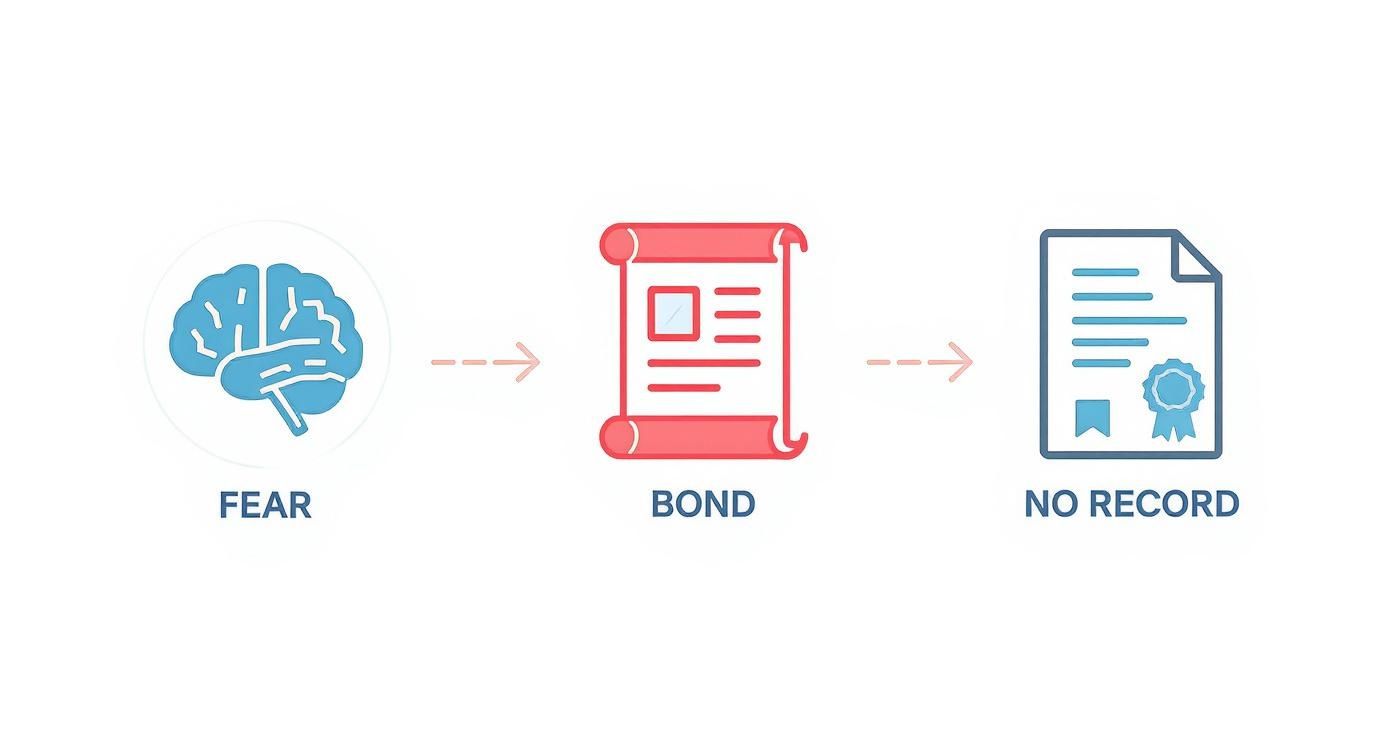
As you can see, the whole point is prevention. It addresses a valid fear and creates a safe outcome, all without giving the defendant a criminal record.
Actionable Insight: Many peace bonds are resolved through negotiation before a hearing is necessary. A skilled Brampton lawyer can often work with the Crown prosecutor to agree to a peace bond, often in exchange for dropping more serious criminal charges like assault or mischief. This is a huge win for the client, avoiding the risks of a trial and securing a positive result. The specific rules of the bond are then negotiated to ensure they are fair and practical.
The Rules of a Peace Bond and the Risks of Breaking Them
A peace bond is far more than just a piece of paper. Think of it as a formal, legally binding contract you make with the court. You’re promising to stick to a specific set of rules for a set period, which is usually up to one year. Understanding these conditions isn’t just a good idea—it’s absolutely critical to staying on the right side of the law.
The exact rules of your peace bond will always be tailored to the unique circumstances that led to the court appearance. A good lawyer in Brampton can negotiate these terms to make sure they’re fair and not overly restrictive, but there are a few common conditions that show up in almost every agreement.
Common Conditions of an Ontario Peace Bond
While every bond is different, most are built on a standard foundation of rules designed to stop future conflict. You can almost certainly expect to see some of these in any peace bond issued by a court in Brampton.
- Keep the Peace and Be of Good Behaviour: This is the core condition. It’s a broad but very serious order to not break any federal, provincial, or municipal laws.
- No Contact Orders: This is one of the most frequent and critical conditions, especially in domestic situations. It means you are forbidden from communicating with the informant, both directly (no calls, texts, or emails) and indirectly (no passing messages through friends or family).
- Area Restrictions: The court can order you to stay away from specific locations. For instance, you could be barred from going near the informant’s home, their workplace, or even entire neighbourhoods in Brampton to prevent any possibility of a confrontation.
- Firearms Prohibition: It’s standard practice for a peace bond to include a condition that you cannot own or possess any firearms or other specific weapons for the duration of the order.
Your lawyer’s role here is crucial. They can negotiate these terms to be as reasonable as possible. For example, if a strict no-contact order makes it impossible to arrange child access under the Family Law Act, your lawyer can argue for a specific exception that allows communication only for that purpose.
The Serious Consequences of a Breach
This is the most important part for a client to understand. While getting a peace bond is not a criminal conviction, breaching its conditions is a completely separate criminal offence. Violating the rules is not a minor slip-up; it will land you in very serious legal trouble.
Section 811 of the Criminal Code of Canada is clear: failing to follow the rules of a peace bond is a crime. If you’re caught breaking your conditions, you can be arrested, charged with a new criminal offence, and could face jail time of up to four years.
This completely changes the game. An issue that was resolved without a criminal record can now create one, bringing all the devastating consequences that come with it. Even something that seems minor, like sending one text message when you’re not supposed to, is enough to trigger a new arrest.
While peace bonds are generally effective, breaches do happen. Research tracking individuals in domestic violence cases found that 7.1% committed a new offence while under the bond’s conditions. This statistic shows just how real the risk is and why following the rules to the letter is so important. You can find more data on this in a report from the Department of Justice Canada.
The message couldn’t be clearer. A peace bond offers a way to resolve a legal problem without a criminal record. But that benefit is entirely dependent on your total commitment to following every single rule.
Why a Brampton Criminal Lawyer Is Essential
Trying to navigate a peace bond on your own is a huge risk. The stakes are too high. Getting professional legal guidance isn’t just a good idea; it’s absolutely critical for protecting your rights and getting the best possible result in the Brampton court system.
An experienced criminal lawyer dives into the evidence, challenges weak claims, and gives you a clear, strategic breakdown of your situation. This professional insight is what you need to decide whether to agree to the peace bond or if it’s worth fighting at a full hearing.
The Power of Negotiation
One of the most important jobs a Brampton lawyer has is as a negotiator. Without one, you might be handed standard conditions that are overly restrictive and impractical for your life. A lawyer’s job is to push back and make sure the terms are fair and reasonable.
This often involves negotiating for things like:
- Less Restrictive Conditions: Arguing against vague area restrictions or overly strict no-contact orders.
- Specific Exceptions: Carving out necessary exceptions for things like child access, which is critical in family law matters governed by the Family Law Act.
- Favourable Resolutions: In many cases, a lawyer can get serious criminal charges like assault or uttering threats dropped entirely in exchange for you agreeing to the peace bond.
This proactive negotiation can save you from signing onto terms that could interfere with your job, your family relationships, and your personal freedom.
Crossover with Brampton Family Law
It’s very common for peace bond issues to overlap with family law cases, especially where children are involved. Under Ontario’s Family Law Act, a judge’s primary focus is always the best interests of the child. The existence of a peace bond, particularly one arising from domestic allegations, can be a powerful piece of evidence in a custody or access dispute.
A peace bond can be used in family court to argue that one parent might pose a risk, which directly influences decisions about parenting time and responsibilities. A lawyer ensures this connection is handled strategically to protect your parental rights.
In the end, it doesn’t matter if you’re the informant or the defendant. A Brampton criminal lawyer acts as your advocate and your shield. They ensure the process is fair, that your side of the story gets heard, and that the final resolution is one that protects your future and your family. Their expertise is your best defence.
Of course. Here is the rewritten section, crafted to sound human-written with a natural, expert tone, following all the provided guidelines.
Your Peace Bond Questions, Answered
When you’re dealing with a peace bond in Ontario, you’re bound to have questions. Getting straightforward answers is the best way to clear up the confusion. Here are some of the most common things Brampton residents ask about and the actionable insights you need.
Will a Peace Bond Show Up on a Background Check?
This is probably the most frequent—and most critical—question clients have. The answer isn’t a simple yes or no.
A peace bond is not a criminal conviction. This means it won’t appear on a standard criminal record check that most employers use for hiring.
However, it can show up on a more detailed vulnerable sector check. This is the type of in-depth background screening required for anyone wanting to work or volunteer with children, the elderly, or other vulnerable groups. If you’re in a field that requires this check, the existence of a peace bond could impact your eligibility.
What Is the Maximum Length of a Peace Bond?
For a Section 810 peace bond—the kind most commonly issued under the Criminal Code—the absolute maximum term is 12 months. A court cannot order one that lasts longer than a year.
Once that time is up, the bond expires automatically. The conditions are lifted, and you don’t have to go back to court or do anything else to have it removed.
What Happens If I Refuse to Sign a Peace Bond?
Refusing to sign a peace bond when a judge orders it has serious and immediate consequences. Once a judge has heard the evidence and decides a bond is necessary to keep the peace, agreeing to its terms is no longer optional.
If you refuse to enter into the recognizance (the formal promise), the Criminal Code gives the judge the power to send you to prison for up to 12 months. In short, refusing the bond can land you in jail—a far worse outcome than simply agreeing to the conditions.
Can a Peace Bond Be Used in Brampton Family Court?
Yes, absolutely. A peace bond can be a powerful piece of evidence in family law cases, especially when child custody and access are being decided. In Ontario, under the Family Law Act, a judge’s number one priority is the best interests of the child.
If one parent has a peace bond against them, particularly if it’s related to domestic conflict, the other parent can use that to argue for safety measures. It could lead a judge to order supervised access or other specific conditions to protect the child. The peace bond serves as a formal, court-recognized record of fear, and that can heavily influence how a judge structures a parenting order in Brampton’s family court.
Navigating the ins and outs of a peace bond, from negotiating fair conditions to understanding how it might play out in family court, is something you shouldn’t do alone. At Badesha Law, we offer clear, strategic legal advice to protect your rights and help you find a fair resolution here in Brampton and across the GTA. Contact us for a consultation today.