

Navigating Brampton: New Drunk Driving Laws in Canada – Your Essential Guide
Recent changes to Canada’s drunk driving laws, outlined in the Criminal Code, have completely shifted the landscape for every driver in Brampton. The single most important update is the introduction of Mandatory Alcohol Screening (MAS). This change gives police the power to demand a breath sample during any lawful traffic stop, even if they have no reason to suspect you’ve been drinking.
This is a fundamental change to your rights and responsibilities. For a Brampton resident, understanding these new rules is the first actionable step in protecting yourself if you see flashing lights in your rearview mirror.
Understanding Your Rights Under New Impaired Driving Laws in Brampton
If you're a driver in Brampton, what used to be a routine traffic stop can now escalate into a criminal investigation much faster than before. Previously, the Criminal Code required an officer to have a "reasonable suspicion" that you had alcohol in your system before they could ask for a breath test. This suspicion usually came from signs like the smell of alcohol, slurred speech, or you admitting to having a drink.
That standard is now gone. Thanks to the new laws, any lawful traffic stop is now grounds for an officer to demand a roadside breath sample. This means you could be pulled over for something as minor as a broken taillight on Steeles Avenue or forgetting to signal a lane change on Queen Street and immediately be asked to blow into a screening device. This is a critical insight for every Brampton driver: a minor infraction can lead directly to a criminal investigation.
To give you a clearer picture of just how much has changed, here’s a quick summary of the most significant updates.
Key Changes to Canadian Impaired Driving Laws at a Glance
This table breaks down the most critical updates to the Criminal Code affecting drivers in Brampton and across Canada, providing actionable insights into what each change means for you.
| Legal Change | What It Means for Brampton Drivers | Actionable Insight |
|---|---|---|
| Mandatory Alcohol Screening (MAS) | Police can demand a breath sample at any lawful traffic stop, even without suspicion of drinking. | A routine stop for a minor traffic violation can now lead directly to a breath demand. Your best action is to comply and contact a lawyer immediately. |
| Elimination of "Bolus Drinking" Defence | The "last drink" defence, claiming alcohol was consumed just before driving and wasn't absorbed, is no longer valid. | Your Blood Alcohol Concentration (BAC) at the time of testing is what matters. Do not rely on timing your drinks as a defence strategy. |
| Increased Maximum Penalties | Harsher fines and longer potential jail sentences for all impaired driving offences under the Criminal Code. | The stakes are higher than ever. Even a first-time offence in Brampton can have severe consequences, making a strong legal defence essential. |
| Expanded Drug Impairment Testing | Police have more tools, including roadside oral fluid tests, to screen for drug-impaired driving. | Being under the influence of drugs (including cannabis) while driving is targeted as aggressively as alcohol impairment. Understand the new per se limits. |
These changes represent a complete overhaul of how impaired driving is policed in Canada.
The Impact on Brampton Drivers
This massive shift in police authority has profound implications for every single driver in Brampton. An interaction that might have once ended with a simple warning can now spiral into a full-blown criminal investigation. The first actionable step to protecting yourself is understanding this new reality.
A mistake made in those first crucial moments of a traffic stop, often stemming from a misunderstanding of these new rules, can seriously damage your case right from the start. Knowing what to do, what to say, and what not to say has never been more critical.
The core change is this: police no longer need to suspect you've been drinking to test you. This single update to the Criminal Code has reshaped the nature of impaired driving investigations across Canada, including right here in Brampton.
Making Proactive Choices
Your rights and obligations are now governed by a complex mix of the federal Criminal Code and Ontario's provincial laws, like the Highway Traffic Act and the Family Law Act (which can be impacted by driving prohibitions affecting family responsibilities). Navigating this legal framework requires careful attention, and it's essential to be aware of how your actions during a stop can be interpreted by law enforcement.
To fully understand and protect your rights, making informed choices about consumption is key. For those looking for options, you can locate non-alcoholic alternatives in Brampton, Ontario.
This guide will continue to break down these new laws, explain how they affect you personally, and outline how an expert legal team can defend your rights. From the moment you are pulled over, every action you take matters.
What Mandatory Alcohol Screening Means for Brampton Drivers
One of the biggest shifts in Canadian drunk driving law has been the introduction of Mandatory Alcohol Screening (MAS). This rule, part of updates to the Criminal Code, completely changes the dynamic of a traffic stop for every driver in Brampton and across the country. It essentially removed the protective barrier that once stood between being pulled over and being investigated for impaired driving.
Before these changes, a police officer needed a "reasonable suspicion" to demand you provide a breath sample. This meant they had to see clear signs of impairment—things like the smell of alcohol on your breath, slurred speech, or you admitting you’d been drinking. That requirement is now gone.
This change gives police a sweeping new authority. Now, during any lawful traffic stop, an officer can demand a preliminary breath sample without needing any reason at all to think you've had a drink.
The New Reality of Roadside Stops in Brampton
Imagine you're driving home in Brampton and get pulled over for something minor, like a burnt-out taillight or forgetting to signal a lane change. In the past, this would likely end with a simple warning or a small ticket. Under the new laws, that same lawful stop is all an officer needs to legally require you to blow into an Approved Screening Device (ASD).
This is the crucial takeaway for every Brampton driver: a perfectly lawful traffic stop for a non-driving-related issue can now instantly become an impaired driving investigation. The old threshold of suspicion has been completely eliminated.
This change was brought in to make roads safer by catching more impaired drivers. The statistics show that tougher measures can have a real impact. In fact, after similar strict sanctions were introduced in Canada, data showed a 39% decrease in fatalities among drivers found to be impaired by alcohol in the following three years. You can explore the data behind these legislative changes to see their full impact.
The Serious Consequences of Refusal
Understanding MAS also means you must understand the penalties for not complying. Refusing to provide a breath sample when a police officer lawfully demands one is a separate criminal offence under the Criminal Code.
Many drivers mistakenly believe that if they haven't been drinking, they can just say no to the test. This is a critical error. The consequences for refusing a breathalyzer test are often just as severe—and sometimes worse—than being convicted for driving with a blood alcohol concentration "Over 80."
Actionable insight: Never refuse a lawful breath demand. A refusal conviction can lead to:
- A significant fine and a mandatory victim surcharge.
- A lengthy, province-wide driving prohibition.
- A permanent criminal record that can affect employment, travel, and immigration status.
Defending Against a Charge Under MAS
While police powers have expanded, your rights have not disappeared. A charge that starts with a Mandatory Alcohol Screening demand is not an automatic conviction, and an experienced criminal defence lawyer in Brampton can challenge the case on several grounds.
For instance, a key defence strategy is to scrutinize the initial traffic stop itself. The police demand for a breath sample is only lawful if the stop that came before it was also lawful. If an officer pulled you over without a valid reason, any evidence they gathered afterward—including your breath sample—could potentially be excluded in court.
Furthermore, the Approved Screening Device used on the roadside must be properly maintained and calibrated. A skilled lawyer will demand and review the device’s maintenance logs. Any procedural misstep by the police can become the cornerstone of your defence. This is why seeking expert legal counsel from a firm like Badesha Law is vital to examine every detail and protect your rights.
The Growing Challenge of Drug-Impaired Driving Charges in Brampton
For years, drunk driving was the main focus of roadside enforcement, but the legal landscape has changed dramatically. Today, drug-impaired driving charges are just as serious a threat for drivers in Brampton, with laws now targeting everything from cannabis to common prescription drugs. But unlike the clear-cut science of a breathalyzer, proving drug impairment is a much more complex and subjective process.
This shift took hold after Canada legalized cannabis in 2018, triggering major updates to the Criminal Code. New laws were introduced specifically to tackle drug-impaired driving, making it a criminal offence to have certain levels of drugs in your system. This created strict "per se" limits for substances like THC and zero-tolerance rules for others. To enforce this, police were given new tools. You can find more detail on these changes on the Public Safety Canada website.
Knowing these new rules is the first step in building a solid defence if you ever find yourself facing a charge in Brampton.
Demystifying Per Se Drug Limits
The idea of "per se" limits is now at the heart of Canada's drug-impaired driving laws. Think of it like the 0.08 Blood Alcohol Concentration (BAC) limit—it’s illegal to have a certain concentration of a drug in your blood within two hours of driving, whether you feel impaired or not.
For cannabis, the law sets specific THC concentration levels, measured in nanograms (ng) per millilitre (ml) of blood:
- Summary Conviction Offence: Driving with 2 ng but less than 5 ng of THC per ml of blood. This is treated as a less serious offence.
- Hybrid Offence: Driving with 5 ng or more of THC per ml of blood. This is a more serious charge that can be prosecuted either summarily or by indictment.
- Hybrid Offence (Combined): Driving with a BAC of 50 mg or more plus a THC level of 2.5 ng or more.
Actionable insight: THC can stay in your system long after impairment fades. This means you could be charged with a criminal offence even if you weren't actually impaired when pulled over in Brampton. Be aware of how long cannabis can be detected after consumption.
Roadside Testing for Drug Impairment
Police in Brampton now have two main tools they use at the roadside to investigate suspected drug impairment: the oral fluid screener and the Standardized Field Sobriety Test (SFST).
If an officer has a reasonable suspicion that you have drugs in your system, they can demand you provide a saliva sample for an oral fluid screener. This device checks for the recent presence of specific drugs, including THC. A positive result gives them the grounds they need to investigate further, which usually means an arrest and a demand for a blood sample.
The SFST is a series of physical coordination exercises performed on the side of the road. If an officer believes you've failed these tests, they may have enough reason to call in a specially trained Drug Recognition Expert.
Think of it this way: a breathalyzer for alcohol is like a simple pass/fail math test—it gives a clear number. In contrast, the process for detecting drug impairment is more like a multi-part essay exam, full of subjective observations and complicated procedures that are wide open to challenge.
The Drug Recognition Expert Evaluation
If a police officer has reasonable grounds to believe a drug has impaired your ability to drive, they can demand you undergo an evaluation by a Drug Recognition Expert (DRE). This isn't a quick test; it's an intensive, 12-step process that can take over an hour to complete back at the police station in Brampton.
The DRE evaluation includes a whole battery of checks:
- A breath alcohol test to rule out alcohol as the main cause.
- An interview with the arresting officer.
- A preliminary physical exam and first pulse check.
- Eye examinations (checking pupil size in different lighting).
- Divided attention tests (like the ones done at the roadside).
- Checks of vital signs like blood pressure, temperature, and a second pulse.
- A dark room examination of your pupils.
- An examination of your muscle tone.
- A search for injection sites and a third pulse check.
- A detailed interview about your drug use.
- The DRE’s analysis and opinion based on all the results.
- A demand for a sample of urine, saliva, or blood for analysis.
This long and highly subjective process creates many opportunities for a skilled Brampton defence lawyer to challenge the evidence. At Badesha Law, we scrutinize every step of the DRE evaluation, from the officer's training to the scientific reliability of their conclusions, to make sure your rights were protected.
What Happens Immediately After an Impaired Driving Charge in Brampton
Getting charged with impaired driving in Brampton isn't just one problem—it’s two. The moment you are charged, two powerful legal processes kick into gear at the same time. You’re suddenly facing a criminal proceeding under the Criminal Code of Canada and an administrative penalty system under Ontario’s Highway Traffic Act.
Understanding what happens in these first critical moments is absolutely essential. The consequences start long before you ever step foot inside a Brampton courtroom.
The Immediate Licence Suspension and Vehicle Impoundment
The first and most jarring reality for most people is the immediate loss of their driving privileges. If you are charged with driving with a blood alcohol concentration over 80 mg/100 ml or for refusing to provide a sample, Ontario law mandates an instant 90-day Administrative Driver’s Licence Suspension (ADLS).
This isn't a "maybe" situation; it happens right there on the spot. This suspension is completely separate from any driving ban a judge might impose later if you are convicted.
At the same time, the vehicle you were driving will be impounded for seven days, and it doesn't matter who the owner is. You'll be on the hook for all the towing and storage fees. These administrative penalties are designed to be swift and severe.
The key takeaway here is that these penalties are automatic. They are applied by the police based on the charge itself, not on a finding of guilt. You lose your licence and your vehicle is taken away based on the officer's grounds for the charge, creating an immediate and stressful disruption to your life in Brampton.
Critical First Steps You Must Take
The hours and days following a charge are a crucial window of opportunity. What you do—or fail to do—can have a massive impact on the outcome of your case. Your top priorities should be preserving evidence and getting expert legal help without any delay.
Here’s your actionable checklist:
-
Contact a Brampton Criminal Defence Lawyer Immediately: This is the single most important step. A lawyer specializing in impaired driving cases in Brampton, like the team at Badesha Law, can give you urgent advice, represent you at your first court appearance, and start building your defence from day one.
-
Document Everything You Remember: As soon as you can, write down every single detail. Note the time and location of the stop in Brampton, what the officer said, any witnesses, and exactly what you ate or drank in the hours leading up to the stop. Small details can become critical pieces of your defence.
-
Preserve Physical Evidence: Gather any receipts, text messages, or phone records that can help build a timeline. If you had passengers, get their contact information right away, as they may be important witnesses.
This chart shows the typical process for drug-impaired driving investigations.
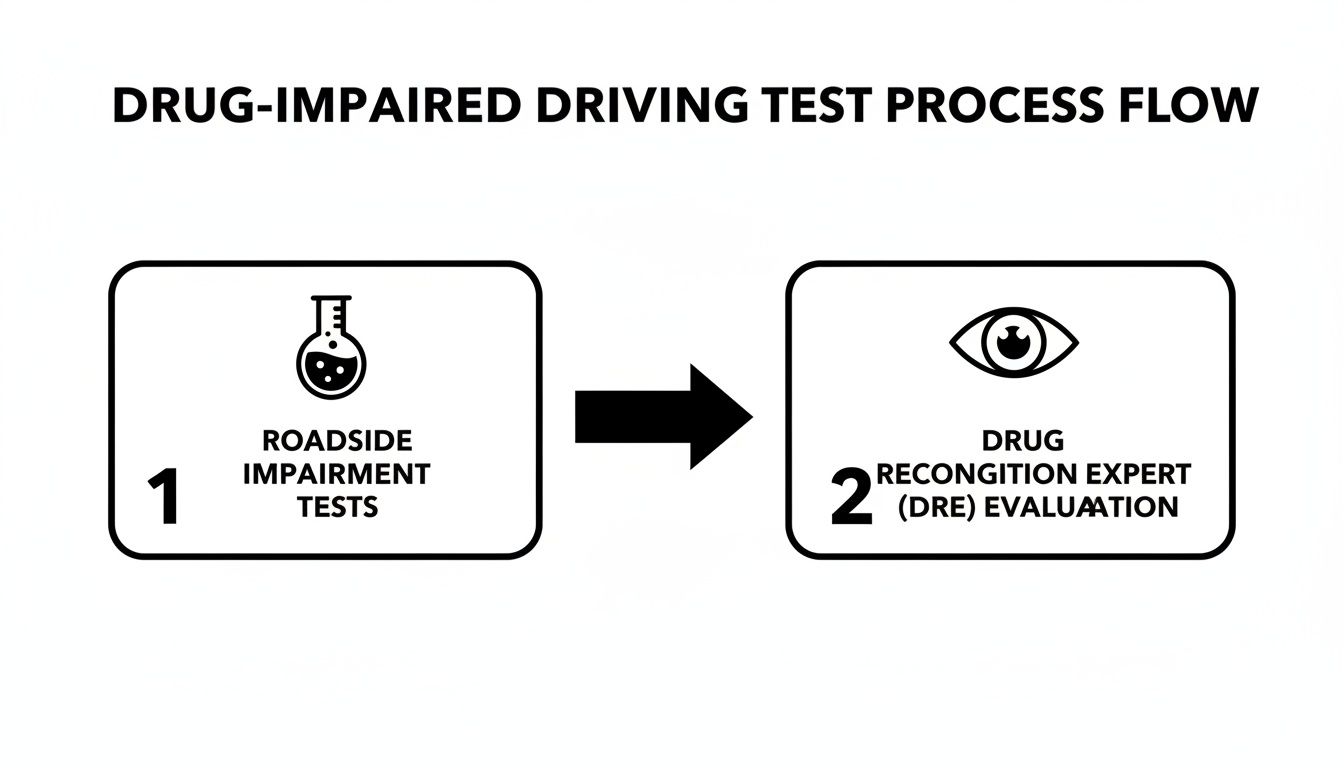
As the flowchart illustrates, what starts as a simple roadside test can quickly escalate into a much more intensive evaluation, highlighting the many procedural steps that must be followed correctly.
How a Lawyer Intervenes Immediately
Hiring a lawyer right away isn't just about preparing for a trial; it's about managing the immediate crisis. An experienced Brampton legal team will immediately initiate the disclosure process—formally requesting all the evidence the police and prosecution have against you, including the officer’s notes and any video footage.
If you are held in custody, they can also start preparing for your bail hearing. From the very beginning, your lawyer acts as both your shield and your advocate. They ensure your rights under the Criminal Code and the Highway Traffic Act in Ontario are protected at every stage of this complex process. Acting fast gives you the best possible chance to challenge the penalties and fight the charges.
How to Build a Strong Legal Defence in Brampton
If you’re facing an impaired driving charge in Brampton, it’s easy to feel like the fight is already lost. But it’s critical to remember that a charge is not a conviction. The Crown prosecutor carries the entire burden of proving every single element of their case beyond a reasonable doubt, and a skilled defence lawyer knows exactly where to look for the cracks.
Building a strong defence is a methodical process of scrutinizing every detail of the police investigation to ensure your rights under the Criminal Code and the Charter of Rights and Freedoms were respected. Every step, from the moment the police lights started flashing to the final breath sample, is a potential point of legal challenge.
Challenging the Initial Traffic Stop
The very foundation of any impaired driving case is the legality of the traffic stop. Under Canadian law, a police officer can’t just pull you over based on a hunch. They must have a valid, specific reason grounded in law, like witnessing a traffic violation or a genuine concern for public safety.
This is the first and most important pressure point your Brampton defence lawyer will investigate. If the stop was unlawful, then any evidence gathered from that point forward could be deemed inadmissible under the Charter. This is often called the "fruit of the poisonous tree" doctrine, and it has the power to dismantle the prosecution’s case.
Protecting Your Charter Rights
The Canadian Charter of Rights and Freedoms guarantees you fundamental protections during any interaction with law enforcement. A violation of these rights is a powerful tool for your defence.
A few key Charter rights often come into play in Brampton impaired driving cases:
- The Right to Counsel: As soon as you are arrested or detained, the police must inform you of your right to speak with a lawyer without delay. They also have to give you a reasonable chance to actually do it. Any failure in this duty can lead to evidence being excluded.
- The Right to be Free from Unreasonable Search and Seizure: This protects you from unwarranted police intrusion, and it’s frequently argued in relation to how breath or blood samples were collected.
- The Right to be Tried Within a Reasonable Time: If the prosecution causes unreasonable delays in getting your case to trial, the charges can be stayed.
A violation of your Charter rights isn't a small technicality. It is a fundamental breach of Canadian law. A successful Charter argument can make crucial evidence, like breathalyzer results, inadmissible, often leading to a complete acquittal in a Brampton court.
Scrutinizing the Evidence and Equipment
Even if the stop was legal and your rights were upheld, the evidence itself has to be airtight. Breathalyzers and roadside screening devices are complicated machines that need precise maintenance, calibration, and operation to work correctly. A good Brampton defence lawyer will never just accept the machine’s readings at face value.
At Badesha Law, we demand and review all maintenance and calibration records for the specific device used in your case. We look for inconsistencies or missed service dates that can be used to cast serious doubt on the accuracy of the blood alcohol readings. The same goes for drug-impaired driving cases—the strict procedures must be followed perfectly.
Exploring Complex Legal Defences
Beyond procedural and Charter arguments, there are often specific legal defences that can be raised depending on the unique facts of your case. For example, while the old "last drink" defence has been mostly eliminated by recent law changes, other sophisticated arguments are still very much alive.
These defences might involve challenging the officer's subjective observations, presenting evidence of a medical condition that could mimic signs of impairment, or finding critical gaps in the Crown's timeline of events. The goal is always to raise a reasonable doubt. If the judge has any reasonable doubt about any single element of the offence, they are legally required to acquit. This is exactly why having a strategic and experienced legal team on your side is essential.
Protecting Your Future from Long-Term Consequences
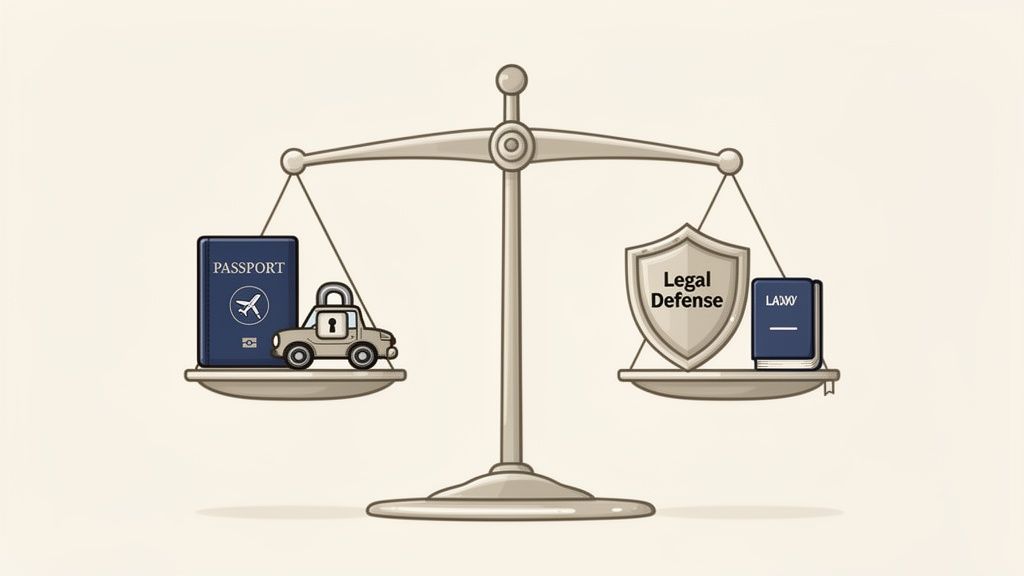
An impaired driving charge in Brampton isn't just a one-time legal headache. A conviction under the Criminal Code goes far beyond fines and court dates, triggering a cascade of serious, lasting consequences that can disrupt your life for years to come.
The most immediate and damaging impact is a permanent criminal record. This label can lock you out of certain jobs, create massive hurdles for your immigration or citizenship status, and bar you from travelling to the United States. For Brampton families, a driving prohibition can also have implications under the Family Law Act, affecting obligations related to child transportation and access.
The Financial and Personal Toll
Beyond the criminal record, the financial hit is staggering. Insurance rates for drivers with an impaired driving conviction can skyrocket by thousands of dollars every single year. You will also be forced to complete Ontario's mandatory "Back on Track" remedial program, which comes with its own costs and a significant time commitment.
On top of that, a conviction will likely mean a mandatory period with an ignition interlock device installed in your vehicle—at your own expense. This device demands a clean breath sample before the car will even start.
Mitigating the Long-Term Damage
This harsh reality is exactly why a proactive, strategic legal defence is so critical. At Badesha Law, our primary goal is to shield your future by aggressively fighting to reduce these severe outcomes. We meticulously pick apart every piece of evidence, searching for any opportunity to have the charges withdrawn or dismissed entirely.
The stakes are incredibly high. A conviction affects your freedom, finances, and future opportunities. Our focus is on a single objective: minimizing the long-term damage to your life.
When an outright acquittal isn't on the table, we work tirelessly to negotiate for a lesser charge, like a careless driving ticket under the Highway Traffic Act, which carries no criminal record. If the case does proceed to sentencing, we prepare a compelling and detailed submission to argue for the most lenient outcome possible.
The aftermath of a car accident can extend beyond legal trouble into emotional and psychological distress. For help in recovery, you might consider exploring ICBC counselling for accident recovery. Protecting your future means addressing every single aspect of the fallout from a charge.
Unpacking the New Drunk Driving Laws: Your Questions Answered
When you're pulled over in Brampton and facing an impaired driving investigation, your mind races with questions. The recent changes to Canada’s laws have made things even more confusing. Here are some straightforward answers to the questions we hear most often.
I Haven’t Had a Drop to Drink. Can I Refuse the Roadside Breath Test?
No, you cannot. This is one of the most significant changes under the Mandatory Alcohol Screening laws in the Criminal Code. A police officer no longer needs a specific reason to suspect you've been drinking before they can demand a breath sample at the roadside.
Refusing to provide that sample is a criminal offence in itself. The penalties for refusal are often just as harsh as blowing over the legal limit. Even if you're 100% sober, the law requires you to comply. The best actionable advice is to provide the sample and then call a defence lawyer immediately to protect your rights.
What Are the Legal Limits for Cannabis When Driving in Ontario?
Just like with alcohol, Canada has set strict blood concentration limits for THC, the active compound in cannabis. These are "per se" limits, meaning that if you have a certain amount of THC in your blood within two hours of driving, you can be charged—whether you feel impaired or not.
The breakdown is as follows:
- 2 to 5 nanograms (ng) of THC per millilitre (ml) of blood: A less serious offence, but still carries significant penalties.
- 5 ng or more of THC per ml of blood: A more serious hybrid offence.
- 50mg/100ml of alcohol combined with 2.5 ng/ml or more of THC: Combining substances also leads to a serious hybrid offence charge.
Will a Canadian DUI Conviction Keep Me Out of the United States?
There's a very high chance it will. U.S. border officials frequently treat a Canadian impaired driving conviction as a "crime of moral turpitude." This designation can make you criminally inadmissible to the U.S., effectively barring you from entry.
If you have a conviction, you may need to apply for a U.S. Entry Waiver, which is a complicated, expensive, and time-consuming process with no guarantee of success. For Brampton residents who travel for work or family, this is one of the most devastating long-term consequences of a DUI.
An impaired driving charge in Brampton is a serious legal crisis that demands immediate, skilled legal action. The team at Badesha Law is here to stand up for your rights, work to keep your licence, and build the strongest possible defence for your case. Your future is on the line—don't wait. Contact us today for expert legal guidance.