Navigating Brampton: New Drunk Driving Laws in Canada – Your Essential Guide

Recent changes to Canada’s drunk driving laws, outlined in the Criminal Code, have completely shifted the landscape for every driver in Brampton. The single most important update is the introduction of Mandatory Alcohol Screening (MAS). This change gives police the power to demand a breath sample during any lawful traffic stop, even if they have no reason to suspect you’ve been drinking.

This is a fundamental change to your rights and responsibilities. For a Brampton resident, understanding these new rules is the first actionable step in protecting yourself if you see flashing lights in your rearview mirror.

Understanding Your Rights Under New Impaired Driving Laws in Brampton

If you're a driver in Brampton, what used to be a routine traffic stop can now escalate into a criminal investigation much faster than before. Previously, the Criminal Code required an officer to have a "reasonable suspicion" that you had alcohol in your system before they could ask for a breath test. This suspicion usually came from signs like the smell of alcohol, slurred speech, or you admitting to having a drink.

That standard is now gone. Thanks to the new laws, any lawful traffic stop is now grounds for an officer to demand a roadside breath sample. This means you could be pulled over for something as minor as a broken taillight on Steeles Avenue or forgetting to signal a lane change on Queen Street and immediately be asked to blow into a screening device. This is a critical insight for every Brampton driver: a minor infraction can lead directly to a criminal investigation.

To give you a clearer picture of just how much has changed, here’s a quick summary of the most significant updates.

Key Changes to Canadian Impaired Driving Laws at a Glance

This table breaks down the most critical updates to the Criminal Code affecting drivers in Brampton and across Canada, providing actionable insights into what each change means for you.

Legal Change What It Means for Brampton Drivers Actionable Insight
Mandatory Alcohol Screening (MAS) Police can demand a breath sample at any lawful traffic stop, even without suspicion of drinking. A routine stop for a minor traffic violation can now lead directly to a breath demand. Your best action is to comply and contact a lawyer immediately.
Elimination of "Bolus Drinking" Defence The "last drink" defence, claiming alcohol was consumed just before driving and wasn't absorbed, is no longer valid. Your Blood Alcohol Concentration (BAC) at the time of testing is what matters. Do not rely on timing your drinks as a defence strategy.
Increased Maximum Penalties Harsher fines and longer potential jail sentences for all impaired driving offences under the Criminal Code. The stakes are higher than ever. Even a first-time offence in Brampton can have severe consequences, making a strong legal defence essential.
Expanded Drug Impairment Testing Police have more tools, including roadside oral fluid tests, to screen for drug-impaired driving. Being under the influence of drugs (including cannabis) while driving is targeted as aggressively as alcohol impairment. Understand the new per se limits.

These changes represent a complete overhaul of how impaired driving is policed in Canada.

The Impact on Brampton Drivers

This massive shift in police authority has profound implications for every single driver in Brampton. An interaction that might have once ended with a simple warning can now spiral into a full-blown criminal investigation. The first actionable step to protecting yourself is understanding this new reality.

A mistake made in those first crucial moments of a traffic stop, often stemming from a misunderstanding of these new rules, can seriously damage your case right from the start. Knowing what to do, what to say, and what not to say has never been more critical.

The core change is this: police no longer need to suspect you've been drinking to test you. This single update to the Criminal Code has reshaped the nature of impaired driving investigations across Canada, including right here in Brampton.

Making Proactive Choices

Your rights and obligations are now governed by a complex mix of the federal Criminal Code and Ontario's provincial laws, like the Highway Traffic Act and the Family Law Act (which can be impacted by driving prohibitions affecting family responsibilities). Navigating this legal framework requires careful attention, and it's essential to be aware of how your actions during a stop can be interpreted by law enforcement.

To fully understand and protect your rights, making informed choices about consumption is key. For those looking for options, you can locate non-alcoholic alternatives in Brampton, Ontario.

This guide will continue to break down these new laws, explain how they affect you personally, and outline how an expert legal team can defend your rights. From the moment you are pulled over, every action you take matters.

What Mandatory Alcohol Screening Means for Brampton Drivers

One of the biggest shifts in Canadian drunk driving law has been the introduction of Mandatory Alcohol Screening (MAS). This rule, part of updates to the Criminal Code, completely changes the dynamic of a traffic stop for every driver in Brampton and across the country. It essentially removed the protective barrier that once stood between being pulled over and being investigated for impaired driving.

Before these changes, a police officer needed a "reasonable suspicion" to demand you provide a breath sample. This meant they had to see clear signs of impairment—things like the smell of alcohol on your breath, slurred speech, or you admitting you’d been drinking. That requirement is now gone.

This change gives police a sweeping new authority. Now, during any lawful traffic stop, an officer can demand a preliminary breath sample without needing any reason at all to think you've had a drink.

The New Reality of Roadside Stops in Brampton

Imagine you're driving home in Brampton and get pulled over for something minor, like a burnt-out taillight or forgetting to signal a lane change. In the past, this would likely end with a simple warning or a small ticket. Under the new laws, that same lawful stop is all an officer needs to legally require you to blow into an Approved Screening Device (ASD).

This is the crucial takeaway for every Brampton driver: a perfectly lawful traffic stop for a non-driving-related issue can now instantly become an impaired driving investigation. The old threshold of suspicion has been completely eliminated.

This change was brought in to make roads safer by catching more impaired drivers. The statistics show that tougher measures can have a real impact. In fact, after similar strict sanctions were introduced in Canada, data showed a 39% decrease in fatalities among drivers found to be impaired by alcohol in the following three years. You can explore the data behind these legislative changes to see their full impact.

The Serious Consequences of Refusal

Understanding MAS also means you must understand the penalties for not complying. Refusing to provide a breath sample when a police officer lawfully demands one is a separate criminal offence under the Criminal Code.

Many drivers mistakenly believe that if they haven't been drinking, they can just say no to the test. This is a critical error. The consequences for refusing a breathalyzer test are often just as severe—and sometimes worse—than being convicted for driving with a blood alcohol concentration "Over 80."

Actionable insight: Never refuse a lawful breath demand. A refusal conviction can lead to:

  • A significant fine and a mandatory victim surcharge.
  • A lengthy, province-wide driving prohibition.
  • A permanent criminal record that can affect employment, travel, and immigration status.

Defending Against a Charge Under MAS

While police powers have expanded, your rights have not disappeared. A charge that starts with a Mandatory Alcohol Screening demand is not an automatic conviction, and an experienced criminal defence lawyer in Brampton can challenge the case on several grounds.

For instance, a key defence strategy is to scrutinize the initial traffic stop itself. The police demand for a breath sample is only lawful if the stop that came before it was also lawful. If an officer pulled you over without a valid reason, any evidence they gathered afterward—including your breath sample—could potentially be excluded in court.

Furthermore, the Approved Screening Device used on the roadside must be properly maintained and calibrated. A skilled lawyer will demand and review the device’s maintenance logs. Any procedural misstep by the police can become the cornerstone of your defence. This is why seeking expert legal counsel from a firm like Badesha Law is vital to examine every detail and protect your rights.

The Growing Challenge of Drug-Impaired Driving Charges in Brampton

For years, drunk driving was the main focus of roadside enforcement, but the legal landscape has changed dramatically. Today, drug-impaired driving charges are just as serious a threat for drivers in Brampton, with laws now targeting everything from cannabis to common prescription drugs. But unlike the clear-cut science of a breathalyzer, proving drug impairment is a much more complex and subjective process.

This shift took hold after Canada legalized cannabis in 2018, triggering major updates to the Criminal Code. New laws were introduced specifically to tackle drug-impaired driving, making it a criminal offence to have certain levels of drugs in your system. This created strict "per se" limits for substances like THC and zero-tolerance rules for others. To enforce this, police were given new tools. You can find more detail on these changes on the Public Safety Canada website.

Knowing these new rules is the first step in building a solid defence if you ever find yourself facing a charge in Brampton.

Demystifying Per Se Drug Limits

The idea of "per se" limits is now at the heart of Canada's drug-impaired driving laws. Think of it like the 0.08 Blood Alcohol Concentration (BAC) limit—it’s illegal to have a certain concentration of a drug in your blood within two hours of driving, whether you feel impaired or not.

For cannabis, the law sets specific THC concentration levels, measured in nanograms (ng) per millilitre (ml) of blood:

  • Summary Conviction Offence: Driving with 2 ng but less than 5 ng of THC per ml of blood. This is treated as a less serious offence.
  • Hybrid Offence: Driving with 5 ng or more of THC per ml of blood. This is a more serious charge that can be prosecuted either summarily or by indictment.
  • Hybrid Offence (Combined): Driving with a BAC of 50 mg or more plus a THC level of 2.5 ng or more.

Actionable insight: THC can stay in your system long after impairment fades. This means you could be charged with a criminal offence even if you weren't actually impaired when pulled over in Brampton. Be aware of how long cannabis can be detected after consumption.

Roadside Testing for Drug Impairment

Police in Brampton now have two main tools they use at the roadside to investigate suspected drug impairment: the oral fluid screener and the Standardized Field Sobriety Test (SFST).

If an officer has a reasonable suspicion that you have drugs in your system, they can demand you provide a saliva sample for an oral fluid screener. This device checks for the recent presence of specific drugs, including THC. A positive result gives them the grounds they need to investigate further, which usually means an arrest and a demand for a blood sample.

The SFST is a series of physical coordination exercises performed on the side of the road. If an officer believes you've failed these tests, they may have enough reason to call in a specially trained Drug Recognition Expert.

Think of it this way: a breathalyzer for alcohol is like a simple pass/fail math test—it gives a clear number. In contrast, the process for detecting drug impairment is more like a multi-part essay exam, full of subjective observations and complicated procedures that are wide open to challenge.

The Drug Recognition Expert Evaluation

If a police officer has reasonable grounds to believe a drug has impaired your ability to drive, they can demand you undergo an evaluation by a Drug Recognition Expert (DRE). This isn't a quick test; it's an intensive, 12-step process that can take over an hour to complete back at the police station in Brampton.

The DRE evaluation includes a whole battery of checks:

  1. A breath alcohol test to rule out alcohol as the main cause.
  2. An interview with the arresting officer.
  3. A preliminary physical exam and first pulse check.
  4. Eye examinations (checking pupil size in different lighting).
  5. Divided attention tests (like the ones done at the roadside).
  6. Checks of vital signs like blood pressure, temperature, and a second pulse.
  7. A dark room examination of your pupils.
  8. An examination of your muscle tone.
  9. A search for injection sites and a third pulse check.
  10. A detailed interview about your drug use.
  11. The DRE’s analysis and opinion based on all the results.
  12. A demand for a sample of urine, saliva, or blood for analysis.

This long and highly subjective process creates many opportunities for a skilled Brampton defence lawyer to challenge the evidence. At Badesha Law, we scrutinize every step of the DRE evaluation, from the officer's training to the scientific reliability of their conclusions, to make sure your rights were protected.

What Happens Immediately After an Impaired Driving Charge in Brampton

Getting charged with impaired driving in Brampton isn't just one problem—it’s two. The moment you are charged, two powerful legal processes kick into gear at the same time. You’re suddenly facing a criminal proceeding under the Criminal Code of Canada and an administrative penalty system under Ontario’s Highway Traffic Act.

Understanding what happens in these first critical moments is absolutely essential. The consequences start long before you ever step foot inside a Brampton courtroom.

The Immediate Licence Suspension and Vehicle Impoundment

The first and most jarring reality for most people is the immediate loss of their driving privileges. If you are charged with driving with a blood alcohol concentration over 80 mg/100 ml or for refusing to provide a sample, Ontario law mandates an instant 90-day Administrative Driver’s Licence Suspension (ADLS).

This isn't a "maybe" situation; it happens right there on the spot. This suspension is completely separate from any driving ban a judge might impose later if you are convicted.

At the same time, the vehicle you were driving will be impounded for seven days, and it doesn't matter who the owner is. You'll be on the hook for all the towing and storage fees. These administrative penalties are designed to be swift and severe.

The key takeaway here is that these penalties are automatic. They are applied by the police based on the charge itself, not on a finding of guilt. You lose your licence and your vehicle is taken away based on the officer's grounds for the charge, creating an immediate and stressful disruption to your life in Brampton.

Critical First Steps You Must Take

The hours and days following a charge are a crucial window of opportunity. What you do—or fail to do—can have a massive impact on the outcome of your case. Your top priorities should be preserving evidence and getting expert legal help without any delay.

Here’s your actionable checklist:

  1. Contact a Brampton Criminal Defence Lawyer Immediately: This is the single most important step. A lawyer specializing in impaired driving cases in Brampton, like the team at Badesha Law, can give you urgent advice, represent you at your first court appearance, and start building your defence from day one.

  2. Document Everything You Remember: As soon as you can, write down every single detail. Note the time and location of the stop in Brampton, what the officer said, any witnesses, and exactly what you ate or drank in the hours leading up to the stop. Small details can become critical pieces of your defence.

  3. Preserve Physical Evidence: Gather any receipts, text messages, or phone records that can help build a timeline. If you had passengers, get their contact information right away, as they may be important witnesses.

This chart shows the typical process for drug-impaired driving investigations.
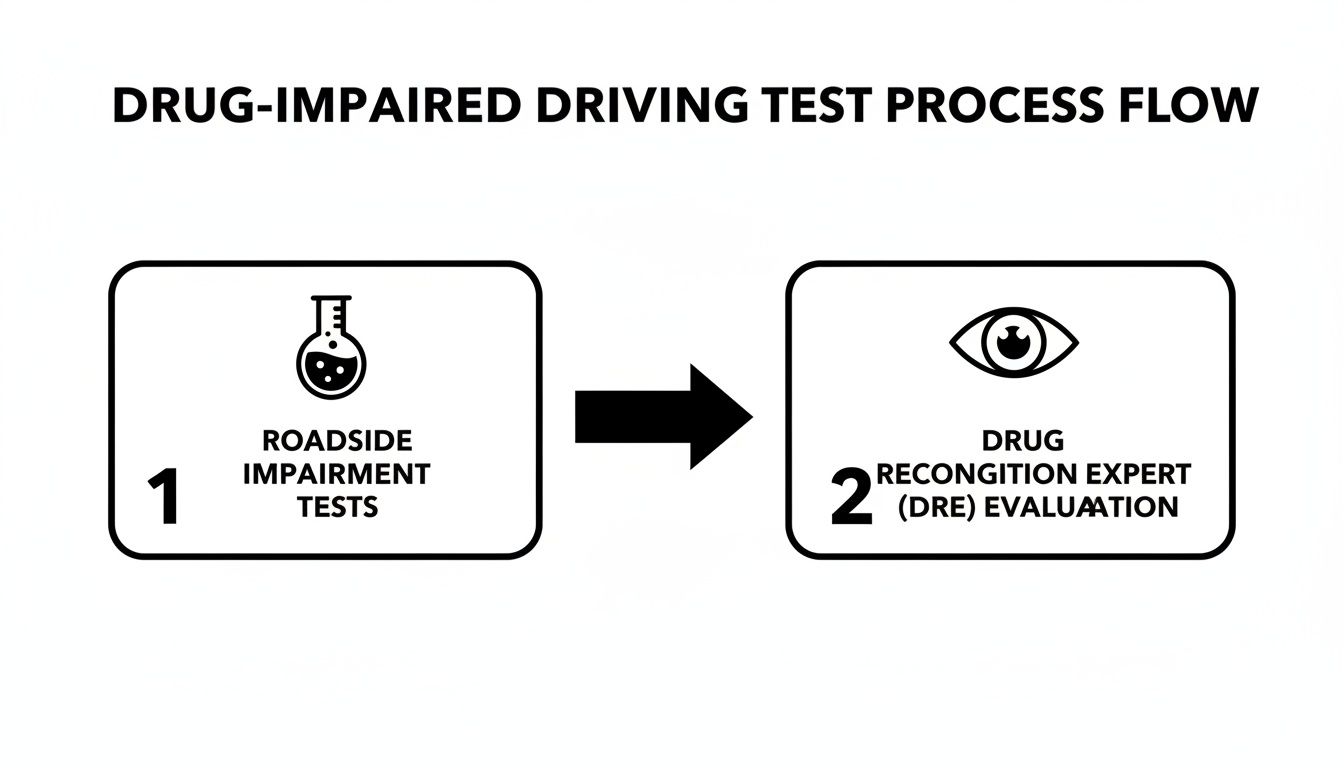
Flowchart detailing the drug-impaired driving test process, from roadside impairment tests to DRE evaluation.

As the flowchart illustrates, what starts as a simple roadside test can quickly escalate into a much more intensive evaluation, highlighting the many procedural steps that must be followed correctly.

How a Lawyer Intervenes Immediately

Hiring a lawyer right away isn't just about preparing for a trial; it's about managing the immediate crisis. An experienced Brampton legal team will immediately initiate the disclosure process—formally requesting all the evidence the police and prosecution have against you, including the officer’s notes and any video footage.

If you are held in custody, they can also start preparing for your bail hearing. From the very beginning, your lawyer acts as both your shield and your advocate. They ensure your rights under the Criminal Code and the Highway Traffic Act in Ontario are protected at every stage of this complex process. Acting fast gives you the best possible chance to challenge the penalties and fight the charges.

How to Build a Strong Legal Defence in Brampton

If you’re facing an impaired driving charge in Brampton, it’s easy to feel like the fight is already lost. But it’s critical to remember that a charge is not a conviction. The Crown prosecutor carries the entire burden of proving every single element of their case beyond a reasonable doubt, and a skilled defence lawyer knows exactly where to look for the cracks.

Building a strong defence is a methodical process of scrutinizing every detail of the police investigation to ensure your rights under the Criminal Code and the Charter of Rights and Freedoms were respected. Every step, from the moment the police lights started flashing to the final breath sample, is a potential point of legal challenge.

Challenging the Initial Traffic Stop

The very foundation of any impaired driving case is the legality of the traffic stop. Under Canadian law, a police officer can’t just pull you over based on a hunch. They must have a valid, specific reason grounded in law, like witnessing a traffic violation or a genuine concern for public safety.

This is the first and most important pressure point your Brampton defence lawyer will investigate. If the stop was unlawful, then any evidence gathered from that point forward could be deemed inadmissible under the Charter. This is often called the "fruit of the poisonous tree" doctrine, and it has the power to dismantle the prosecution’s case.

Protecting Your Charter Rights

The Canadian Charter of Rights and Freedoms guarantees you fundamental protections during any interaction with law enforcement. A violation of these rights is a powerful tool for your defence.

A few key Charter rights often come into play in Brampton impaired driving cases:

  • The Right to Counsel: As soon as you are arrested or detained, the police must inform you of your right to speak with a lawyer without delay. They also have to give you a reasonable chance to actually do it. Any failure in this duty can lead to evidence being excluded.
  • The Right to be Free from Unreasonable Search and Seizure: This protects you from unwarranted police intrusion, and it’s frequently argued in relation to how breath or blood samples were collected.
  • The Right to be Tried Within a Reasonable Time: If the prosecution causes unreasonable delays in getting your case to trial, the charges can be stayed.

A violation of your Charter rights isn't a small technicality. It is a fundamental breach of Canadian law. A successful Charter argument can make crucial evidence, like breathalyzer results, inadmissible, often leading to a complete acquittal in a Brampton court.

Scrutinizing the Evidence and Equipment

Even if the stop was legal and your rights were upheld, the evidence itself has to be airtight. Breathalyzers and roadside screening devices are complicated machines that need precise maintenance, calibration, and operation to work correctly. A good Brampton defence lawyer will never just accept the machine’s readings at face value.

At Badesha Law, we demand and review all maintenance and calibration records for the specific device used in your case. We look for inconsistencies or missed service dates that can be used to cast serious doubt on the accuracy of the blood alcohol readings. The same goes for drug-impaired driving cases—the strict procedures must be followed perfectly.

Exploring Complex Legal Defences

Beyond procedural and Charter arguments, there are often specific legal defences that can be raised depending on the unique facts of your case. For example, while the old "last drink" defence has been mostly eliminated by recent law changes, other sophisticated arguments are still very much alive.

These defences might involve challenging the officer's subjective observations, presenting evidence of a medical condition that could mimic signs of impairment, or finding critical gaps in the Crown's timeline of events. The goal is always to raise a reasonable doubt. If the judge has any reasonable doubt about any single element of the offence, they are legally required to acquit. This is exactly why having a strategic and experienced legal team on your side is essential.

Protecting Your Future from Long-Term Consequences

An impaired driving charge in Brampton isn't just a one-time legal headache. A conviction under the Criminal Code goes far beyond fines and court dates, triggering a cascade of serious, lasting consequences that can disrupt your life for years to come.

The most immediate and damaging impact is a permanent criminal record. This label can lock you out of certain jobs, create massive hurdles for your immigration or citizenship status, and bar you from travelling to the United States. For Brampton families, a driving prohibition can also have implications under the Family Law Act, affecting obligations related to child transportation and access.
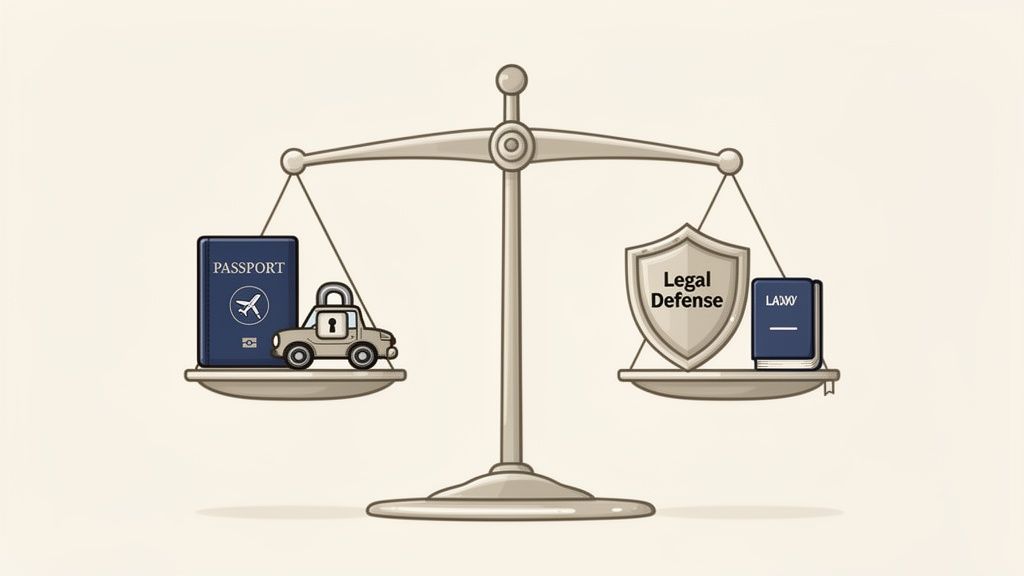
Legal scales showing passport and locked car balanced against a legal defense shield and law book.

The Financial and Personal Toll

Beyond the criminal record, the financial hit is staggering. Insurance rates for drivers with an impaired driving conviction can skyrocket by thousands of dollars every single year. You will also be forced to complete Ontario's mandatory "Back on Track" remedial program, which comes with its own costs and a significant time commitment.

On top of that, a conviction will likely mean a mandatory period with an ignition interlock device installed in your vehicle—at your own expense. This device demands a clean breath sample before the car will even start.

Mitigating the Long-Term Damage

This harsh reality is exactly why a proactive, strategic legal defence is so critical. At Badesha Law, our primary goal is to shield your future by aggressively fighting to reduce these severe outcomes. We meticulously pick apart every piece of evidence, searching for any opportunity to have the charges withdrawn or dismissed entirely.

The stakes are incredibly high. A conviction affects your freedom, finances, and future opportunities. Our focus is on a single objective: minimizing the long-term damage to your life.

When an outright acquittal isn't on the table, we work tirelessly to negotiate for a lesser charge, like a careless driving ticket under the Highway Traffic Act, which carries no criminal record. If the case does proceed to sentencing, we prepare a compelling and detailed submission to argue for the most lenient outcome possible.

The aftermath of a car accident can extend beyond legal trouble into emotional and psychological distress. For help in recovery, you might consider exploring ICBC counselling for accident recovery. Protecting your future means addressing every single aspect of the fallout from a charge.

Unpacking the New Drunk Driving Laws: Your Questions Answered

When you're pulled over in Brampton and facing an impaired driving investigation, your mind races with questions. The recent changes to Canada’s laws have made things even more confusing. Here are some straightforward answers to the questions we hear most often.

I Haven’t Had a Drop to Drink. Can I Refuse the Roadside Breath Test?

No, you cannot. This is one of the most significant changes under the Mandatory Alcohol Screening laws in the Criminal Code. A police officer no longer needs a specific reason to suspect you've been drinking before they can demand a breath sample at the roadside.

Refusing to provide that sample is a criminal offence in itself. The penalties for refusal are often just as harsh as blowing over the legal limit. Even if you're 100% sober, the law requires you to comply. The best actionable advice is to provide the sample and then call a defence lawyer immediately to protect your rights.

What Are the Legal Limits for Cannabis When Driving in Ontario?

Just like with alcohol, Canada has set strict blood concentration limits for THC, the active compound in cannabis. These are "per se" limits, meaning that if you have a certain amount of THC in your blood within two hours of driving, you can be charged—whether you feel impaired or not.

The breakdown is as follows:

  • 2 to 5 nanograms (ng) of THC per millilitre (ml) of blood: A less serious offence, but still carries significant penalties.
  • 5 ng or more of THC per ml of blood: A more serious hybrid offence.
  • 50mg/100ml of alcohol combined with 2.5 ng/ml or more of THC: Combining substances also leads to a serious hybrid offence charge.

Will a Canadian DUI Conviction Keep Me Out of the United States?

There's a very high chance it will. U.S. border officials frequently treat a Canadian impaired driving conviction as a "crime of moral turpitude." This designation can make you criminally inadmissible to the U.S., effectively barring you from entry.

If you have a conviction, you may need to apply for a U.S. Entry Waiver, which is a complicated, expensive, and time-consuming process with no guarantee of success. For Brampton residents who travel for work or family, this is one of the most devastating long-term consequences of a DUI.


An impaired driving charge in Brampton is a serious legal crisis that demands immediate, skilled legal action. The team at Badesha Law is here to stand up for your rights, work to keep your licence, and build the strongest possible defence for your case. Your future is on the line—don't wait. Contact us today for expert legal guidance.

Charged with a DUI in Brampton? What You Need to Know from a Criminal Lawyer in Brampton

Facing a *driving under the influence (DUI)* charge in Brampton can be an unsettling experience, leading to immediate legal challenges. The decisions made in the initial hours are crucial and significantly influence the progression of your case. It is essential to comprehend the documents you receive and promptly take steps to safeguard your rights under both the *Criminal Code of Canada* and Ontario's driving legislation. This guide offers practical advice specifically for Brampton residents confronted with these charges, emphasizing the importance of consulting a criminal lawyer in Brampton to navigate the legal process effectively.

Your First Steps After a DUI Charge in Brampton

The moments right after a DUI arrest are often a blur of confusion and anxiety. Your first priority must be to shift from a state of shock to one of clear, focused action, because the decisions you make now will ripple through your future. The legal process starts immediately, and your response must be just as fast.

Start by carefully reading every piece of paper the police gave you. These documents aren't just administrative formalities; they are legal orders that get the ball rolling on your case. Ignoring them is a surefire way to land in even deeper trouble.

Understand Your Initial Paperwork

When you’re released, you’ll likely have a few key documents in hand. One of the most important is your Appearance Notice or Undertaking. This is the document that officially summons you to court in Brampton. It will also include conditions you must follow until your case is over, such as abstaining from alcohol or not being in the driver's seat of any vehicle. Violating these conditions is a separate criminal offence.

You will also be given papers related to an immediate 90-day Administrative Driver’s Licence Suspension (ADLS). This is a civil penalty from the Ministry of Transportation of Ontario (MTO), and it runs completely separate from your criminal case. It kicks in instantly—meaning you are legally prohibited from driving the second you are charged.

The biggest mistake you can make after a DUI charge in Brampton is thinking you have time. The legal process starts immediately. Protecting your rights begins with understanding your obligations and immediately calling legal counsel experienced with the Brampton courthouse.

Document Everything Immediately

While the arrest is still fresh in your mind, write down everything you can remember. Your memory of the event will fade surprisingly quickly, and what seems like a small detail now could become a crucial piece of evidence for your defence. This personal account can help your lawyer spot procedural mistakes or potential violations of your Charter rights.

Jot down notes on these key points:

  • The Traffic Stop: Why did the officer say they pulled you over in Brampton? What questions did they ask you?

  • The Arrest: When and how did the officer inform you of your right to speak with a lawyer? Did they provide a private space for that call?

  • The Breath Tests: Did you have any issues with the breathalyzer machine? What instructions were you given?

  • Your Condition: What had you eaten or had to drink in the hours before the stop? Were you tired, sick, or taking any medication?

The Most Critical Action to Take

Hiring an experienced Brampton criminal defence lawyer is, without a doubt, the single most important step you can take. Getting a lawyer involved early is absolutely vital.

A lawyer can immediately dive into the facts of your case, ensure you understand your release conditions, and begin communicating with the Crown prosecutor on your behalf. They will request and analyze the police evidence—what's known as "disclosure"—to begin crafting a solid defence strategy tailored to the Brampton courts. This proactive approach ensures no deadlines are missed and puts you in the best possible position for a favourable outcome.

Decoding Impaired Driving Offences in Ontario

When you hear the term “DUI,” it’s easy to think it’s a single, straightforward charge. But in Ontario, a driving under the influence DUI investigation can actually lead to several distinct criminal offences under the Criminal Code of Canada.

Knowing the difference between these charges is the first step in building a defence. Each one has its own legal elements, and the Crown prosecutor must prove every one of them to get a conviction. Let's break down the three most common charges you might face in Brampton.

Before we dive into the details, it helps to see the charges side-by-side. Each one targets a different aspect of impaired driving, from your physical ability to the numbers on a machine.

Key Differences in Ontario DUI Charges

Charge What It Means in Simple Terms Crown's Main Focus
Impaired Operation Your ability to drive was affected by alcohol or drugs to any degree. Proving your impairment through the police officer’s observations of your driving and behaviour.
Operation "Over 80" You had too much alcohol in your system, specifically a BAC of 80 mg or more. Proving the breathalyzer or blood test reading was accurate and obtained legally.
Failure or Refusal You didn't provide a breath or blood sample when a police officer lawfully demanded one. Proving that a lawful demand was made and you refused without a valid legal excuse.

This table gives you a quick snapshot, but the real story is in the details. The evidence needed for each charge is completely different, which means the defence strategies are too.

Impaired Operation of a Conveyance

This is the classic "DUI" charge most people picture. The core of this offence isn't about a specific number on a breathalyzer—it's all about your ability to drive.

To convict you, the Crown must prove beyond a reasonable doubt that your capacity to operate a vehicle was impaired by alcohol or a drug to any degree. Even slight impairment is enough. Evidence here is built entirely on the police officer's observations: seeing you swerve on a Brampton road, smelling alcohol on your breath, noticing slurred speech, or poor performance on a Standardized Field Sobriety Test (SFST). It’s a subjective charge, resting heavily on the officer’s perception and testimony.

Operation Over the Legal Limit ("Over 80")

Unlike the impairment charge, the “Over 80” offence is all about science and numbers. Its official name is Operating a Conveyance with a Blood Alcohol Concentration (BAC) of 80 milligrams of alcohol in 100 millilitres of blood or higher.

For an "Over 80" charge, the only thing that matters is the number from the breathalyzer or a blood test. The officer’s opinion about whether you seemed drunk is irrelevant.

The Crown's case hinges entirely on that chemical test result. A reading of 80 or higher is all they need. A strong defence often focuses on challenging the reliability of the breath-testing machine, its maintenance records, how the officer operated it, and whether your constitutional rights were protected during the process.

Failure or Refusal to Provide a Sample

This charge is unique because it doesn't require any proof that you were actually impaired. You can be charged with refusal if you fail or refuse to comply with a lawful demand for a breath or blood sample without a "reasonable excuse."

The penalties for refusal are exactly the same as for an impaired driving or "Over 80" conviction—the Criminal Code treats the refusal to provide evidence just as seriously as the evidence itself. The Crown only needs to prove:

  • The officer made a clear, lawful demand.

  • You understood what was being asked of you.

  • You clearly refused or failed to provide a proper sample.

  • You didn’t have a legally valid reason for refusing.

It's also crucial to know about the Mandatory Alcohol Screening (MAS) laws. These changes to the Criminal Code now allow police to demand a breath sample from any driver they lawfully pull over, even with zero suspicion of alcohol consumption. This has dramatically changed traffic stops in Brampton and across Ontario, making it far easier for police to launch a full DUI investigation from a simple traffic violation.

Navigating Ontario's Two-Track Penalty System

Many people charged with a driving under the influence DUI in Brampton are shocked to discover they aren't just dealing with the criminal courts. In Ontario, a DUI charge kicks off two separate and parallel legal processes at the same time. Understanding this dual-track system is critical, because one part moves much faster and comes with immediate consequences.

The first is an administrative process, handled by the Ministry of Transportation of Ontario (MTO). The second is the criminal process, which plays out in the Brampton courthouse under the Criminal Code of Canada. These two tracks run independently; winning in criminal court does not automatically reverse the administrative penalties.

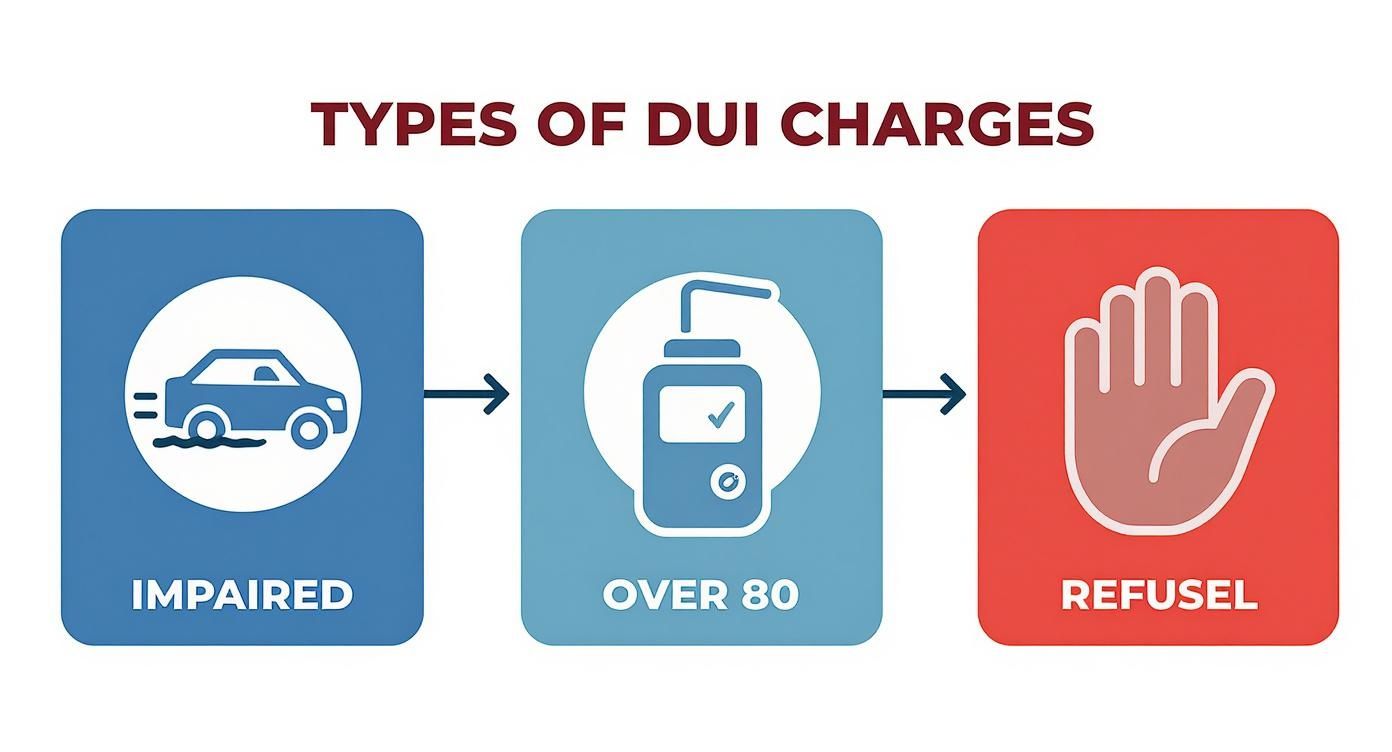
This diagram helps break down the common charges that can come from a DUI investigation.

Diagram illustrating three distinct types of DUI charges: Impaired, Over 80, and Refusal.

As you can see, a DUI isn't just one offence. It's a category that includes being impaired by observation, blowing over the legal limit, or refusing to give a breath sample.

The Immediate Administrative Penalties

The administrative track hits you first and hard. These penalties are enforced by the police on behalf of the MTO right at the roadside, long before you ever step foot in a courtroom. These aren't criminal punishments; they're civil measures designed to protect public safety.

The two most common administrative penalties are:

  • A 90-day Administrative Driver's Licence Suspension (ADLS): Your licence is seized on the spot. You cannot drive for three months. This happens automatically if you register a "Fail" on a roadside breathalyzer, have a blood alcohol concentration over 80, or refuse to provide a sample.

  • A 7-day Vehicle Impoundment: The vehicle you were driving gets towed and impounded for seven days, regardless of who owns it. You are responsible for all towing and storage fees.

It’s crucial to understand that these MTO penalties stick, even if your criminal charges are later withdrawn or you're found not guilty in court. Fighting them requires a separate and very time-sensitive appeal process directly with the MTO.

The Parallel Criminal Court Process

While your licence is suspended, the second track—the criminal case—is just getting started. This is the process that involves your court dates in Brampton, meetings with a Crown prosecutor, and potentially a trial.

The administrative penalties are about your privilege to drive, managed by the province. The criminal process is about whether you've committed a federal crime, which carries far more severe, life-altering consequences if you're convicted.

A criminal conviction for a driving under the influence DUI offence results in penalties that are completely separate from—and on top of—the initial MTO sanctions. These court-ordered punishments are much more serious and can include:

  • A mandatory minimum $1,000 fine for a first offence.

  • A criminal record that can affect your job, ability to travel, and immigration status.

  • A mandatory driving prohibition of at least one year.

  • Potential jail time, especially for repeat offenders or in cases involving an accident.

Successfully navigating both the immediate MTO penalties and the longer-term criminal proceedings requires a strategic legal approach from day one.

The True Cost of a DUI Conviction in Brampton

A passport, car key, and cash on a table with 'REAL CONSEQUENCES' text, symbolizing legal outcomes.

A conviction for driving under the influence (DUI) is far more than a bad day in court. It’s an event that sends costly and life-altering shockwaves through every corner of your personal and professional life. The penalties in the Criminal Code of Canada are severe and designed to escalate with each subsequent offence. The "hidden" costs—from a permanent criminal record to professional roadblocks and travel bans—often have a more profound and lasting impact on your future. For anyone in Brampton facing these charges, understanding the full scope of these consequences is absolutely critical. It is also important to note that a conviction can be used in family law proceedings, especially where parenting and custody are at issue.

Criminal Penalties That Escalate

Canadian law imposes mandatory minimum penalties for all impaired driving convictions. A judge has no discretion to go below these punishments, which get dramatically harsher for second and subsequent offences.

Here's a look at how quickly the minimums stack up:

Mandatory Minimum Penalties for DUI Convictions

Offence Minimum Fine Minimum Jail Time Minimum Driving Prohibition
First Offence $1,000 (increases with higher BAC) None 1 Year
Second Offence None 30 Days 2 Years
Third Offence None 120 Days 3 Years

Remember, these are just the starting points. A judge can, and often does, impose much higher fines, longer jail sentences, and lengthier driving prohibitions based on the specifics of your case—like a very high BAC reading or if an accident was involved.

The Permanent Shadow of a Criminal Record

Beyond the immediate court-ordered penalties, a DUI conviction saddles you with a permanent criminal record. This follows you for life unless you are granted a record suspension (formerly a pardon), a process that is neither quick nor guaranteed.

A criminal record can feel like a closed door you never saw coming. It can prevent you from securing your dream job, volunteering for your child's school, or even crossing the border for a weekend trip.

This record can significantly limit your opportunities in several key areas:

  • Employment: Many employers in Brampton and the GTA require a clean criminal record check. A DUI can instantly disqualify you from entire career fields.

  • Immigration: If you are not a Canadian citizen, a DUI conviction can lead to deportation or prevent you from ever becoming a permanent resident or citizen.

  • Travel: A criminal record for impaired driving makes you inadmissible to the United States. You will likely be turned away at the border.

The Financial Fallout Beyond the Fines

The financial burden of a DUI conviction extends far beyond the initial court fine. One of the most immediate and painful hits is to your car insurance. After a conviction, insurance companies will label you a "high-risk" driver. Your premiums will skyrocket, often by $8,000 to $10,000 per year for several years. In some cases, insurers may refuse to cover you at all, making it legally impossible to get back on the road in Ontario.

Mandatory Post-Conviction Programs in Ontario

Even after you’ve paid your fines and served your driving prohibition, your journey isn't over. The Province of Ontario requires you to complete mandatory remedial programs at your own expense before you can get your licence back.

This includes the "Back on Track" program, an educational and assessment course that costs over $600. After that, you will likely be required to install an Ignition Interlock Device in your vehicle for a set period. This device, which prevents your car from starting if it detects alcohol on your breath, comes with installation fees and monthly monitoring costs that add hundreds or thousands more to your total bill.

Building a Strong Defence Against Your DUI Charge

Facing a charge for driving under the influence (DUI) can feel overwhelming. But it's critical to understand that a charge is an accusation, not a conviction. The Crown prosecutor has the heavy burden of proving every single element of their case against you beyond a reasonable doubt. A skilled Brampton defence lawyer’s job is to scrutinize that case for weaknesses.

Many successful DUI defences focus on whether the police followed the strict legal procedures required by the Criminal Code of Canada and the Canadian Charter of Rights and Freedoms. If they don't, the evidence against you could be excluded from court.

Challenging the Police Investigation

A strong defence starts with a microscopic examination of every detail of the police investigation. Any deviation from proper procedure can open the door for a powerful legal challenge. A thorough defence lawyer will dig into these areas:

  • The Legality of the Traffic Stop: Did the police have a legitimate, lawful reason to pull you over in Brampton? An arbitrary stop may violate your rights.

  • Proper Administration of Tests: Were the roadside sobriety tests performed correctly? Was the demand for a breath sample made at the right time and in the right way? The timing and wording are critical.

  • Officer Qualifications: Was the officer who operated the breath-testing machine properly trained and certified? Their qualifications can be challenged in court.

Even a minor procedural mistake can derail the Crown's case. For example, if an officer fails to make a proper breath demand, the results could be excluded from evidence, often causing the entire case to collapse.

Violations of Your Charter Rights

The Canadian Charter of Rights and Freedoms is a shield that protects every Canadian from unfair state action. When police violate these rights during a DUI investigation, a judge has the power to rule that any evidence they collected is inadmissible.

Your rights are not suggestions; they are constitutional guarantees. A violation of your right to counsel or protection against unreasonable search can be the key to having your DUI charges dismissed entirely.

The most common and powerful Charter defences in DUI cases involve:

  1. The Right to Counsel (Section 10(b)): After being arrested, you have the right to speak with a lawyer of your choice without delay. If police fail to inform you of this right immediately, or if they don't provide a real, private opportunity to speak with a lawyer, any evidence they gather afterward—including your breath samples—can be excluded.

  2. The Right to Be Free from Unreasonable Search and Seizure (Section 8): The police cannot force you to provide a breath sample without proper grounds. They need to have reasonable grounds to believe you’re impaired or have committed an offence. If their demand is based on a hunch, it could be deemed an unreasonable seizure.

Technical and Scientific Defences

Beyond police procedures and Charter rights, a strong defence for a driving under the influence DUI charge often involves the science of breath testing. The approved instruments used to measure blood alcohol content are complex machines that require constant maintenance and precise calibration.

A meticulous defence strategy means obtaining all records for the specific breathalyzer used in your case. Your lawyer will comb through the maintenance logs and calibration records. If it can be shown that the machine was not working perfectly on the day of your test, its readings can be challenged as unreliable. This technical approach can create the reasonable doubt needed to win your case.

Your Questions About Brampton DUI Charges Answered

Getting charged with a DUI (driving under the influence) throws you into a confusing and intimidating legal world. This section provides clear, straightforward answers to the questions we hear most often from clients in Brampton.

Can I Get My Car Back After It Is Impounded?

Yes, but you have to wait. In Ontario, when you’re charged with an impaired driving offence, your vehicle will be impounded for seven days. This is an administrative penalty from the Ministry of Transportation.

There is no way to shorten this seven-day impoundment. After the week is up, you must go to the impound lot and pay all towing and storage fees. These costs can easily run into hundreds of dollars.

Will a DUI Conviction Stop Me From Traveling to the US?

It is very likely, yes. A DUI conviction can create major problems at the border. The United States views a Canadian DUI as a serious criminal offence, which can make you criminally inadmissible. U.S. Customs and Border Protection (CBP) officers can deny you entry at any crossing.

To have a chance of entering the U.S. again, you would need to apply for a U.S. Entry Waiver. This is a complicated, expensive, and long application with no guarantee of success.

What Is the Difference Between a Suspension and a Prohibition?

This is an important distinction. An administrative suspension and a criminal driving prohibition are two different penalties from two different systems.

  • Administrative Driver's Licence Suspension (ADLS): This is the immediate 90-day licence suspension the MTO imposes the moment you’re charged. It is a civil, not a criminal, penalty.

  • Criminal Driving Prohibition: This is a much longer driving ban that a judge orders only if you are convicted in criminal court. The mandatory minimum prohibition for a first-time offence is one year.

Think of it this way: the administrative suspension is a temporary measure to get you off the road immediately. The criminal prohibition is a long-term punishment that only comes after a guilty finding in court.

How Can a Lawyer Actually Help with My Brampton DUI Case?

An experienced Brampton DUI lawyer does far more than just show up for you in court. Their job is to pull the case against you apart and protect your rights every step of the way.

From the moment you hire them, your lawyer gets to work:

  1. Digging into the Police Evidence: They demand and review all evidence the police have—the "disclosure." This includes officer’s notes, any video, and the maintenance logs for the breathalyzer, all searched for mistakes, inconsistencies, or rights violations.

  2. Finding a Defence Strategy: Based on the evidence, your lawyer builds a defence. Did the police have a legal reason to pull you over? Did they inform you of your right to a lawyer without delay? Was the breath machine working properly? These questions can dismantle the Crown’s case.

  3. Handling All the Court Appearances: Your lawyer takes care of the procedural court dates in Brampton and all administrative headaches so you don’t have to.

  4. Negotiating with the Crown Prosecutor: A sharp lawyer knows how to strategically negotiate with the Crown. The goal is the best possible outcome for you, whether that means convincing the Crown to withdraw the charge, negotiating a deal to a non-criminal offence, or preparing for a full trial to fight for an acquittal.

A lawyer’s deep understanding of impaired driving law, local Brampton court procedures, and the Criminal Code and Charter of Rights is essential. They bring the expertise needed to challenge the prosecution’s narrative and protect your future. Facing a driving under the influence DUI charge alone means walking into a complex system without the right tools to defend yourself.


When you are facing the serious consequences of a DUI charge, you need a legal team that will stand by you with integrity and unwavering support. At Badesha Law, we provide precise, clear advocacy aimed at securing fair and positive resolutions. If you have been charged in Brampton or the surrounding area, contact us for a confidential consultation to protect your rights and your future. Learn more at https://badeshalaw.ca/brampton-criminal-lawyer.

Brampton Impaired Driving Lawyers: 7 Things You Must Know

Being charged with impaired driving in Brampton is a serious event with immediate consequences for your licence, freedom, and future. The moments after an arrest are filled with confusion and stress, but the decisions you make can significantly impact the outcome of your case. This guide provides actionable insights tailored for Brampton residents, breaking down the essential steps to take and explaining how experienced impaired driving lawyers can protect your rights.

Navigating the complexities of an impaired driving charge in Brampton requires specialized legal knowledge. You may be facing charges under Canada’s Criminal Code for offences like “Over 80” or refusing a breath sample. At the same time, your driver’s licence is immediately suspended under Ontario’s Highway Traffic Act. Understanding how these federal and provincial laws intersect is the first step toward building a robust defence.

This comprehensive guide serves as your roadmap. We will explore what a strong defence looks like, from challenging the evidence gathered by Peel Regional Police to negotiating favourable outcomes with the Crown Attorney at the Brampton courthouse. You will learn the specific steps to take immediately following an arrest, what an impaired driving lawyer does to manage your case, and how to evaluate and choose the best legal representation for your situation. We will analyze various resources and law firms, including Badesha Law, to provide a clear path forward. Our goal is to equip you with the knowledge needed to confidently handle this difficult process and secure the best possible result.

1. Badesha Law: Client-Focused Defence for Brampton and the GTA

When facing an impaired driving charge in Brampton, your first step is to secure legal advice. Badesha Law’s website (www.badeshalaw.ca) is a critical resource, offering clarity and a direct line to experienced impaired driving lawyers who practice in the Brampton courts. The platform is designed as a first-response tool for individuals needing immediate, actionable information relevant to their situation in Peel Region.

The site’s primary strength is its comprehensive content tailored specifically to Ontario’s legal landscape. It provides detailed explanations of offences like DUI, Over 80, and Refusal to Provide a Sample, all of which fall under Canada’s Criminal Code. This focus on education empowers potential clients, helping them understand the gravity of their situation and the specific legal challenges they face in the Brampton justice system. A charge can also trigger family law issues, such as impacting child custody arrangements under Ontario’s Family Law Act, and a firm that understands this intersection is crucial.

Strategic Breakdown & Key Takeaways

Badesha Law’s platform directly addresses your most urgent needs with a clear, user-friendly interface.

  • Immediate Actionability: The website prominently features a 24/7 hotline. This is a crucial feature if you have been arrested in Brampton, as securing legal counsel for a bail hearing or getting initial advice is extremely time-sensitive.
  • Targeted Brampton Content: The site offers specific insights into how impaired driving cases are handled in Peel Region. This localized approach demonstrates a deep understanding of local Crown prosecutors and procedures at the Brampton courthouse, a significant advantage for your case.
  • Transparent Process: The site outlines what a lawyer does, from handling bail to trial strategy. This demystifies the legal process for clients who are often navigating the criminal justice system for the first time.

Key Insight: Badesha Law’s website serves as a strategic educational hub. By providing free, high-quality information about the Criminal Code and Brampton-specific consequences, it builds trust and establishes authority before you even pick up the phone.

Practical Application for Users

For someone in Brampton charged with an impaired driving offence, the Badesha Law website is an essential first stop.

  1. Educate Yourself: Use the “Criminal Defence” section to understand the specific charge you are facing, whether it’s impaired operation or failure to comply with a demand under the Criminal Code.
  2. Understand the Stakes: Review the detailed pages on consequences, which cover everything from licence suspensions under the Highway Traffic Act to a potential criminal record and its impact on your life.
  3. Initiate Contact: Use the 24/7 contact number for immediate advice, especially if you or a loved one is in custody at a Peel Regional Police station and needs a lawyer for a bail hearing. This swift action is vital for securing release and beginning your defence.

2. Canadian Bar Association (CBA) – Find-a-Lawyer

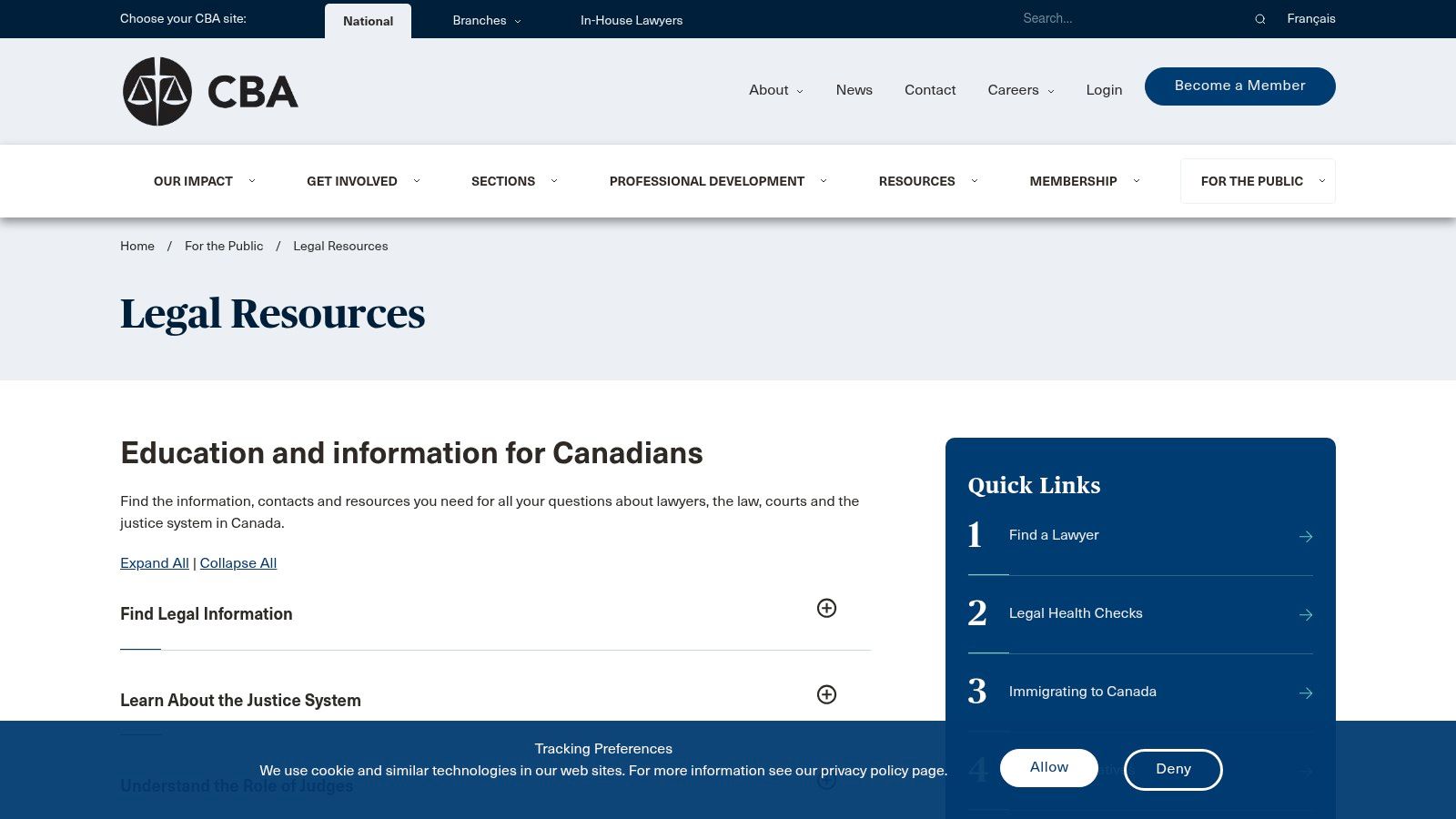
When charged with impaired driving in Brampton, finding a qualified legal professional can feel overwhelming. The Canadian Bar Association’s (CBA) Find-a-Lawyer service (www.cba.org/public/legal-resources/) acts as a trusted, nationwide directory. It offers a reliable starting point for individuals seeking impaired driving lawyers, helping you filter the market down to a manageable list of accredited professionals.

Canadian Bar Association (CBA) – Find‑a‑Lawyer

The platform’s core value is its credibility. Unlike a general internet search, every lawyer listed is a member of the CBA, providing a baseline of professional standing. For someone in Brampton facing a charge under the Criminal Code, the ability to search specifically for “Criminal Law” and filter by “Brampton” provides an immediate, curated list of potential representatives who specialize in the exact legal help you need.

Strategic Breakdown & Key Takeaways

The CBA’s directory provides a structured and trustworthy pathway to finding legal representation in Brampton.

  • Verified Professionalism: CBA membership acts as an initial quality filter. It assures you that you are connecting with lawyers who are part of a national professional association.
  • Targeted Search Functionality: The ability to filter results by city (Brampton), area of practice (Criminal Law), and language is highly effective. This ensures you find local lawyers who can navigate the specific procedures of the Brampton courthouse.
  • Educational Gateway: The platform links to public legal information, empowering you to learn about the basics of your Criminal Code charge before you make contact with a lawyer.

Key Insight: The CBA Find-a-Lawyer service functions as a “trusted aggregator.” It leverages the authority of a national professional body to give you confidence in your search, transforming a stressful process into a methodical search for qualified counsel.

Practical Application for Users

For an individual in Brampton charged with an impaired driving offence, the CBA directory is an excellent resource for building a list of potential lawyers to consult.

  1. Filter Your Search: Navigate to the directory, input “Brampton” as the city, and select “Criminal Law” as the area of practice to generate a relevant list.
  2. Create a Shortlist: Review the profiles of the lawyers who appear. Note their contact information and any details they provide about their practice focus on impaired driving cases.
  3. Cross-Reference and Consult: Use this list as a starting point. Visit the individual websites of the lawyers you’ve identified to learn more about their specific experience with Criminal Code offences in Brampton and schedule initial consultations.

3. Law Society of Ontario (LSO) – Law Society Referral Service

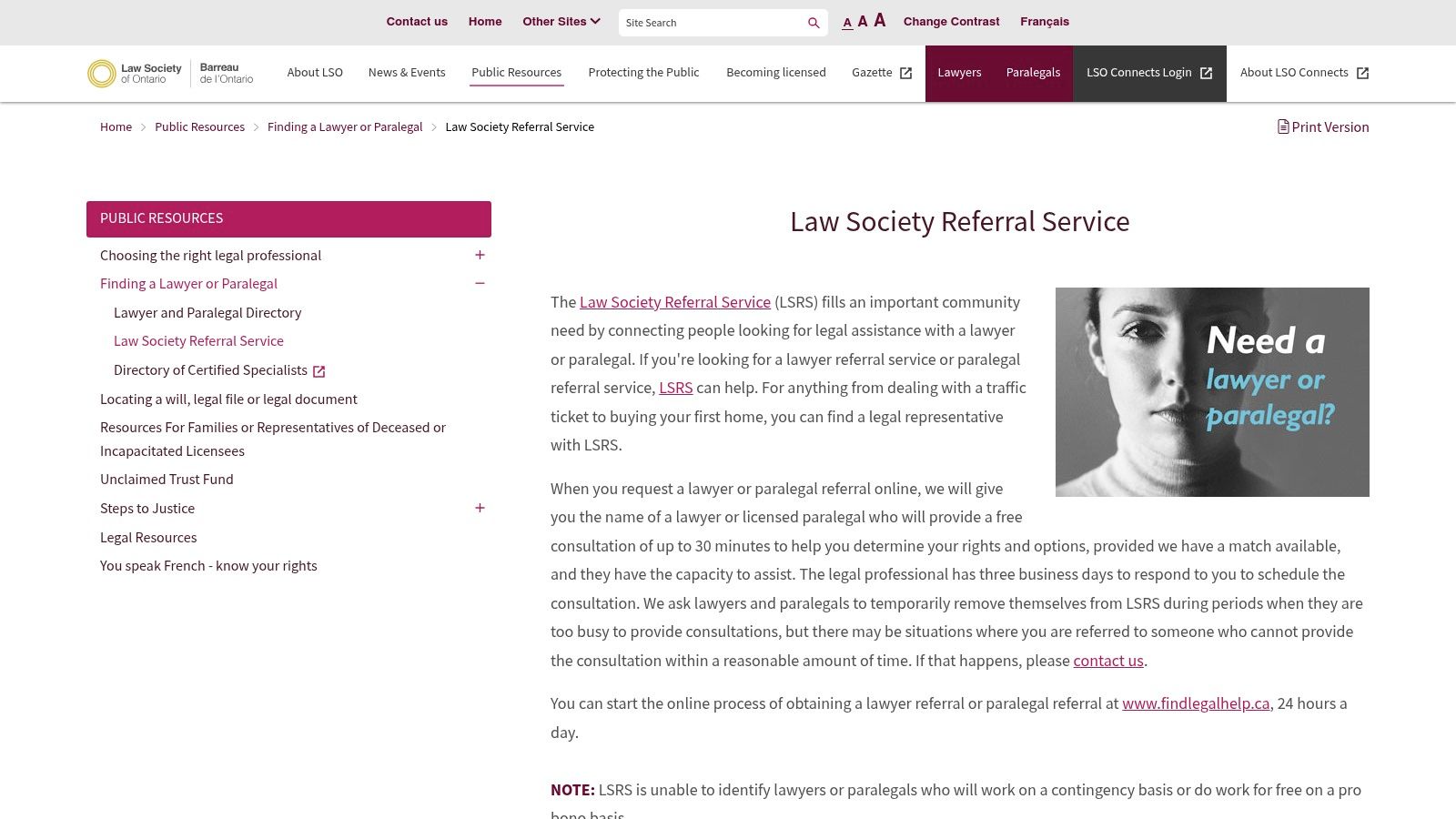
If you’ve been charged with impaired driving in Brampton, you need a lawyer, but knowing where to start can be difficult. The Law Society of Ontario (LSO) provides a crucial public service with its Law Society Referral Service (https://lso.ca/public-resources/finding-a-lawyer-or-paralegal/law-society-referral-service). This is not a law firm but a tool from the regulatory body designed to connect you with a verified Ontario lawyer for a free consultation.

Law Society of Ontario (LSO) – Law Society Referral Service

The service’s value lies in its credibility and accessibility. For someone in Brampton facing serious charges under the Criminal Code, the LSO offers a trustworthy, no-cost first step. It simplifies the search by guaranteeing a free, up-to-30-minute consultation with a lawyer who practises criminal defence. This initial meeting is invaluable for getting a preliminary assessment of your case and understanding your immediate rights and obligations.

Strategic Breakdown & Key Takeaways

The LSO’s platform serves as a regulated and impartial starting point, prioritizing your access to justice.

  • Vetted and Verified Professionals: Every lawyer in the referral service is licensed and in good standing with the LSO. The accompanying Lawyer and Paralegal Directory allows you to check a professional’s status and disciplinary history, providing an essential layer of due diligence.
  • Guaranteed Initial Access: Unlike cold-calling firms, the service guarantees you a consultation. This removes the uncertainty and potential cost of making initial contact, which is critical when time is a factor after an arrest in Brampton.
  • Impartial Matching: The service connects you to a lawyer based on your legal needs (impaired driving defence) and location (Brampton). This impartial process ensures you are matched with a relevant professional.

Key Insight: The Law Society Referral Service functions as a critical safety net. It ensures anyone in Ontario can access a licensed impaired driving lawyer to understand their rights under both the Criminal Code and Ontario’s Highway Traffic Act without an upfront cost.

Practical Application for Users

For an individual in Brampton recently charged with an impaired driving offence, the LSO’s service is a risk-free starting point.

  1. Request a Referral: Use the 24/7 online request form. Clearly state that your issue is “criminal law” and specify the charge (DUI, Over 80, Refusal) to be matched with an appropriate lawyer in your area.
  2. Prepare for Your Free Consultation: This 30-minute consultation is a valuable opportunity. Have your documents ready (e.g., your notice of suspension, promise to appear) and prepare a list of key questions about your case and the Brampton court process.
  3. Conduct Your Due Diligence: Use the LSO’s public directory to verify the licence and regulatory history of the lawyer you were referred to, as well as any other impaired driving lawyers you are considering in Brampton. This step is crucial for making an informed hiring decision.

4. Law Society of British Columbia – Lawyer Directory: The Verification Tool

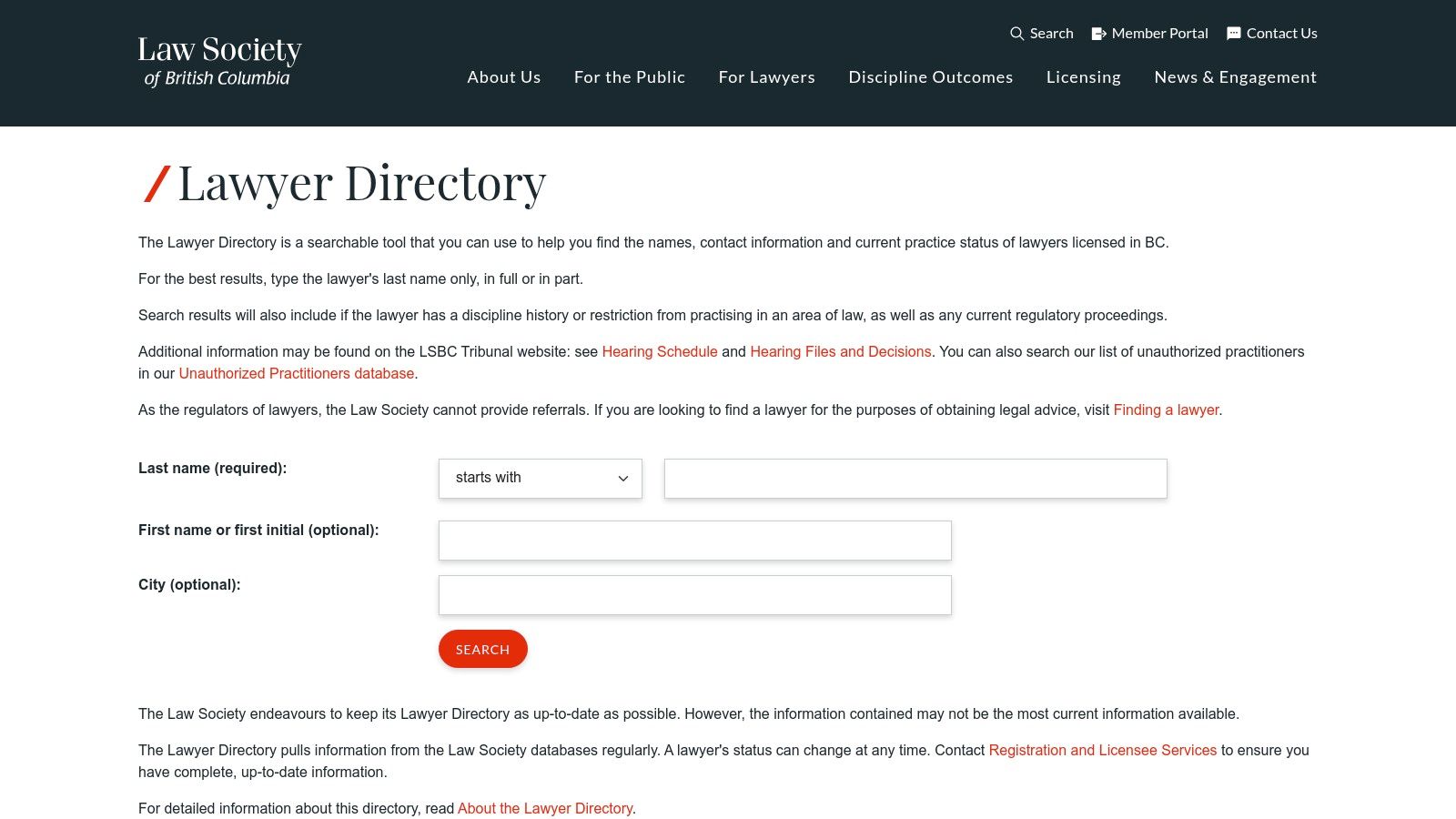
While not a direct source for finding impaired driving lawyers in Brampton, the Law Society of British Columbia’s Lawyer Directory (https://www.lawsociety.bc.ca/lsbc/apps/lkup/directory/mbr-search.cfm) serves an equally critical, though different, function. Its value lies in due diligence and verification. After you’ve compiled a list of potential lawyers, this platform acts as an official, unbiased tool to confirm their credentials, check their practising status, and review any public disciplinary history. For someone in a vulnerable position, this step provides an essential layer of security.

Law Society of British Columbia – Lawyer Directory

The website’s core strength is its status as the official regulator. Unlike marketing-driven directories, the information here is factual, up-to-date, and impartial. It allows you to search a lawyer’s name and instantly see if they are a practising member in good standing, their contact information, and links to any disciplinary actions. This is a powerful tool for vetting the claims made on a lawyer’s personal website and avoiding unauthorized practitioners or scams, ensuring you entrust your case to a qualified professional.

Strategic Breakdown & Key Takeaways

The Law Society’s directory empowers users by offering transparency and a reliable method for due diligence, a crucial step before retaining legal counsel.

  • Credential Verification: The primary function is to confirm a lawyer’s status. Before you pay a retainer, you can verify they are legally permitted to practise law, which is a non-negotiable first step.
  • Discipline History Check: The platform provides access to a lawyer’s public disciplinary record. This helps you identify any past professional misconduct, which could be a major red flag when choosing who will defend your Criminal Code charges.
  • User Empowerment: It provides a sense of control and security in a stressful time. By checking a lawyer’s background yourself, you are making a more informed and confident hiring decision, rather than relying solely on marketing materials.

Key Insight: The Law Society directory isn’t for finding a lawyer, but for validating one. Using this official resource as a final check is a strategic move to protect yourself and ensure the advocate you choose has a clean and current professional record.

Practical Application for Users

For someone in the GTA looking for an impaired driving lawyer, think of this directory as the final background check before you commit.

  1. Create a Shortlist: First, identify 2-3 potential impaired driving lawyers in the Brampton or Mississauga area through referrals, online searches, or other directories.
  2. Verify Each Candidate: Use the directory to search each lawyer by name. Confirm their practising status is “Active” and check for any disciplinary history or tribunal records.
  3. Make an Informed Decision: Combine this objective information with your own consultations. If a lawyer has a concerning disciplinary record, you can confidently remove them from consideration, protecting yourself from potential issues down the road.

5. Access Pro Bono – Legal Referral Service

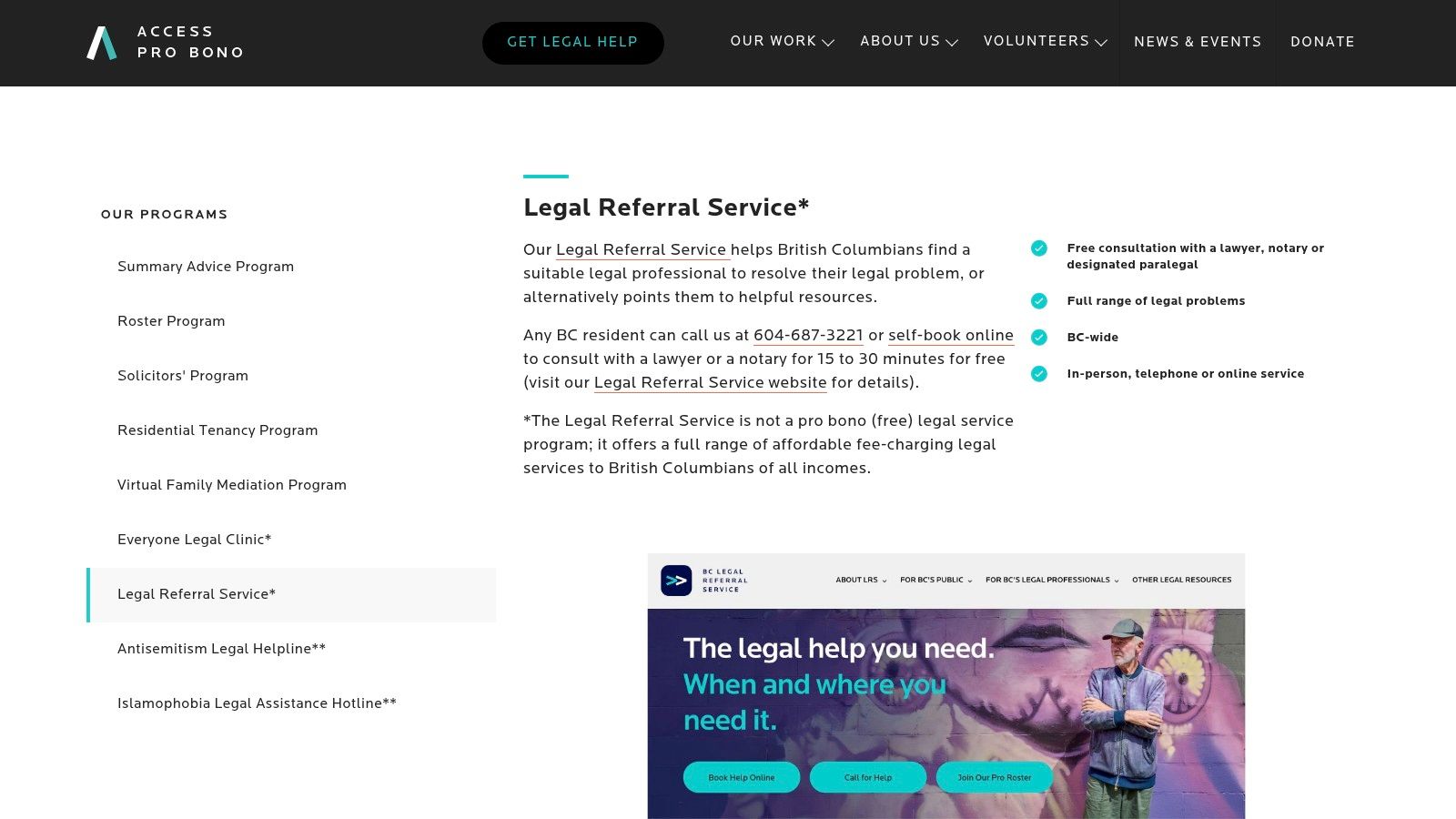
While not a direct law firm, Access Pro Bono’s Legal Referral Service (www.accessprobono.ca/our-programs/legal-referral-service) offers a crucial first step for individuals seeking legal counsel, particularly those who are unsure where to begin their search. This British Columbia-based service acts as a streamlined connector, matching users with qualified lawyers for an initial, free consultation. Although it is a BC service, its model provides a valuable template for understanding how to initiate contact with legal professionals, a process that can be daunting for someone just charged.

Access Pro Bono – Legal Referral Service

The platform’s strength is its simplicity and transparency. It demystifies the process of finding and speaking to a lawyer for the first time by offering a structured, low-commitment entry point. For a nominal fee (which can be waived), it provides a scheduled 15 to 30-minute consultation, giving a user direct access to legal advice without the immediate pressure of retaining a lawyer. This model is particularly useful for getting preliminary answers about the Criminal Code and what to expect next.

Strategic Breakdown & Key Takeaways

Access Pro Bono’s platform excels by removing the initial friction and uncertainty involved in contacting a lawyer, making it a powerful resource for rapid legal orientation.

  • Low-Barrier Entry: The service offers a free 15 to 30-minute consultation. This allows individuals to get a professional opinion on their impaired driving charge without a significant financial commitment, making legal advice more accessible from the outset.
  • Structured Process: Users can book online or by phone, and the system matches them with a suitable lawyer. This eliminates the guesswork of cold-calling multiple firms, which is a key advantage for someone in distress after being charged.
  • Transparent Model: The platform is clear that this is a referral service for fee-charging lawyers, not an ongoing free service. It manages expectations effectively by positioning the free consult as an introductory step to paid representation.

Key Insight: The true value of a service like Access Pro Bono is in its ability to quickly bridge the gap between an individual in crisis and a qualified professional. It normalizes the initial contact phase, empowering users to take swift, informed action by speaking directly with impaired driving lawyers who can assess their case.

Practical Application for Users

Although this service is based in BC, a person in Brampton can learn from its model to take a similar, proactive approach to finding legal help.

  1. Seek Initial Consultations: Many Ontario firms, like Badesha Law, offer free initial consultations. Use this opportunity to discuss the specifics of your charge, whether it’s an Over 80 or a Refusal charge under the Criminal Code.
  2. Prepare Your Questions: Before your consultation, write down key questions. Ask about the lawyer’s experience with cases in Peel Region, their familiarity with local court procedures, and their initial thoughts on your defence.
  3. Assess the Fit: Use the initial meeting not just for legal advice but to determine if the lawyer is the right fit for you. This first interaction is crucial for building the trust needed for an effective defence strategy.

6. Law Society of Alberta – Find a Lawyer

While our focus is on Brampton, understanding how to verify a lawyer’s credentials is a universally critical step. The Law Society of Alberta’s website (www.lawsociety.ab.ca) serves as a benchmark for official regulatory directories. It is the official source for vetting legal professionals in that province, offering a layer of security and transparency that private directories cannot match. It models the exact process you should follow with the Law Society of Ontario.

This platform is a public utility designed for your protection. Its core function is to allow anyone to search for and verify the status of a lawyer, including confirming they are licensed to practise and checking for any public disciplinary history. This is an indispensable tool for ensuring the impaired driving lawyer you consider hiring in Brampton is in good standing with their governing body.

Law Society of Alberta – Find a Lawyer

Strategic Breakdown & Key Takeaways

The Law Society of Alberta’s directory excels by prioritizing consumer protection and transparency, providing you with the tools to make an informed choice.

  • Official Verification: The directory’s most crucial feature is the ability to confirm a lawyer’s practising status and view any public disciplinary records. This helps you avoid suspended or disbarred practitioners, a vital check before retaining counsel.
  • Targeted Search Filters: Users can filter their search by practice area (like “criminal law”) and location. This helps narrow down a large pool of lawyers to find local specialists.
  • Educational Support: The site provides guides that explain what different status terms mean (e.g., “active,” “inactive”). This empowers you to properly interpret the search results.

Key Insight: Although specific to Alberta, this platform models the essential first step for anyone hiring a lawyer in Ontario. Before engaging impaired driving lawyers found through marketing, it is crucial to verify their status with the Law Society of Ontario to ensure they are licensed and in good standing.

Practical Application for Users

For someone in Brampton, this site serves as an excellent model for how to conduct due diligence using your local regulator, the Law Society of Ontario (LSO).

  1. Model the Process: Use the Alberta site as an example of what to look for—note its search functions and status checks.
  2. Conduct Your Own Check: Go to the Law Society of Ontario’s Lawyer and Paralegal Directory. Search for any lawyer you are considering hiring in Brampton.
  3. Verify Credentials: Confirm that the lawyer’s status is listed as “practising law” and check for any public regulatory notices or disciplinary history. This simple step validates their qualifications and protects you from hiring an unqualified representative.

7. LawyerLocate.ca: A Broad Network for Finding Legal Counsel

When charged with an impaired driving offence in Brampton, the initial process of finding the right legal representation can be overwhelming. LawyerLocate.ca (https://lawyerlocate.ca/criminal-law/impaired-driving-over-80-ml-dui/) functions as a nationwide directory, allowing individuals in Brampton to quickly find multiple impaired driving lawyers who practise in their area.

This platform is particularly useful for comparing several options efficiently. Instead of searching for individual law firms one by one, you can either browse the dedicated “Impaired Driving / Over 80 / DUI” category or submit a single, free referral request. This request is then forwarded to relevant lawyers in the Brampton area, who may then reach out to you directly, saving valuable time in a critical situation.

LawyerLocate.ca – DUI/Impaired Driving category

Strategic Breakdown & Key Takeaways

LawyerLocate.ca’s value lies in its efficiency and breadth, providing a rapid way to generate a list of potential legal representatives.

  • Accelerated Outreach: The free referral form is the platform’s core strength. For someone in Brampton needing urgent counsel for a bail hearing, submitting one form can result in contact from several qualified local lawyers.
  • Targeted Search: The directory has a specific sub-category for impaired driving. This ensures you can focus your search on lawyers experienced with the Criminal Code offences you are facing.
  • Comparative Advantage: By design, the platform encourages comparison. Receiving responses from multiple lawyers allows you to quickly gauge different communication styles, fee structures, and initial thoughts on your case, facilitating a more informed hiring decision.

Key Insight: LawyerLocate.ca is a lead generation tool for both clients and lawyers. Its primary function is to make the initial connection, empowering you to vet multiple candidates before committing, which is a significant advantage in your high-stakes impaired driving defence.

Practical Application for Users

For an individual in Brampton facing a DUI charge, LawyerLocate.ca can be a powerful starting point for assembling a list of potential legal allies.

  1. Submit a Referral Request: Use the confidential online form. Include key details such as the specific charge (e.g., Over 80, Refusal) and the jurisdiction (Brampton).
  2. Filter and Research: As lawyers respond, research each one individually. Crucially, verify their status with the Law Society of Ontario and review their firm’s website for specific experience with impaired driving cases in Brampton.
  3. Conduct Consultations: The initial contact from a lawyer via the platform is not a full consultation. Use it as an opportunity to schedule a proper, more detailed discussion to assess if they are the right fit for your defence.

Top 7 Impaired-Driving Lawyer Comparison

Option 🔄 Implementation complexity ⚡ Resource / speed 📊 Expected outcomes 💡 Ideal use cases ⭐ Key advantages
Badesha Law 🔄🔄 Medium — full-service firm handling urgent bail and trials ⚡⚡ Fast crisis response; paid retainers; local offices in Brampton/Mississauga Rapid bail/release planning; criminal defence and family-law resolution; trial advocacy Clients in GTA needing urgent bail help or combined criminal/family representation Experienced local firm; rapid crisis response; plain-language client care
Canadian Bar Association – Find‑a‑Lawyer 🔄 Low — searchable directory platform ⚡⚡ Fast nationwide search; free to use (fees arranged with lawyers) Multiple member listings; links to legal resources to inform decisions Canada‑wide initial search for criminal/DUIs; filter by language/specialty Broad national coverage; CBA membership as a trust signal
Law Society of Ontario – Referral Service 🔄 Low–Medium — intake/triage referral process ⚡⚡ Free up to 30‑min consult; online 24/7 request; Ontario residents only Guaranteed initial consult with a matched lawyer; verified licensing info Ontario residents seeking a no‑cost vetted initial consult Free matched consult; regulatory verification and directory access
Law Society of British Columbia – Directory 🔄 Low — regulator search and records lookup ⚡⚡ Immediate verification of status; no direct referrals Practising status, discipline history and contact details for due diligence Vetting BC lawyers before retaining impaired driving counsel Official regulator data; up‑to-date licensing and discipline records
Access Pro Bono – Legal Referral Service 🔄 Medium — provincial matching plus booking system ⚡⚡ Fast match with 15–30 min free consult; $25 booking fee (waived by phone for low income) Quick initial consult leading to paid services; clear next steps BC residents needing a quick, low‑cost initial consult for DUI matters Transparent fees and waivers; province‑wide access; streamlined booking
Law Society of Alberta – Find a Lawyer 🔄 Low — searchable regulator directory with guides ⚡⚡ Immediate searchable results; no direct referrals Verify practising status, discipline/hearing records; filter by practice area Alberta residents vetting impaired driving or criminal counsel Official, current lawyer info; explanatory guides for status terms
LawyerLocate.ca – DUI/Impaired Driving 🔄 Low — marketing directory + referral form ⚡⚡ Rapid lead generation; free referral requests (lawyers may contact you) Multiple lawyer contacts/responses; platform does not verify licensing Quickly generate multiple Canada‑wide leads for DUI/Over‑80 cases Dedicated DUI category; free nationwide referral; quick multiple contacts

Take Control of Your Defence Today

Navigating the aftermath of an impaired driving charge in Brampton is a complex and high-stakes journey. The landscape is intricate, governed by Canada’s Criminal Code and Ontario’s driving laws. From understanding the nuances of an “Over 80” charge versus a refusal, knowledge is your first and most powerful tool.

This guide has equipped you with a strategic framework to move from the uncertainty of an arrest to a position of informed action. You now have a clear roadmap of the immediate steps to take, the critical role an impaired driving lawyer plays, and the criteria for selecting the right legal advocate for your specific situation in Brampton.

Key Insights and Actionable Takeaways

Remember, the success of your defence hinges on proactive, strategic decisions made from the very beginning. Here are the most critical takeaways for your Brampton case:

  • The Power of Silence is Strategic: Your right to remain silent under the Criminal Code is your primary defence mechanism post-arrest. Politely decline to answer questions from Peel Regional Police until you have spoken with a lawyer.
  • Evidence is Time-Sensitive: The details of your traffic stop, the officer’s observations, and your memory of events are crucial. Document everything you can remember as soon as possible, as these details can form the foundation of a strong defence.
  • Legal Tools are Your Allies: We’ve reviewed several tools, from the Law Society of Ontario’s Referral Service to legal directories. These resources help you find qualified impaired driving lawyers, but your own due diligence—including consultations—is essential.

Strategic Insight: The most effective “tool” is a well-chosen legal representative who understands the specific procedures and personnel at the Brampton courthouse. Local experience is an invaluable asset.

Implementing Your Defence Strategy

Choosing the right legal professional is the single most important decision you will make. It’s not just about finding a lawyer; it’s about securing a strategic partner who can navigate the complexities of your Brampton case.

When evaluating potential impaired driving lawyers, focus on these factors:

  1. Specialised Experience: Do they focus specifically on impaired driving defence? A general criminal lawyer may not have the niche expertise required to challenge breathalyzer results or police procedures effectively.
  2. Local Courtroom Knowledge: Ask about their experience in Brampton. A lawyer familiar with the local Crown Attorneys and judges at the A. Grenville and William Davis Courthouse can provide a significant strategic advantage.
  3. Clear Communication: Your lawyer should explain complex legal concepts in a way you understand, outline a clear defence strategy, and be transparent about potential costs and outcomes.

The journey ahead may seem daunting, but you are not powerless. By applying the knowledge and strategies outlined in this guide, you can take decisive action to protect your rights, your licence, and your future. The choice to hire an experienced Brampton impaired driving lawyer is an investment in a robust defence, providing you with the best possible chance to mitigate the consequences and move forward. Take that first crucial step today.


Facing an impaired driving charge requires immediate, expert legal counsel. The team at Badesha Law specialises in crafting strategic defences for clients in Brampton and the GTA, leveraging deep knowledge of local court systems to protect your rights. Schedule a consultation to understand your options and start building your defence with experienced Badesha Law professionals on your side.