

Charged with a DUI in Brampton? What You Need to Know from a Criminal Lawyer in Brampton
Facing a *driving under the influence (DUI)* charge in Brampton can be an unsettling experience, leading to immediate legal challenges. The decisions made in the initial hours are crucial and significantly influence the progression of your case. It is essential to comprehend the documents you receive and promptly take steps to safeguard your rights under both the *Criminal Code of Canada* and Ontario's driving legislation. This guide offers practical advice specifically for Brampton residents confronted with these charges, emphasizing the importance of consulting a criminal lawyer in Brampton to navigate the legal process effectively.
Your First Steps After a DUI Charge in Brampton
The moments right after a DUI arrest are often a blur of confusion and anxiety. Your first priority must be to shift from a state of shock to one of clear, focused action, because the decisions you make now will ripple through your future. The legal process starts immediately, and your response must be just as fast.
Start by carefully reading every piece of paper the police gave you. These documents aren't just administrative formalities; they are legal orders that get the ball rolling on your case. Ignoring them is a surefire way to land in even deeper trouble.
Understand Your Initial Paperwork
When you’re released, you’ll likely have a few key documents in hand. One of the most important is your Appearance Notice or Undertaking. This is the document that officially summons you to court in Brampton. It will also include conditions you must follow until your case is over, such as abstaining from alcohol or not being in the driver's seat of any vehicle. Violating these conditions is a separate criminal offence.
You will also be given papers related to an immediate 90-day Administrative Driver’s Licence Suspension (ADLS). This is a civil penalty from the Ministry of Transportation of Ontario (MTO), and it runs completely separate from your criminal case. It kicks in instantly—meaning you are legally prohibited from driving the second you are charged.
The biggest mistake you can make after a DUI charge in Brampton is thinking you have time. The legal process starts immediately. Protecting your rights begins with understanding your obligations and immediately calling legal counsel experienced with the Brampton courthouse.
Document Everything Immediately
While the arrest is still fresh in your mind, write down everything you can remember. Your memory of the event will fade surprisingly quickly, and what seems like a small detail now could become a crucial piece of evidence for your defence. This personal account can help your lawyer spot procedural mistakes or potential violations of your Charter rights.
Jot down notes on these key points:
-
The Traffic Stop: Why did the officer say they pulled you over in Brampton? What questions did they ask you?
-
The Arrest: When and how did the officer inform you of your right to speak with a lawyer? Did they provide a private space for that call?
-
The Breath Tests: Did you have any issues with the breathalyzer machine? What instructions were you given?
-
Your Condition: What had you eaten or had to drink in the hours before the stop? Were you tired, sick, or taking any medication?
The Most Critical Action to Take
Hiring an experienced Brampton criminal defence lawyer is, without a doubt, the single most important step you can take. Getting a lawyer involved early is absolutely vital.
A lawyer can immediately dive into the facts of your case, ensure you understand your release conditions, and begin communicating with the Crown prosecutor on your behalf. They will request and analyze the police evidence—what's known as "disclosure"—to begin crafting a solid defence strategy tailored to the Brampton courts. This proactive approach ensures no deadlines are missed and puts you in the best possible position for a favourable outcome.
Decoding Impaired Driving Offences in Ontario
When you hear the term “DUI,” it’s easy to think it’s a single, straightforward charge. But in Ontario, a driving under the influence DUI investigation can actually lead to several distinct criminal offences under the Criminal Code of Canada.
Knowing the difference between these charges is the first step in building a defence. Each one has its own legal elements, and the Crown prosecutor must prove every one of them to get a conviction. Let's break down the three most common charges you might face in Brampton.
Before we dive into the details, it helps to see the charges side-by-side. Each one targets a different aspect of impaired driving, from your physical ability to the numbers on a machine.
Key Differences in Ontario DUI Charges
| Charge | What It Means in Simple Terms | Crown's Main Focus |
|---|---|---|
| Impaired Operation | Your ability to drive was affected by alcohol or drugs to any degree. | Proving your impairment through the police officer’s observations of your driving and behaviour. |
| Operation "Over 80" | You had too much alcohol in your system, specifically a BAC of 80 mg or more. | Proving the breathalyzer or blood test reading was accurate and obtained legally. |
| Failure or Refusal | You didn't provide a breath or blood sample when a police officer lawfully demanded one. | Proving that a lawful demand was made and you refused without a valid legal excuse. |
This table gives you a quick snapshot, but the real story is in the details. The evidence needed for each charge is completely different, which means the defence strategies are too.
Impaired Operation of a Conveyance
This is the classic "DUI" charge most people picture. The core of this offence isn't about a specific number on a breathalyzer—it's all about your ability to drive.
To convict you, the Crown must prove beyond a reasonable doubt that your capacity to operate a vehicle was impaired by alcohol or a drug to any degree. Even slight impairment is enough. Evidence here is built entirely on the police officer's observations: seeing you swerve on a Brampton road, smelling alcohol on your breath, noticing slurred speech, or poor performance on a Standardized Field Sobriety Test (SFST). It’s a subjective charge, resting heavily on the officer’s perception and testimony.
Operation Over the Legal Limit ("Over 80")
Unlike the impairment charge, the “Over 80” offence is all about science and numbers. Its official name is Operating a Conveyance with a Blood Alcohol Concentration (BAC) of 80 milligrams of alcohol in 100 millilitres of blood or higher.
For an "Over 80" charge, the only thing that matters is the number from the breathalyzer or a blood test. The officer’s opinion about whether you seemed drunk is irrelevant.
The Crown's case hinges entirely on that chemical test result. A reading of 80 or higher is all they need. A strong defence often focuses on challenging the reliability of the breath-testing machine, its maintenance records, how the officer operated it, and whether your constitutional rights were protected during the process.
Failure or Refusal to Provide a Sample
This charge is unique because it doesn't require any proof that you were actually impaired. You can be charged with refusal if you fail or refuse to comply with a lawful demand for a breath or blood sample without a "reasonable excuse."
The penalties for refusal are exactly the same as for an impaired driving or "Over 80" conviction—the Criminal Code treats the refusal to provide evidence just as seriously as the evidence itself. The Crown only needs to prove:
-
The officer made a clear, lawful demand.
-
You understood what was being asked of you.
-
You clearly refused or failed to provide a proper sample.
-
You didn’t have a legally valid reason for refusing.
It's also crucial to know about the Mandatory Alcohol Screening (MAS) laws. These changes to the Criminal Code now allow police to demand a breath sample from any driver they lawfully pull over, even with zero suspicion of alcohol consumption. This has dramatically changed traffic stops in Brampton and across Ontario, making it far easier for police to launch a full DUI investigation from a simple traffic violation.
Navigating Ontario's Two-Track Penalty System
Many people charged with a driving under the influence DUI in Brampton are shocked to discover they aren't just dealing with the criminal courts. In Ontario, a DUI charge kicks off two separate and parallel legal processes at the same time. Understanding this dual-track system is critical, because one part moves much faster and comes with immediate consequences.
The first is an administrative process, handled by the Ministry of Transportation of Ontario (MTO). The second is the criminal process, which plays out in the Brampton courthouse under the Criminal Code of Canada. These two tracks run independently; winning in criminal court does not automatically reverse the administrative penalties.
This diagram helps break down the common charges that can come from a DUI investigation.
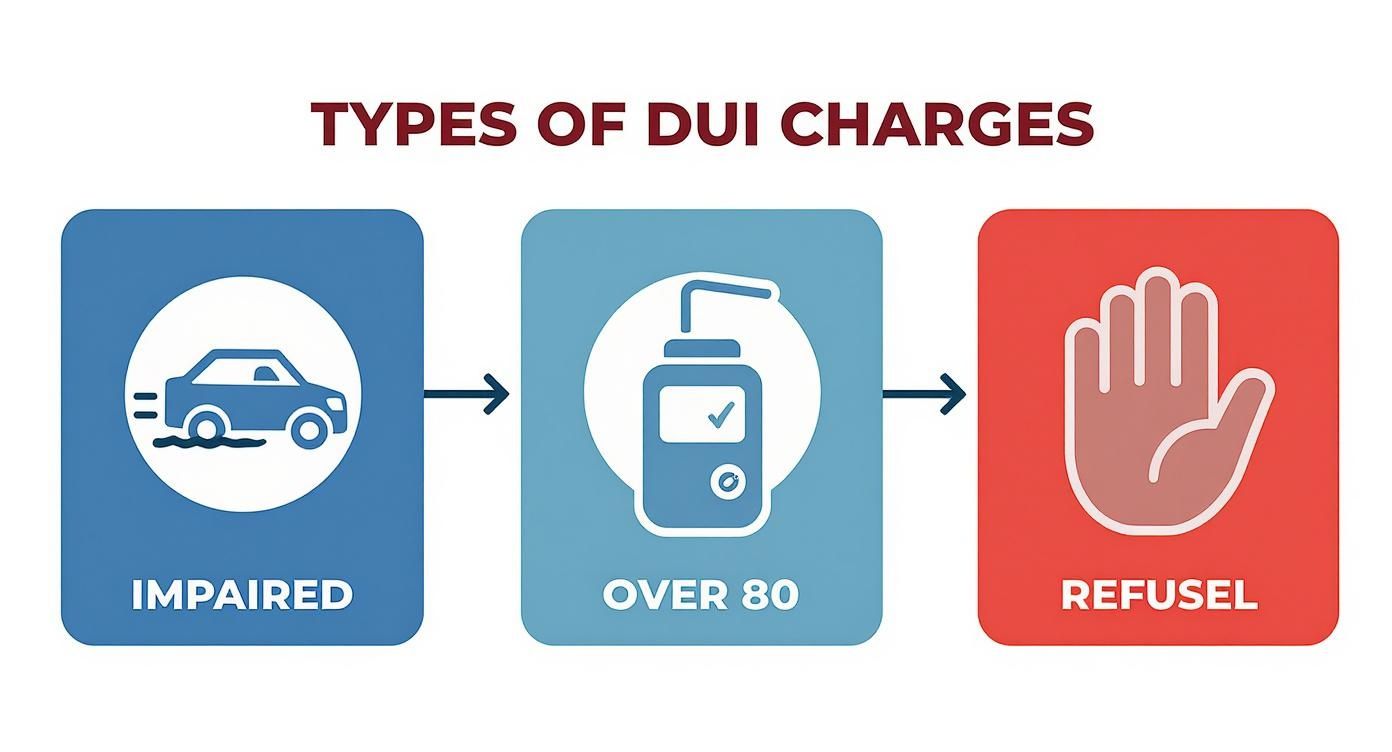
As you can see, a DUI isn't just one offence. It's a category that includes being impaired by observation, blowing over the legal limit, or refusing to give a breath sample.
The Immediate Administrative Penalties
The administrative track hits you first and hard. These penalties are enforced by the police on behalf of the MTO right at the roadside, long before you ever step foot in a courtroom. These aren't criminal punishments; they're civil measures designed to protect public safety.
The two most common administrative penalties are:
-
A 90-day Administrative Driver's Licence Suspension (ADLS): Your licence is seized on the spot. You cannot drive for three months. This happens automatically if you register a "Fail" on a roadside breathalyzer, have a blood alcohol concentration over 80, or refuse to provide a sample.
-
A 7-day Vehicle Impoundment: The vehicle you were driving gets towed and impounded for seven days, regardless of who owns it. You are responsible for all towing and storage fees.
It’s crucial to understand that these MTO penalties stick, even if your criminal charges are later withdrawn or you're found not guilty in court. Fighting them requires a separate and very time-sensitive appeal process directly with the MTO.
The Parallel Criminal Court Process
While your licence is suspended, the second track—the criminal case—is just getting started. This is the process that involves your court dates in Brampton, meetings with a Crown prosecutor, and potentially a trial.
The administrative penalties are about your privilege to drive, managed by the province. The criminal process is about whether you've committed a federal crime, which carries far more severe, life-altering consequences if you're convicted.
A criminal conviction for a driving under the influence DUI offence results in penalties that are completely separate from—and on top of—the initial MTO sanctions. These court-ordered punishments are much more serious and can include:
-
A mandatory minimum $1,000 fine for a first offence.
-
A criminal record that can affect your job, ability to travel, and immigration status.
-
A mandatory driving prohibition of at least one year.
-
Potential jail time, especially for repeat offenders or in cases involving an accident.
Successfully navigating both the immediate MTO penalties and the longer-term criminal proceedings requires a strategic legal approach from day one.
The True Cost of a DUI Conviction in Brampton

A conviction for driving under the influence (DUI) is far more than a bad day in court. It’s an event that sends costly and life-altering shockwaves through every corner of your personal and professional life. The penalties in the Criminal Code of Canada are severe and designed to escalate with each subsequent offence. The "hidden" costs—from a permanent criminal record to professional roadblocks and travel bans—often have a more profound and lasting impact on your future. For anyone in Brampton facing these charges, understanding the full scope of these consequences is absolutely critical. It is also important to note that a conviction can be used in family law proceedings, especially where parenting and custody are at issue.
Criminal Penalties That Escalate
Canadian law imposes mandatory minimum penalties for all impaired driving convictions. A judge has no discretion to go below these punishments, which get dramatically harsher for second and subsequent offences.
Here's a look at how quickly the minimums stack up:
Mandatory Minimum Penalties for DUI Convictions
| Offence | Minimum Fine | Minimum Jail Time | Minimum Driving Prohibition |
|---|---|---|---|
| First Offence | $1,000 (increases with higher BAC) | None | 1 Year |
| Second Offence | None | 30 Days | 2 Years |
| Third Offence | None | 120 Days | 3 Years |
Remember, these are just the starting points. A judge can, and often does, impose much higher fines, longer jail sentences, and lengthier driving prohibitions based on the specifics of your case—like a very high BAC reading or if an accident was involved.
The Permanent Shadow of a Criminal Record
Beyond the immediate court-ordered penalties, a DUI conviction saddles you with a permanent criminal record. This follows you for life unless you are granted a record suspension (formerly a pardon), a process that is neither quick nor guaranteed.
A criminal record can feel like a closed door you never saw coming. It can prevent you from securing your dream job, volunteering for your child's school, or even crossing the border for a weekend trip.
This record can significantly limit your opportunities in several key areas:
-
Employment: Many employers in Brampton and the GTA require a clean criminal record check. A DUI can instantly disqualify you from entire career fields.
-
Immigration: If you are not a Canadian citizen, a DUI conviction can lead to deportation or prevent you from ever becoming a permanent resident or citizen.
-
Travel: A criminal record for impaired driving makes you inadmissible to the United States. You will likely be turned away at the border.
The Financial Fallout Beyond the Fines
The financial burden of a DUI conviction extends far beyond the initial court fine. One of the most immediate and painful hits is to your car insurance. After a conviction, insurance companies will label you a "high-risk" driver. Your premiums will skyrocket, often by $8,000 to $10,000 per year for several years. In some cases, insurers may refuse to cover you at all, making it legally impossible to get back on the road in Ontario.
Mandatory Post-Conviction Programs in Ontario
Even after you’ve paid your fines and served your driving prohibition, your journey isn't over. The Province of Ontario requires you to complete mandatory remedial programs at your own expense before you can get your licence back.
This includes the "Back on Track" program, an educational and assessment course that costs over $600. After that, you will likely be required to install an Ignition Interlock Device in your vehicle for a set period. This device, which prevents your car from starting if it detects alcohol on your breath, comes with installation fees and monthly monitoring costs that add hundreds or thousands more to your total bill.
Building a Strong Defence Against Your DUI Charge
Facing a charge for driving under the influence (DUI) can feel overwhelming. But it's critical to understand that a charge is an accusation, not a conviction. The Crown prosecutor has the heavy burden of proving every single element of their case against you beyond a reasonable doubt. A skilled Brampton defence lawyer’s job is to scrutinize that case for weaknesses.
Many successful DUI defences focus on whether the police followed the strict legal procedures required by the Criminal Code of Canada and the Canadian Charter of Rights and Freedoms. If they don't, the evidence against you could be excluded from court.
Challenging the Police Investigation
A strong defence starts with a microscopic examination of every detail of the police investigation. Any deviation from proper procedure can open the door for a powerful legal challenge. A thorough defence lawyer will dig into these areas:
-
The Legality of the Traffic Stop: Did the police have a legitimate, lawful reason to pull you over in Brampton? An arbitrary stop may violate your rights.
-
Proper Administration of Tests: Were the roadside sobriety tests performed correctly? Was the demand for a breath sample made at the right time and in the right way? The timing and wording are critical.
-
Officer Qualifications: Was the officer who operated the breath-testing machine properly trained and certified? Their qualifications can be challenged in court.
Even a minor procedural mistake can derail the Crown's case. For example, if an officer fails to make a proper breath demand, the results could be excluded from evidence, often causing the entire case to collapse.
Violations of Your Charter Rights
The Canadian Charter of Rights and Freedoms is a shield that protects every Canadian from unfair state action. When police violate these rights during a DUI investigation, a judge has the power to rule that any evidence they collected is inadmissible.
Your rights are not suggestions; they are constitutional guarantees. A violation of your right to counsel or protection against unreasonable search can be the key to having your DUI charges dismissed entirely.
The most common and powerful Charter defences in DUI cases involve:
-
The Right to Counsel (Section 10(b)): After being arrested, you have the right to speak with a lawyer of your choice without delay. If police fail to inform you of this right immediately, or if they don't provide a real, private opportunity to speak with a lawyer, any evidence they gather afterward—including your breath samples—can be excluded.
-
The Right to Be Free from Unreasonable Search and Seizure (Section 8): The police cannot force you to provide a breath sample without proper grounds. They need to have reasonable grounds to believe you’re impaired or have committed an offence. If their demand is based on a hunch, it could be deemed an unreasonable seizure.
Technical and Scientific Defences
Beyond police procedures and Charter rights, a strong defence for a driving under the influence DUI charge often involves the science of breath testing. The approved instruments used to measure blood alcohol content are complex machines that require constant maintenance and precise calibration.
A meticulous defence strategy means obtaining all records for the specific breathalyzer used in your case. Your lawyer will comb through the maintenance logs and calibration records. If it can be shown that the machine was not working perfectly on the day of your test, its readings can be challenged as unreliable. This technical approach can create the reasonable doubt needed to win your case.
Your Questions About Brampton DUI Charges Answered
Getting charged with a DUI (driving under the influence) throws you into a confusing and intimidating legal world. This section provides clear, straightforward answers to the questions we hear most often from clients in Brampton.
Can I Get My Car Back After It Is Impounded?
Yes, but you have to wait. In Ontario, when you’re charged with an impaired driving offence, your vehicle will be impounded for seven days. This is an administrative penalty from the Ministry of Transportation.
There is no way to shorten this seven-day impoundment. After the week is up, you must go to the impound lot and pay all towing and storage fees. These costs can easily run into hundreds of dollars.
Will a DUI Conviction Stop Me From Traveling to the US?
It is very likely, yes. A DUI conviction can create major problems at the border. The United States views a Canadian DUI as a serious criminal offence, which can make you criminally inadmissible. U.S. Customs and Border Protection (CBP) officers can deny you entry at any crossing.
To have a chance of entering the U.S. again, you would need to apply for a U.S. Entry Waiver. This is a complicated, expensive, and long application with no guarantee of success.
What Is the Difference Between a Suspension and a Prohibition?
This is an important distinction. An administrative suspension and a criminal driving prohibition are two different penalties from two different systems.
-
Administrative Driver's Licence Suspension (ADLS): This is the immediate 90-day licence suspension the MTO imposes the moment you’re charged. It is a civil, not a criminal, penalty.
-
Criminal Driving Prohibition: This is a much longer driving ban that a judge orders only if you are convicted in criminal court. The mandatory minimum prohibition for a first-time offence is one year.
Think of it this way: the administrative suspension is a temporary measure to get you off the road immediately. The criminal prohibition is a long-term punishment that only comes after a guilty finding in court.
How Can a Lawyer Actually Help with My Brampton DUI Case?
An experienced Brampton DUI lawyer does far more than just show up for you in court. Their job is to pull the case against you apart and protect your rights every step of the way.
From the moment you hire them, your lawyer gets to work:
-
Digging into the Police Evidence: They demand and review all evidence the police have—the "disclosure." This includes officer’s notes, any video, and the maintenance logs for the breathalyzer, all searched for mistakes, inconsistencies, or rights violations.
-
Finding a Defence Strategy: Based on the evidence, your lawyer builds a defence. Did the police have a legal reason to pull you over? Did they inform you of your right to a lawyer without delay? Was the breath machine working properly? These questions can dismantle the Crown’s case.
-
Handling All the Court Appearances: Your lawyer takes care of the procedural court dates in Brampton and all administrative headaches so you don’t have to.
-
Negotiating with the Crown Prosecutor: A sharp lawyer knows how to strategically negotiate with the Crown. The goal is the best possible outcome for you, whether that means convincing the Crown to withdraw the charge, negotiating a deal to a non-criminal offence, or preparing for a full trial to fight for an acquittal.
A lawyer’s deep understanding of impaired driving law, local Brampton court procedures, and the Criminal Code and Charter of Rights is essential. They bring the expertise needed to challenge the prosecution’s narrative and protect your future. Facing a driving under the influence DUI charge alone means walking into a complex system without the right tools to defend yourself.
When you are facing the serious consequences of a DUI charge, you need a legal team that will stand by you with integrity and unwavering support. At Badesha Law, we provide precise, clear advocacy aimed at securing fair and positive resolutions. If you have been charged in Brampton or the surrounding area, contact us for a confidential consultation to protect your rights and your future. Learn more at https://badeshalaw.ca/brampton-criminal-lawyer.