

Getting a careless driving ticket in Brampton carries significant implications that many may not fully appreciate. Unlike a minor infraction, this charge comes with severe repercussions. The financial penalties alone are substantial, with fines starting at $400 and potentially reaching up to $2,000. Additionally, the charge results in six demerit points added to your driving record, which can lead to increased insurance premiums. More critically, there is the possibility of facing jail time, and your driver's licence could be suspended for as long as two years. Such outcomes can be particularly disruptive for Brampton residents who depend on their vehicles for daily commuting or work-related travel, leading to prolonged inconvenience and lifestyle disruptions.
Given these serious consequences, it is crucial for individuals facing such charges to seek professional legal advice. Consulting a criminal lawyer in Brampton can provide guidance and representation to navigate the complexities of the legal system effectively. An experienced attorney can assess your case, explore possible defenses, and work towards mitigating the impact of the charges on your life. With the potential for lasting effects on your freedom and ability to drive, obtaining knowledgeable legal counsel is an essential step in managing the situation and striving for the best possible outcome.
The Real Cost of a Careless Driving Conviction
When a Peel Regional Police officer hands you that ticket, the first thing on your mind is probably the fine. And while that initial hit to your wallet is a big deal, it's really just the tip of the iceberg. A conviction under Section 130 of the Highway Traffic Act sets off a chain reaction of penalties that can seriously impact your money, your freedom, and your future.
For anyone in Brampton who needs their car for work, school, or just getting around, these consequences aren't just an inconvenience—they can completely derail your life. The conviction instantly slaps six demerit points on your licence. If you're a novice driver, that's often enough to get your licence suspended right away.
Immediate Financial and Legal Penalties
The penalties for careless driving are intentionally severe because the offence itself is taken very seriously. The court has a lot of leeway in deciding what consequences to impose, and it all depends on the details of your situation.
Here’s a quick look at what you could be up against:
-
Fines: The minimum fine is $400, but it can climb all the way to $2,000. If you get the ticket in a designated Community Safety Zone, those fines are automatically doubled.
-
Jail Time: Yes, you can go to jail. In more serious cases, a conviction could mean a sentence of up to six months.
-
Licence Suspension: A judge has the power to take away your driving privileges for up to two years.
To give you a quick summary of what's at stake, here’s a table breaking down the penalties under the Highway Traffic Act.
At-a-Glance Penalties for Careless Driving in Ontario
| Penalty Type | Details (Section 130) |
|---|---|
| Fines | $400 to $2,000 (doubled in Community Safety Zones) |
| Jail Time | Up to six months |
| Licence Suspension | Up to two years |
| Demerit Points | 6 demerit points |
| Insurance Impact | Major conviction, significant premium increases |
| Record Duration | Stays on your driving record for three years |
This table shows just how much is on the line. It's not a minor ticket you can just pay and forget about.
A careless driving conviction is not a minor traffic violation; it's a serious provincial offence that law enforcement, courts, and insurance companies treat with significant gravity. Understanding the full scope of these penalties is the first step toward building a strong defence.
The Hidden Cost: Insurance Shock
Honestly, the most painful and long-lasting hit from a careless driving conviction is what it does to your car insurance. Insurers see this offence as a massive red flag, and they'll immediately label you a "high-risk" driver.
Here in Ontario, insurance data shows that drivers with a careless driving conviction can expect their premiums to jump by 150% or more. Why? Because insurance companies put it in the same category as a criminal offence like impaired driving.
That conviction stays on your driving record for at least three years, which means you’ll be stuck paying those sky-high rates for a long time. I’ve seen some Ontario cases where drivers’ rates went up by over 300%, costing them more than $13,000 in extra insurance payments over those three years. You can learn more about how a conviction affects insurance rates, but the bottom line is, it’s financially devastating.
What Legally Counts as Careless Driving in Ontario?
Most drivers have heard the term "careless driving," but few know what it actually means in the eyes of the law. It’s not as clear-cut as a speeding ticket, which is tied to a specific number on a radar gun. A careless driving charge is far more subjective and often comes down to a police officer's judgment of your actions.
This gray area can be frustrating, but the legal definition itself gives us a solid starting point. Under Section 130 of Ontario's Highway Traffic Act, careless driving is defined as operating a vehicle "without due care and attention or without reasonable consideration for other persons using the highway."
In simple terms, the law asks: were you driving the way a reasonably prudent person would have in the same situation? If an officer decides the answer is no, you could be facing a serious charge.
From the Highway Traffic Act to the Streets of Brampton
Let's bring this legal jargon into the real world. Forget the dense legal text for a moment and think about the roads we all drive on every day in Brampton. Careless driving isn’t just for extreme road rage incidents; it often covers common mistakes that put others at risk.
Here are a few real-world Brampton scenarios that could easily lead to a careless driving charge:
-
Weaving through traffic on Queen Street: Aggressively changing lanes during rush hour without signalling, cutting other drivers off.
-
Tailgating on Highway 410: Following the car ahead so closely that you have zero chance of stopping if they suddenly brake.
-
Getting distracted near Bramalea City Centre: Looking down at your phone, fiddling with the GPS, or trying to eat a messy lunch while navigating busy intersections with heavy foot traffic.
-
A "rolling stop" in a quiet neighbourhood: Failing to come to a complete stop at a stop sign, endangering pedestrians or cyclists you didn't see.
Any of these actions could be seen by an officer as a failure to show "due care and attention." The deciding factor is whether your driving created a potential—or actual—risk to anyone else on the road.
What Is the "Prudent Driver" Standard?
The law doesn’t demand perfection from drivers, but it absolutely holds you to a standard. This standard is based on the idea of a "prudent driver"—a legal concept for a hypothetical, reasonably cautious person. When a court looks at a careless driving charge, it measures your actions against what this ideal driver would have done.
This is a critical point: your intent doesn't matter. You can be found guilty even if you never meant to cause harm or an accident. The court focuses entirely on the act of driving itself. For example, if you spill a hot coffee in your lap, lose control for a split second, and swerve into the next lane, that could be deemed careless. It doesn't matter that you didn't intend to drive dangerously.
The core of a careless driving charge is negligence. The prosecution doesn’t have to prove you intended to be reckless, only that your driving fell below the standard of care expected of every motorist in Ontario.
A Critical Distinction: When an Accident Causes Harm
The consequences for a careless driving charge get dramatically worse when someone is injured or killed. While the standard charge under Section 130 is already serious, if your driving leads to bodily harm or death, the stakes become terrifyingly high.
This introduces a separate, more severe offence: Careless Driving Causing Bodily Harm or Death. It's still a Highway Traffic Act offence, not a criminal charge, but the penalties are designed to reflect the tragic outcome.
-
Standard Careless Driving: Fines up to $2,000, jail time up to six months, and a licence suspension for up to two years.
-
Careless Driving Causing Bodily Harm or Death: Fines skyrocket to $50,000, potential jail time increases to two years, and your licence could be suspended for up to five years.
Understanding this difference is absolutely vital. A moment of inattention that causes a minor fender-bender is one thing. That same lapse in judgment that results in a serious injury will be prosecuted far more aggressively, leading to a much more devastating Ontario careless driving penalty. This is precisely why any charge involving an accident requires you to seek serious legal advice immediately.
Demerit Points and Licence Suspensions: The Hidden Penalties
A conviction for careless driving impacts more than just your finances; it initiates a series of consequences that directly threaten your driving privileges. The immediate repercussion is the addition of six demerit points to your driving record, which can lead to significant complications for many drivers.
These demerit points are more than mere figures on a report. They serve as a method for the Ministry of Transportation (MTO) to identify drivers who pose a higher risk on the roads. Accumulating a substantial number of points signals to the MTO that you may be a potential hazard while driving. In response, the MTO has implemented a structured system of penalties intended to either catch your attention or potentially remove you from the road completely.
If you find yourself facing such a situation, consulting a Brampton criminal lawyer can be a crucial step. A knowledgeable lawyer can help navigate the legal complexities, potentially minimizing penalties and providing guidance on how to protect your driving privileges effectively.
How Demerit Points Actually Work in Ontario
The entire demerit point system is designed to correct bad driving habits or, if that fails, to remove unsafe drivers from our roads. How these points affect you depends entirely on what kind of licence you hold, which is a critical distinction for new drivers in Brampton.
-
Fully Licensed Drivers (Class G): If you have a full G licence, you have a bit more breathing room. The MTO typically won't take action until you hit nine points.
-
Novice Drivers (Class G1 or G2): For new drivers, the rules are incredibly strict. Consequences kick in after you accumulate just four points.
Think about that for a second. A single careless driving conviction and its six demerit points is more than enough to trigger an immediate licence suspension for any G1 or G2 driver. This is a wake-up call for young drivers or anyone new to Ontario's graduated licensing system.
Demerit points stick to your record for two years from the day you committed the offence. But the conviction itself? That stays on your driving record for a full three years, meaning it can haunt your insurance rates long after the points are gone.
From Warning Letters to Ministry Interviews
For a fully licensed driver, the penalties ramp up progressively. The process usually starts with a warning letter in the mail once you reach six points.
If you climb to nine points, expect a summons to attend an interview with the MTO. You'll have to sit down and explain your driving record and justify why you should be allowed to keep your licence. Hit fifteen or more points, and it's an automatic 30-day suspension. No questions asked. For novice drivers, these penalties happen much faster and are far more severe.
The path from a single poor decision to serious consequences is shorter than most people think.
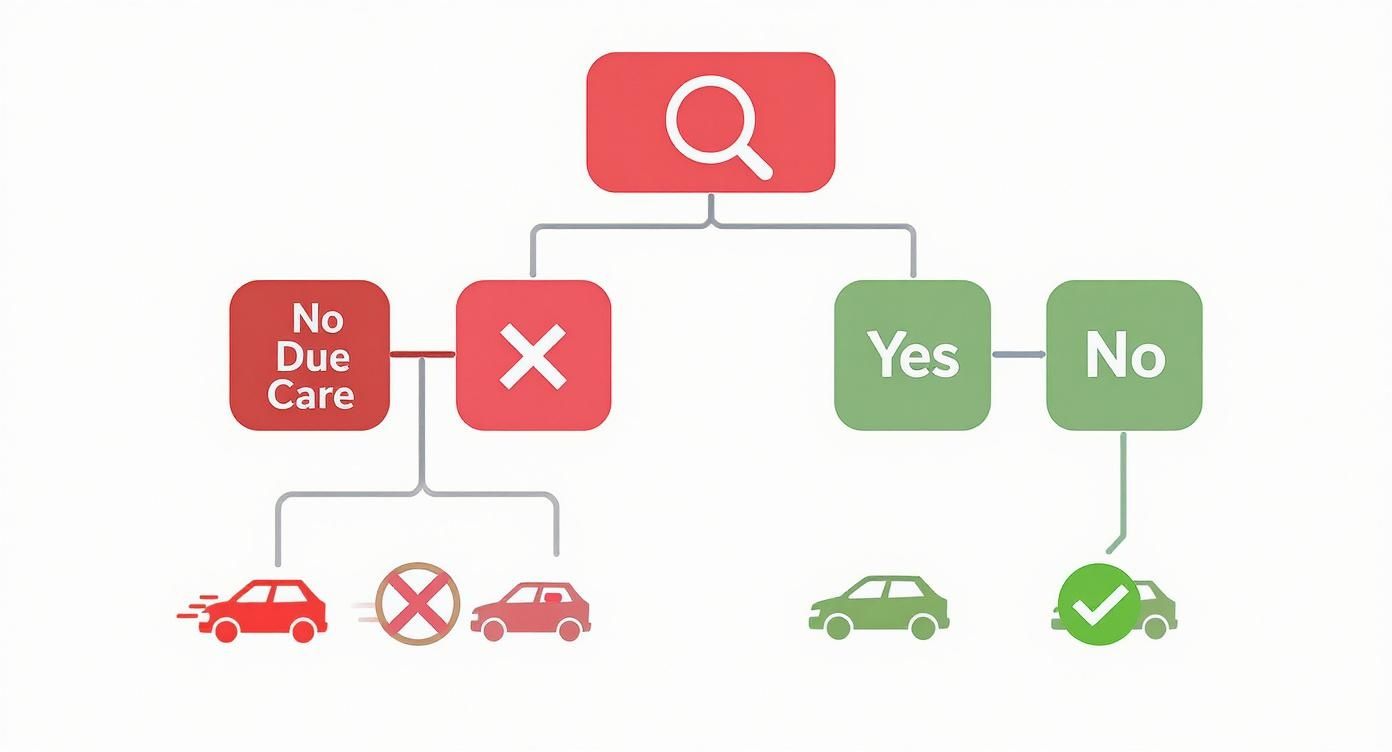
This flowchart breaks it down simply: if the court finds you drove without the "due care" required by law, the outcome is penalties. Drive responsibly, and you avoid the entire mess.
Here's a closer look at how the demerit point system impacts different drivers.
Demerit Point Consequences for Ontario Drivers
| Driver Class | 2-8 Points | 9-14 Points | 15+ Points |
|---|---|---|---|
| Fully Licensed (G) | Warning Letter (at 6 points) | Required MTO Interview | 30-Day Licence Suspension |
| Novice (G1/G2) | Warning Letter (at 2-3 points) | 30-Day Licence Suspension (at 4 points) | 60-Day Licence Suspension & MTO Interview (at 9 points) |
As the table shows, the consequences escalate quickly, especially for new drivers who have very little margin for error.
Court-Ordered Licence Suspensions
On top of the MTO's demerit point system, the judge who convicts you has the independent power to suspend your licence. This is a completely separate penalty that can be handed down no matter how many points you currently have.
A judge can suspend your licence for up to two years for a standard careless driving conviction. If you're convicted of the more serious offence of "Careless Driving Causing Bodily Harm or Death," that suspension can be as long as five years.
Losing your licence for that long is life-altering, especially in a commuter city like Brampton. It impacts your ability to:
-
Get to work and earn a living
-
Manage family duties like school runs and appointments
-
Maintain your independence and social connections
The ripple effect is enormous. Arranging alternative transportation for months or years is a logistical nightmare and a huge financial burden. This is a massive part of the overall Ontario careless driving penalty.
The Long-Term Stain on Your Driving Record
A frequently neglected consequence of a careless driving conviction is its lasting impact. Such a conviction stays on your public driving record for three years from the date of the guilty verdict. During this period, whether you are applying for insurance, seeking employment that involves driving, or interacting with law enforcement during a traffic stop, the conviction remains prominent. This label designates you as a high-risk driver, resulting in elevated insurance premiums and diminished opportunities, even after the financial penalty has been settled. If you find yourself facing such a situation in Brampton, consulting with a criminal lawyer, such as those at Badesha Law, can provide valuable guidance and assistance in managing the repercussions.
How Distracted Driving Can Escalate to Careless Driving
A quick glance at your phone or a moment spent adjusting the GPS seems minor, right? But in the eyes of the law, that small act can snowball into a far more serious careless driving charge. It's a critical distinction that many drivers in Brampton overlook, often with devastating legal and financial fallout.
The line between a simple distracted driving ticket and a life-altering careless driving charge is thinner than most people realize.
This escalation usually happens when a momentary distraction leads to a dangerous situation on the road. A police officer isn't just looking at the act of you holding a phone; they're evaluating the consequence of that action. If you swerve into another lane on Steeles Avenue, fail to brake in time for slowing traffic on Highway 410, or nearly hit a pedestrian near Shoppers World Brampton, your distraction is no longer a simple offence. It has become a clear and present danger to others.
The Officer's Perspective
When a Peel Regional Police officer decides to lay a careless driving charge instead of a distracted driving ticket, they are making a judgment call based on the risk your behaviour created. They’re trained to assess whether your driving fell below the standard of what a reasonably prudent person would do.
Here are a few common distractions that can quickly get upgraded to a careless charge in Brampton:
-
Using a Handheld Device: If texting or talking on your phone causes you to drift, run a red light, or make an erratic move, expect the charge to be upgraded. The officer will note the dangerous outcome, not just the phone use.
-
Interacting with In-Car Technology: Getting lost in your infotainment system or fiddling with the GPS for too long can easily lead to a near-miss or a collision. That’s careless driving.
-
Eating, Drinking, or Grooming: Any activity that takes one or both hands off the wheel—and your focus off the road—can be deemed careless if it compromises your control of the vehicle.
The officer’s notes will focus on how your distraction endangered other people, which is exactly what the prosecution needs to prove a careless driving charge in court.
A Growing Danger on Ontario Roads
There's a reason law enforcement takes this so seriously, and it's backed by some alarming statistics. Distracted driving has become a massive road safety issue, even surpassing impaired driving as a leading cause of traffic fatalities in Ontario.
In fact, 1 in 5 road fatalities are now attributed to driving while distracted, and deaths from these collisions have doubled since 2000. Tens of thousands of accidents are caused by this behaviour in Ontario every single year—a trend that authorities are fighting with much stricter enforcement. You can discover more insights about the dangers of distracted driving in Ontario and its impact on road safety.
The moment your distraction forces another driver to slam on their brakes or swerve to avoid you, you have crossed the line. From a legal standpoint, you are no longer just distracted; you are driving without the "due care and attention" required by law.
Avoiding the Split-Second Mistake
Ultimately, the responsibility of preventing this escalation lies in understanding that no message, phone call, or snack justifies the associated risks. A ticket for distracted driving is already a costly affair, but being charged with careless driving carries much more severe consequences under the Ontario Highway Traffic Act. This includes a penalty of six demerit points, significant increases in insurance premiums, and the possibility of facing jail time.
The most practical approach to avoid such consequences is straightforward. Prepare everything before you begin your journey. This means setting up your GPS navigation system, choosing your playlist, and finishing your coffee before you engage the vehicle's drive mode. In a city like Brampton, where traffic conditions can be unpredictable and change rapidly, maintaining undivided attention is not just a prudent practice—it serves as your most effective safeguard against a charge that could impact your record for years to come.
What to Do After Being Charged in Brampton

The moments after a police officer hands you a summons for careless driving are almost always filled with stress and uncertainty. Your mind is probably racing, but it’s critical to understand that the actions you take right now can dramatically shape the outcome of your case.
How you respond in these first few hours and days really sets the foundation for your entire defence.
The most common mistake drivers in Brampton make is treating a careless driving charge like a simple parking ticket. They look at the fine and think about just paying it to make the whole thing go away. This is a massive error. Paying that ticket is an admission of guilt, and it unleashes the full force of the Ontario careless driving penalty—we're talking six demerit points, a conviction on your driving record, and a painful hike in your insurance premiums.
Your Immediate Action Plan
First, take a deep breath. It's essential to move from reacting emotionally to taking proactive steps. Avoid hasty decisions. Instead, concentrate on collecting comprehensive information and recording every detail of the incident. This approach will help you regain control and avoid common errors.
The most crucial document in your possession is the summons or ticket itself. Thoroughly review each detail on this document.
-
Verify for accuracy: Examine the date, time, and location of the alleged offense carefully. Ensure your personal details, such as your name and address, are correctly spelled.
-
Identify the charge: Ensure the charge is listed under Section 130 of the Highway Traffic Act.
-
Locate your court date: Determine the response deadline and the date for your initial court appearance. Missing this could lead to an automatic conviction.
This document outlines the official allegations against you. Even minor discrepancies or errors could play a significant role in your defense. Consider consulting a criminal lawyer in Brampton for guidance through this process and to strengthen your defense strategy.
Preserve Your Memory of the Incident
As soon as you get home, sit down and write out everything you can remember about what happened. Memories fade incredibly fast, and a detail that seems minor now could become vital down the road. Make your notes as thorough as possible.
To jog your memory, ask yourself these questions:
-
What were the road and weather conditions? Was it raining, sunny, icy?
-
What was traffic like? Was it heavy rush hour or a quiet side street?
-
Where exactly were you, and what were you doing in the moments before being pulled over?
-
What did the police officer say to you? What did you say back?
-
Were there any witnesses? Think about passengers in your car or even other drivers nearby.
Jot it all down, even if it doesn't seem to help your case. The more detailed your account is, the better equipped your legal representative will be to find potential weaknesses in the prosecutor's argument.
The most powerful tool you have immediately after being charged is your own detailed memory. Documenting the scene, the interaction, and the context while it's fresh provides the raw material for building a robust defence.
Why You Must Seek Legal Advice Immediately
Once you’ve reviewed the summons and written down your account, the next step is non-negotiable: contact a legal professional who specializes in traffic law and is familiar with the A. Grenville and William Davis Courthouse in Brampton. Trying to handle a careless driving charge on your own is like walking into an exam you haven't studied for—you’re at a huge disadvantage.
An experienced lawyer or paralegal can immediately get to work.
-
File on Your Behalf: They'll handle all the initial court filings, making sure you don’t miss any critical deadlines.
-
Request Disclosure: Your legal counsel will formally request all the evidence the prosecutor has against you. This includes the police officer’s notes and any witness statements. You are legally entitled to see this evidence, and it’s often where the key to a strong defence is found.
-
Analyze the Case: They are trained to spot inconsistencies in an officer's notes or identify legal arguments you would never see on your own. For example, was the officer's view of the incident clear? Do their written notes match what they told you?
Navigating the Brampton legal system requires local knowledge. A professional who regularly appears in the Brampton courthouse understands how local prosecutors operate and the specific procedures of that court. This local insight, which a firm like Badesha Law can provide, is invaluable when negotiating to get a charge reduced to a lesser offence or, in some cases, withdrawn entirely. Taking this step promptly is the single best investment you can make in protecting your licence, your record, and your financial future.
Got Questions About Your Careless Driving Charge?
If you’ve just been handed a careless driving ticket in Brampton, your head is probably spinning. The uncertainty can be paralyzing, so getting clear, straight-up answers is the first step toward getting a handle on the situation. Let’s tackle the most urgent questions we hear from drivers in Brampton facing this serious charge.
Can I Actually Go to Jail for Careless Driving?
Yes, and this is the wake-up call for many people. Jail time is a very real possibility for a careless driving conviction in Ontario. It's not just a beefed-up speeding ticket. The Highway Traffic Act gives judges the power to sentence a driver to up to six months in jail for a standard careless driving conviction under Section 130.
Now, this isn't the outcome for every case. A judge usually reserves a jail sentence for the most extreme situations—think incidents involving incredibly reckless behaviour, crazy high speeds, or accidents that show a complete disregard for everyone else on the road. Still, the fact that it's on the table shows just how seriously the Brampton courts take this charge.
And if the incident was even more severe, leading to a charge of "Careless Driving Causing Bodily Harm or Death," the stakes get much higher. The maximum jail time jumps to two years. Whether a judge considers jail depends entirely on the facts of your case, your driving record, and the arguments made in court. This is exactly why getting an experienced lawyer involved isn't just a good idea—it's essential to protect yourself from the worst-case scenario.
Will a Careless Driving Conviction Get Me Fired?
It absolutely can. The fallout from a careless driving conviction can spill over from the courthouse directly into your workplace, and for anyone who drives for a living in Brampton, the consequences can be swift and severe.
-
Commercial Drivers: If you drive a truck, bus, delivery van, or any kind of company vehicle, a careless driving conviction is often a career-ender. The insurance companies that cover commercial fleets simply won't accept that kind of risk, making you unemployable in that role.
-
Daily Commuters: Even if your job is in an office, how do you get there? A long licence suspension could make it impossible to commute. In a city like Brampton, where public transit doesn't work for everyone, losing your licence can mean losing your job.
-
Future Job Hunts: More and more employers are asking for a clean driving abstract as part of their hiring process, even for roles that don't involve driving. A careless driving conviction is a massive red flag that could get your application tossed in the bin.
While a careless driving conviction isn’t a criminal record, don’t let that fool you. Employers and their insurance companies see it as a serious liability. Never underestimate the threat it poses to your livelihood.
Is It Really Worth Hiring a Lawyer for a Careless Driving Ticket?
For a charge this serious, bringing in a lawyer or a licensed paralegal who lives and breathes traffic law is almost always a smart move. When you start adding up the long-term costs of a conviction and compare it to the cost of legal help, the value becomes obvious.
Think about the financial hit you're facing if convicted:
-
Fines that can go up to $2,000 (or even higher if someone was hurt).
-
Insurance premium hikes that can easily cost you thousands of extra dollars over the next three to five years.
-
The potential loss of your job and income.
A sharp legal professional who knows the ins and outs of the Brampton courts understands the local procedures and has built relationships with the prosecutors. They can dissect the evidence against you, spot weaknesses, and negotiate to get the charge knocked down to something less serious, like an "unsafe lane change." A lesser charge means fewer demerit points and a much smaller hit to your insurance. In some cases, they might even find a way to get the charge thrown out completely. Walking into that courtroom to face a trained prosecutor by yourself is a huge, and unnecessary, risk.
What's the Difference Between Dangerous Driving and Careless Driving?
This is probably one of the most important distinctions in traffic law, because the consequences are worlds apart.
Careless Driving is a provincial offence under Ontario's Highway Traffic Act. If you're convicted, you're looking at penalties like fines, demerit points, and maybe a licence suspension. Crucially, it does not give you a criminal record. The prosecution just has to prove you drove "without due care and attention."
Dangerous Driving, on the other hand, is a criminal offence under the Criminal Code of Canada. A conviction for Dangerous Driving means a permanent criminal record. That record can stop you from travelling to the United States and other countries, and it can slam the door on job opportunities for the rest of your life. The legal test is also much higher—the Crown has to prove your driving was a "marked departure" from the norm, showing a blatant disregard for public safety.
While both are serious, a Dangerous Driving charge carries life-altering consequences that go far beyond any Ontario careless driving penalty.
Facing a careless driving charge in Brampton demands a smart, strategic response. The penalties can hit your wallet, your freedom, and your future. At Badesha Law, our experienced legal team knows the complexities of traffic law in Brampton. We're here to protect your rights and fight for the best possible outcome for you. If you've been charged, don't go it alone. Contact us today for a consultation.