A Practical Guide to the Form 13.1 Financial Statement in Ontario

If you're heading into a separation or divorce in Ontario, you're going to get very familiar with Form 13.1: Financial Statement. This isn't just another piece of paperwork; it's the single most critical document that will shape the entire financial outcome of your case, from child support and spousal support to the division of your property.

Think of it as the mandatory, sworn foundation upon which all financial negotiations are built.

Why Form 13.1 Is The Cornerstone Of Your Family Law Case

A Form 13.1 Financial Statement with a pen and glasses on a wooden desk, overlooking a government building with a flag.

When a relationship ends, the task of untangling years of shared finances can feel completely overwhelming. The law demands a structured, transparent process to make sure things are handled fairly, and Form 13.1 is the tool that makes it happen. It’s the official map of your financial life that both you, your ex-partner, and the court will use to navigate every decision about money.

The entire point is to force complete financial transparency. In Ontario family law, this document is required for any case involving property division or support claims. It's not optional. Under Family Law Rule 13(1), you are legally required to serve and file it with any application that touches on financial matters. This rule protects everyone by ensuring all cards are on the table from the very beginning.

The Three Critical Valuation Dates

What makes Form 13.1 so powerful is its focus on three specific points in time. You’ll have to calculate the value of all your assets and debts on these exact dates:

  • Date of Marriage: This sets the financial baseline for when your partnership began.
  • Date of Separation: This marks the official end of your financial partnership.
  • Current Date: This provides a real-time view of where things stand today.

These three snapshots aren't random. They are used to perform the crucial calculation required by Ontario's Family Law Act to determine your Net Family Property (NFP). The court then compares your NFP to your spouse's NFP, and the difference usually results in an equalization payment—a lump sum paid from one spouse to the other to ensure the property built during the marriage is shared equally.

The accuracy of your Form 13.1 is everything. A judge will rely on this sworn document to make decisions that will affect your financial life for years. Any omissions, mistakes, or outright lies can destroy your credibility and lead to severe legal and financial penalties.

More Than Just a Form

For many people, filling out this document is the first time they've ever had to take such a deep, detailed inventory of their finances. It’s a demanding process. You have to track down bank statements, get property and pensions appraised, and account for absolutely everything you own and owe.

To make sense of what you're compiling, it can be really helpful to understand the basics of how to read financial statements for beginners. This little bit of background knowledge can make the whole task feel a lot less intimidating.

Getting this form right from the very start is absolutely crucial. It sets the tone for negotiations, mediation, and any court hearings that might follow. A complete and accurate statement can streamline the entire process, reduce conflict, and end up saving you a significant amount of time and legal fees. For a deeper dive into the legal framework, take a look at our guide on family law rights and responsibilities in Canada.

Accurately Disclosing Your Income

Part 1 of your Form 13.1 financial statement is all about income, but it goes way beyond the number on your bi-weekly paycheque. Think of this section as the engine that drives all support calculations. Its accuracy isn't just important—it's paramount. Every single dollar you earn, from every possible source, has to be declared transparently and backed up with hard proof.

The court needs a complete and honest picture of your financial capacity. This isn’t just about your base salary; it’s about bonuses, commissions, overtime, self-employment earnings, investment income, and even government benefits. Failing to disclose even a minor income stream can shatter your credibility and lead to serious legal consequences down the road.

More Than Just Your Salary

Your total income is a puzzle, and your T4 salary is just the biggest piece. To give the court the full picture, you have to account for all the other streams of revenue that complete it.

For many professionals in the GTA, income isn't a fixed, predictable amount. A sales professional in Brampton might have a modest base salary but earn significant commissions, while a freelance graphic designer in Mississauga might have wildly fluctuating project income month to month. Both of these scenarios demand careful calculation and full, honest disclosure.

Here are the common income sources you absolutely must include:

  • Employment Income: This covers your salary, wages, bonuses, and any overtime pay.
  • Self-Employment Income: You need to report your gross business income and then deduct legitimate business expenses. Be ready to justify every single deduction.
  • Investment Income: This includes dividends from stocks, interest earned from savings accounts or GICs, and any capital gains.
  • Rental Income: If you own a rental property, you must declare the gross rent you receive.
  • Benefits and Pensions: This means income from CPP, private pensions, EI, or any disability benefits.

Calculating Variable Income

Figuring out income that isn't a fixed salary can be tricky. While the Family Law Act and the Child Support Guidelines provide the official framework, the general rule is to present an average that is fair and truly representative of your earnings.

If you have variable income, like a real estate agent, you can't just pick your best month or your worst. The court will typically look at a three-year average to establish a pattern and determine a fair income for support purposes. This approach smooths out any unusually high or low earning periods to land on a realistic number. To see how these numbers get plugged into the formulas, you can check out our overview of the spousal support calculator in Ontario.

Real-World Scenario: A construction contractor in the GTA earns the bulk of their income during the busy spring and summer months. On their Form 13.1, they can't just use their lower winter earnings. Instead, they must use their total annual income from the past three years to calculate a monthly average, which gives a far more accurate picture of their true earning capacity.

The Essential Paper Trail

Your income disclosure is only as strong as the documents that back it up. You can't just write down numbers and expect the court to take your word for it. You are required to attach specific documents to your Form 13.1 to verify every single figure you claim.

This isn't a suggestion; it's a mandatory requirement. Your filing will be considered incomplete—and likely rejected—without this essential backup.

Key Documents to Attach:

  1. Income Tax Returns: You must provide your complete personal income tax returns for the last three consecutive years.
  2. Notices of Assessment (NOA): Your NOAs from the Canada Revenue Agency for the last three years are also required, along with any Reassessment notices. These are crucial because they confirm the CRA's official assessment of your filed returns.
  3. Proof of Current Income: You’ll need to attach your most recent pay stubs or a formal statement from your employer that details your year-to-date earnings. If you're self-employed, a recent profit-and-loss statement is what you'll need.

Gathering these documents early is one of the most important things you can do to get started. Being organized and thorough here prevents frustrating delays and shows the court that you're participating in the process transparently and in good faith.

Calculating Your Net Family Property

After you’ve laid out your income, Form 13.1 gets to the real heavy lifting: calculating your Net Family Property (NFP). This is the heart of Ontario’s property division process, and getting it right is everything. Parts 2 through 6 of the form are designed to walk you through this calculation, turning a complex legal formula into a step-by-step financial inventory.

The whole point is to list and value every single asset and debt you have on three specific dates: the day you got married, the day you separated, and right now. This reveals the financial value each of you built up during the marriage, which is then divided equally.

Valuing Your Assets and Debts Across Time

Your first big task is to build a detailed inventory of your financial life. You need to list everything you own, from big-ticket items like your house and investments down to your car and any valuable collections. This isn't the time for guesswork; it’s a meticulous process that demands total transparency.

For each item, you’ll have to assign a fair market value for all three key dates. This can be a real headache, especially for assets that change in value.

  • Real Estate: For your matrimonial home or any other properties, you'll almost certainly need a professional appraisal to get an accurate value for the separation and current dates.
  • Vehicles: You can use resources like the Canadian Black Book or get a dealer appraisal to figure out what your car, boat, or motorcycle is worth.
  • Bank Accounts & Investments: This means digging up old statements from your bank or brokerage to find the exact balances on your marriage and separation dates. Start this process early—it can take a while.
  • Pensions: Valuing a company pension is incredibly complex. It’s not something you can just estimate. You will need a specialized actuarial valuation to determine its worth on the date you separated.

This simple diagram shows how your financial details come together for the disclosure process.
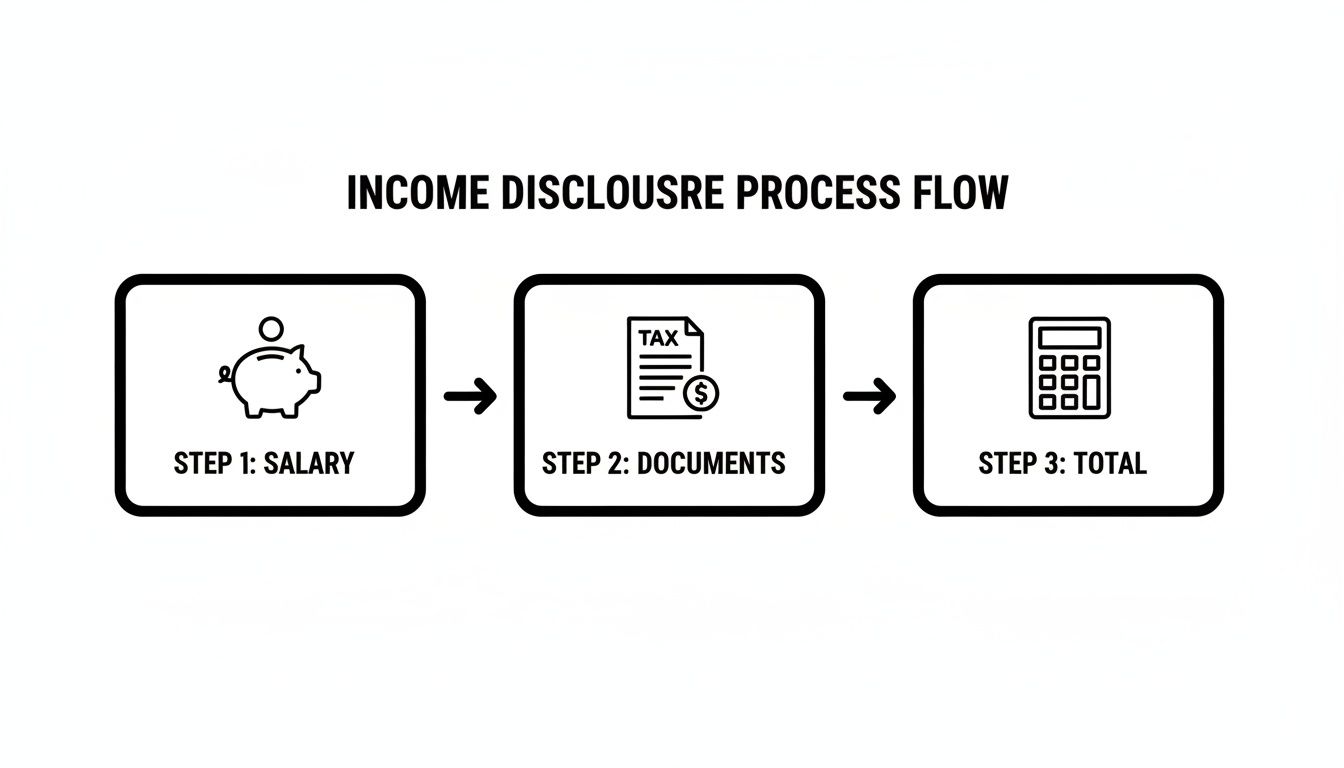
An income disclosure process flow diagram showing three steps: Salary, Documents, and Total calculation.

This flow—from income sources to supporting documents to a final total—is the same logic you'll use when listing and valuing every single asset and debt.

The Crucial Role of Excluded Property

One of the most important—and often misunderstood—parts of this section is excluded property. Ontario's Family Law Act recognizes that certain assets don't belong in the "family pot" to be divided. This means you can deduct their value from your total assets, which can have a massive impact on the final equalization payment.

Common examples of excluded property include:

  • Gifts or inheritances received from a third party during the marriage.
  • The value of property you already owned on your wedding day (except for the matrimonial home).
  • Proceeds from a life insurance policy.
  • Damages awarded to you from a personal injury lawsuit.

But there's a huge catch: you must be able to trace the excluded funds. If you got a $50,000 inheritance and dropped it into a joint bank account where it got mixed with family money and used for groceries and bills, it can lose its protected status. Keeping those funds separate is the key to protecting them.

A Brampton Couple Scenario

Let’s think about a local couple, Priya and Raj, who are separating in Brampton. Five years ago, Priya received a $100,000 inheritance from her aunt, which she wisely kept in a separate investment account in her name only.

When filling out her Form 13.1, Priya would list the current value of that investment account under her assets. But she would also claim a $100,000 deduction as excluded property. This ensures her inheritance isn't unfairly split with Raj. If she had used that money for a down payment on their shared matrimonial home, the situation would be far more complicated.

Demystifying the Equalization Calculation

Once all your assets, debts, and exclusions are listed, the form guides you through the final calculation. Here’s a simplified version of how it works:

  1. Calculate Assets on Separation Date: Add up the value of everything you owned the day you separated.
  2. Subtract Debts on Separation Date: From that total, subtract all your liabilities as of that date.
  3. Subtract Excluded Property: Next, deduct the value of any property you’ve properly claimed as excluded.
  4. Subtract Net Worth on Marriage Date: Finally, subtract what you were worth (assets minus debts) on the day you got married.

The number you're left with is your Net Family Property. Your spouse will do the exact same calculation. The person with the higher NFP then pays half of the difference to the person with the lower NFP. This is called an equalization payment. The accurate calculation of your Net Family Property is a critical step when drafting a Divorce Settlement Agreement.

Getting these sections right is absolutely essential for a fair outcome. It’s where the financial results of your separation are truly decided.

Detailing Your Budget and Special Expenses

Once you've mapped out your assets and debts, Form 13.1 shifts its focus from your financial past to your day-to-day reality. Part 7, your proposed monthly budget, is far more than just a list of expenses—it tells a story about your financial needs and standard of living. This section is absolutely critical if you're making or responding to a claim for spousal support, or if you need to argue that a support amount would cause you undue hardship.

A flat lay shows a monthly budget notebook, dental brace receipts, a calculator, and a child's toy, symbolizing family financial planning.

The court looks at your budget to understand what it actually costs for you to live each month. Let's be blunt: inflating your numbers or guessing will destroy your credibility. The key is to be meticulous and ground every single figure in actual, provable spending.

Building a Justifiable Monthly Budget

Your best friends in this process are your bank and credit card statements from the last six to twelve months. This historical data is what moves you from guesswork to fact-based reporting. You need to go through those statements line by line, categorizing every single expense.

Common budget categories you’ll need to account for include:

  • Housing: Mortgage or rent, property taxes, condo fees, utilities, and home insurance.
  • Transportation: Car payments, insurance, gas, maintenance, and public transit passes.
  • Personal Care: Haircuts, toiletries, and other personal grooming expenses.
  • Food and Household Supplies: Groceries, cleaning supplies, and other day-to-day necessities.
  • Health: Prescription drugs, dental costs not covered by insurance, and other medical expenses.

A well-prepared budget is your evidence. If you claim you spend $800 per month on groceries, your bank statements better back that up. Judges have seen thousands of these forms and can spot an exaggerated or unrealistic budget in a heartbeat.

Accuracy is your greatest asset here. A detailed, verifiable budget strengthens your position, whether you're seeking support to meet your needs or demonstrating your actual financial capacity. This groundwork is also a key step when preparing a separation agreement and what you need to know.

Understanding Section 7 Special Expenses

Part 8 of Form 13.1 deals with a very specific category of costs known as special or extraordinary expenses. These are costs for your children that go above and beyond the basic monthly child support amount. Under Section 7 of the Child Support Guidelines, these expenses are shared between the parents in proportion to their respective incomes.

But not every extra cost makes the cut. For an expense to qualify under Section 7, it has to be both necessary for the child’s best interests and reasonable, considering the family's financial situation.

Examples of Qualifying Special Expenses:

  • Health-Related: Orthodontics (braces), prescription glasses, counselling, or physiotherapy that isn't fully covered by insurance.
  • Childcare: Costs you have to pay so you can work, go to school, or manage an illness.
  • Education: Post-secondary education costs or private school tuition, but usually only if it matches the family's lifestyle before the separation.
  • Extracurricular Activities: This typically means costs for high-level competitive sports (like elite hockey in the GTA) or specialized arts programs, not just house league soccer.

Calculating Proportional Shares

Once an expense is agreed upon as "special and extraordinary," the cost is split based on each parent's Line 15000 income from their tax returns.

Let’s run through a quick scenario:

  • Parent A’s income: $100,000
  • Parent B’s income: $50,000
  • Total combined family income: $150,000
  • The annual cost for their child's competitive hockey is $6,000.

To calculate the shares, we see that Parent A earns two-thirds of the total income ($100,000 / $150,000 = 66.7%). They would be on the hook for $4,000 of the hockey fees. Parent B, earning one-third, would cover the remaining $2,000. This formula ensures the financial weight is shared fairly, reflecting each parent's ability to contribute.

Common Mistakes We See and How to Avoid Them

A small error on your Form 13.1 financial statement can snowball into a major headache. From our experience in the Brampton and GTA courts, we've seen how simple mistakes lead to costly legal disputes, drawn-out delays, and a total loss of credibility in front of a judge.

Honesty and thoroughness aren't just suggestions; they are your best strategy for getting through this process smoothly. Think of this section as a final gut check before you sign and swear to the accuracy of your financial life. Getting these details right from the start protects you from a world of unnecessary complications down the road.

Undervaluing or "Forgetting" Assets

One of the most frequent and damaging errors we see is the undervaluing of assets. It’s tempting to assign a lowball value to your truck, your collectible art, or that expensive set of tools in the garage, but this is a serious misstep.

Equally problematic is "forgetting" to disclose a small TFSA, a line of credit with a zero balance, or an old cryptocurrency account you haven't touched in a while. The other side’s lawyer will scrutinize your statement, and if they find an asset you’ve undervalued or failed to disclose, it immediately raises red flags.

The Real-World Consequence: If you aren't transparent, a judge can draw an "adverse inference" against you. This means they can assume you're hiding other things, which completely tanks your credibility. They can also impute a value to the asset—often a higher one than its actual worth—or order you to pay the other side's legal costs for the time they spent uncovering your mistake.

Incomplete Documentation

Submitting your Form 13.1 without every single required supporting document is like turning in an exam half-finished. You simply cannot file the form without attaching your complete tax returns and Notices of Assessment for the last three years, plus proof of your current income.

This isn't a minor administrative slip-up. The court clerk will almost certainly reject an incomplete filing, causing significant delays and potentially making you miss critical deadlines.

To help you get organized, here’s a quick reference for the essential documents you'll need to gather before you even think about filing.

Form 13.1 Document Checklist

Document Type Why It's Needed Where to Find It
Tax Returns (3 years) Verifies your historical income and financial claims, showing a pattern of earnings. Your accountant or your CRA My Account portal.
Notices of Assessment Confirms the CRA's official assessment of your tax returns for those three years. Your personal files or downloadable from your CRA My Account.
Recent Pay Stubs Shows your current, year-to-date earnings and any deductions. Your employer's payroll department or online employee portal.
Bank/Investment Statements Proves the value of all financial assets on key dates, like the date of separation. Your financial institution's online portal or by requesting archived statements.

Having this package complete and ready to go is non-negotiable for a successful filing.

Miscalculating Income and Expenses

Guessing your monthly budget figures is another common pitfall we see all the time. Stating you spend $1,000 on groceries when your bank statements clearly show an average of $600 is an inconsistency that is easily disproven.

The same goes for income—if you’re self-employed, you can’t just estimate your earnings or use a ballpark figure. The court expects you to use actual data from bank statements, credit card bills, and business records to build your budget.

For income, especially if it fluctuates, a three-year average is the standard practice. An inaccurate income figure directly leads to incorrect support calculations, which will be challenged and ultimately corrected by the court, costing you a great deal of time and money.

When You Need Professional Legal Guidance

Let’s be honest, you can fill out a Form 13.1 financial statement on your own. But there’s a critical point where the process shifts from tedious paperwork to a high-stakes financial exercise—a point where trying to DIY can be a costly mistake.

If your financial picture is anything more than a straightforward salary and a few basic assets, the risk of getting it wrong skyrockets. Navigating the murky waters of a family business valuation, properly accounting for stock options, or trying to trace hidden assets requires a deep understanding of both finance and family law.

An experienced lawyer does more than just fill in the blanks. They ensure your financial disclosure is not only accurate but strategically prepared to support your overall goals in the case.

When Legal Counsel Is Non-Negotiable

Some financial scenarios are so complex that they almost always demand professional guidance to protect your interests. It’s in these situations that a small mistake can have massive consequences.

  • Complex Income: If you or your spouse are self-employed, own a corporation, or earn a variable income from commissions, figuring out the correct number for support calculations is notoriously tricky.
  • Hidden or Undisclosed Assets: Do you have a gut feeling your spouse isn’t being completely honest about their finances? A lawyer can use formal legal tools to compel full disclosure and uncover what’s really there.
  • Significant Excluded Property: If you’re trying to protect an inheritance or a large gift from being divided, you have to trace it meticulously. This is a task loaded with legal pitfalls that are easy to fall into.

The whole point of this exercise is to secure a fair and legally sound outcome. An error in valuing a business or a pension can lead to a lopsided equalization payment, potentially costing you tens or even hundreds of thousands of dollars in the long run.

At Badesha Law, our day-in, day-out familiarity with the Peel Region courts gives us a unique insight into how judges here interpret financial information. Understanding the benefits of hiring a local Brampton family lawyer can be the single factor that separates a manageable process from a costly, drawn-out dispute. We can help you see clearly when a DIY approach is good enough—and when you need an expert to secure your financial future.

Brampton Clients Often Ask…

Navigating the Form 13.1 financial statement is a detailed process, and it almost always brings up practical, real-world questions. Here are some clear, straightforward answers to the concerns we hear most often from our clients here in Brampton and across the GTA.

What Happens If My Spouse Refuses to Provide Their Financial Disclosure?

This is a scenario we see all too often, but the law is crystal clear: financial disclosure is not optional. If a spouse fails to provide their Form 13.1, the court can—and will—impose serious penalties under the Family Law Rules.

A judge has the power to:

  • Order them to pay your legal costs for causing the delay.
  • “Strike” their court documents, which means their own claims might not even be heard.
  • Make a final order based only on the financial information you have provided, which is a massive risk for the non-disclosing party.

How Often Do I Need to Update My Form 13.1?

Think of your financial statement as a current snapshot of your financial reality. It has to be up-to-date. You are legally required to update your Form 13.1 if your finances change in any significant way during your case—for example, if you get a new job, lose a job, or receive a large inheritance.

It must also be updated and re-sworn before any major court appearance, like a case conference or a motion. This ensures the court is always working with the most current information when making decisions that will absolutely impact your future.

What If I Don’t Know the Exact Value of an Asset from the Date of Marriage?

This is an incredibly common problem, especially for couples who were married for many years. Don’t panic. You are expected to make a reasonable and honest effort to find the value. This might mean digging through old filing cabinets for bank statements or contacting a financial institution to see if they can pull archival records.

If you’ve exhausted all options and simply cannot find the exact value, the next step is to provide a well-reasoned estimate. The key is to be prepared to explain exactly how you arrived at that figure.

Can I Fill Out Form 13.1 Myself Without a Lawyer?

Yes, you are legally permitted to complete and file the form on your own. However, given its central importance and complexity, this is one of those areas where trying to save a little money can cost you dearly in the long run.

Having an experienced family lawyer review it is crucial to avoid costly errors or omissions. For any situation involving a business, complex investments, pensions, or arguments over excluded property, getting professional legal advice isn’t just recommended—it’s essential for protecting your financial interests.


Navigating the complexities of a Form 13.1 Financial Statement can be a challenge, but you don’t have to do it alone. The experienced team at Badesha Law provides clear, step-by-step guidance to ensure your financial disclosure is accurate, complete, and strategically prepared to protect your future. Contact us for a consultation to move forward with confidence.


8 Essential Resources for Understanding the Statute of Limitations in Canada

In law, time is often not on your side. Missing a critical legal deadline, known as a 'limitation period,' can permanently extinguish your right to seek justice. The concept of a statute of limitations in Canada is a complex legal web, with rules that differ based on the specific nature of your case. For residents of Brampton, a clear understanding of these timelines is the first and most crucial step in protecting your legal rights, whether you're facing a criminal charge or navigating a family dispute.

This guide is designed to provide actionable resources and clear explanations, demystifying the deadlines that govern your legal options in Brampton. We will break down the essential tools and knowledge you need to act before it's too late. From understanding the basic two-year rule in Ontario's Limitations Act, 2002 to identifying specific timelines within the Family Law Act and the Criminal Code of Canada, this comprehensive listicle will provide the clarity you need.

You will learn how to identify the correct limitation period for your situation and recognize the critical moment when you need to contact a Brampton criminal lawyer for professional guidance. This resource will help you make informed, timely decisions about your case.

1. Limitation Act, 2002 (Ontario) – Primary Statute

For anyone in Brampton, Mississauga, or the Greater Toronto Area contemplating a civil lawsuit, Ontario's Limitation Act, 2002 is the foundational piece of legislation. It fundamentally changed how the statute of limitations in Canada, specifically within Ontario, operates. The Act moved away from a complex system of varied time limits to a more streamlined approach.

At its core, the Act establishes a basic two-year limitation period. This means that for most civil claims, including personal injury, breach of contract, or property damage, you have two years to file a lawsuit. This two-year clock starts ticking not from the date the incident occurred, but from the day the claim was "discovered."

The Crucial Role of Discoverability

Understanding the principle of "discoverability" is essential. The clock doesn't just start automatically. Under the Act, a claim is discovered on the day that a potential plaintiff first knew, or reasonably ought to have known:

  • That the injury, loss, or damage had occurred.
  • That the damage was caused by or contributed to by an act or omission.
  • That the act or omission was that of the person against whom the claim is made.
  • That a legal proceeding would be an appropriate means to seek a remedy.

This rule protects individuals who may not realize the full extent of their damages or the cause of their loss immediately. For example, in product liability cases, a defect might only become apparent years after purchase. The limitation period would begin when the defect and its resulting harm are discovered, not the purchase date.

Practical Tips for Ontario Residents

If you believe you have a potential civil claim, timing is everything. Keep these actionable steps in mind:

  • Document Everything: Immediately record the exact date you first became aware of your loss and any facts connecting it to the potential defendant's actions. This documentation is vital for establishing your discovery date.
  • Preserve Evidence: Secure all relevant documents, photos, emails, and physical evidence as soon as you discover a potential claim. Evidence can be lost or degrade over time.
  • Understand Tolling: Certain situations can pause, or "toll," the limitation clock. For instance, the period does not run against a minor who is not represented by a litigation guardian. It is also suspended during any period the person is incapable of commencing a proceeding due to a physical, mental, or psychological condition.
  • Seek Legal Advice Promptly: The rules surrounding limitation periods are complex. If you are in Brampton or the surrounding area, contacting a lawyer is the most critical step to protect your rights and ensure you do not miss a crucial deadline.

2. Federal and Provincial Limitation Statutes Comparison Chart

While Ontario's Limitation Act governs most civil matters in the province, the legal landscape for the statute of limitations in Canada is not uniform. Each province and territory has its own legislation, and federal laws can apply to specific types of claims, such as those against the federal government. This complexity makes a comprehensive comparison chart an invaluable resource for understanding which rules apply to your unique situation, especially for claims that cross provincial borders.

Laptop displaying legal data spreadsheet with world map and documents on desk

This type of resource lays out the basic limitation periods side-by-side, highlighting key differences. For instance, while Ontario has a general two-year period, British Columbia’s limitation period for personal injury claims also has a two-year discovery-based rule, but the details of its application can differ. A claim involving a breach of a federal contract might be governed by the federal Crown Liability and Proceedings Act rather than provincial law, introducing a different set of deadlines. These charts are crucial for getting a preliminary understanding before diving into specific statutes.

Navigating Jurisdictional Differences

Understanding which jurisdiction’s laws apply is the first and most critical step. A comparison chart helps visualize the potential deadlines that could impact your claim. It serves as a starting point for identifying potential issues, such as:

  • The distinction between general limitation periods (like breach of contract) and specific ones (like claims against a municipality).
  • How different provinces handle discoverability and ultimate limitation periods, which set a final deadline regardless of when the claim was discovered.
  • Exclusions from general limitation acts, such as worker's compensation claims, which fall under entirely separate legislative schemes.
  • The differences between a "limitation period," which bars the remedy, and a "repose period," which can extinguish the right to sue altogether.

For residents in Brampton or Mississauga, this becomes relevant if your claim involves a party or an event in another province. A car accident in Quebec or a contract dispute with a company based in Alberta will require a careful analysis of which limitation period applies.

Practical Tips for Multi-Jurisdictional Issues

If your case involves elements outside Ontario, a comparison chart is a great initial guide. Always supplement it with these steps:

  • Verify the Source: Ensure any chart you consult is up-to-date. Laws change, and relying on outdated information can be catastrophic for your claim.
  • Check Specialized Statutes: General limitation periods often do not apply to specific areas like employment, family law, or real estate. Always check for specialized legislation that might impose shorter, non-negotiable deadlines.
  • Cross-Reference Procedural Rules: Filing a lawsuit involves more than just meeting the limitation deadline. You must also adhere to the Rules of Civil Procedure for the specific court, which have their own timelines.
  • Consult a Legal Professional: Due to the severe consequences of missing a deadline, using a chart as anything more than a preliminary guide is risky. A lawyer in Brampton can conduct a proper jurisdictional analysis and confirm the correct limitation period to protect your legal rights.

3. Canadian Case Law Database – Limitation Period Case Summaries

While statutes provide the black-and-white rules, case law reveals how those rules are applied in the real world. For anyone in Brampton dealing with a potential lawsuit, understanding how judges interpret the statute of limitations in Canada is critical. Legal databases, with CanLII being the most prominent free resource, are invaluable tools that index and summarize court decisions, providing a clear picture of judicial reasoning on limitation periods.

These databases allow you to see precisely how courts have handled cases similar to yours. By reviewing decisions from the Supreme Court of Canada or the Court of Appeal for Ontario, you can understand the nuances of principles like discoverability and tolling. Landmark cases such as R. v. Jordan have redefined timelines in criminal law, while family law decisions clarify how limitation periods in the Family Law Act function for property division in Brampton. This precedent is what lawyers use to build legal arguments.

The Crucial Role of Precedent

Understanding case law is not just an academic exercise; it's a strategic necessity. The legal principle of stare decisis means that lower courts are bound by the decisions of higher courts. Therefore, a past ruling from the Supreme Court or an Ontario appellate court can directly determine the outcome of a new case. For instance, if you are unsure whether your claim was "discovered" two years and one day ago, finding a case with similar facts can provide significant clarity and help predict how a court might rule. This is how the static text of a statute comes to life.

Practical Tips for Researching Case Law

While navigating legal databases can seem daunting, a focused approach yields the best results. Whether you are a litigant or working with your lawyer, keep these tips in mind:

  • Use Specific Search Terms: Combine "limitation period" with your claim type, such as "summary conviction" or "equalization payment." Use Boolean operators like AND/OR to refine your search for more relevant results.
  • Prioritize Higher Courts: Focus on decisions from the Supreme Court of Canada and the Court of Appeal for Ontario. These judgments carry more weight and are binding on trial courts in Brampton and Mississauga.
  • Track Precedent with "Cited By": Use the "cited by" function on platforms like CanLII. This powerful tool shows you how subsequent cases have interpreted or applied a specific ruling, helping you understand its current legal authority.
  • Consult a Legal Professional: Case law is complex and often contains dense legal reasoning. The most effective strategy is to discuss your findings with a Brampton lawyer who can interpret the decisions within the full context of your case and the broader legal landscape.

4. Law Society of Ontario Legal Help Directory and Pro Bono Services

For individuals in Brampton, Mississauga, and the GTA who are facing a looming deadline but lack the resources to hire a lawyer, the Law Society of Ontario (LSO) provides crucial access points to legal assistance. The LSO doesn't provide direct legal advice, but its directories and referral services act as a vital gateway to finding qualified help, including pro bono (free) services. This is an indispensable resource when navigating the complexities of the statute of limitations in Canada, particularly for low-income or unrepresented litigants.

These services connect you with a range of options, from community legal clinics to specialized pro bono organisations. For instance, Pro Bono Ontario operates free legal advice hotlines, while law schools like the University of Toronto and Osgoode Hall often run clinics where students, supervised by lawyers, can provide guidance on limitation period issues. These resources are designed to ensure that financial barriers do not prevent someone from understanding and protecting their legal rights before a critical deadline expires.

The Crucial Role of Accessible Legal Advice

Understanding how to access these services can make the difference between filing a claim on time and losing your right to sue. These directories are not just lists; they are curated pathways to help you find the right support for your specific situation. For example, a Brampton resident facing a separation may be connected with a clinic specializing in family law who can explain the deadlines for property claims under the Family Law Act.

The primary goal of these services is to provide initial guidance, helping you understand if you have a valid claim, when your limitation period likely expires, and what your next steps should be. This initial consultation is often the most critical part of the process.

Practical Tips for Accessing Pro Bono Help

If you believe a limitation period is fast approaching and you need assistance, here are some actionable steps to take:

  • Call Ahead: Contact the clinic or service first to confirm they handle your type of claim (e.g., family law, criminal defence) and have experience with limitation period issues.
  • Check Eligibility: Many pro bono services have financial eligibility thresholds. Be prepared to provide information about your income to ensure you qualify for assistance before booking an appointment.
  • Prepare Your Documents: Gather all relevant paperwork, including anything that helps establish a timeline of events, such as separation agreements, police reports, or medical records.
  • Ask for Specialized Referrals: If the clinic cannot help you directly, ask if they can refer you to a lawyer or another organisation that specializes in your specific area of law and has experience with statute of limitations in Canada cases.

5. Limitations Period Calculators and Online Tools

While legislation like Ontario’s Limitation Act, 2002 provides the framework, determining the exact expiry date for a potential lawsuit can still feel daunting. This is where limitations period calculators and online tools become invaluable practical resources. These interactive web-based tools are designed to automatically compute expiry dates based on key inputs like the discovery date, jurisdiction, and the specific type of claim.

For residents in Brampton and Mississauga, these tools offer a quick, accessible first step in understanding the critical deadlines governing their potential civil action. While they do not replace formal legal advice, they serve as an excellent organizational aid for both individuals and legal professionals, helping to visualize timelines and flag approaching deadlines. Their primary benefit lies in translating complex statutory rules into a clear, actionable date, which is a crucial part of navigating the statute of limitations in Canada.

Person using mobile phone app to check statute of limitations period for Ontario jurisdiction

The Crucial Role of Accurate Inputs

The utility of a limitations calculator is entirely dependent on the accuracy of the information you provide. The single most important, and often most contentious, input is the "discovery date." An incorrect assumption about when the two-year clock started ticking will lead to an incorrect expiry date. The tool simply performs a calculation; it cannot interpret the nuances of your specific case to determine if your assumed discovery date would hold up in court.

For example, a tool might calculate a deadline two years from the date of a car accident. However, if a hidden injury from that accident was only reasonably discoverable a year later, the actual limitation period would be significantly different. Online calculators cannot account for such case-specific details or complex situations like those involving minors, fraud, or ultimate limitation periods.

Practical Tips for Using Online Calculators

If you are using an online tool to get a preliminary idea of your deadline, approach it with caution and a clear strategy. Keep these actionable steps in mind:

  • Double-Check the Discovery Date: The biggest source of error is the discovery date. Be honest and conservative with your assessment of when you knew, or should have known, about the key elements of your claim.
  • Cross-Verify Results: Always compare the calculator's output with the actual text of the relevant statute. These tools are aids, not substitutes for the law itself.
  • Screenshot for Your Records: Keep a record of the information you entered and the date the calculator provided. This can be a helpful piece of documentation for your personal files or when you meet with a lawyer.
  • Understand They Are Not a Guarantee: A calculator cannot account for tolling periods (e.g., for a minor or an incapable person) or other complex exceptions. Do not rely on a tool as the final word, especially if your case has unique circumstances.
  • Consult a Professional Immediately: The most reliable way to confirm your limitation period is to speak with a lawyer. For anyone in the Brampton area, getting professional legal advice is the only way to ensure your rights are fully protected and you don't miss a critical deadline.

6. Exceptions to Limitation Periods – Detailed Explanations and Guides

While the two-year basic limitation period seems rigid, the legal framework governing the statute of limitations in Canada includes several crucial exceptions. These exceptions are designed to promote fairness, recognizing that certain circumstances prevent a plaintiff from bringing a claim within the standard timeframe. For residents in Brampton and across Ontario, understanding these exceptions is vital, as they can pause, extend, or even eliminate a limitation period entirely.

Legal exceptions binder with broken clock symbolizing statute of limitations time constraints in Canada

These rules, often referred to as "tolling" or "suspension" provisions, acknowledge that justice should not be denied due to a person's vulnerability or an opposing party's deceptive conduct. The law aims to balance the defendant's need for certainty with the plaintiff's right to seek a remedy when they are justifiably delayed in doing so.

The Crucial Role of Common Exceptions

The principles behind these exceptions are fundamental to ensuring the justice system is accessible and fair. For instance, limitation periods do not run against minors or individuals who are legally incapacitated, protecting the most vulnerable. Key exceptions include:

  • Minority: For individuals under the age of 18, the limitation clock does not start until their 18th birthday. This allows them to pursue a claim once they reach the age of majority.
  • Incapacity: If a person lacks the mental capacity to make decisions about a lawsuit and does not have a litigation guardian, the limitation period is suspended until they regain capacity or a guardian is appointed.
  • Fraudulent Concealment: If a defendant deliberately hides wrongdoing or misleads a plaintiff to prevent them from discovering their claim, the court may prevent them from using the limitation period as a defence. The clock only starts when the fraud is discovered or reasonably should have been.
  • Special Claims: Certain claims, particularly those involving historical sexual assault, have been carved out from ultimate limitation periods in Ontario, acknowledging the unique trauma and barriers to timely disclosure.

Practical Tips for Ontario Residents

If you believe an exception to a limitation period applies to your situation, meticulous documentation and prompt legal action are essential.

  • Gather Evidence of Concealment: If you suspect fraud, immediately collect any emails, documents, or records that show the defendant deliberately hid facts from you. This is crucial for your argument.
  • Establish Incapacity: A claim of mental incapacity often requires a formal assessment by a qualified professional. You will need medical evidence to prove the individual was incapable of commencing a proceeding.
  • Identify the Age of Majority: For a minor's claim, confirm the exact date they turn 18. The two-year clock will typically begin on that day, so it is a critical deadline to track.
  • Consult a Lawyer Immediately: The rules for exceptions are highly technical and fact-specific. A Brampton lawyer can assess whether your circumstances qualify for a suspension or extension and ensure you plead the correct exceptions in your legal filings to protect your right to sue.

7. Statement of Claim and Limitation Pleading Sample Forms

For residents of Brampton and Mississauga navigating civil litigation, understanding legal documents is as crucial as knowing the deadlines. Statement of Claim and Limitation Pleading sample forms are not just templates; they are practical guides that demonstrate how the statute of limitations in Canada is argued and defended within the court system. These forms illustrate the precise language required to frame limitation arguments effectively.

When a defendant believes a claim is statute-barred, they must formally state this in their Statement of Defence. Conversely, a plaintiff may need to plead facts explaining why their claim falls within an exception, like the discoverability rule. Sample forms, such as Ontario’s Form 14A (Statement of Claim), provide a structural blueprint for how to articulate these complex legal positions, ensuring they are presented in a manner that the court will recognize and consider.

The Crucial Role of Proper Pleading

Properly pleading a limitation issue is a non-negotiable step in civil procedure. Simply stating "the claim is too late" is insufficient. A defence must specifically reference the relevant legislation and the facts supporting the argument that the limitation period has expired. For example, a defendant might plead that the plaintiff knew or ought to have known about the loss on a specific date, which falls more than two years before the claim was filed.

Failing to plead a limitation defence at the outset can be catastrophic, as courts may view it as the defendant waiving their right to rely on it later. These sample forms serve as an indispensable resource for lawyers, paralegals, and even self-represented litigants, guiding them to correctly raise these critical arguments and avoid procedural errors that could derail their case.

Practical Tips for Using Legal Forms

If you are involved in a civil dispute, leveraging sample pleadings can provide clarity and direction. Keep these actionable steps in mind:

  • Reference Specific Statutes: Your pleading must name the specific act and section you are relying on, for example, "The claim is barred by section 4 of the Limitation Act, 2002."
  • State the Discovery Date: Clearly articulate the exact date you argue the claim was discovered and provide a factual basis for why that date is correct.
  • Plead Supporting Facts for Exceptions: If you are a plaintiff relying on an exception like tolling for minors or incapacity, you must plead the specific facts that support this claim in your Statement of Claim.
  • Use Jurisdictional Forms: Always source sample forms from your specific jurisdiction’s court website, as formatting and content requirements can vary significantly. An Ontario form may not be appropriate for a federal court matter.
  • Seek a Legal Review: While forms are helpful, the strategic implications of a limitation argument are complex. Having a Brampton lawyer review any pleading before it is filed is a critical step to protect your legal interests.

8. Comprehensive Legal Guides: 'Understanding Limitation Periods in Canada' Publications

For those seeking a deep, academic understanding of limitation periods, authoritative legal guides serve as indispensable resources. While primary legislation and case law are the ultimate sources, comprehensive publications synthesize the complex web of rules governing the statute of limitations in Canada, providing invaluable context and analysis. These guides are often the starting point for legal professionals and self-represented litigants alike.

These resources distill decades of legal precedent and statutory interpretation into a single, accessible format. They explain core principles like discoverability, ultimate limitation periods, and tolling across different jurisdictions, offering a national perspective that is crucial for claims involving multiple provinces. Guides like Klar & Hogg's Limitation Periods in Canada are considered the gold standard, providing detailed commentary and citing key judicial decisions that have shaped the law.

The Crucial Role of Expert Synthesis

Understanding the raw text of a statute is one thing; appreciating how it has been interpreted by the courts is another. These guides bridge that gap by explaining not just what the law says, but what it means in practice. They connect the dots between various provincial acts and federal laws, highlighting inconsistencies and common principles.

This synthesis is vital for complex cases. For example, a Brampton resident involved in criminal proceedings for an offence like assault may need to understand both the specific timelines in the Criminal Code and any overlapping civil limitation periods. A comprehensive guide can provide the foundational knowledge needed to tackle such multi-jurisdictional challenges, explaining how courts determine which limitation period applies.

Practical Tips for Using Legal Guides

If you decide to consult a legal guide to better understand your situation, remember that they are educational tools, not substitutes for professional advice.

  • Check the Publication Date: The law evolves. Ensure you are using a recent edition, as older versions may not reflect important amendments or landmark court rulings.
  • Cross-Reference with Primary Sources: Always verify the information in the guide against the current text of the relevant statute (like Ontario's Limitation Act, 2002) and recent case law.
  • Use the Index and Table of Contents: These books are dense. Use the index to quickly locate specific topics, such as "discoverability in tort claims" or "tolling for minors," to find the exact information you need.
  • Supplement with Legal Counsel: The nuances of limitation periods are notoriously complex. Use these guides to become an informed client, but rely on a qualified lawyer in the GTA to apply that knowledge to the unique facts of your case and protect your legal rights.

Statute of Limitations in Canada — 8-Resource Comparison

Item ✨ Core features ★ Quality / 🏆 Strength 👥 Target audience 💰 Price / Access
Limitation Act, 2002 (Ontario) – Primary Statute ✨ 2‑yr discovery rule; 15‑yr ultimate bar; province-wide framework ★★★★☆ 🏆 Foundational statute 👥 Plaintiffs & defence counsel in Ontario 💰 Free (public statute)
Federal & Provincial Limitation Statutes Comparison Chart ✨ Side‑by‑side of 13 jurisdictions; claim‑type columns; exceptions highlighted ★★★★☆ Practical for multi‑jurisdiction research 👥 Litigators, clerks, multi‑jurisdiction teams 💰 Free/varies (law society portals)
Canadian Case Law Database – Limitation Period Case Summaries ✨ Full‑text searchable; headnotes; cited‑by links; jurisdiction tags ★★★★★ 🏆 Essential precedent research 👥 Lawyers, researchers, appellate counsel 💰 Free (CanLII) to paid (Westlaw/Lexis)
Law Society of Ontario Legal Help Directory & Pro Bono Services ✨ Regional clinic search; lawyer referrals; PLE resources ★★★☆☆ Accessible safety‑net for urgent needs 👥 Low‑income & self‑represented litigants 💰 Free/low‑cost; eligibility rules
Limitation Period Calculators & Online Tools ✨ Date inputs, jurisdiction dropdowns, tolling options, PDF export ★★★☆☆ Fast, user‑friendly deadline checks 👥 Paralegals, SRLs, busy lawyers for quick checks 💰 Free to low‑cost; verify against statute
Exceptions to Limitation Periods – Detailed Guides ✨ Deep dives on fraud, minority, incapacity, tolling; case examples ★★★★☆ 🏆 Crucial for complex exception pleading 👥 Claimants, counsel handling concealed/abuse cases 💰 Free/paid (varies by publisher)
Statement of Claim & Limitation Pleading Sample Forms ✨ Court‑formatted templates, affidavits, motion materials ★★★★☆ Practical for accurate pleadings 👥 Paralegals, self‑represented litigants, small firms 💰 Free (court sites) to paid template vendors
Comprehensive Guides: "Understanding Limitation Periods in Canada" ✨ Jurisdiction chapters, timelines, case syntheses, practice tips ★★★★★ 🏆 Authoritative, teaching‑quality resource 👥 Lawyers, academics, CLE attendees 💰 $ (Free to $200+ depending on format)

Taking Action: When to Consult a Brampton Lawyer About Your Deadline

Navigating the intricate web of legal deadlines in Canada can feel like trying to hit a moving target. As we've explored, the statute of limitations in Canada is not a single, monolithic rule but a complex framework of provincial and federal laws, exceptions, and judicial interpretations. From Ontario’s Limitations Act, 2002, to the specific time limits for summary conviction offences under the Criminal Code, these deadlines are unforgiving. Missing one can mean the permanent loss of your right to seek justice or mount a defence.

The core takeaway from our deep dive is that time is a critical, and non-renewable, legal resource. Whether you are dealing with a personal injury claim, a contract dispute, or a family law matter concerning property division, the clock starts ticking from the moment of "discoverability". Understanding this principle, which marks when a reasonable person would have known they have a claim, is often the most contentious and complex part of any limitation period dispute. It’s a nuanced legal test, not a simple calendar date.

Key Insights: From Theory to Practical Application

The resources detailed in this article provide an excellent starting point. However, they are tools, not answers. Applying these tools effectively requires a strategic understanding of the law as it pertains to your unique situation in Brampton or the GTA.

Consider these critical points of application:

  • Criminal Law Nuances: While indictable offences like murder have no time limit, the 12-month limitation on summary conviction offences is a powerful defence tool. If you've been charged with a lesser offence like causing a disturbance or certain types of assault, a lawyer must immediately scrutinize the timeline between the alleged event and when charges were laid. A delay by the Crown could lead to the charges being stayed.
  • Family Law Complexities: In family law, limitation periods are equally crucial but often less straightforward. Under Ontario's Family Law Act, claims for property equalization must generally be started within six years of the date of separation or two years after a divorce is granted, whichever comes first. Waiting too long can extinguish your right to a fair share of marital assets. Similarly, while child support is the right of the child and has flexible rules, retroactive claims are not infinite and depend heavily on the circumstances.
  • The Power of Exceptions: Remember, rules like the discovery principle, tolling for minors or incapable persons, and fraudulent concealment are not automatic. They must be argued and proven. A skilled Brampton lawyer knows how to gather the evidence needed to demonstrate why your specific circumstances justify an extension of the standard limitation period.

Your Next Steps: Preserving Your Legal Rights in Brampton

If you suspect a legal deadline is approaching, or if you believe one may have already passed, passive worry is your greatest enemy. Proactive steps are essential to protect your interests. The single most important action you can take is to seek professional legal advice without delay. Do not assume your claim is invalid or your defence is lost based on a simple calendar calculation. The nuances of the law could provide an avenue you haven't considered.

Ultimately, mastering the concept of the statute of limitations in Canada means recognizing its power to shape legal outcomes. It underscores the importance of diligence, awareness, and timely action. A deadline is more than a date on a calendar; it is the legal gatekeeper to the justice system. Ensuring that gate remains open for you requires expert guidance and a strategic approach, especially when your financial future or personal liberty is at stake.


Don't let a procedural deadline determine the outcome of your family or criminal law case. The legal team at Badesha Law has extensive experience navigating the Family Law Act and the Criminal Code for clients across Brampton, Mississauga, and the GTA. Contact Badesha Law today to ensure your rights are protected and your case is handled with the urgency it deserves.