

How to Prove Parental Alienation in Ontario Family Court
Proving parental alienation in court requires demonstrating a clear and persistent pattern of behaviour from one parent specifically designed to damage a child's relationship with the other. This isn't about isolated incidents of poor co-parenting. To succeed in Ontario, you must build a case with concrete evidence—texts, emails, and detailed logs—that illustrates the real harm being done to your child, as defined by Canadian family law.
What Is Parental Alienation in Ontario Law?

Before you can learn how to prove parental alienation, it's crucial to understand what it means within the context of an Ontario family court. Parental alienation is far more than a child being temporarily upset or siding with one parent after an argument. It refers to a severe and relentless campaign of manipulation aimed at systematically destroying a child’s bond with the other parent.
It is not a single act but a form of psychological manipulation. The court views this behaviour through one critical lens: the best interests of the child. This principle is the foundation of both the federal Divorce Act and Ontario's Children's Law Reform Act. When a parent's actions actively sabotage the child's relationship with the other parent, it is considered a form of emotional harm that directly violates this fundamental legal standard.
Recognizing the Signs of Alienation
The behaviours can be subtle or shockingly overt, but they all serve one purpose: to poison your child’s perception of you. Knowing what to look for is the first step in identifying the problem and starting to gather the proof you'll need. It is often challenging to distinguish between the normal challenges of co-parenting and a deliberate alienating strategy.
This guide can help you distinguish between typical conflict and the red flags of alienation.
Recognizing Alienating Behaviours vs. Normal Conflict
This table helps you distinguish between typical co-parenting challenges and the deliberate patterns of behaviour that signify parental alienation.
| Behaviour | Typical Parent-Child Disagreement | Potential Indicator of Parental Alienation |
|---|---|---|
| Negative Comments | A parent expresses frustration about a co-parenting issue in private but encourages the child's relationship. | One parent constantly badmouths the other in front of the child, using derogatory language. |
| Scheduling Conflicts | A child is sad about missing an event due to a pre-set parenting schedule. | A parent consistently schedules "fun" activities that conflict with the other parent's time, forcing the child to choose. |
| Communication | A child occasionally forgets to call the other parent. | One parent actively interferes with calls, "forgets" to pass on messages, or takes away the child's phone during the other parent's time. |
| Child's Loyalty | A child temporarily sides with one parent after a disagreement. | A parent makes the child feel guilty or disloyal for enjoying their time with or showing affection to the other parent. |
| Information Sharing | There are occasional mix-ups or delays in sharing school or medical information. | One parent deliberately withholds important information about the child's health, school, or well-being. |
| Accusations | Parents disagree on parenting styles or rules. | One parent invents false stories of abuse, neglect, or abandonment to make the child fearful. |
This table provides a clearer picture of the difference. While every family has disagreements, the behaviours on the right demonstrate a destructive pattern, not just a simple conflict.
The Legal Threshold in Ontario
For a judge to recognize parental alienation, you must show more than just a few isolated incidents. The court looks for a consistent, pervasive pattern of behaviour that has caused a real, negative impact on your child. This is why meticulous documentation is your most powerful tool.
The core issue for the court is the emotional and psychological harm inflicted on the child. Alienation is seen as a failure of the alienating parent to promote the child’s healthy development and their right to a meaningful relationship with both parents.
Parental alienation is a well-recognized and pervasive issue in Canada's family courts that deeply affects child welfare. Statistics indicate it may impact a significant number of children involved in high-conflict separations, highlighting the urgency for parents in Peel and the Greater Toronto Area to gather concrete evidence.
Ultimately, winning your case means proving to the court that the other parent’s conduct is the direct cause of the breakdown in your relationship with your child. To better understand the fundamental duties of a parent in a custody situation, it’s helpful to review our guide on understanding child custody in Ontario. This sets the stage for the next steps, where we'll explore exactly how to collect the evidence you need to build a compelling legal argument.
Gathering Your Evidence to Build a Strong Case

To convince a judge of parental alienation, your feelings and suspicions are not enough. A court in Ontario requires a clear, undeniable pattern of alienating behaviour, supported by concrete, organized evidence. It is not an effective strategy to simply pit your word against the other parent's. You need a foundation of documented proof that transforms your intuition into a compelling legal case.
Your goal is to build a detailed record showing a consistent campaign of manipulation. This isn't just about collecting random incidents; it's about creating a narrative that shows the court precisely how the other parent's actions are damaging your child's well-being and your relationship with them. Taking this step is critical before you find yourself in a fight in family court for your child, as a well-prepared evidence file is your strongest asset.
Digital Communications: The Undeniable Record
Much of modern life leaves a digital footprint, which can be a valuable source of evidence. Text messages, emails, and social media posts can provide a judge with a direct window into the other parent's conduct and true intentions.
These communications can expose a pattern of obstruction, manipulation, or hostility. A series of texts showing the other parent constantly creating last-minute excuses to deny your parenting time speaks volumes. Similarly, a string of emails where they claim to have "forgotten" to pass on important messages from you to your child can establish a pattern.
When gathering these communications, you must preserve them in their original format.
- Text Messages: Take screenshots, but also consider using software to export entire conversations with dates and timestamps. This provides crucial context and proves the messages haven't been cherry-picked or altered.
- Emails: Print them, but also save them as PDFs. Pay attention to the full email headers, which contain metadata that can be important.
- Social Media: Screenshot any disparaging posts, comments, or private messages from the alienating parent. It's also worth capturing posts from their close friends or family if they are clearly part of the campaign. Always note the date and time.
Organize all of this evidence chronologically. This helps you and your lawyer present a clear, easy-to-follow timeline to the court, showing how seemingly small, isolated incidents add up to a sustained pattern of alienating behaviour.
The Power of a Detailed Behavioural Journal
While digital evidence is powerful, a detailed, ongoing journal is often the backbone of a parental alienation case. This is your personal log where you document every incident, no matter how small it may seem. This practice transforms your memory into credible evidence.
The key to a journal that a judge will take seriously is objectivity. Record the facts, not your feelings. Treat each entry like an incident report.
Your journal should be a factual, chronological account of events. Stick to what happened, what was said, and who was present. Avoid emotional language, interpretation, or accusations. Let the documented facts speak for themselves.
For example, if your child comes home and says, "Daddy said you don't really love me, you just don't want to be alone," a powerful journal entry would capture the date, the time, that exact quote, and how you calmly and supportively responded. Over months, these entries build a compelling narrative of manipulation that a judge cannot ignore.
Third-Party Observations: Unbiased Validation
Independent validation from neutral third parties can significantly boost your claim's credibility. When people who interact with your child regularly can corroborate the changes you've observed, their testimony is often seen as highly credible because they have no personal stake in your case.
Consider individuals who can speak to your child’s behaviour or to things they’ve directly overheard:
- Teachers or School Counsellors: They might notice a sudden drop in grades, a troubling change in social behaviour, or hear your child repeating negative things about you that sound rehearsed.
- Doctors or Therapists: These professionals can document signs of anxiety, stress, or other emotional turmoil, especially if it seems to coincide with visitation exchanges.
- Coaches or Extracurricular Leaders: They might witness the other parent making disparaging remarks about you or see your child become withdrawn and reluctant to participate when you are present.
When you approach these individuals, be clear: you are asking them to report on what they have personally seen or heard. Their objective, unbiased observations are what give their potential testimony its power in court.
Seeking an Expert Assessment
In complex cases, the definitive evidence can come from an expert assessment by a psychologist or social worker. In Ontario, Section 30 of the Children's Law Reform Act allows the court to order a formal assessment to investigate specific questions about parenting and the child's best interests. This is often called a Custody and Access Assessment or a parenting assessment.
The assessor will typically interview both parents, the child, and other relevant individuals (like teachers or new partners). They will review all documents and then provide a detailed report with recommendations directly to the court. These assessments can be expensive and time-consuming, but their findings carry significant weight with a judge.
Before pushing for an assessment, it is essential to consult with your family lawyer. They can help you determine if it is the right strategic move for your specific situation.
Mastering the Behavioural Log for Court
When you’re fighting to prove parental alienation, a detailed behavioural log is the single most powerful tool in your arsenal. It’s the bridge that turns scattered, painful memories into a compelling, chronological narrative a judge can actually follow. This isn't just about keeping a diary; it's about building a piece of legal evidence, one entry at a time.
Relying on memory alone in court is a risky strategy. Under the stress of cross-examination, details can become fuzzy, timelines can blur, and your testimony may sound uncertain. A consistent, well-kept log, however, serves as an unshakeable, factual record. It helps your family lawyer establish the pervasive pattern of alienation that judges in Ontario need to see.
What to Record in Every Entry
To have weight in court, your log must be structured and objective. While your feelings are valid, your log is a place for facts. For every incident, no matter how minor it seems, you need to capture the critical details.
This disciplined approach transforms your personal notes into a court-ready document. Treat each entry like an incident report, focusing entirely on what happened, not how you felt about it.
Here's a breakdown of the crucial components for every entry.
Anatomy of a Court-Ready Log Entry
Use this checklist to ensure every journal entry contains the critical information needed to be effective evidence in family court.
| Component | Why It Matters for Your Case | Practical Example |
|---|---|---|
| Date and Time | Establishes a clear, undeniable timeline of events, which is crucial for showing a consistent pattern to the court. | March 15, 2024, 6:15 PM |
| Location | Provides context. Incidents happening during parenting time exchanges are particularly significant. | During pickup at the other parent's home. |
| Who Was Present | Identifies potential witnesses. Notes if the child, the other parent, or third parties were there. | Present: Myself, my child (Liam), and the other parent. |
| Factual Account | Describes exactly what happened, avoiding emotional language. Stick to observable actions and events. | Liam refused to get in the car. The other parent said, "He doesn't want to go with you." |
| Direct Quotes | Captures the exact words used by your child or the other parent. This is incredibly powerful evidence. | Liam said, "Mommy told me you don't really want to see me, you just have to." |
| Your Response | Shows the court your calm, child-focused reaction. This demonstrates you are the reasonable parent. | I told Liam, "I always want to see you and I love our time together." |
| Child's Behaviour | Objectively describe your child's demeanour. Were they anxious, angry, withdrawn, or parroting phrases? | Liam would not make eye contact and seemed very anxious. |
Following this structure for every entry will, over time, build an incredibly persuasive body of evidence.
Turning Your Log into a Legal Tool
Consistency is crucial. An entry every few months is not sufficient. You must document every cancelled visit, every disparaging remark your child repeats, and every time communication is blocked. This relentless documentation demonstrates the severity and persistence of the problem.
Imagine providing your lawyer with six months of detailed, dated entries. This log allows them to connect the dots and present a clear story of alienation to the judge. They can show, for instance, a pattern where every time a special event is planned, your parenting time is suddenly disrupted for a flimsy reason. To better understand your rights regarding these arrangements, you can find more information by exploring our resources on navigating parenting time in Ontario.
A well-kept log does more than just record events; it reveals the alienating parent's strategy. It shows the court that the child's rejection is not random or organic but is the direct result of a calculated campaign of manipulation.
Ultimately, this log becomes the foundation of your affidavit—the sworn legal document where you present your evidence to the court. A detailed log makes that document infinitely stronger. Instead of a vague statement like, "The other parent often badmouths me," you can state, "On March 15, 2024, the child stated…," followed by a direct quote from your log. That level of specificity is what persuades a judge to act.
Working with Witnesses and Professional Experts
Your detailed log is the foundation of your case, but bringing in objective, third-party voices can make it irrefutable. When trying to prove something as complex as parental alienation, the observations of neutral professionals carry enormous weight in an Ontario courtroom. Their testimony can validate the patterns you’ve documented, turning your personal account into a powerful, multi-faceted legal argument.
Using external voices requires a strategic approach. It’s not about finding people to take your side; it's about identifying individuals who can provide unbiased, factual accounts of what they've seen or heard firsthand.
Identifying Credible Third-Party Witnesses
A credible witness is someone who is neutral and can speak to specific, observable facts—not just offer opinions or repeat what you’ve told them. Their power comes from impartiality. A judge wants to know what they personally witnessed.
Consider the people who see your child regularly and might have noticed a change in behaviour or overheard concerning comments:
- School Staff: A teacher might notice a sudden drop in your child's grades or a new pattern of anxiety before your scheduled parenting time. A child repeating negative things about you that sound rehearsed is a significant red flag.
- Medical Professionals: A family doctor or paediatrician can be a powerful witness. They can speak to increased anxiety, stress-related physical complaints, or other emotional issues that coincide with the conflict.
- Coaches and Activity Leaders: A coach who overhears the other parent making disparaging remarks, or a teacher who sees a once-happy child become withdrawn, can provide valuable testimony.
When you reach out to these individuals, be direct. You are asking if they would be willing to share their professional observations with the court if needed, not asking them to take a side.
Understanding the Role of Professional Experts
While witnesses provide snapshots, professional experts can deliver a comprehensive analysis. In Ontario, their reports give the court a deeper understanding of the family dynamics and the psychological harm being done. It's critical to know the different roles professionals play.
A child’s therapist can provide notes about the child’s emotional state. However, their role is therapeutic, not investigative. Their duty is to help the child, so they usually cannot definitively state that parental alienation is occurring. Their reports are helpful but have limitations.
The most powerful tool is often a formal assessment. Under Section 30 of the Children's Law Reform Act, the court can order a Custody and Access Assessment. This is an in-depth investigation conducted by a trained social worker, psychologist, or psychiatrist.
An assessor interviews both parents, the child, and other key people in the child's life. They review documents, observe interactions, and write a comprehensive report with recommendations for the court. Because these assessors are neutral and appointed by the court, judges give their findings significant weight.
The Critical First Step: Your Lawyer
Before engaging an expert or formally listing witnesses, you must speak with your family lawyer. This is a crucial strategic move.
Your lawyer will help you determine if an expert assessment is the right decision for your case, weighing the potential costs, timelines, and impact.
Attempting to hire an expert without legal guidance can backfire. The expert's instructions, or "mandate," must be framed precisely to address the specific legal issues before the judge. Your lawyer ensures the expert's report will be admissible in court and directly relevant to proving your parental alienation claim. For a better sense of how this conversation starts, you might want to learn more about what a free divorce lawyer consultation covers. This guidance ensures every step you take is aligned with your strategy to protect your relationship with your child.
Navigating the Ontario Family Court Process
Once you have gathered your evidence, the next phase is presenting it effectively in the Ontario family court system. This process can feel daunting, but understanding how it works and which documents matter most will provide clarity and confidence. The system is designed to bring your proof before a judge in a structured, compelling way.
Your evidence is not simply handed over in a folder; it must be formally presented through specific legal documents. The most important of these is the Affidavit, a sworn written statement where you lay out the facts for the court. This is where your detailed behavioural log, organized text messages, and third-party witness statements come together to form the backbone of your legal argument.
Filing the Right Application
If a parenting order is already in place, you will likely need to file a Motion to Change. To succeed, you must show the court there has been a "material change in circumstances" since the last order was made. The pattern of parental alienation you have documented is this critical change. It demonstrates that the current parenting plan is no longer in your child’s best interests due to the other parent's harmful actions.
All the proof you have gathered connects to one central legal principle: the "best interests of the child" test. This is the standard set out in both the federal Divorce Act and Ontario's Children's Law Reform Act. A judge will evaluate every piece of your evidence through this lens. Your job is to show that the alienation is actively damaging your child's emotional well-being and their fundamental right to a meaningful relationship with both parents.
Here’s a simple way to think about how different types of third-party evidence can be layered to build a powerful case.
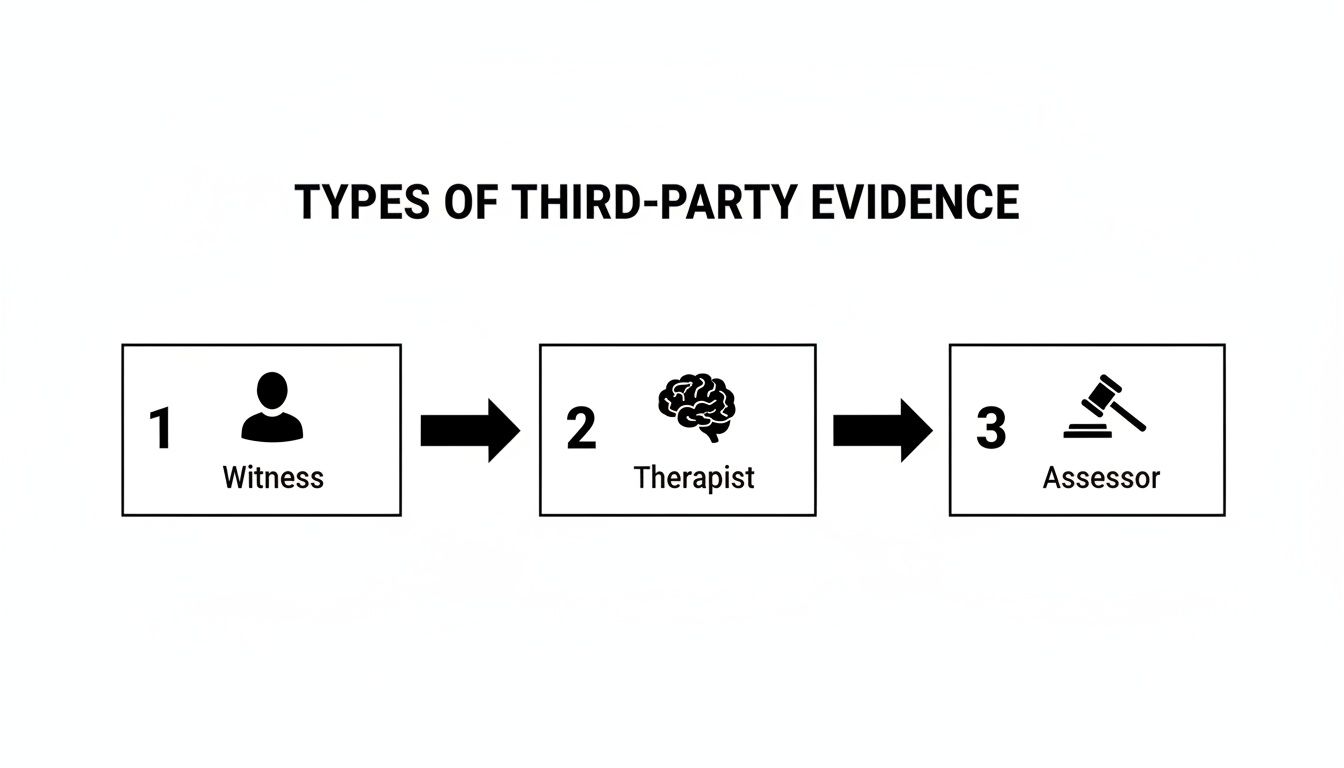
This visual illustrates how you can begin with direct observations from witnesses and then escalate to more formal, in-depth analyses from therapists or court-appointed assessors to strengthen your case.
Understanding Key Court Appearances
The court process is a series of steps, not a single event. Knowing what to expect can reduce stress and help you and your lawyer prepare effectively.
Case Conferences
This is often the first step. A case conference is a less formal meeting with a judge to identify the issues, explore potential settlements, and set a schedule for the next steps. It is the first opportunity for your lawyer to introduce the issue of parental alienation to the judge. To better understand this initial stage, you can learn more about what a case conference entails and how to prepare for it.
Motions
A motion is a formal request for the court to make a specific temporary order. For example, your lawyer might file a motion asking for a temporary order to enforce parenting time, appoint an expert for an assessment, or order therapeutic intervention. Your affidavit and the attached evidence are crucial for convincing the judge to grant your request.
The ultimate goal is to transform your collection of facts into a persuasive legal narrative. An experienced family lawyer is essential in this process, framing your evidence to show a clear pattern of alienating conduct that warrants court intervention to protect your child.
Trials
If the dispute cannot be resolved through earlier steps, it may proceed to a trial. This is the final, formal hearing where your lawyer presents all evidence, calls witnesses to testify, and makes legal arguments to a judge. The judge will then make a final, binding decision. A trial is the culmination of all your efforts to prove parental alienation and secure an order that protects your child's relationship with you for the long term.
Common Questions About Proving Parental Alienation
Facing a parental alienation claim brings a flood of urgent questions. It is a complex and emotionally draining situation, and getting clear, direct answers is the first step toward building a solid legal strategy.
Here are answers to some of the most common concerns we hear from parents in Ontario.
How Do Courts Tell the Difference Between Alienation and a Child Just Being Angry?
Judges are trained to look beyond surface-level anger to determine the real reason for a child's feelings and to identify the influence of an alienating parent.
A key indicator is the child's reasoning. A child who is justifiably angry can usually provide specific, age-appropriate reasons based on their own experiences. An alienated child, however, often repeats complaints that sound scripted or borrowed from the alienating parent, without genuine firsthand examples to support them.
The court is not just looking at one comment; it's looking for a clear pattern of manipulative behaviour from one parent matched with irrational, flimsy justifications for the rejection from the child. When a child can't provide legitimate, personal reasons for their anger, that’s a massive red flag for the court.
Are My Text Messages and Emails Admissible as Evidence in Court?
Yes, absolutely. In Ontario family courts, digital communications like text messages, emails, and social media messages are not only admissible but are often some of the most powerful evidence you can present. They create a direct, undeniable timeline of the alienating parent's actions.
To ensure they are effective, you must handle them correctly:
- Preserve them properly. Take screenshots and use software to export entire conversations with dates and timestamps intact.
- Organize them chronologically. This helps your lawyer and the judge see the escalating pattern of behaviour.
- Do not alter them. Any modification, no matter how small, can destroy their credibility.
What Should I Do If I Am Falsely Accused of Parental Alienation?
Being falsely accused is a serious allegation that requires an immediate and strategic response. Instead of arguing, focus on methodically building your own evidence that demonstrates you are a positive, supportive co-parent.
Start a detailed log of every effort you make to encourage communication and support your child's relationship with the other parent. Keep all your texts and emails respectful and focused on the child. The courts take false allegations very seriously, and the best defence is to prove that your actions have always been in your child's best interests. It is vital to consult a family lawyer immediately.
Proving parental alienation takes skill, the right evidence, and powerful legal advocacy. If you are facing this difficult battle, you do not have to do it alone. The team at Badesha Law provides the clear guidance and dedicated representation you need to protect your relationship with your child. Contact us for a consultation to start building your case today. https://badeshalaw.ca