

Matrimonial Home Rights Ontario: Your Essential Guide to Property in a Separation
When a marriage ends in Ontario, the family home isn’t just another asset—it’s often the most valuable and emotionally charged piece of the puzzle. That’s why your matrimonial home rights in Ontario get special protection under the Family Law Act. These rules, grounded in Part II of the Act, ensure both spouses have an equal claim to live in the home and share in its value, no matter whose name is actually on the property title. This unique status gives you a critical layer of security when you need it most.
Defining Your Rights to the Matrimonial Home

Think of the matrimonial home as a protected bubble with its own set of rules. Under Ontario’s Family Law Act, it’s defined as the property you and your spouse were ordinarily living in as a family right up until you separated. This special designation, established in Section 18(1) of the Act, automatically gives both spouses two very powerful rights.
First, you have the right of possession. As per Section 19 of the Act, this means your spouse can’t legally lock you out, sell the house from under you, or take out a new mortgage on it without your written consent—even if your name isn’t on the ownership papers. Both of you have an equal right to live there until a court order or a signed separation agreement says otherwise. This rule is designed to prevent one spouse from being left homeless during the chaos of separation.
Second, you have a right to an equal share of its value. Unlike other assets, the matrimonial home gets unique treatment during property division. Its entire value on the date you separate gets factored into the financial calculations, a key principle of equalization under Part I of the Act. It’s the law’s way of recognizing that both spouses contribute to the marriage and deserve to benefit from the home’s equity.
Ownership Versus Possession
It’s absolutely vital to understand the difference between owning the property and having the right to live there. One is about whose name is on the legal title, while the other is about the right to occupy the space. In Ontario family law, these are two totally separate concepts, and knowing how they differ is the first step to protecting your interests.
The core principle is simple: marriage grants both spouses possessory rights to the home, even if only one spouse holds legal ownership. This ensures stability and fairness when it is needed most.
Let’s break down this crucial distinction. The table below clarifies what each concept really means for you during a separation.
Ownership vs Possession A Quick Comparison
Understanding the key differences between who legally owns the matrimonial home and who has the right to live in it during a separation.
| Legal Concept | What It Means For You | Who It Applies To | Key Takeaway |
|---|---|---|---|
| Ownership | This is about legal title—whose name is on the deed to the property. | Only the person(s) listed on the title. | Ownership alone does not give one spouse the right to kick the other out after separation. |
| Possession | This is the right to live in the home and not be locked out. | Both spouses, regardless of who owns the property. | Marriage automatically grants you possessory rights. Your spouse cannot sell or mortgage the home without you. |
Simply put, possession is a right you gain through marriage, while ownership is a matter of legal title. This distinction is the cornerstone of how the law protects both partners during a separation.
How We Got Here: The Legal Fight for Matrimonial Home Rights
To really grasp how powerful your matrimonial home rights are today, you have to look at where they came from. The protections you have now weren’t just handed down; they were won through a massive legal overhaul designed to fix a century of unfairness. For decades, Ontario family law operated under outdated rules that often left one spouse—usually the wife—with absolutely nothing after a marriage ended.
Before the 1970s, the law was brutally simple. It was based on old common law principles that said whoever’s name was on the deed owned the property. Period. This rigid system completely ignored the real-world, non-financial contributions that keep a family going, like raising children, running the household, and supporting a spouse’s career.
From Injustice to a Call for Reform
This old-school approach led to devastating outcomes. A spouse who poured their entire life into building a family but wasn’t the legal owner of the home could be left with no claim to its value after a separation. As society evolved, this was recognized for what it was: a profound injustice. The public and legal community started demanding change.
The major turning point came thanks to the Ontario Law Reform Commission. After digging deep into the issue, the Commission released a groundbreaking report in 1974 that didn’t pull any punches, openly slamming the existing laws. This report lit the fuse for one of the biggest explosions in Ontario’s family law history.
The Game-Changing Family Law Reform Act
In a truly landmark move, Ontario passed the Family Law Reform Act in 1975. This wasn’t a minor tweak; it was a complete demolition of the archaic Married Women’s Property Act of 1884. The Ontario Law Reform Commission had declared the old laws were ‘no longer responsive to the needs of society,’ taking direct aim at how they punished spouses for their essential, unpaid work as homemakers and caregivers.
This new law was built on a revolutionary concept for the time: that marriage is an equal partnership. It introduced the idea of the matrimonial home as a unique, special asset. For the first time, both spouses were given a right to possess the home and share in its value, no matter whose name was on the title.
This legal evolution was more than just a technical update. It was a fundamental shift that finally recognized that contributions to a marriage are not just financial. The law finally caught up to the reality of modern partnerships.
This change paved the way for the current Family Law Act we operate under today. The core principles born in 1975 are still what protect spouses, ensuring that the family home—often a couple’s most valuable asset—is treated with the special status it deserves. Understanding this history makes it clear why your matrimonial home rights in Ontario are so fiercely protected. The law was rewritten from the ground up to prevent the injustices of the past and secure a fairer outcome for families navigating separation.
How the Home Impacts Your Financial Settlement
When it comes to splitting up assets in an Ontario separation, the matrimonial home plays by its own set of rules. It’s the one big exception in family law math, and understanding how it works is absolutely critical because it can dramatically change your final financial settlement.
Most assets are divided based on the value they gained during the marriage. But the home? It gets treated completely differently.
This special treatment all comes down to a legal concept called Net Family Property (NFP), as defined in Section 4 of the Family Law Act. Think of your NFP as the wealth you built up from your wedding day to your separation day. To figure it out, you add up all your assets at separation, then subtract your debts and the value of any assets you brought into the marriage (with some exceptions, of course).
The whole point of this exercise is to equalize that growth. The spouse with the higher NFP usually pays the other half of the difference. This is called an equalization payment. But the matrimonial home throws a massive wrench into these standard calculations.
The Home and Net Family Property Calculation
Here is the single most important rule you need to remember: you do not get to deduct the value of the matrimonial home that you owned on the date of marriage. For every other asset you brought into the marriage—an RRSP, a car, an investment property—you can subtract its pre-marriage value from your NFP. But not the home.
Under Ontario’s Family Law Act, the matrimonial home has a unique legal status. Its full value on the date of separation gets thrown into the pot for the spouse who owns it, with no credit for what it was worth before the marriage. This rule, which came out of major legal reforms after 1975, completely changes the divorce math.
This infographic traces the legal journey that led to these modern protections.
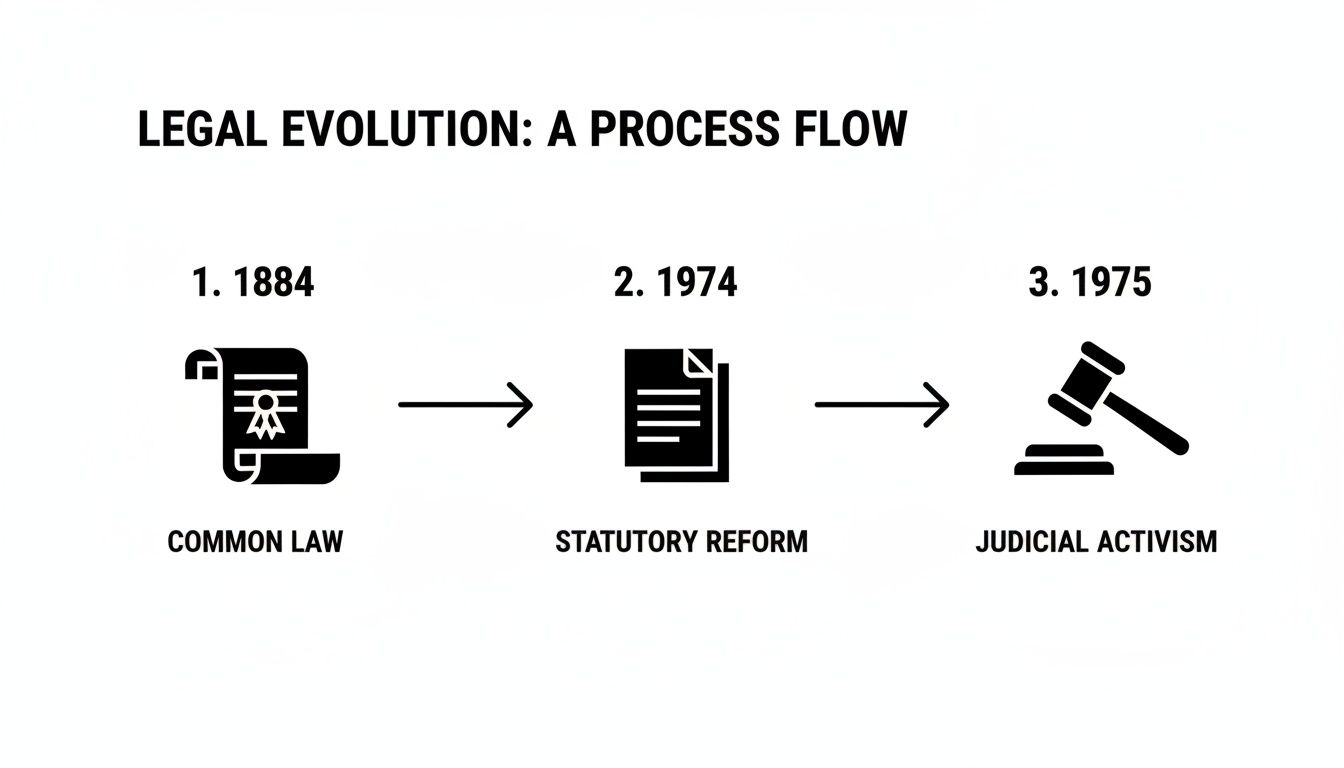
As you can see, the law evolved from outdated ideas that ignored a spouse’s non-financial contributions to the modern framework that recognizes the home as the core family asset. This unique rule ensures both spouses share equally in the home’s total value, no matter who owned it first.
A Look at the Financial Impact
Let’s walk through a practical example to see how this plays out in the real world.
Imagine Spouse A owned a house worth $500,000 on the day they got married. During the marriage, it became the family’s matrimonial home. On the date of separation, the home is now worth $1,200,000. Meanwhile, Spouse B came into the marriage with no assets and has $50,000 in a savings account at separation.
Here’s how a simplified calculation would look:
Sample Equalization Calculation With a Matrimonial Home
This table shows a hypothetical scenario of how the home’s special status dramatically affects the final equalization payment.
| Asset Details | Spouse A (Homeowner) | Spouse B (Non-Homeowner) |
|---|---|---|
| Value of Assets at Separation | Matrimonial Home: $1,200,000 | Savings: $50,000 |
| Value of Assets at Marriage | Home: $500,000 | $0 |
| Deductions for Pre-Marriage Assets | $0 (No deduction allowed for the home) | $0 |
| Debts at Separation | $0 | $0 |
| Net Family Property (NFP) Total | $1,200,000 | $50,000 |
To equalize their NFP, we find the difference: $1,200,000 – $50,000 = $1,150,000.
The equalization payment is half of that difference, meaning Spouse A owes Spouse B $575,000.
If the home were treated like any other asset, Spouse A could have deducted the $500,000 pre-marriage value, which would have slashed the equalization payment. This example shows just how profound the financial consequences of the home’s special status really are. Getting these numbers right is also a key part of figuring out if financial support is needed. You can learn more by checking out our guide on the spousal support calculator in Ontario.
Key Takeaway: The full value of the matrimonial home on the date of separation is always included in the property division calculation for the spouse who owns it, with no credit given for its value at the start of the marriage.
When you’re trying to work through these complex financial issues, alternative methods like mediation can be a great way to resolve disagreements. Learning how to prepare for mediation is a smart first step toward reaching a fair and sensible resolution.
Securing an Order for Exclusive Possession

While both spouses technically have an equal right to stay in the matrimonial home after separating, the reality is that sharing a space during a high-conflict divorce can be impossible—and in some cases, downright unsafe. For these incredibly difficult situations, Ontario law provides a powerful solution: an order for exclusive possession.
This is a court order that temporarily hits pause on one spouse’s right to live in the home, giving the other spouse sole occupancy. It’s crucial to understand that this order doesn’t touch ownership or change how the home’s value is divided down the road. Instead, it’s a tool designed to bring immediate stability and safety to a volatile living situation.
Getting an order like this isn’t automatic. A judge won’t just grant it because you ask. You have to present compelling evidence showing that it’s both necessary and fair under the circumstances. The court’s decision is guided by very specific criteria laid out in Section 24(3) of Ontario’s Family Law Act.
What the Court Considers for Exclusive Possession
When a judge is asked to grant an order for exclusive possession, they must carefully weigh several factors. Their main goal is to figure out what is just and equitable for everyone involved, especially any children caught in the middle.
The court is required to consider:
- The Best Interests of the Children: This is always the top priority. The judge will look at how the conflict is affecting the kids and which living arrangement would cause the least amount of disruption to their lives, including their school and social circles.
- The Financial Situation of Both Spouses: A judge will assess each person’s ability to find and pay for another place to live.
- Any History of Family Violence: Any form of domestic violence, whether physical or emotional, is taken extremely seriously. A documented history of violence by one spouse against the other or the children can be a deciding factor.
- The Availability of Other Suitable Housing: The court will look at whether there are other reasonable places for the non-occupying spouse to live.
This right to seek exclusive possession is a modern protection that evolved from major legal shifts. Ontario’s 1975 Family Law Reform Act didn’t just reform property rights; it also created these crucial possessory rights. This prevented one spouse from unilaterally selling the home or evicting the other during separation—a game-changer in GTA markets where 2023 Brampton home prices averaged $1.15 million.
Making a Compelling Case in Court
To successfully get an order for exclusive possession, you need to build a rock-solid case backed by evidence. Simply saying that you can’t live together anymore isn’t going to cut it. You have to show the court why it is no longer practical or safe for both of you to stay under the same roof.
Think of it like building a case brick by brick. Your evidence can include:
- Affidavits: Your sworn written statement detailing the living situation, the conflict, and any specific instances of violence or behaviour that make living together impossible.
- Third-Party Evidence: Statements from neighbours, family members, or friends who have witnessed the conflict firsthand.
- Police or Medical Reports: If there has been violence, these official reports are critical pieces of evidence.
- Financial Documents: Proof of your income and expenses to demonstrate your financial position.
A judge will not make an order lightly, as it temporarily displaces one person from their home. The evidence must clearly show that the harm of continuing to live together outweighs the hardship of forcing one spouse to move out.
The process usually starts by filing a motion with the court. Because these situations are often urgent, they can be heard by a judge relatively quickly. If you are struggling with a spouse who refuses to cooperate on key decisions, you may find our article on what to do if your spouse won’t sign a separation agreement helpful. Securing an order for exclusive possession is a complex legal step, and having an experienced family lawyer guide you through the process is essential to protecting your family’s well-being.
Using Legal Agreements to Protect Your Interests
While knowing your rights under the Family Law Act is a great start, the real power comes from proactively managing them. Formal legal agreements are the tools that let you do just that. They allow you to bring certainty and control to your situation by setting your own rules for the matrimonial home, rather than leaving things up to the default legal framework.
The two main tools for this are Marriage Contracts (often called prenups) and Separation Agreements. Each one is used at a different stage of a relationship, but they share the same goal: preventing future conflict by setting crystal-clear expectations.
Marriage Contracts for Proactive Planning
A Marriage Contract is something you put in place before or during your marriage to decide how assets, especially the matrimonial home, will be dealt with if you ever separate. This is a game-changer for anyone coming into a marriage with significant property or for blended families who need to protect specific assets.
Think of it as ‘opting out’ of the standard rules. For instance, you could specify that the value of the home you owned before the marriage will be kept separate from the Net Family Property calculation, overriding the special status the law would otherwise give it. To proactively define property rights and responsibilities concerning the matrimonial home before marriage, a prenuptial agreement can be a valuable legal tool. For a deeper dive into how these agreements work in Canada, check out our guide on prenuptial agreements in Canada.
By creating a marriage contract, you are essentially creating your own private law for your relationship. It replaces ambiguity with a clear, mutually agreed-upon plan, which can save immense stress and expense later on.
Separation Agreements for Post-Separation Clarity
Once you’ve separated, a Separation Agreement becomes the most important document you’ll sign. It’s a legally binding contract that lays out exactly how you’ll untangle your lives, with the matrimonial home almost always being a central piece of the puzzle.
A well-drafted Separation Agreement provides firm answers to the most stressful questions about your home. It can set a hard date for selling the property, outline who gets to live there until it’s sold, and specify precisely how the money will be divided.
This agreement can cover crucial details such as:
- Exclusive Possession: Granting one spouse the right to live in the home for a fixed period.
- Buyout Terms: Detailing the exact process for one spouse to buy out the other’s share, including how the home will be valued and when payment is due.
- Sale and Division: Clearly stating how the net proceeds from the sale will be calculated and distributed between both of you.
By formalizing these decisions, a Separation Agreement provides a clear roadmap. It prevents the costly and emotionally draining court battles that often erupt from uncertainty over matrimonial home rights in Ontario.
Common Questions About Matrimonial Home Rights
Navigating a separation brings a wave of uncertainty, and questions about the home are often the most urgent and emotional. Here are clear, straightforward answers to the most common queries we hear about matrimonial home rights in Ontario, grounded in the realities of the Family Law Act.
Can I Be Kicked Out if My Name Is Not on the Title?
Absolutely not. This is a powerful protection built into Ontario’s family law. Once you are legally married, both spouses have an equal right to possess (live in) the matrimonial home. This right has nothing to do with whose name is on the property title.
Your spouse cannot legally change the locks, throw your things out, or force you to leave without either a signed separation agreement or a formal court order for exclusive possession. It’s one of the most fundamental rights the law provides to spouses during a breakdown of the marriage.
Do I Have to Share the Value of a Home I Owned Before Marriage?
Yes, and this is a critical point that catches many people by surprise. The matrimonial home is treated as a special, shared asset, unlike almost anything else you might have owned before the wedding.
You don’t get to deduct the home’s value from the date you got married when calculating your Net Family Property. Its full value on the date of separation is thrown into the pot for the equalization calculation. This means your spouse is legally entitled to half of its total worth, not just the growth in value during the marriage.
What Rights Do Common-Law Partners Have to the Home?
This is where the law draws a very hard line. Common-law partners do not have the same automatic rights to the home that married spouses do. The special legal status of a “matrimonial home”—and the property division rules that come with it—only apply to legally married couples in Ontario.
A common-law partner whose name isn’t on the title might have to make a trust claim to get a share of the property’s value. This is a far more complex, expensive, and uncertain legal battle that involves proving you contributed to the property’s value or upkeep in a significant way.
Key Insight: The distinction between married and common-law status is one of the most significant in Ontario family law, especially concerning real estate. Marriage grants automatic property rights to the home that common-law relationships simply do not.
Can My Spouse Sell the Home Without My Consent?
No. A core protection of your matrimonial home rights in Ontario is that one spouse cannot sell, refinance, or put a new mortgage on the home by themselves. This is true even if the other spouse’s name is not on the legal title.
For any major transaction involving the property, both spouses must provide their written consent. This legal safeguard stays in place until the home’s fate is officially decided in a separation agreement or through a court order. If you’re worried about what happens to your assets during this process, you can learn more about how to protect your property in a divorce in our detailed guide.
Navigating the complexities of matrimonial home rights requires clear, experienced legal guidance. The team at Badesha Law provides precise representation to protect your interests and help you move forward with confidence. For a consultation to discuss your specific situation, visit us at https://badeshalaw.ca.