

Charged with Assault. Hire a Criminal Lawyer in Brampton
When you're facing an assault charge in Brampton, what you do in the first few hours is absolutely critical. Things move fast—especially your bail hearing—so the most important step you can take is to get a dedicated assault lawyer Brampton residents trust to protect their rights from the get-go. At Badesha Law, our team is ready to jump in with immediate, strategic advice the moment you're arrested.
What steps should I take immediately after being charged with assault?
Being arrested and charged with assault in Brampton is a disorienting, high-stress experience. The moments and hours right after are a crucial window where your actions—or inaction—can seriously impact how your case unfolds. The two most important things to remember are your right to legal counsel and your right to remain silent.
After an arrest, the main goal of the Peel Regional Police is to gather evidence, and that often means questioning you about what happened. While you have to provide basic identifying information, you are under no legal obligation to answer questions about the alleged incident. Anything you say can and will be handed over to the Crown Attorney to build a case against you.
Your Legal Right: Under the Canadian Charter of Rights and Freedoms, you have the right to remain silent and the right to retain and instruct counsel without delay. Using these rights is not an admission of guilt; it’s a fundamental protection you must use.
The Booking Process in Peel Region
After an arrest in Brampton, you’ll be taken to a Peel Regional Police station for booking. This is where officers will take your fingerprints, photograph you, and formally record the charge. It’s also during this time that you’ll get your opportunity to call a lawyer. This is your moment to connect with a criminal lawyer in Brampton who can start defending you right away.
It's vital to use this call to contact a firm like Badesha Law. An experienced lawyer can give you on-the-spot advice about handling police questions and explain what's coming next, including the all-important bail hearing.
The Urgency of the Bail Hearing
Once arrested, you'll have a bail hearing, usually within 24 hours. A Justice of the Peace will decide whether to release you and under what conditions. The decision is based on ensuring public safety, not on determining guilt or innocence. In domestic assault cases, for example, bail conditions are often incredibly strict to prevent any contact with the alleged victim.
Having a skilled Brampton criminal lawyer is essential to argue for the least restrictive bail conditions possible. You can learn more about the specifics of bail in domestic assault cases in Brampton on badeshalaw.ca.
Key Steps to Protect Yourself
If you find yourself in this situation, the following steps are your first line of defence. The table below breaks down exactly what to do and why it’s so important for your case.
**Immediate Actions Following an Assault Charge in Brampton** 1. **Remain Silent**: It is crucial to remain calm and politely inform the authorities that you wish to remain silent until you have spoken with your lawyer. This approach helps prevent you from unintentionally providing any information that could be used against you by the police or Crown. 2. **Contact Your Lawyer Immediately**: As soon as you are allowed to make a phone call, reach out to **Badesha Law**. Provide your name, the location of the police station where you are being held, and the charge against you. This enables your lawyer to begin safeguarding your rights and preparing for your bail hearing without delay. 3. **Avoid Discussing the Case**: Refrain from talking about the incident with anyone, including police officers, cellmates, or even family members over the phone. These conversations may be monitored and potentially used as evidence against you. The details of your case should only be discussed with your lawyer. 4. **Cooperate but Remain Firm**: While it is important to comply with basic procedures such as fingerprinting, maintain your decision not to answer questions regarding the allegations. This demonstrates your willingness to cooperate while also asserting your awareness of your rights. By adhering to these steps, you safeguard yourself, allowing an experienced legal professional to take charge of the situation and begin constructing a robust defense from the outset. The initial hours are critical, and having a trusted advocate by your side can significantly impact the outcome.
What is an assault with a weapon charge in Ontario?
When police add the words “with a weapon” to an assault allegation, everything changes. The charge instantly becomes more serious, and under Canada's Criminal Code, the definition of a 'weapon' is much broader than most people realize. This one detail can dramatically alter the course of your case in the Brampton courts.
Many people hear 'weapon' and immediately think of a gun or a knife. But legally, a weapon can be almost anything if it's used to hurt or threaten someone. This means common, everyday items—a beer bottle, a hockey stick, or even a car driven aggressively towards another person—can elevate a simple assault into a much more severe charge.
The moment a weapon is involved, the Crown Attorney in Bramton will handle the case with far greater intensity. It bumps the charge up from a simple assault to an offence that is almost always prosecuted by indictment, which opens the door to much heavier penalties.
The Different Levels of Assault
The seriousness of an assault charge climbs depending on how much harm was caused or the way it was inflicted. The first thing a Brampton criminal lawyer will do is dig into the details of your case to see exactly what the Crown has to prove.
-
Simple Assault (Section 266): This is the foundational charge. It covers everything from a shove in a heated moment to a deliberate, unwanted touch.
-
Assault with a Weapon or Causing Bodily Harm (Section 267): This is a step up in severity. "Bodily harm" means any injury that affects a person's health or comfort and is more than just minor or fleeting. The involvement of a weapon also places the charge in this category.
-
Aggravated Assault (Section 268): This is the most serious form of assault. It happens when an attack wounds, maims, disfigures, or puts the complainant's life in danger.
The specific charge you face is decided based on the evidence Peel Regional Police gather and the Crown Attorney's review. That classification sets the stage for everything that follows, from your bail conditions to the potential sentence you might face.
The Impact of Domestic Relationships
When an assault allegation involves intimate partners or family members, the legal system in Brampton handles the case very differently. These are labelled as domestic assault cases under both Ontario's Family Law Act and specific Crown policies in Peel Region.
Even if the charge is simple assault, the "domestic" label changes the entire game. The Crown's office in Brampton has a zero-tolerance policy for these situations, which means they are highly unlikely to withdraw the charges, even if the person who made the complaint wants to reconcile.
Bail conditions are almost always stricter, often including a non-negotiable no-contact order with the alleged victim and a ban on returning to the family home. If convicted, the penalties can be harsher because the domestic context is seen as an aggravating factor at sentencing. If you're facing this kind of allegation, you absolutely need a lawyer with specific experience in this area. You can learn more on our page about domestic assault charges in Brampton.
Understanding these differences is crucial. It helps you see just how serious your situation is and why a cookie-cutter defence won't work. At Badesha Law, our first move is always to meticulously review the allegations and evidence to give you a clear, honest picture of what you're up against and how we can best defend your rights.
What happens after an assault in Brampton?
Being released after an assault arrest isn’t the end of the story—it’s just the beginning of your legal journey. Trying to understand the path your case will take through the Brampton court system can feel completely overwhelming, but it follows a structured process. Knowing what to expect is the first step toward getting some control back.
Your case is going to be handled at the A. Grenville and William Davis Courthouse in Brampton. This is where everything happens, from your first appearance right up to a potential trial. The first major hurdle you'll face is the bail hearing, where the judge or Justice of the Peace decides the conditions of your release.
This is where a skilled assault lawyer Brampton residents trust becomes absolutely essential. At the bail hearing, the Crown Attorney will push for conditions they see as necessary to protect the public. Your lawyer’s job is to fight for the least restrictive conditions possible, allowing you to live your life with as much normalcy as you can while the case moves forward.
The Critical Bail Phase and Its Conditions
Bail conditions aren’t just suggestions; they are legally binding court orders. If you violate even one of them, no matter how minor it seems, you can be hit with a new criminal charge for breach of recognizance. This only makes your original assault case more complicated and hurts your chances of getting a good result.
Common bail conditions in Brampton assault cases often include:
-
No-Contact Orders: You will almost certainly be ordered not to communicate with the complainant, directly or indirectly. That means no phone calls, texts, emails, or even passing a message through a friend.
-
Residency Restrictions: You might have to live at a specific address and let the court know if you move. In domestic assault cases, this usually means you can't go back to the family home.
-
Weapons Prohibitions: A ban on possessing any firearms or other weapons is a standard condition.
-
Reporting Requirements: You may have to check in with a bail supervisor or a police officer on a regular basis.
Following these conditions to the letter is non-negotiable. One slip-up could land you right back in custody, and getting bail a second time is much, much harder.
From Disclosure to Resolution
Once the bail hearing is over, the process shifts to gathering evidence and negotiating. The first thing that happens is you receive disclosure—the complete file of evidence the Crown Attorney has against you. This package usually contains everything from the police officer’s notes and witness statements to photos or any other evidence they’ve collected.
Your Brampton criminal lawyer will go through this disclosure with a fine-tooth comb, right alongside you. This review is what your entire defence strategy is built on. It’s how we spot the weaknesses in the Crown’s case, find potential violations of your Charter rights, and identify the best path toward a successful defence.
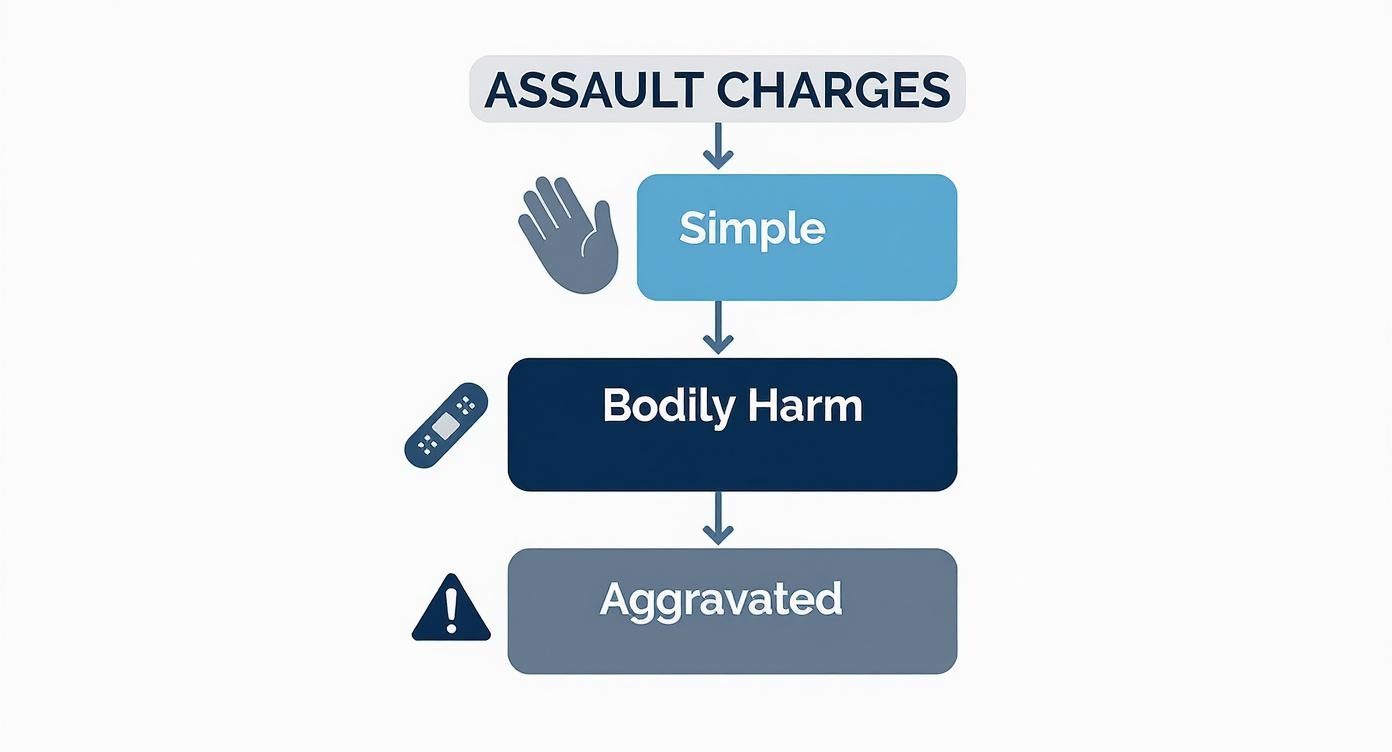
This hierarchy shows how the alleged harm directly impacts everything that follows, from the strictness of your bail conditions to the potential penalties you could face.
After reviewing the disclosure, your lawyer starts talking with the Crown Attorney. These meetings, known as Crown Pre-Trials, are where we negotiate a potential resolution. Your lawyer might push for the charges to be withdrawn completely, maybe in exchange for you signing a peace bond or completing a diversion program.
If we can't reach an agreement there, the next step is usually a Judicial Pre-Trial. This is a more formal sit-down with the Crown and a judge to hash out the case's issues, figure out how long a trial would take, and make one last push to resolve things without going to court.
Ultimately, your case will end in one of a few ways:
-
Withdrawal: The Crown agrees to drop the charges entirely.
-
Peace Bond: You agree to follow certain conditions for a set time (usually 12 months), and in return, the criminal charge is withdrawn.
-
Diversion: You complete a program, like counselling, and then the Crown withdraws the charge.
-
Trial: If no other resolution is possible, your case goes to trial, where a judge will decide if you are guilty or not guilty.
Every single step, from that first bail hearing to the final outcome, demands careful strategic planning. Having a top criminal lawyer in Brampton like the team at Badesha Law in your corner ensures your rights are protected and every possible option for a positive result is explored. We’ll stand with you through this entire process, giving you clear guidance and powerful advocacy at the Brampton courthouse.
What are the typical penalties for an assault charge in Canada?
If you're convicted of assault in Brampton, the consequences don't just stay inside the courtroom. The penalties aren't a simple slap on the wrist; they're decided by the court based on the unique details of the incident, your personal history, and the case presented by your assault lawyer Brampton. It’s crucial to understand what’s at stake and why a strong, proactive defence is so important.
In Canada, assault penalties depend on whether the Crown prosecutor treats the charge as a less serious "summary" offence or a more severe "indictable" offence. The specific section of the Criminal Code also matters. Outcomes can be anything from a fine for a minor incident to years in prison for a serious act of violence.
How Brampton Courts Decide on a Sentence
When a judge in Brampton is deciding on a sentence, they don’t just look at the charge and call it a day. They consider a whole mix of factors to land on a penalty that fits the crime. A good Brampton criminal lawyer will focus on presenting the mitigating factors—the things that paint a fuller picture of you and the situation—to argue for the lightest possible sentence.
Here are the key things a judge will be looking at:
-
The Seriousness of the Assault: Was someone hurt? How badly? The amount of harm caused is always a top consideration.
-
Your Criminal Record: A first-time offender will be viewed much more leniently than someone with a history of similar or violent offences.
-
The Circumstances of the Incident: Was it a domestic situation? Was a weapon involved? Was the other person particularly vulnerable? These are considered aggravating factors and can lead to tougher penalties.
-
Your Level of Remorse: Taking responsibility and showing you're committed to rehabilitation—like attending anger management counselling—can make a real difference in a judge's eyes.
A Breakdown of Potential Penalties
The potential consequences for assault are tiered, meaning they get more serious as the charge does. The table below gives you a clear idea of what you could be up against, which is exactly why our first goal is always to avoid a conviction altogether.
Here is a comparative look at the penalties associated with different levels of assault charges under the Criminal Code of Canada.
| Type of Assault | Potential Penalties (Summary Conviction) | Potential Penalties (Indictable Offence) |
|---|---|---|
| Simple Assault | Up to 2 years less a day in jail and/or a $5,000 fine. | Up to 5 years in prison. |
| Assault with a Weapon or Causing Bodily Harm | Up to 18 months in jail. | Up to 10 years in prison. |
| Aggravated Assault | Not applicable; always treated as an indictable offence. | Up to 14 years in prison. |
It's important to remember that these penalties are just the starting point.
Beyond jail time and fines, a conviction usually brings other orders that follow you for years. This can mean long probation periods with strict rules, court-ordered counselling, a lifetime ban on owning weapons, and having to give a DNA sample to a national database. The laws are also getting tougher. Recent reforms, like those detailed in the Bail and Sentencing Reform Act, show a clear trend toward stricter bail and sentencing, especially in violent offence cases.
The Enduring Impact of a Criminal Record: A conviction for assault saddles you with a permanent criminal record. This can slam the door on job opportunities, prevent you from volunteering, and make it extremely difficult to travel, especially to the United States.
These heavy consequences are precisely why you need to build a powerful defence from the moment you are charged. The job of an experienced criminal lawyer in Brampton isn’t just to minimize the penalties—it’s to fight for an outcome that avoids them completely. At Badesha Law, our entire strategy is built around getting the charges withdrawn, negotiating a peace bond, or winning a full acquittal at trial to protect both your record and your future.
How can I find a criminal defence lawyer near me for an assault charge?
After being charged with assault, picking the right legal representation is the single most important decision you'll make. The outcome of your case often hinges on your lawyer’s skill, local knowledge, and strategic thinking. This guide will walk you through how to choose a top assault lawyer Brampton residents trust for a powerful defence.

Your choice needs to go deeper than a quick internet search. You need someone who truly understands how things work at the Brampton courthouse, including the specific tendencies of local Crown Attorneys and judges. That kind of insider knowledge is a massive advantage.
What to Look for in a Brampton Criminal Lawyer
When your future is hanging in the balance, you need a lawyer with a proven track record in assault cases. Don't settle for a general practitioner; you want a dedicated Brampton criminal lawyer whose entire practice is focused on criminal defence.
Here’s what you should be looking for:
-
Specific Assault Case Experience: Ask them directly about their experience with cases just like yours, from simple assault to aggravated assault.
-
Local Courtroom Knowledge: A lawyer who is a regular face at the A. Grenville and William Davis Courthouse knows the system inside and out.
-
Clear Communication: They should be able to break down complex legal jargon into plain language you can actually understand.
-
A Defined Strategy: A good lawyer will review the details of your case and outline a potential defence plan, not just offer vague promises.
Choosing a lawyer is like choosing a surgeon; you want a specialist with a steady hand and extensive experience in the exact procedure you need. A local firm like Badesha Law provides this specialized focus on the Peel Region's justice system.
Key Questions to Ask During Your Consultation
The initial consultation is your chance to interview potential lawyers. Make sure you come prepared with a list of questions to feel confident in your decision. This is your opportunity to gauge their expertise, professionalism, and whether they're the right fit for you.
Here are some essential questions to have ready:
-
What’s your experience handling assault charges specifically at the Brampton courthouse?
-
Based on what you know so far, what’s your proposed strategy for my case?
-
What are all the possible outcomes I should be prepared for?
-
How will you keep me in the loop about my case's progress?
-
What are your fees, and how does the payment structure work?
Asking direct questions helps you see a lawyer's competence and transparency. A confident and experienced criminal lawyer in Brampton will give you clear, straight answers, giving you the peace of mind that you're in capable hands. For more details on the cases we handle, you can explore our Brampton criminal law practice page. Making the right choice now is the first—and most critical—step toward protecting your future.
An assault charge can derail your entire future. The legal team at Badesha Law has the experience and strategic insight to protect your rights and fight for the best possible outcome.
Don’t wait. Contact us today for a confidential consultation.
Get Your Free Consultation with a Brampton Criminal Lawyer Now