Charged with Assault. Hire a Criminal Lawyer in Brampton

When you're facing an assault charge in Brampton, what you do in the first few hours is absolutely critical. Things move fast—especially your bail hearing—so the most important step you can take is to get a dedicated assault lawyer Brampton residents trust to protect their rights from the get-go. At Badesha Law, our team is ready to jump in with immediate, strategic advice the moment you're arrested.

What steps should I take immediately after being charged with assault?

Being arrested and charged with assault in Brampton is a disorienting, high-stress experience. The moments and hours right after are a crucial window where your actions—or inaction—can seriously impact how your case unfolds. The two most important things to remember are your right to legal counsel and your right to remain silent.
A sparse interrogation room with a table, two chairs, and legal documents, featuring 'REMAIN SILENT' text.

After an arrest, the main goal of the Peel Regional Police is to gather evidence, and that often means questioning you about what happened. While you have to provide basic identifying information, you are under no legal obligation to answer questions about the alleged incident. Anything you say can and will be handed over to the Crown Attorney to build a case against you.

Your Legal Right: Under the Canadian Charter of Rights and Freedoms, you have the right to remain silent and the right to retain and instruct counsel without delay. Using these rights is not an admission of guilt; it’s a fundamental protection you must use.

The Booking Process in Peel Region

After an arrest in Brampton, you’ll be taken to a Peel Regional Police station for booking. This is where officers will take your fingerprints, photograph you, and formally record the charge. It’s also during this time that you’ll get your opportunity to call a lawyer. This is your moment to connect with a criminal lawyer in Brampton who can start defending you right away.

It's vital to use this call to contact a firm like Badesha Law. An experienced lawyer can give you on-the-spot advice about handling police questions and explain what's coming next, including the all-important bail hearing.

The Urgency of the Bail Hearing

Once arrested, you'll have a bail hearing, usually within 24 hours. A Justice of the Peace will decide whether to release you and under what conditions. The decision is based on ensuring public safety, not on determining guilt or innocence. In domestic assault cases, for example, bail conditions are often incredibly strict to prevent any contact with the alleged victim.

Having a skilled Brampton criminal lawyer is essential to argue for the least restrictive bail conditions possible. You can learn more about the specifics of bail in domestic assault cases in Brampton on badeshalaw.ca.

Key Steps to Protect Yourself

If you find yourself in this situation, the following steps are your first line of defence. The table below breaks down exactly what to do and why it’s so important for your case.

**Immediate Actions Following an Assault Charge in Brampton** 1. **Remain Silent**: It is crucial to remain calm and politely inform the authorities that you wish to remain silent until you have spoken with your lawyer. This approach helps prevent you from unintentionally providing any information that could be used against you by the police or Crown. 2. **Contact Your Lawyer Immediately**: As soon as you are allowed to make a phone call, reach out to **Badesha Law**. Provide your name, the location of the police station where you are being held, and the charge against you. This enables your lawyer to begin safeguarding your rights and preparing for your bail hearing without delay. 3. **Avoid Discussing the Case**: Refrain from talking about the incident with anyone, including police officers, cellmates, or even family members over the phone. These conversations may be monitored and potentially used as evidence against you. The details of your case should only be discussed with your lawyer. 4. **Cooperate but Remain Firm**: While it is important to comply with basic procedures such as fingerprinting, maintain your decision not to answer questions regarding the allegations. This demonstrates your willingness to cooperate while also asserting your awareness of your rights. By adhering to these steps, you safeguard yourself, allowing an experienced legal professional to take charge of the situation and begin constructing a robust defense from the outset. The initial hours are critical, and having a trusted advocate by your side can significantly impact the outcome.

What is an assault with a weapon charge in Ontario?

When police add the words “with a weapon” to an assault allegation, everything changes. The charge instantly becomes more serious, and under Canada's Criminal Code, the definition of a 'weapon' is much broader than most people realize. This one detail can dramatically alter the course of your case in the Brampton courts.

Many people hear 'weapon' and immediately think of a gun or a knife. But legally, a weapon can be almost anything if it's used to hurt or threaten someone. This means common, everyday items—a beer bottle, a hockey stick, or even a car driven aggressively towards another person—can elevate a simple assault into a much more severe charge.

The moment a weapon is involved, the Crown Attorney in Bramton will handle the case with far greater intensity. It bumps the charge up from a simple assault to an offence that is almost always prosecuted by indictment, which opens the door to much heavier penalties.

The Different Levels of Assault

The seriousness of an assault charge climbs depending on how much harm was caused or the way it was inflicted. The first thing a Brampton criminal lawyer will do is dig into the details of your case to see exactly what the Crown has to prove.

  • Simple Assault (Section 266): This is the foundational charge. It covers everything from a shove in a heated moment to a deliberate, unwanted touch.

  • Assault with a Weapon or Causing Bodily Harm (Section 267): This is a step up in severity. "Bodily harm" means any injury that affects a person's health or comfort and is more than just minor or fleeting. The involvement of a weapon also places the charge in this category.

  • Aggravated Assault (Section 268): This is the most serious form of assault. It happens when an attack wounds, maims, disfigures, or puts the complainant's life in danger.

The specific charge you face is decided based on the evidence Peel Regional Police gather and the Crown Attorney's review. That classification sets the stage for everything that follows, from your bail conditions to the potential sentence you might face.

The Impact of Domestic Relationships

When an assault allegation involves intimate partners or family members, the legal system in Brampton handles the case very differently. These are labelled as domestic assault cases under both Ontario's Family Law Act and specific Crown policies in Peel Region.

Even if the charge is simple assault, the "domestic" label changes the entire game. The Crown's office in Brampton has a zero-tolerance policy for these situations, which means they are highly unlikely to withdraw the charges, even if the person who made the complaint wants to reconcile.

Bail conditions are almost always stricter, often including a non-negotiable no-contact order with the alleged victim and a ban on returning to the family home. If convicted, the penalties can be harsher because the domestic context is seen as an aggravating factor at sentencing. If you're facing this kind of allegation, you absolutely need a lawyer with specific experience in this area. You can learn more on our page about domestic assault charges in Brampton.

Understanding these differences is crucial. It helps you see just how serious your situation is and why a cookie-cutter defence won't work. At Badesha Law, our first move is always to meticulously review the allegations and evidence to give you a clear, honest picture of what you're up against and how we can best defend your rights.

What happens after an assault in Brampton?

Being released after an assault arrest isn’t the end of the story—it’s just the beginning of your legal journey. Trying to understand the path your case will take through the Brampton court system can feel completely overwhelming, but it follows a structured process. Knowing what to expect is the first step toward getting some control back.

Your case is going to be handled at the A. Grenville and William Davis Courthouse in Brampton. This is where everything happens, from your first appearance right up to a potential trial. The first major hurdle you'll face is the bail hearing, where the judge or Justice of the Peace decides the conditions of your release.

This is where a skilled assault lawyer Brampton residents trust becomes absolutely essential. At the bail hearing, the Crown Attorney will push for conditions they see as necessary to protect the public. Your lawyer’s job is to fight for the least restrictive conditions possible, allowing you to live your life with as much normalcy as you can while the case moves forward.

The Critical Bail Phase and Its Conditions

Bail conditions aren’t just suggestions; they are legally binding court orders. If you violate even one of them, no matter how minor it seems, you can be hit with a new criminal charge for breach of recognizance. This only makes your original assault case more complicated and hurts your chances of getting a good result.

Common bail conditions in Brampton assault cases often include:

  • No-Contact Orders: You will almost certainly be ordered not to communicate with the complainant, directly or indirectly. That means no phone calls, texts, emails, or even passing a message through a friend.

  • Residency Restrictions: You might have to live at a specific address and let the court know if you move. In domestic assault cases, this usually means you can't go back to the family home.

  • Weapons Prohibitions: A ban on possessing any firearms or other weapons is a standard condition.

  • Reporting Requirements: You may have to check in with a bail supervisor or a police officer on a regular basis.

Following these conditions to the letter is non-negotiable. One slip-up could land you right back in custody, and getting bail a second time is much, much harder.

From Disclosure to Resolution

Once the bail hearing is over, the process shifts to gathering evidence and negotiating. The first thing that happens is you receive disclosure—the complete file of evidence the Crown Attorney has against you. This package usually contains everything from the police officer’s notes and witness statements to photos or any other evidence they’ve collected.

Your Brampton criminal lawyer will go through this disclosure with a fine-tooth comb, right alongside you. This review is what your entire defence strategy is built on. It’s how we spot the weaknesses in the Crown’s case, find potential violations of your Charter rights, and identify the best path toward a successful defence.
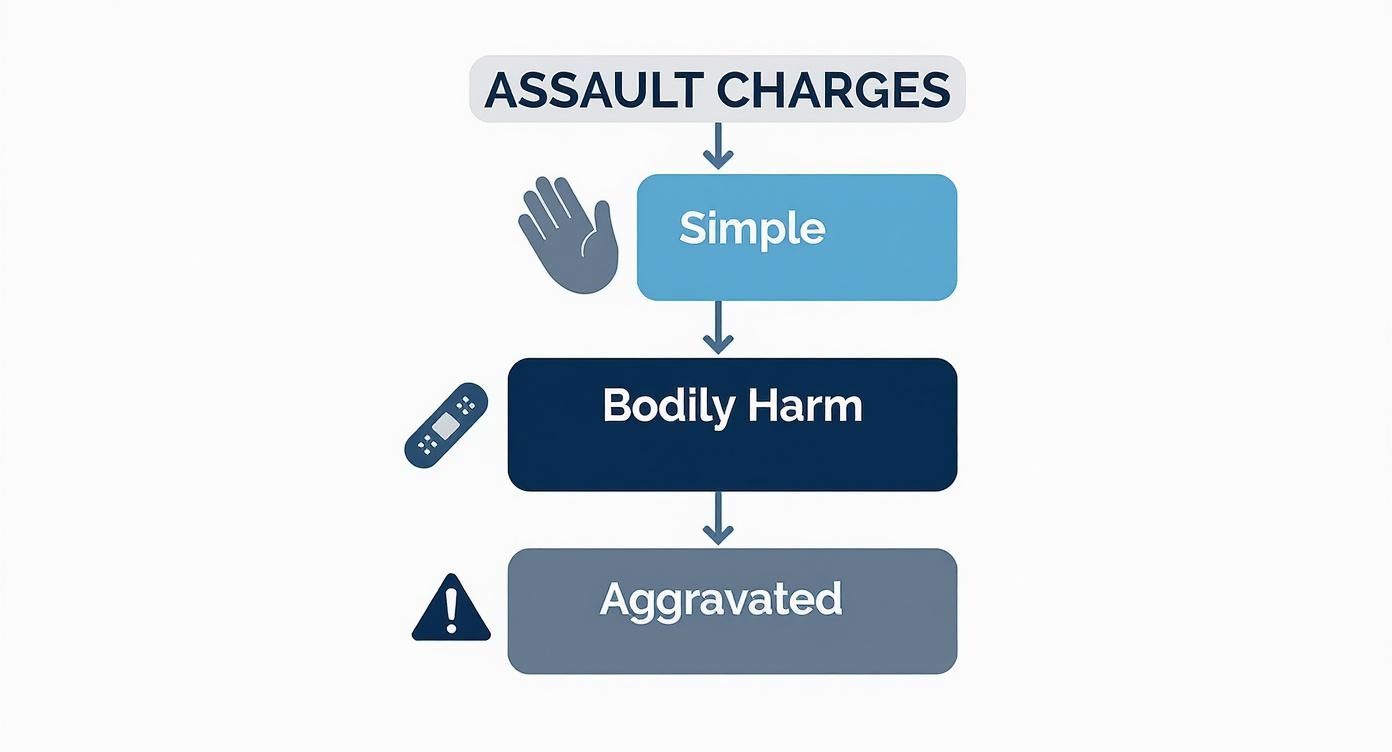
A flowchart illustrating the three types of assault charges: Simple, Bodily Harm, and Aggravated.

This hierarchy shows how the alleged harm directly impacts everything that follows, from the strictness of your bail conditions to the potential penalties you could face.

After reviewing the disclosure, your lawyer starts talking with the Crown Attorney. These meetings, known as Crown Pre-Trials, are where we negotiate a potential resolution. Your lawyer might push for the charges to be withdrawn completely, maybe in exchange for you signing a peace bond or completing a diversion program.

If we can't reach an agreement there, the next step is usually a Judicial Pre-Trial. This is a more formal sit-down with the Crown and a judge to hash out the case's issues, figure out how long a trial would take, and make one last push to resolve things without going to court.

Ultimately, your case will end in one of a few ways:

  1. Withdrawal: The Crown agrees to drop the charges entirely.

  2. Peace Bond: You agree to follow certain conditions for a set time (usually 12 months), and in return, the criminal charge is withdrawn.

  3. Diversion: You complete a program, like counselling, and then the Crown withdraws the charge.

  4. Trial: If no other resolution is possible, your case goes to trial, where a judge will decide if you are guilty or not guilty.

Every single step, from that first bail hearing to the final outcome, demands careful strategic planning. Having a top criminal lawyer in Brampton like the team at Badesha Law in your corner ensures your rights are protected and every possible option for a positive result is explored. We’ll stand with you through this entire process, giving you clear guidance and powerful advocacy at the Brampton courthouse.

What are the typical penalties for an assault charge in Canada?

If you're convicted of assault in Brampton, the consequences don't just stay inside the courtroom. The penalties aren't a simple slap on the wrist; they're decided by the court based on the unique details of the incident, your personal history, and the case presented by your assault lawyer Brampton. It’s crucial to understand what’s at stake and why a strong, proactive defence is so important.

In Canada, assault penalties depend on whether the Crown prosecutor treats the charge as a less serious "summary" offence or a more severe "indictable" offence. The specific section of the Criminal Code also matters. Outcomes can be anything from a fine for a minor incident to years in prison for a serious act of violence.

How Brampton Courts Decide on a Sentence

When a judge in Brampton is deciding on a sentence, they don’t just look at the charge and call it a day. They consider a whole mix of factors to land on a penalty that fits the crime. A good Brampton criminal lawyer will focus on presenting the mitigating factors—the things that paint a fuller picture of you and the situation—to argue for the lightest possible sentence.

Here are the key things a judge will be looking at:

  • The Seriousness of the Assault: Was someone hurt? How badly? The amount of harm caused is always a top consideration.

  • Your Criminal Record: A first-time offender will be viewed much more leniently than someone with a history of similar or violent offences.

  • The Circumstances of the Incident: Was it a domestic situation? Was a weapon involved? Was the other person particularly vulnerable? These are considered aggravating factors and can lead to tougher penalties.

  • Your Level of Remorse: Taking responsibility and showing you're committed to rehabilitation—like attending anger management counselling—can make a real difference in a judge's eyes.

A Breakdown of Potential Penalties

The potential consequences for assault are tiered, meaning they get more serious as the charge does. The table below gives you a clear idea of what you could be up against, which is exactly why our first goal is always to avoid a conviction altogether.

Here is a comparative look at the penalties associated with different levels of assault charges under the Criminal Code of Canada.

Type of Assault Potential Penalties (Summary Conviction) Potential Penalties (Indictable Offence)
Simple Assault Up to 2 years less a day in jail and/or a $5,000 fine. Up to 5 years in prison.
Assault with a Weapon or Causing Bodily Harm Up to 18 months in jail. Up to 10 years in prison.
Aggravated Assault Not applicable; always treated as an indictable offence. Up to 14 years in prison.

It's important to remember that these penalties are just the starting point.

Beyond jail time and fines, a conviction usually brings other orders that follow you for years. This can mean long probation periods with strict rules, court-ordered counselling, a lifetime ban on owning weapons, and having to give a DNA sample to a national database. The laws are also getting tougher. Recent reforms, like those detailed in the Bail and Sentencing Reform Act, show a clear trend toward stricter bail and sentencing, especially in violent offence cases.

The Enduring Impact of a Criminal Record: A conviction for assault saddles you with a permanent criminal record. This can slam the door on job opportunities, prevent you from volunteering, and make it extremely difficult to travel, especially to the United States.

These heavy consequences are precisely why you need to build a powerful defence from the moment you are charged. The job of an experienced criminal lawyer in Brampton isn’t just to minimize the penalties—it’s to fight for an outcome that avoids them completely. At Badesha Law, our entire strategy is built around getting the charges withdrawn, negotiating a peace bond, or winning a full acquittal at trial to protect both your record and your future.

How can I find a criminal defence lawyer near me for an assault charge?

After being charged with assault, picking the right legal representation is the single most important decision you'll make. The outcome of your case often hinges on your lawyer’s skill, local knowledge, and strategic thinking. This guide will walk you through how to choose a top assault lawyer Brampton residents trust for a powerful defence.

A man and a woman in business attire discussing documents at a table, with 'Find a Lawyer' text.

Your choice needs to go deeper than a quick internet search. You need someone who truly understands how things work at the Brampton courthouse, including the specific tendencies of local Crown Attorneys and judges. That kind of insider knowledge is a massive advantage.

What to Look for in a Brampton Criminal Lawyer

When your future is hanging in the balance, you need a lawyer with a proven track record in assault cases. Don't settle for a general practitioner; you want a dedicated Brampton criminal lawyer whose entire practice is focused on criminal defence.

Here’s what you should be looking for:

  • Specific Assault Case Experience: Ask them directly about their experience with cases just like yours, from simple assault to aggravated assault.

  • Local Courtroom Knowledge: A lawyer who is a regular face at the A. Grenville and William Davis Courthouse knows the system inside and out.

  • Clear Communication: They should be able to break down complex legal jargon into plain language you can actually understand.

  • A Defined Strategy: A good lawyer will review the details of your case and outline a potential defence plan, not just offer vague promises.

Choosing a lawyer is like choosing a surgeon; you want a specialist with a steady hand and extensive experience in the exact procedure you need. A local firm like Badesha Law provides this specialized focus on the Peel Region's justice system.

Key Questions to Ask During Your Consultation

The initial consultation is your chance to interview potential lawyers. Make sure you come prepared with a list of questions to feel confident in your decision. This is your opportunity to gauge their expertise, professionalism, and whether they're the right fit for you.

Here are some essential questions to have ready:

  1. What’s your experience handling assault charges specifically at the Brampton courthouse?

  2. Based on what you know so far, what’s your proposed strategy for my case?

  3. What are all the possible outcomes I should be prepared for?

  4. How will you keep me in the loop about my case's progress?

  5. What are your fees, and how does the payment structure work?

Asking direct questions helps you see a lawyer's competence and transparency. A confident and experienced criminal lawyer in Brampton will give you clear, straight answers, giving you the peace of mind that you're in capable hands. For more details on the cases we handle, you can explore our Brampton criminal law practice page. Making the right choice now is the first—and most critical—step toward protecting your future.


An assault charge can derail your entire future. The legal team at Badesha Law has the experience and strategic insight to protect your rights and fight for the best possible outcome.

Don’t wait. Contact us today for a confidential consultation.

Get Your Free Consultation with a Brampton Criminal Lawyer Now

Brampton Guide to a Sexual Assault Charge

When you’re hit with a sexual assault charge in Brampton, your entire world can feel like it’s grinding to a halt. Under the Criminal Code of Canada, this charge means any intentional, unwanted touching of a sexual nature. It’s a serious allegation that centres on the absence of consent, not whether an injury occurred. If you're facing these allegations in Brampton, the first and most critical step is to speak with an experienced Brampton criminal lawyer immediately.

Understanding a Sexual Assault Charge in Brampton

In the eyes of Canadian law, a sexual assault charge covers a wide range of deliberate, non-consensual contact that is sexual in nature. To secure a conviction, the Crown prosecutor at the Brampton courthouse must prove beyond a reasonable doubt that you intentionally touched another person, and that person did not voluntarily agree to it.

Consent is the absolute cornerstone of these cases. It’s not something that can be assumed or implied; it must be a voluntary, ongoing, and enthusiastic agreement throughout every single part of an interaction.

A legal desk setup with open documents, books, reading glasses, and a pen. Text overlay reads 'KNOW THE CHARGE'.

What Does the Crown Have to Prove?

To understand what you’re up against, it’s helpful to know the legal building blocks the Crown must use to build their case. The law breaks it down into a few key elements, each one essential for a conviction.

This table gives you a straightforward summary of the core legal elements you'll encounter when facing a sexual assault charge in the Brampton court system.

Key Legal Concepts for a Sexual Assault Charge
Legal Element
Actus Reus (The Physical Act)
Mens Rea (The Mental Intent)
Absence of Consent
Levels of Charges

Think of these elements like links in a chain—if the Crown can't prove even one of them beyond a reasonable doubt, their entire case falls apart.

Defining Consent: It’s Not Complicated, But It’s Strict

Section 273.1 of the Criminal Code is crystal clear: consent must be voluntary, continuous, and informed. Any hint of coercion, threats, or manipulation immediately invalidates any agreement.

A few non-negotiable points the courts stand by:

  • Silence does not mean consent.
  • A previous relationship or sexual history does not imply consent for a new act.
  • Someone who is heavily intoxicated cannot legally give reliable consent.

Important: Consent must be active and ongoing. It's not a one-time permission slip. Someone can say "yes" and change their mind to "no" at any point, and that "no" must be respected immediately.

Key Terms to Know

When you're in the legal system, you'll hear two terms constantly. The complainant is the person who has made the allegation of assault, while the accused is the individual who is facing the charges. Understanding these roles is the first step to making sense of the courtroom dynamics.

Why Local Expertise in Brampton Matters

You might think any lawyer can handle a case, but the reality is that every courthouse has its own rhythm. The Brampton courts and the local Crown attorneys' office have specific procedures, patterns, and unwritten rules that someone from the outside just wouldn't know.

A local Brampton criminal lawyer brings invaluable insight:

  • Deep familiarity with Brampton courthouse processes and personnel.
  • Established relationships with duty counsel and Crown attorneys, which can open doors for negotiation.

Hiring a lawyer who knows the lay of the land in Brampton can make a significant difference in how your case unfolds, from bail hearings to potential resolutions.

Criminal Code Sections at Play

The charges you face will be tied to specific sections of the Criminal Code. You’ll likely see these cited in court documents:

  • Section 271 covers what's often called "simple" sexual assault.
  • Section 272 deals with sexual assault involving a weapon, threats, or causing bodily harm.
  • Section 273 is for aggravated sexual assault, the most serious level of the offence.

These distinctions are incredibly important, as they drastically change the potential penalties and the defence strategies your lawyer will need to build. To demystify the charge against you and figure out your next steps, it's crucial to consult a dedicated Brampton criminal lawyer at Badesha Law as soon as possible.

The First 48 Hours After Being Charged

That moment when you're charged with sexual assault in Brampton can turn your world upside down. It’s overwhelming, confusing, and scary. But what you do in the first 48 hours is absolutely critical and can set the entire tone for your defence.

Your first and most important move is to exercise your right to remain silent. You need to politely but firmly tell the police that you won't answer any questions until you have spoken with a lawyer.

Don't ever think about waiving your right to legal counsel. It's not just a formality; it's a fundamental protection under the Canadian Charter of Rights and Freedoms, and it ensures anything you say from that point forward is properly guided.

  • Right to Silence: Simply state, “I am exercising my right to remain silent.”
  • Request a Lawyer: Immediately ask for a Brampton criminal lawyer.
  • Contact Badesha Law: Make sure you call our team before you provide any statement.

The decisions you make right at the start have a massive impact down the road. A clear, calm refusal to answer questions until your lawyer is present is one of the strongest moves you can make to protect yourself.

Immediate Actions to Protect Your Rights

From your first interaction with police, keep your communication to an absolute minimum. You only need to provide basic identifying information like your name and address.

Anything more than that can—and likely will—be used against you in court. This isn't the time to explain what happened or offer context, no matter how simple it seems.

Resist the urge to tell your side of the story until you've received legal advice. A seasoned Brampton criminal lawyer understands police tactics and knows precisely how to protect your interests during these initial, high-pressure moments.

Do’s and Don’ts in Early Detention

How you handle yourself in custody can influence more than just the immediate situation; it can affect your bail hearing.

Do’s

  1. Remain Calm – Your demeanour matters. A judge at the Brampton courthouse will take note of your conduct when considering bail.
  2. Be Polite – Respectful behaviour can de-escalate tension and shows you're cooperative with the process, not the investigation.
  3. Record Details – As soon as you can, mentally note or write down the officer’s name or badge number, the time of arrest, and the location.

Don’ts

  1. Avoid Social Media – Do not post anything about the accusation, your arrest, or any potential bail conditions.
  2. No Contact – Under no circumstances should you try to reach out to the complainant. This is a critical mistake.
  3. No Voluntary Statements – Decline to give any written or recorded interviews without your lawyer present.

Following these simple rules can make a real difference at your bail hearing. Judges at the Brampton courthouse look at your initial behaviour when deciding on bail terms.

Understanding Your Bail Hearing

Your bail hearing will typically happen within 24 hours of your arrest. This is your first appearance at the Brampton courthouse, where a judge or justice of the peace will decide whether to release you or keep you in custody while your case proceeds.

The court considers several key factors, including any past criminal record, your ties to the Brampton community, and whether you pose a risk to public safety. For example, having a steady job in Brampton and a clean record works strongly in your favour. Your lawyer can often negotiate release conditions, like no-contact orders or a curfew, as an alternative to detention.

  • Community Ties: Strong connections like local employment, family, and housing in Brampton.
  • Public Safety: Showing that you are not a risk to reoffend.
  • Flight Risk: Agreeing to surrender your passport or follow reporting instructions.
  • Compliance: Proactively agreeing to reasonable bail conditions.

A strong bail plan is essential. This often includes letters of support from family or your employer and proof of a stable address. A Brampton criminal lawyer can pull these materials together quickly, turning a stressful hearing into a manageable first step.

A detailed bail plan demonstrates to the court that you respect its authority and have a solid support system in the community.

The legal strategy you build in this initial window can shape your entire case.

Partner With Local Expertise

Navigating this high-stakes period isn't something you should do alone. You need someone with local knowledge—a lawyer who practices in Brampton every day and understands the specific tendencies of the local courthouse and Crown attorneys.

Contact Badesha Law’s Brampton Criminal Lawyer for immediate help. Getting an expert in your corner from the very beginning is the best way to preserve your rights and start building a strong defence.

Schedule a free consultation today to get your case review started without delay.

Navigating the Brampton Court Process

Facing a sexual assault charge means you'll be stepping into the formal court system in Brampton. It can feel intimidating, but understanding how the process unfolds will help demystify what’s ahead and prevent you from being caught off guard.

Your first court date is called an arraignment. This is where the charge is read out loud and you formally enter your plea. It's also the first time you’ll receive the disclosure—the complete file of evidence the Crown plans to use against you.

This package can contain hundreds of pages, and a Brampton criminal lawyer is essential for dissecting it. A thorough, painstaking review of every single document is the bedrock of a strong defence, as it uncovers the strengths and, more importantly, the weaknesses in the Crown’s case.

Reviewing Your Disclosure Package

Think of the disclosure package as being handed your opponent's playbook before the game even starts. It’s a goldmine of information. Inside, you'll typically find:

  • Police statements from the complainant and any witnesses detailing the allegations.
  • Any photographs or surveillance footage related to the events.
  • Transcripts from police interviews, showing exactly what was asked and answered.
  • Expert reports, which could include forensic or medical evidence.

Going through this material early is crucial. It’s where we find the missing links, the contradictory statements, and the inconsistencies that can become powerful tools for negotiation or for raising doubt at trial.

“A single missing page in disclosure can derail the Crown’s timeline.” — Local insight from a Brampton criminal lawyer.

A skilled lawyer knows exactly what to look for—from procedural errors made by police to subtle contradictions in witness accounts. Transparency about what we find in the disclosure builds your confidence and helps you make informed decisions at every stage.

Making the Most of Pre-Trials

Pre-trials, both with the Crown and with a judge, are essentially strategic negotiation meetings. They aren't about determining guilt or innocence; they're about managing the case efficiently. Here, we can discuss:

  1. A possible resolution, like a peace bond or a diversion program, that avoids a criminal conviction.
  2. Clarifying or narrowing down the specific charges before heading to a full trial.
  3. Exchanging more evidence to help speed things up.

It’s a bit like a high-stakes business negotiation. We go in knowing what the other side wants and propose realistic compromises that protect your interests.

Comparing Pre-Trial Stages

Each type of hearing has a different focus, and knowing the difference helps you prepare.

Stage Focus Goal
Crown Pre-Trial Discuss evidence and possible resolutions directly with the prosecutor. Narrow the issues, maybe even resolve the case.
Judicial Pre-Trial Formal meeting in court with a judge present. Set the trial schedule and get a judge’s input.
Case Conference An early opportunity to discuss settlement. Explore diversion or other non-trial options.

Understanding who you’re meeting with and what their goals are allows us to plan everything from witness preparation to legal motions much more effectively. For a deeper dive, check out our guide on the complete Criminal Defence Process.

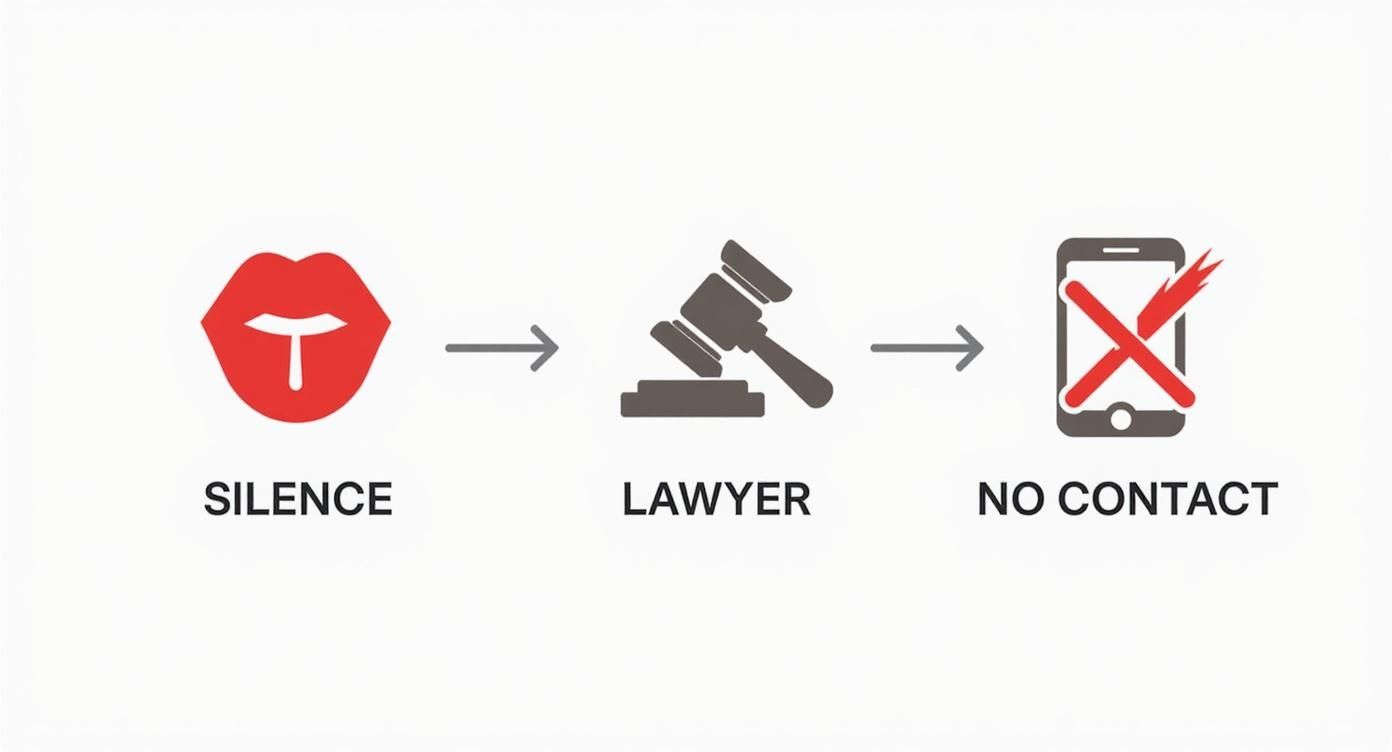
The infographic below shows the critical steps you must take within the first 48 hours after being charged.

Diagram showing the sequence: silence (lips icon), then a lawyer (gavel), then no contact (crossed-out phone).

This visual makes it clear: your immediate priorities are to exercise your right to silence, call a lawyer, and have absolutely no contact with the complainant.

Navigating Court Appearances

Court dates in Brampton follow a structured path. The key milestones you'll encounter include:

  • Bail hearing: This is where the conditions of your release are determined.
  • Case conference: An early chance to explore resolutions with the Crown.
  • Pre-trial: Where trial logistics are sorted out and evidence is discussed more formally.
  • Trial: The final stage for presenting arguments and cross-examining witnesses.

Effective preparation reduces stress and builds credibility with the judge.

Simply following each step shows you respect the process, which reflects positively on you and your defence.

Preparing for Trial

Trial prep is where all the pieces of your defence strategy come together. This is an intensive phase that involves:

  • Crafting a compelling opening statement to frame the narrative in your favour.
  • Organizing the witness list and confirming their availability.
  • Developing detailed cross-examination plans to challenge the credibility of Crown witnesses.
  • Lining up any expert testimony needed to support your case.

Think of your defence as a complex puzzle—every single piece must fit perfectly. Missing evidence or an unprepared witness can create a gap that a sharp Crown prosecutor will immediately exploit. Staying organized and proactive is absolutely essential.

Your Brampton criminal lawyer will quarterback all these tasks, ensuring every deadline is hit and every detail is accounted for.

Building a Strategic Defence That Works in Court

When you’re facing a sexual assault charge, a successful defence isn’t just about legal theories—it’s about grounding your case in evidence, sharp legal analysis, and practical courtroom experience. This is where a generic defence falls short and a strategy built for a Brampton courtroom truly makes a difference.

The goal is to move beyond what should work and focus on what does work, based on real outcomes in local cases.

The Honest But Mistaken Belief in Consent Defence

One of the most complex defences to mount is arguing you had an honest but mistaken belief in consent. This isn't just about what you thought; it's about what you did. The court demands proof that you took reasonable steps to confirm the other person was consenting.

To make this defence stick, you need to show:

  • Your belief was based on the complainant's clear words or actions, not silence or ambiguity.
  • You had no reason to suspect they weren't consenting.
  • You actively took steps to confirm consent, like asking directly or pausing to check in.
  • Your belief was genuine and not clouded by your own intoxication or wishful thinking.

“An honest but mistaken belief defence requires more than a gut feeling; it demands verifiable actions.” — Local insight from a Brampton criminal lawyer

Challenging Credibility to Create Reasonable Doubt

In many sexual assault cases, it comes down to one person's word against another's. A key part of the defence is often challenging the credibility of the complainant's story to introduce reasonable doubt. This isn't about attacking someone's character; it's about methodically testing the reliability of their testimony.

An experienced Brampton criminal lawyer will meticulously comb through the evidence, looking for inconsistencies that can undermine the Crown’s case. This often involves:

  • Scrutinizing police interview transcripts and video statements for conflicting details.
  • Comparing what a witness said to physical evidence, like surveillance footage or text messages.
  • Pinpointing gaps or contradictions in the timeline of events.
  • Using expert testimony to explain how factors like trauma or stress can impact memory and recall.

For instance, if a complainant gives two different accounts of where an alleged incident took place, that's a red flag. These are the kinds of details that can weaken a prosecutor’s narrative and form the foundation of a strong defence.

Finding the Weaknesses in the Crown’s Evidence

Every piece of evidence the Crown presents has a potential weakness. A strong defence strategy involves finding and exploiting those weak links to dismantle their case piece by piece.

Evidence Type Potential Defence Tactic
Text Messages Point out missing context, edited messages, or ambiguous phrasing.
Forensic Reports Challenge the chain of custody to question if evidence was handled properly.
Physical Evidence Highlight the risk of contamination or alternative explanations for its presence.

A detailed review by a criminal lawyer ensures that no stone is left unturned. Each weakness you expose adds another layer of doubt, making it harder for the Crown to prove its case against you.

Evidence gathered improperly can often be excluded from trial under s.24(2) of the Charter, which is a powerful tool for the defence.

Crafting a Defence Plan Tailored to Your Case

There is no one-size-fits-all defence for a sexual assault charge. Your strategy must be built around the specific facts of your situation. The moment you hire a Brampton criminal lawyer, the process of building that custom plan begins.

  1. Gathering Disclosure: The first step is to get every piece of evidence the police and Crown have against you.
  2. Interviewing Witnesses: We identify and speak with anyone who can confirm your side of the story or challenge the complainant’s claims.
  3. Engaging Experts: If needed, we bring in forensic specialists or psychologists to provide expert analysis on evidence or consent.
  4. Preparing for Cross-Examination: We develop sharp, targeted questions designed to expose the weaknesses in the testimony of Crown witnesses.

A proactive, evidence-first approach is the best way to protect yourself in court. To get started, you can consult our Brampton criminal lawyer at Badesha Law for a thorough review of your case.

Why Local Courtroom Experience is Crucial

Knowing the law is one thing, but knowing the local legal landscape is another. A lawyer who frequently works in Brampton’s courts understands the unwritten rules. They know the tendencies of specific Crown Attorneys, which judges are more receptive to certain legal arguments, and how to effectively negotiate resolutions like peace bonds or withdrawals.

This inside track from Badesha Law helps shape everything from your bail plan to defence motions, giving you a strategic edge before you even step into the courtroom.

This local insight isn't just a small advantage; it can be the factor that turns a case in your favour.

What You Need to Do Right Now to Strengthen Your Defence

Time is not on your side after being charged. The sooner you act, the better your chances of preserving crucial evidence and building a robust defence.

  1. Contact Badesha Law Immediately. The first hours are critical for evidence preservation and legal advice.
  2. Gather Digital Proof. Compile all relevant phone records, text messages, social media chats, and photos.
  3. Write Everything Down. Document your detailed recollection of events while your memory is still fresh.
  4. Stay Silent. Do not speak to the police or the Crown about your case without your lawyer present. Anything you say can be used against you.

Every action you take from this moment on matters. Defending against a sexual assault charge in Brampton requires immediate, strategic action. Reach out to our dedicated Brampton criminal lawyer team for a confidential consultation today.

The Lifelong Impact of a Conviction

A professional desk setting with a briefcase, passport, documents, and a sign stating 'LONG-TERM IMPACT'.

A conviction for sexual assault isn't just about the sentence handed down by a judge. It's a permanent mark that can follow you for the rest of your life, impacting your reputation, career, and even your family relationships.

The stigma alone is a heavy burden, but the concrete penalties and consequences can reshape your entire future. Understanding the full scope of what's at stake under the Criminal Code of Canada is the first step toward protecting yourself.

A conviction for simple sexual assault (s.271) can lead to 10 years in prison. If it involves bodily harm or a weapon (s.272), the sentence starts at a mandatory minimum of 4 years and can go up to 14 years.

For aggravated sexual assault (s.273), the law demands a 5-year minimum sentence, with the possibility of life in prison for the most severe cases.

Potential Criminal Code Penalties

The specific sentence depends on the offence and the unique circumstances of the case.

Here’s a quick breakdown of the potential sentences under the Criminal Code:

  • Simple sexual assault (s.271): Penalties can range from probation to 10 years imprisonment, depending on aggravating factors.
  • Sexual assault with a weapon or bodily harm (s.272): A 4-year mandatory minimum sentence, with a maximum of 14 years.
  • Aggravated sexual assault (s.273): Starts at a 5-year mandatory minimum and can extend to a life sentence.
  • Conditional sentences: In very rare situations, a judge might allow a sentence to be served in the community under extremely strict conditions.

But the penalties handed down in court are just the beginning. The "collateral consequences" are what truly last a lifetime.

Collateral Consequences

A conviction automatically triggers registration on the National Sex Offender Registry (SOIRA), often for life. This requirement severely restricts your privacy and ability to move freely.

For non-citizens, a conviction can mean deportation or the loss of immigration status, turning a criminal charge into a permanent barrier to living in Canada.

Many careers become instantly inaccessible because employers require vulnerable sector checks, which will reveal the conviction.

  • Family Impact: In custody disputes under Ontario's Family Law Act, any history of violence is a major red flag for judges deciding on child access.
  • Professional Restrictions: Forget about jobs in teaching, healthcare, or even volunteering. A record creates an immediate roadblock.
  • Travel Limitations: Travelling internationally becomes nearly impossible, as many countries deny visas to individuals on a sex offender registry.
  • Insurance Issues: Some insurers may refuse to provide coverage or will charge significantly higher rates.

It's a harsh reality: 85% of individuals with a sex offence record report facing major career barriers within just one year of their release.

These lifelong consequences are precisely why retaining a Brampton criminal lawyer is not a choice—it's a necessity.

How to Protect Your Future

Taking immediate and decisive action is the only way to mitigate the potential for lifelong harm. A well-planned, strategic defence can sometimes lead to a complete withdrawal of charges or significantly reduced penalties.

Here are the first steps you absolutely must take to protect your rights:

  1. Call a lawyer immediately. Contact a Brampton criminal lawyer at Badesha Law without any delay. We can help create a release plan and navigate your bail conditions.
  2. Preserve all evidence. Gather any digital or physical evidence you have—text messages, call logs, photos, and contact information for potential witnesses.
  3. Write everything down. Document your detailed recollection of what happened while the events are still fresh in your mind.
  4. Stay silent. Do not discuss your case with anyone other than your lawyer. This includes friends, family, and especially social media.
  5. Explore your options. Your lawyer can explore resolutions like having the charges withdrawn, signing a peace bond, or entering a diversion program to avoid a conviction.

Every day that passes is a day that evidence can be lost or memories can fade.

Acting quickly demonstrates to the court and the Crown that you are taking the matter seriously, which can help your credibility. Sometimes, a proactive and well-prepared defence is enough to get charges withdrawn or resolved with a peace bond, leaving you without a criminal record.

For a personalized strategy, schedule a confidential consultation with the Badesha Law team right away. Immediate legal advice can uncover defences you might not even know exist, like a mistaken belief in consent or critical flaws in the Crown's evidence.

Don't wait. Reach out to our experienced Brampton criminal lawyer to discuss your case in strict confidence and start protecting your future today.

Why a Brampton Lawyer Is Your Best Defence

When you're facing a sexual assault charge, the choice of your lawyer is one of the most critical decisions you'll ever make. While any criminal lawyer knows the law, a seasoned Brampton criminal lawyer brings a distinct, tactical advantage that simply can't be overstated. Your future is not the time for a learning curve; it’s the time for local, proven expertise.

A lawyer who works in the Brampton courthouse every day has an invaluable understanding of the local legal landscape. They know the procedural quirks, the specific expectations of local judges, and the negotiating styles of the Crown Attorneys prosecuting your case. This insider knowledge is absolutely crucial for building an effective strategy.

The Advantage of Local Courtroom Insight

An experienced local lawyer can anticipate how a certain Crown might handle a plea bargain or how a specific judge tends to rule on evidence motions. This familiarity lets them tailor your defence in ways a non-local lawyer just can't.

  • Strategic Negotiations: Understanding the Crown’s tendencies can lead to better outcomes, like a withdrawal of charges or securing a peace bond.
  • Courtroom Credibility: A familiar face who has built a reputation for professionalism and diligence is often received more favourably by judges and prosecutors.
  • Efficient Process: Knowing the local procedures saves time and helps avoid costly administrative mistakes that could weaken your defence.

Your defence is far too important to leave to chance. Securing a lawyer who is a regular fixture in the Brampton justice system provides a strategic edge that can profoundly influence the outcome of your case.

Protecting Your Rights from Day One

A dedicated Brampton criminal lawyer does more than just represent you in court—they become your shield through the entire process. From the moment you're charged, they work to protect your rights under the Canadian Charter of Rights and Freedoms, making sure police conducted their investigation properly and that your right to counsel was respected.

Your lawyer will meticulously dissect the evidence, from forensic reports and medical records to digital communications like text messages and social media history. They pinpoint inconsistencies and weaknesses in the Crown’s case, preparing you for every step—from bail hearings to pre-trials and, if it comes to it, a full trial. This thorough preparation ensures you are never caught off guard.

Don’t wait to protect your future. Contact a Brampton criminal lawyer at Badesha Law today for a confidential consultation to discuss your case and learn how our local expertise can become your strongest defence.


Answers to Your Most Urgent Questions

When you're suddenly facing a sexual assault charge, your mind races with questions. The uncertainty can be overwhelming. Here are some straightforward, no-nonsense answers to the most common concerns we hear from clients in the Brampton area.

What’s the Difference Between Sexual Assault and Sexual Harassment?

This is a critical distinction that trips many people up. The two are handled in completely different legal worlds.

Sexual assault is a criminal offence. It’s defined in the Criminal Code of Canada and involves any kind of unwanted sexual touching. Because it's a crime, the case is prosecuted by the Crown in a criminal court, where a conviction can lead to serious penalties, including jail time.

On the other hand, sexual harassment is almost always a civil issue. It’s typically dealt with at Ontario's Human Rights Tribunal and usually involves inappropriate behaviour in a workplace or housing situation. The legal standards, the process, and the outcomes for these two are night and day.

Can the Person Who Complained Just Drop the Charges?

No. This is one of the biggest myths out there. Once the police have laid a sexual assault charge, the ball is entirely in the Crown Attorney’s court. The decision to continue with the prosecution or withdraw the charge belongs to them and them alone.

Sure, the complainant’s wishes are a factor the Crown will consider, but they are far from the final word. The Crown’s job is to assess the strength of the evidence and determine if proceeding is in the public's best interest. They make the final call.

A complainant can tell the Crown they don’t want to proceed, but they don’t have the power to "drop the charges." That authority rests solely with the Crown Attorney.

How Will This Charge Affect My Family Court Case?

A sexual assault charge can have a devastating impact on any ongoing family law matters, like a divorce or custody dispute under Ontario’s Family Law Act.

In family court, a judge's number one priority is always the best interests of the child. Any allegation or finding related to violence will be taken extremely seriously when the court makes decisions about child custody and access. It’s absolutely essential that your criminal defence strategy is built with these parallel family law consequences in mind. Your Brampton criminal lawyer needs to be thinking about both courts at the same time.


At Badesha Law, we know just how much pressure you're under and what’s at stake when you're accused of sexual assault. Our experienced Brampton criminal lawyers are here to provide the strategic, confidential, and immediate legal help you need. Protect your rights and your future—schedule a consultation today at https://badeshalaw.ca/brampton-criminal-lawyer.