Top Guide: Finding the Best Family Law Lawyer in Brampton
When you’re staring down a family law issue, it feels like everything is on the line. But taking that first step—finding the right family law lawyer in Brampton—is the most important move you can make. This isn't just about managing a conflict; it’s about carefully building a new, stable future for yourself and your family. A good local lawyer is your guide, the person who can navigate you through Ontario's complex legal system with both skill and compassion.
Your First Step in Brampton Family Law

When your family's structure is shifting, the road ahead can look blurry, filled with complicated questions and uncertainty. Family law in Ontario is a specialized area of law created to bring a clear, structured framework to these incredibly sensitive personal matters. Governed by key legislation like Ontario's Family Law Act and the federal Divorce Act, it covers everything from the legal process of divorce to the delicate details of parenting plans and the fair division of the assets you've built together.
The goal is simple: move from a place of confusion to one of clarity. Think of your lawyer not just as a legal representative, but as your strategic partner. They're the one who translates the dense language of the law into practical, real-world steps that actually make sense for your unique situation. This first stage is all about setting a solid foundation for the crucial decisions you'll have to make.
Core Areas of Family Law
At its heart, family law is about the legal side of family relationships. While every single case has its own unique story, most will fall into a few key categories. Getting a handle on these pillars will help you figure out what you need and communicate it clearly to your lawyer.
Here’s what we’re usually dealing with:
- Divorce and Separation: This is the formal process of ending a marriage and creating a legal separation agreement that lays out all the terms of the split, as defined under both federal and provincial laws.
- Parenting Time and Decision-Making Responsibility: This area, formerly known as custody and access, is about creating a stable, predictable parenting plan that always puts the children’s best interests first, as mandated by the Divorce Act.
- Child and Spousal Support: This involves figuring out the financial obligations one person may have to the other to make sure both the children and spouses have financial stability after the separation, calculated using specific guidelines.
- Property Division: This is the process of fairly dividing the assets and debts you both accumulated during the marriage, which can include complex things like the matrimonial home, businesses, or pensions, according to the equalization rules in the Family Law Act.
Why a Local Brampton Lawyer Matters
There’s a real, tangible benefit to choosing a lawyer who lives and breathes family law right here in Brampton and the Peel Region. These professionals have spent years in the local Brampton courthouse. They know its specific procedures, the court staff, and the judges who will be hearing your case.
This kind of local insight is priceless, often leading to a smoother, more efficient, and predictable process. For a deeper dive, you can learn more about why hiring a local Brampton family lawyer can make a difference in your case. A local expert handles your case with a true understanding of the community and legal environment you're in.
Your first meeting with a family law lawyer is an opportunity to gain control over your situation. It’s about replacing anxiety with a clear plan, ensuring you are equipped to make informed choices for yourself and your family.
Understanding Your Family Law Needs
When you hear "family law," most people immediately think of divorce. But that's just one piece of a much larger puzzle. To find the right family law lawyer in Brampton, the first step is figuring out exactly what kind of help you need.
Think of it this way: you wouldn't hire a plumber to fix your roof. The same logic applies here. Family law is a highly specialized field, and every situation demands a unique strategy grounded in Ontario's Family Law Act. Getting clear on your specific issue empowers you to find a lawyer with the right experience to handle it, whether you're planning for the future or navigating a painful separation right now.
The Main Pillars of Family Law Services
Most family law matters fall into one of four key areas. Knowing which category your situation fits into will help you have a much more productive conversation with a lawyer.
- Divorce and Separation Agreements: This is the big one. It involves legally ending a marriage, but more importantly, it requires creating a separation agreement. This document is the blueprint for your new reality, formally outlining how property is divided, what support will be paid, and how you’ll co-parent. A solid agreement prevents endless conflict down the road.
- Parenting Time and Decision-Making Responsibility: This area, which used to be called custody and access, is all about the kids. It establishes how parents will share time with their children (parenting time) and who gets to make the big calls about things like their education, health care, and religious upbringing (decision-making responsibility). The "best interests of the child" is the only test applied.
- Child and Spousal Support: This pillar deals with the financial realities of a separation. Child support is a child's right and is calculated using federal guidelines to ensure their needs are consistently met. Spousal support might be paid to one partner to help address economic disparities that arose from the marriage or its breakdown.
- Property Division: When you're married, the assets and debts you accumulate become family property. When the marriage ends, all of that has to be divided fairly. This process, called equalization, involves calculating each spouse's net family property to ensure an equitable split. It can get complicated, especially with assets like the matrimonial home, pensions, or a family business.
A separation agreement isn't just a legal document; it's a roadmap for respectful co-parenting and financial independence. Getting it right from the start, with professional guidance, can save immense stress and expense down the road.
What Service Do You Actually Need?
To make it even clearer, here's a simple breakdown of the most common family law services we provide to clients in Brampton and what each one is designed to accomplish for you.
Common Family Law Services in Brampton
| Legal Service | What It Achieves For You | Governed By |
|---|---|---|
| Separation Agreement | Creates a legally binding roadmap for property, support, and parenting after you separate. | Family Law Act (Ontario) |
| Divorce Application | Legally terminates your marriage, allowing you to remarry. | Divorce Act (Federal) |
| Parenting Plan | Sets out clear, predictable rules for parenting time and decision-making for your children. | Divorce Act & Children's Law Reform Act |
| Child & Spousal Support | Ensures financial obligations are met, providing stability for children and the lower-income spouse. | Federal Child Support Guidelines & Spousal Support Advisory Guidelines |
| Property Division | Fairly divides the value of all assets and debts accumulated during the marriage. | Family Law Act (Ontario) |
| Marriage Contract | Protects assets and defines financial rights before or during a marriage. Often called a "prenup." | Family Law Act (Ontario) |
| Cohabitation Agreement | Provides similar protections as a marriage contract, but for unmarried couples living together. | Family Law Act (Ontario) |
Understanding these distinctions helps you walk into a consultation prepared and confident, ready to have a meaningful discussion about your future.
Specialized Services You Might Need
Beyond those core pillars, some situations require a more specific legal tool. A full-service family law firm in Brampton will be able to handle these unique circumstances, making sure every angle is covered.
For instance, a prenuptial agreement (legally known as a marriage contract in Ontario) acts like an insurance policy for your marriage. It defines financial rights and responsibilities ahead of time to protect assets and give both partners peace of mind. Cohabitation agreements do the exact same thing for unmarried couples who live together.
You might also need something like a foreign divorce opinion letter. This is a document you'll need if you were divorced outside of Canada and want to get remarried here. It's a lawyer's official opinion confirming that your foreign divorce is recognized as valid in Ontario.
Knowing where your needs fit helps you prepare for your first meeting with a lawyer. The more clarity you have, the more you’ll get out of that initial consultation. To see how these services play out in the real world, take a look at our guide on 7 common scenarios that require a family lawyer in Brampton.
What to Expect on Your Journey with a Family Lawyer
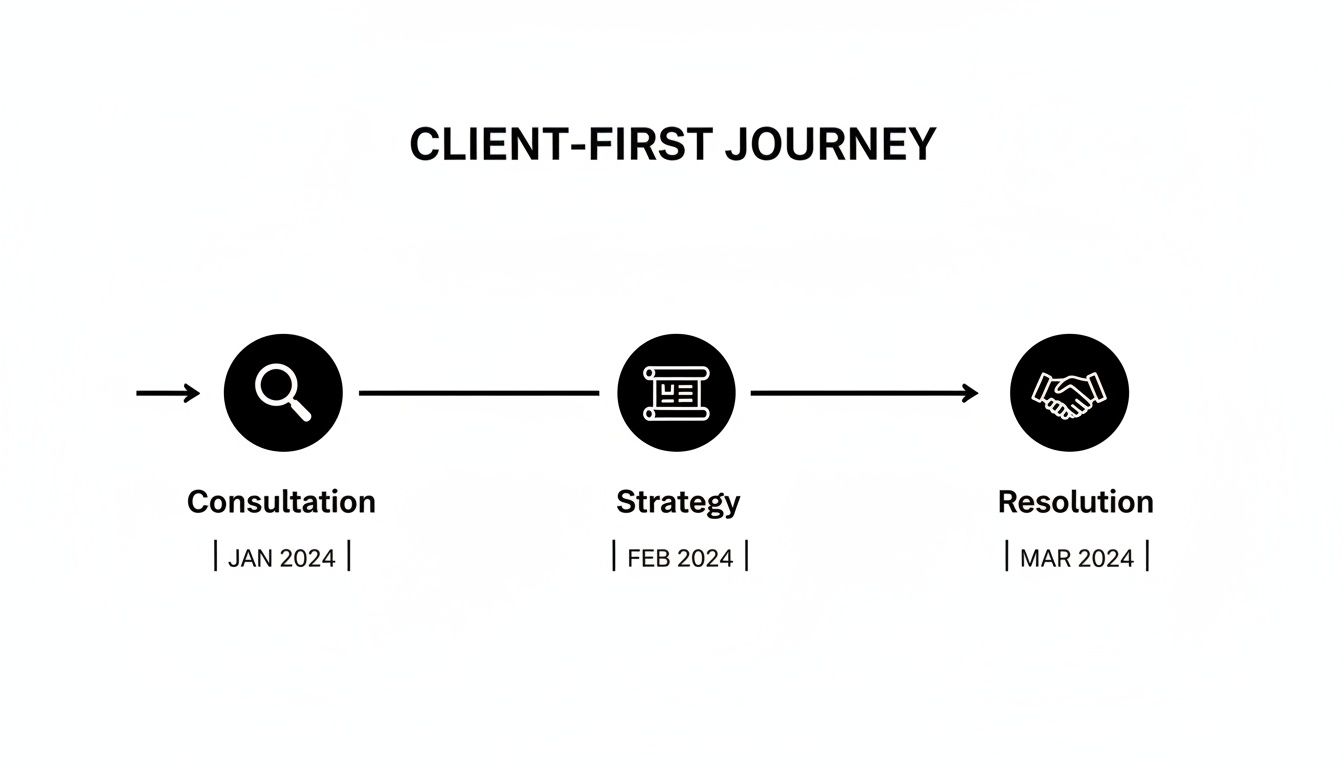
Hiring a family law lawyer in Brampton for the first time can feel incredibly intimidating. The good news is that the process isn’t a chaotic free-for-all. It’s actually a structured and predictable path designed to take you from a place of uncertainty to a clear resolution. Once you understand the client journey, you can replace that anxiety with the confidence that comes from knowing what’s next.
It all starts with an initial consultation, which many firms offer for free. This is your moment to tell your story, get a handle on your rights under Ontario law, and figure out if the lawyer is the right fit for you. The key is to come prepared: jot down key dates, gather your financial details, and make a list of every question you have. Remember, this meeting is a two-way street—you're interviewing them just as much as they're learning about your case.
This visual shows how most family law cases progress, starting with the initial separation and then moving through the critical stages of parenting arrangements and financial support.
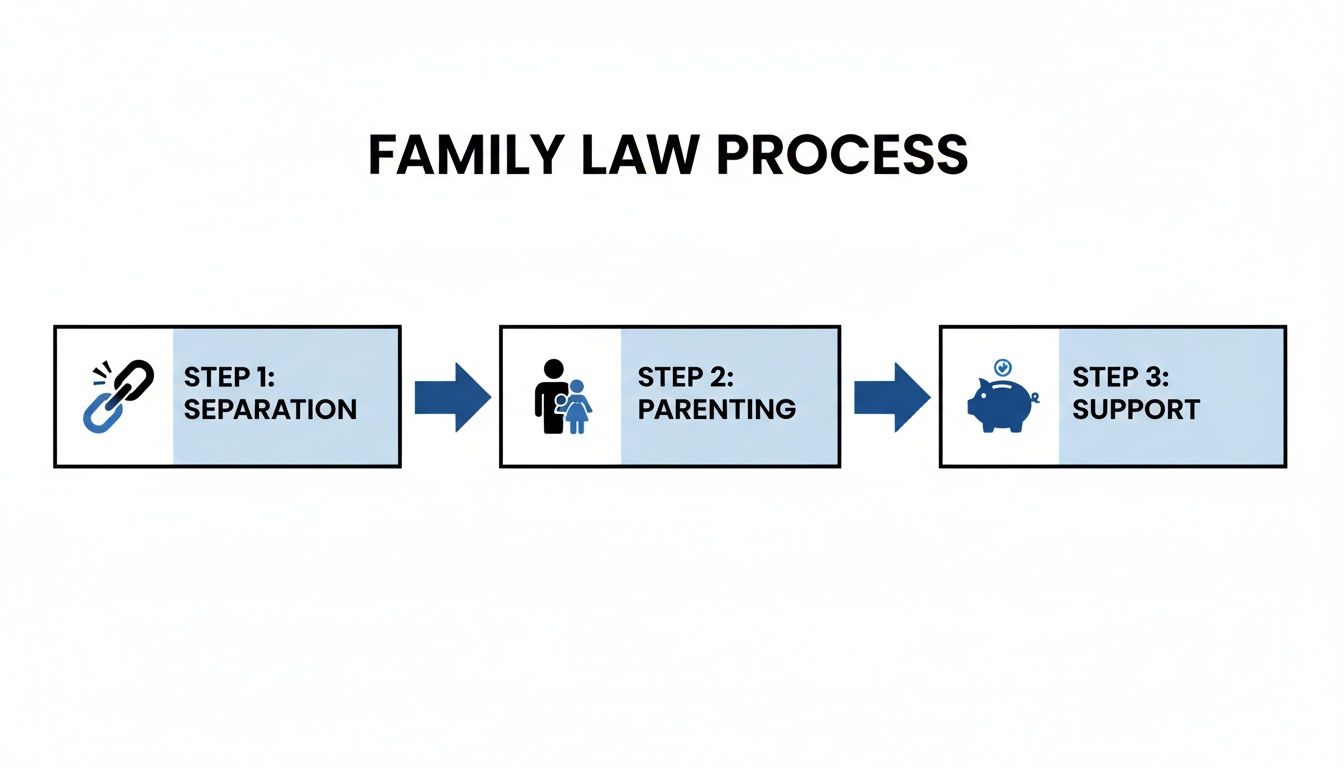
As the infographic makes clear, family law issues aren't a single event. They are a series of interconnected stages that you need to navigate carefully, one step at a time.
The First Steps: From Consultation to Disclosure
After the consultation, the first official step is signing a retainer agreement. This is the document that legally confirms the lawyer is representing you. It spells out all the terms of your relationship, including their fees and how you’ll communicate. Once that’s signed, your lawyer becomes your official advocate, handling all contact with your former partner or their lawyer from that point on.
What follows is one of the most critical phases in any family law case: financial disclosure. Under Ontario's Family Law Rules, both you and your ex-partner are legally required to provide complete and honest documentation of your finances. We’re talking about everything—bank statements, tax returns, property valuations, and even business records.
This step is non-negotiable. It’s the foundation for every single negotiation about dividing property and calculating support. Full transparency is absolutely essential to reaching a fair and legally binding outcome.
A Real-World Example: Following a Client's Journey
To make this all a bit more concrete, let's walk through a hypothetical journey with a client we'll call Sarah. After retaining her lawyer, Sarah and her former spouse exchange their financial disclosure documents. Her lawyer digs in, analyzes everything, and pinpoints the key issues: how to divide the matrimonial home, how to calculate child support, and what the parenting plan will look like.
From there, the focus shifts to negotiation. Sarah's lawyer drafts an initial proposal for a separation agreement and sends it over to her ex-spouse's lawyer. This kicks off a back-and-forth process aimed at reaching a settlement without ever having to step inside a courtroom.
It’s a fact that might surprise you: the overwhelming majority of family law cases in Ontario—over 95%—are resolved through negotiation and settlement, not a trial. Your lawyer’s most important role is often that of a skilled negotiator, working to find common ground and avoid the stress and expense of litigation.
If direct negotiations hit a snag, the next step might be a case conference. This is a meeting with a judge, but it isn't a trial. The judge's role is to help both sides narrow down the main issues, encourage them to find a resolution, and set a schedule for what comes next if an agreement still can't be reached. For Sarah, this conference helps them zero in on the last few points of disagreement, which clears the path for a final settlement meeting.
Eventually, Sarah and her ex-spouse reach a full agreement. Her lawyer drafts the final separation agreement, a detailed document that both of them sign. This legally binding contract becomes the blueprint for their post-separation lives, giving everyone involved the clarity and security they need to move forward. This structured path—from the first phone call to a final signed agreement—is the standard journey for most clients facing a family law issue in Brampton.
Navigating Legal Fees and Timelines
Let's be honest: for most people going through a separation, the two biggest worries are how much this will cost and how long it will take. Getting a handle on how legal fees work and what really drives your timeline can take a lot of that stress off the table and put you back in control. When you're looking for a family law lawyer in Brampton, a transparent, no-nonsense approach to billing should be non-negotiable.
The most common way lawyers bill is by the hourly rate. This means you are charged for the actual time your lawyer and their team spend working on your file. That includes everything from drafting court documents and making phone calls to showing up in court for you. For experienced family lawyers in Brampton, those rates typically fall between $275 and $440 per hour plus HST. This range reflects the specialized skill it takes to handle complex family law cases and is quite competitive, often coming in slightly below the broader Canadian average which can span anywhere from $100 to $650 per hour.
Understanding Retainers and Billing Practices
When you hire a lawyer, one of the first things you'll do is provide a retainer. It's a common point of confusion, so think of it this way: a retainer isn't a flat fee for the whole case. It's more like a down payment or a security deposit that your lawyer holds for you in a special trust account.
As your legal team works on your file, they will bill their time against that retainer money. You'll get a detailed invoice each month that breaks down exactly what work was done and how much time it took. Once those initial funds run low, you'll be asked to replenish the retainer. This system keeps your case moving forward without interruption and gives you a crystal-clear picture of your costs as you go.
For very simple, straightforward matters—like an uncontested divorce where everything is already agreed upon—some lawyers might offer a flat fee. But for most family law cases that involve back-and-forth negotiation or the possibility of court, the hourly model is the standard because it’s impossible to predict exactly how much time will be needed.
What Influences the Final Cost and Timeline?
The final bill for your family law case is tied directly to one thing: time. While every family's situation is different, a few key factors have an outsized impact on both your legal fees and how long the entire process will drag on.
- Level of Cooperation: This is, without a doubt, the single biggest factor. If you and your ex can communicate respectfully and are both willing to find a middle ground, your costs will be dramatically lower. High-conflict separations, where every single issue turns into a battle, require constant lawyer involvement, which drives up costs and extends timelines.
- Complexity of Assets: Splitting a simple chequing account is easy. But dividing a family business, untangling multiple real estate properties, or dealing with complex investment portfolios? That requires financial experts, formal valuations, and a whole lot more negotiation, all of which adds time and expense.
- Parenting Disputes: If hashing out parenting time and decision-making responsibility becomes a major sticking point, the process will take longer and cost more. Cases that involve child psychologists, expert assessments, or high levels of conflict demand significantly more legal work.
The most effective way to control your costs and shorten the timeline is to focus on reaching a negotiated settlement instead of gearing up for a court battle. A settlement is almost always faster, cheaper, and far less emotionally draining than going to trial.
Think of it like this: a separation agreement that's negotiated over a couple of months might cost a few thousand dollars. Taking those exact same issues to a trial could easily take over two years and cost you tens of thousands. The key is to make smart, business-like decisions with your lawyer's guidance. To get a more detailed perspective on financial expectations, check out our guide on understanding Ontario divorce costs.
Your Checklist for Choosing the Right Brampton Family Lawyer

Of all the decisions you'll make in your family law case, one stands out as the most critical: choosing your advocate. Selecting the right family law lawyer in Brampton sets the entire tone for your journey, impacting everything from your stress levels to the final outcome. This isn't a decision to be rushed with a quick online search and a phone call; it demands careful thought.
To make the best choice, you need a plan. Think of it like hiring a key expert for the most important project of your life—because that’s exactly what this is. This practical checklist will help you navigate those initial consultations, empowering you to ask the right questions and evaluate potential lawyers with confidence.
Core Competence and Specialization
Not all lawyers are the same, especially when it comes to the intricate world of family law. A general practitioner might handle a bit of everything, but family law requires a deep, current understanding of Ontario's Family Law Act and the federal Divorce Act. You don’t want a jack-of-all-trades; you need a specialist.
When you meet with a potential lawyer, get specific about their practice. Ask them what percentage of their caseload is dedicated exclusively to family law. Ideally, the answer should be a huge majority, if not 100%. This tells you they live and breathe the same issues you're facing, from complex parenting plans to property division.
The family law profession in Brampton is tightly regulated, and lawyers must meet strict standards set by the Law Society of Ontario. Some of the most experienced practitioners even become certified specialists. When you're researching, look for client satisfaction ratings; top local firms often hold reviews around the 4.8-star mark, setting a clear benchmark for excellence.
Local Insight and Strategic Approach
Legal knowledge is essential, but it’s only half the battle. You also need a lawyer with practical, on-the-ground experience in the Brampton courthouse. Someone who knows the local judges, court staff, and other lawyers brings a massive strategic advantage to your case. This local insight often leads to smoother negotiations and more predictable outcomes if you have to go to court.
Just as important is their strategic mindset. Does their approach actually line up with your goals?
- If you want an amicable split: Ask about their experience with mediation, collaborative law, and negotiated settlements. Do they know how to de-escalate conflict?
- If you're in a high-conflict situation: Ask about their litigation experience. Are they ready and able to be a fierce advocate in the courtroom if that's what it takes?
A great family lawyer is like a skilled navigator. They know when to sail smoothly with negotiation and when to brace for a storm and fight hard in court. Their strategy should always be tailored to get you to your destination.
Transparency and Communication
Ultimately, your relationship with your lawyer has to be built on trust, and that starts with clear communication and transparent billing. During your consultation, you should feel completely comfortable asking direct questions about fees, retainers, and how you’ll be kept in the loop. Vague answers are a major red flag.
A good lawyer will walk you through their billing process, provide regular, itemized invoices, and set up a clear communication plan. Ask who your main point of contact will be and what their typical response time is for calls and emails. Feeling heard and respected is non-negotiable.
Showing up prepared also helps build this trust. For example, understanding key documents like the Form 13.1 Financial Statement before your first meeting shows a lawyer you’re serious and helps them give you a more accurate assessment from day one. Your comfort level with their communication style is one of the best predictors of a successful partnership.
To help you stay organized during your consultations, we've put together this simple checklist. Use it to compare different lawyers and find the one who is the absolute best fit for you and your family.
Lawyer Evaluation Checklist
| Evaluation Criteria | Key Questions to Ask | Why It Matters |
|---|---|---|
| Family Law Specialization | "What percentage of your practice is dedicated to family law?" | Ensures they have deep, current knowledge of the specific laws affecting your case. |
| Brampton Court Experience | "How often are you at the Brampton courthouse? Are you familiar with the local judges?" | Local insight provides a strategic edge in negotiations and court appearances. |
| Strategic Approach | "What is your philosophy on negotiation vs. litigation? When do you recommend each?" | Their strategy must align with your goals, whether that's peaceful settlement or aggressive advocacy. |
| Communication Style | "Who will be my main point of contact? What is your policy for returning calls/emails?" | Clear, consistent communication reduces stress and ensures you're always informed. |
| Fee Structure & Transparency | "Can you explain your fee structure, retainer, and billing process in detail?" | Avoids financial surprises and builds trust through total transparency. |
| Your Comfort Level | "Do I feel heard and respected? Does this lawyer seem to understand my priorities?" | This is a long-term professional relationship. A strong rapport is essential for success. |
Taking the time to ask these questions will pay off enormously. It helps you move past the sales pitches and get to the core of what each lawyer can offer, ensuring you find a true partner for the journey ahead.
Common Questions About Family Law in Brampton
When you’re facing a family law issue, your mind is probably swimming with questions and a deep sense of uncertainty. Getting clear, straightforward answers is the very first step toward feeling like you're back in control. We've gathered some of the most common questions we hear from people right here in Brampton to give you the clarity you need to see the path forward.
Do I Need a Lawyer for an Amicable Separation?
This is one of the first and most important questions people ask. It’s a great sign that you and your former partner are on good terms and can agree on most things, but hiring a family law lawyer in Brampton is still one of the smartest decisions you can make. The problem with a friendly handshake deal is that it’s not legally enforceable.
A lawyer's job in a friendly separation isn't to stir up trouble—it's to prevent it down the road. They make sure your separation agreement is drafted correctly, accurately captures what you've both agreed to, and is ironclad under Ontario’s Family Law Act. This formal document protects both of you from future arguments or misunderstandings, giving everyone a stable foundation to build their new lives on.
Think of a separation agreement like the foundation of a house. Even if you and your co-builder agree on the design, you need a professional to ensure the foundation is built to code so it doesn't crumble later. A lawyer provides that professional oversight for your future.
How Is Decision-Making Responsibility for Children Decided?
In Ontario, every single decision a judge makes about children comes down to one guiding principle: the best interests of the child. You might hear older terms like "custody," but the law now uses "decision-making responsibility" and "parenting time" to shift the focus away from what parents want and onto what children need.
Decision-making responsibility is about who has the final say on the big-picture issues in a child's life, like:
- Health: Choices about doctors, dentists, and significant medical treatments.
- Education: Deciding on schools, tutoring, or special programs.
- Religion and Spirituality: Guiding a child's religious upbringing.
- Significant Extracurriculars: Things like competitive sports or other major commitments.
This responsibility can be shared jointly between parents, or a judge can grant it solely to one parent. A Brampton judge will look at many factors laid out in the federal Divorce Act, including the child’s specific needs, how well the parents can cooperate, and any history of family violence. The goal is always to create the most stable and supportive environment possible for the child. You can find a deeper explanation by exploring more about your rights and responsibilities under Canadian family law.
What Documents Should I Bring to My First Consultation?
Walking into your first meeting prepared can make a world of difference. It helps your lawyer give you sharp, practical advice right from the get-go. You don’t need to bring a mountain of paperwork, but gathering a few key items can make the consultation incredibly productive.
Here’s a simple checklist of what to grab if you can:
- A Timeline of Your Relationship: Jot down key dates—when you moved in together, the date you got married, and the date you separated.
- Information About Your Children: Their full names and birthdates.
- Basic Financial Information: Your last tax return or notice of assessment, a recent pay stub, and a rough list of major assets (your home) and debts (your mortgage or car loan).
- Existing Legal Documents: If you have any past court orders or agreements, bring copies.
- A List of Your Questions: This is the most important one. Write down every single question and worry that’s on your mind.
Don’t stress if you can’t find everything. The most important things to bring are your story and your questions. This first meeting is all about us understanding your situation, outlining your options, and helping you make a clear-headed decision about what to do next.
Your New Beginning Starts Now
Going through a family separation is, without a doubt, one of the toughest things life can throw at you. We've covered a lot of ground in this guide—from making sense of your rights under Ontario’s Family Law Act to figuring out what to look for in a lawyer and getting ready for the road ahead. It might seem like a maze, but there's a clear, structured path through it all toward a stable new future.
If there's one thing to take away from all this, it's that you don't have to figure it out alone. The right lawyer does so much more than just file paperwork. They bring clarity when everything feels confusing, offer a steady hand when emotions are running high, and fight for your best interests, every single time. It all comes down to compassionate guidance, skilled advocacy, and putting you first.
Finding a Fair Resolution is the Goal
The legal system can feel incredibly intimidating, but remember, its main purpose in family law is to help create fair and lasting solutions. The vast majority of cases in Ontario are settled through negotiation or mediation, not a dramatic courtroom battle. This saves you an immense amount of time, money, and emotional strain. Your lawyer’s job is to find the most direct and effective path to a resolution that protects you and your kids.
This process is about rebuilding. It's about crafting a separation agreement that acts as a solid blueprint for your future, setting up parenting plans that put your children’s well-being first, and making sure assets are divided fairly so you can start your next chapter on solid financial footing. With the right family law lawyer in Brampton, you can turn this period of uncertainty into one of empowerment.
The most important step in any family law case is always the first one. By getting professional advice early on, you give yourself the knowledge and strategy to make smart decisions, protecting your rights and securing a stable future for your family from the very beginning.
Take the First Step Today
Family transitions are hard, but with a dedicated legal partner by your side, you can move forward with confidence and stability. You have the power to take control of your situation and start building a clear path toward resolution. It all starts with a simple, no-pressure conversation to understand where you stand and what your options are.
Right now, your priority is clarity. Once you understand your legal position and the steps ahead, you can replace that feeling of anxiety with a sense of purpose. We are here to provide that clarity, answer your questions, and offer the steadfast support you need. Don't wait to find out where you stand.
At Badesha Law, we’re committed to helping you navigate this challenging time with compassionate, precise representation. We offer free consultations and extended hours to make sure you can get the help you need when you need it most. To discuss your case and find your clear path forward, contact us today at https://badeshalaw.ca.