

How to Get a Divorce Certificate in Ontario: A Step-by-Step Guide
Obtaining your divorce certificate is the final administrative step that officially closes a major chapter in your life. This guide will walk you through exactly what this document is, why you need it, and the specific steps on how to get a divorce certificate in Ontario. We’ll cut through the legal jargon to give you a clear, actionable path forward.
Right from the start, we know that dealing with court procedures can be overwhelming. This article provides the practical steps you need to get this essential document efficiently, covering everything from finding your court file number to submitting your application online, by mail, or in person.
What Is a Divorce Certificate and Why Do You Need It?
Simply put, an Ontario divorce certificate is an official government document that proves you are divorced. Issued by the court, it confirms your marriage has been legally dissolved and contains key details like the names of both parties and the date the divorce became final.
It’s crucial to understand this is not the same as a Divorce Order. A judge signs the Divorce Order to legally end your marriage. You can only apply for your divorce certificate after the 31-day appeal period for that order has passed. The full divorce process in Ontario has several stages, and getting this certificate is the final one.
Why You’ll Need This Proof of Divorce
You might be surprised how often you need to produce your certificate of divorce for legal and administrative tasks. It’s the official proof required for many common life events.
The most frequent reasons you’ll need it include:
- Getting Remarried: This is the most common reason. You cannot legally remarry in Canada without providing your divorce certificate to prove your previous marriage has officially ended.
- Updating Your ID: It’s often required to change your last name back on government identification, like your passport, driver’s licence, or health card.
- Financial Matters: Banks, insurance companies, and government agencies like the Canada Revenue Agency (CRA) may request it to update your marital status, change beneficiaries, or process benefits.
Whether you’re in Brampton, Mississauga, or anywhere else in the GTA, this guide is your roadmap to getting this essential document in your hands.
Step 1: Confirming Eligibility and Gathering Your Documents
Before starting your application for an Ontario divorce certificate, a little prep work can save you headaches. First, ensure you’re applying in the right place. This process is specifically for divorces granted by an Ontario court. If your divorce was finalized in another province or country, you must follow a different set of rules.
Once confirmed, the next step is getting your information in order. Having these details ready will make the process—whether online, by mail, or in person—much smoother.
Your Document Checklist
Think of this as your pre-flight checklist. You need these key details at your fingertips:
- Full Legal Names: The complete names of you and your ex-spouse, spelled exactly as they were on the original divorce application.
- Court Location: The city or town where the courthouse that granted your divorce is located (e.g., Brampton, Toronto, Ottawa).
- Year of Divorce: The year your divorce was officially finalized.
- Court File Number: This is the most critical piece of information you’ll need. It’s the unique identifier for your case in the court system.
This stage is different from the initial divorce filing; if you need a refresher on that, you can explore our guide on how to file for divorce in Ontario.
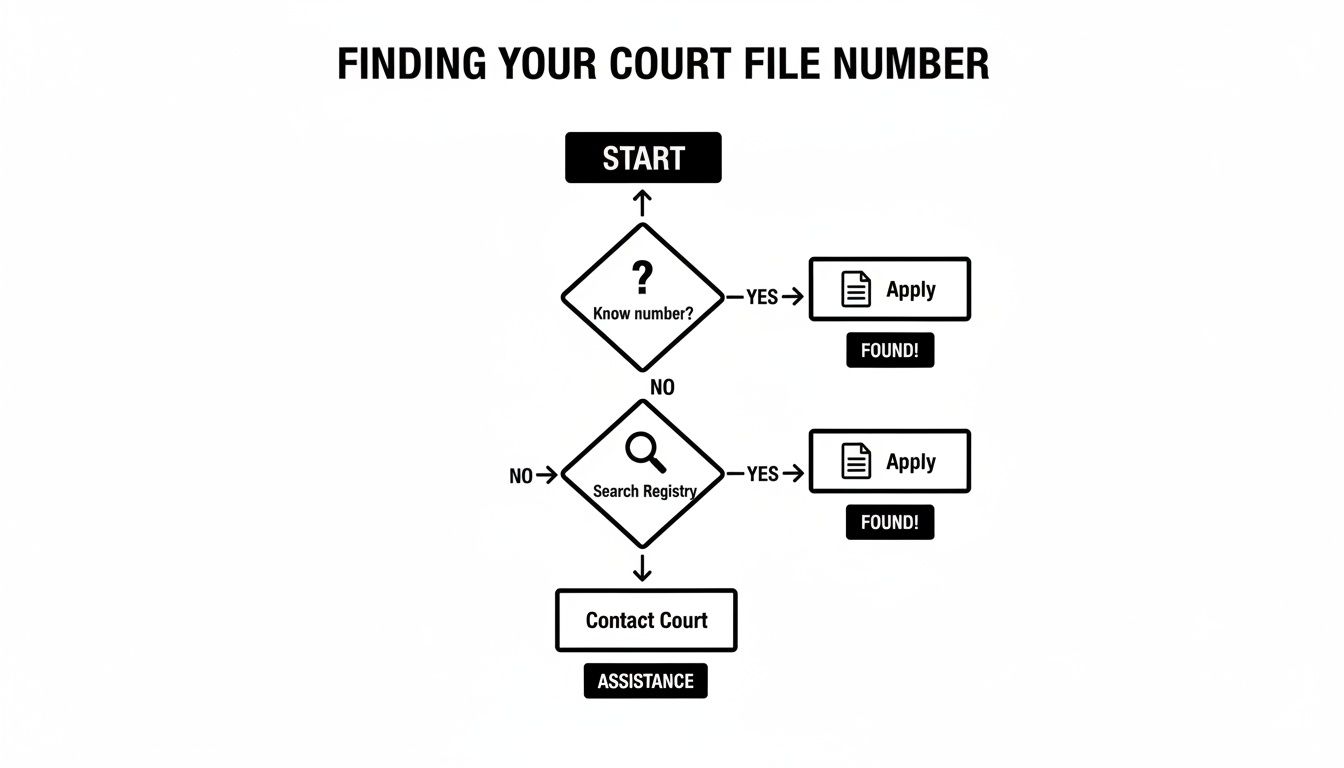
Finding Your Court File Number
Misplacing your court file number is common, but it’s usually easy to solve. If you have any original divorce papers, like the final Divorce Order, the file number will be printed at the top of the document.
If you can’t find any paperwork, you still have options. To successfully request a divorce certificate, you must provide the court location, file number, and the year the divorce was granted. For those who don’t know which courthouse handled their divorce, the federal Central Registry of Divorce Proceedings can help. This central database can provide you with the courthouse address and a reference number to assist your search.
You can learn more about getting copies of family law documents directly from the Ontario government’s official page.
Step 2: Navigating The Application Process in Ontario
Once you have your court file number, you can apply for your divorce certificate. Ontario offers three ways to do this, allowing you to pick the route that best suits your needs. Each path—online, mail, or in-person—has its own procedure.
The Modern Route: Applying Online
For most people, the fastest and easiest way is applying online through the official Government of Ontario portal.
Here’s what the online process looks like:
- Head over to the Ontario Court Services website.
- Log into or create your My Ontario account.
- Find the service for requesting family court documents.
- Fill out the digital version of Form 36B: Certificate of Divorce.
- Pay the $25 fee with a credit card (Visa/Mastercard) or a debit card.
While some legal processes use leading electronic signature software platforms, the government’s portal has its own secure system.
The Traditional Method: Applying by Mail
If you prefer paper, applying by mail is a reliable option. This involves downloading, printing, and filling out Form 36B by hand. Ensure every section is completed accurately to avoid delays. Mail the form to the specific courthouse where your divorce was granted.
A critical tip for mail-in applications is payment. You must include a certified cheque or a money order for the fee, made payable to the “Minister of Finance.” Personal cheques are not accepted.
The In-Person Option: Visiting the Courthouse
Your third choice is to apply in person at the same courthouse that finalized your divorce. This is a great option if you live nearby or have questions for the court staff. You’ll fill out Form 36B on-site and pay the fee. Depending on the courthouse’s workload, you might walk out with your certificate the same day, but it may take a few business days.
Comparing Application Methods for Your Ontario Divorce Certificate
This table provides a quick comparison to help you decide which path is right for you.
| Method | Best For | Processing Time (Estimate) | Payment Options |
|---|---|---|---|
| Online | Speed, convenience, and tracking. Ideal for those comfortable with digital forms. | 5-15 business days (often fastest) | Credit Card (Visa/Mastercard), Debit Card |
| Those who prefer a paper trail or are not comfortable with online applications. | 15-20 business days (plus mailing time) | Certified Cheque, Money Order | |
| In-Person | Immediate assistance, asking questions, or potentially same-day service (courthouse dependent). | Same day to a few business days | Credit Card, Debit Card, Certified Cheque, Money Order |
Step 3: Understanding the Costs and Timelines
When you’re at the final stage, the last thing you want are surprises with costs and waiting periods. The main government fee for the certificate itself is straightforward.
- Certificate Fee: The cost to request your official divorce certificate is $25.
This is an additional cost on top of initial court filing fees. In total, government fees for the court process and final certificate are approximately $694, before any legal representation costs. For a more detailed look, see our complete guide to Ontario divorce costs.
Standard Processing Times
How quickly you receive your certificate depends on how you apply.
- Online Requests: Usually processed within 5 to 15 business days.
- Mail-in Requests: Expect to wait 15 to 20 business days, plus postage time.
- In-Person Requests: Can range from same-day service to a few business days, depending on the courthouse.
These are estimates; court workloads and public holidays can cause delays.
Needing Your Certificate Urgently
If you have a remarriage ceremony booked or an urgent immigration deadline, you may be able to expedite your request.
To request urgent processing, you need a valid reason and proof, such as a letter from a religious official confirming a wedding date or a copy of your travel itinerary.
Make this request directly to the court clerk when you submit your application. If applying by mail, include a clear cover letter explaining the urgency. The court has the final say on whether to approve an expedited request.
Handling Special Cases Like Foreign Divorces
Not every divorce neatly fits the standard Ontario process. One of the most common hurdles involves divorces granted outside of Canada. A divorce from another country is not automatically recognized in Ontario for the purpose of getting remarried here.
The Role of a Foreign Divorce Opinion Letter
To get an overseas divorce legally validated for remarriage in Ontario, you need a Foreign Divorce Opinion Letter. This is a formal legal opinion from an Ontario lawyer confirming that your foreign divorce was legitimate and would be recognized under Canadian law.
Getting this letter involves a clear legal process:
- Provide the original or a court-certified copy of your foreign divorce order.
- An experienced lawyer will assess the legal grounds and jurisdiction of the foreign court.
- The lawyer drafts a formal letter that you submit with your marriage licence application.
This step is mandatory if you plan to remarry in Ontario after being divorced abroad. Review our detailed guide on the Foreign Divorce Opinion Letter process.
Dealing with Other Complexities
- Document Translation: If your original documents are not in English or French, you must use certified and notarized translation services.
- Correcting Errors: A misspelled name or incorrect date on your divorce order requires a formal motion to the court to have the order corrected before a new certificate can be issued.
- Accessing Old Records: If your divorce was decades ago, your file might be in long-term storage with the Archives of Ontario, which adds extra steps and time.
Seeking legal advice early ensures these “special cases” don’t become major roadblocks.
Serving Brampton and the Greater Toronto Area
Knowing the general rules is one thing; understanding how they play out in a specific courthouse is another. At Badesha Law, we work in the Peel Region and Greater Toronto Area every day. Our team knows the ins and outs of the Brampton and Mississauga courthouses, which helps prevent frustrating delays.

Related Reading
- The Complete Divorce Process in Ontario: Understand every stage from start to finish.
- How to File for Divorce in Ontario: A detailed look at the initial application process.
- Understanding Ontario Divorce Costs: A breakdown of fees and expenses.
- What is an Uncontested Divorce in Ontario?: Learn about the simplest path to divorce.
- The Foreign Divorce Opinion Letter Process: Your guide to validating an international divorce.
Disclaimer: The information provided in this article is for general informational purposes only and does not constitute legal advice. Family law is complex and specific to your situation. You should consult with a qualified legal professional for advice regarding your individual circumstances.
Written by the legal team at Badesha Law, experts in Ontario family law.
Frequently Asked Questions About Ontario Divorce Certificates
What is the difference between a Divorce Order and a Divorce Certificate?
A Divorce Order is the legal document a judge signs to end your marriage. The Divorce Certificate is the official proof that the divorce is final. You must wait 31 days after the Divorce Order is granted before you can apply for the certificate, which is the document needed to remarry.
How long does it take to get a divorce certificate in Ontario?
Processing times vary by application method. Applying online is fastest, typically taking 5 to 15 business days. Mail-in applications are the slowest, often taking 15-20 business days plus postage time. Applying in person can sometimes result in same-day service, but it depends entirely on the courthouse’s workload.
Can I get an Ontario divorce certificate if my divorce was outside Canada?
No, an Ontario court can only issue a certificate for a divorce granted in Ontario. If you were divorced in another country and wish to remarry here, you will need a Foreign Divorce Opinion Letter from an Ontario lawyer to validate your foreign divorce for legal purposes in the province.
What do I do if I don’t know my court file number?
If you can’t find your court file number on your old documents, contact the Central Registry of Divorce Proceedings in Ottawa. They maintain a national database and can provide you with your file number and the specific courthouse location where your divorce was processed. This information is mandatory for your application.
What is the cost of a divorce certificate in Ontario?
The government fee to obtain a Certificate of Divorce in Ontario is $25. This fee is payable at the time of your application, whether you apply online, by mail, or in person. This is an additional cost to the initial court filing fees for the divorce itself.
At Badesha Law, we know that even the final administrative steps of a divorce can feel overwhelming. If you’re stuck, have more questions, or need help with a complex issue like a foreign divorce opinion letter, our team is here to provide clear, practical answers.
Book a free, no-obligation consultation today and let us help you close this chapter with confidence.