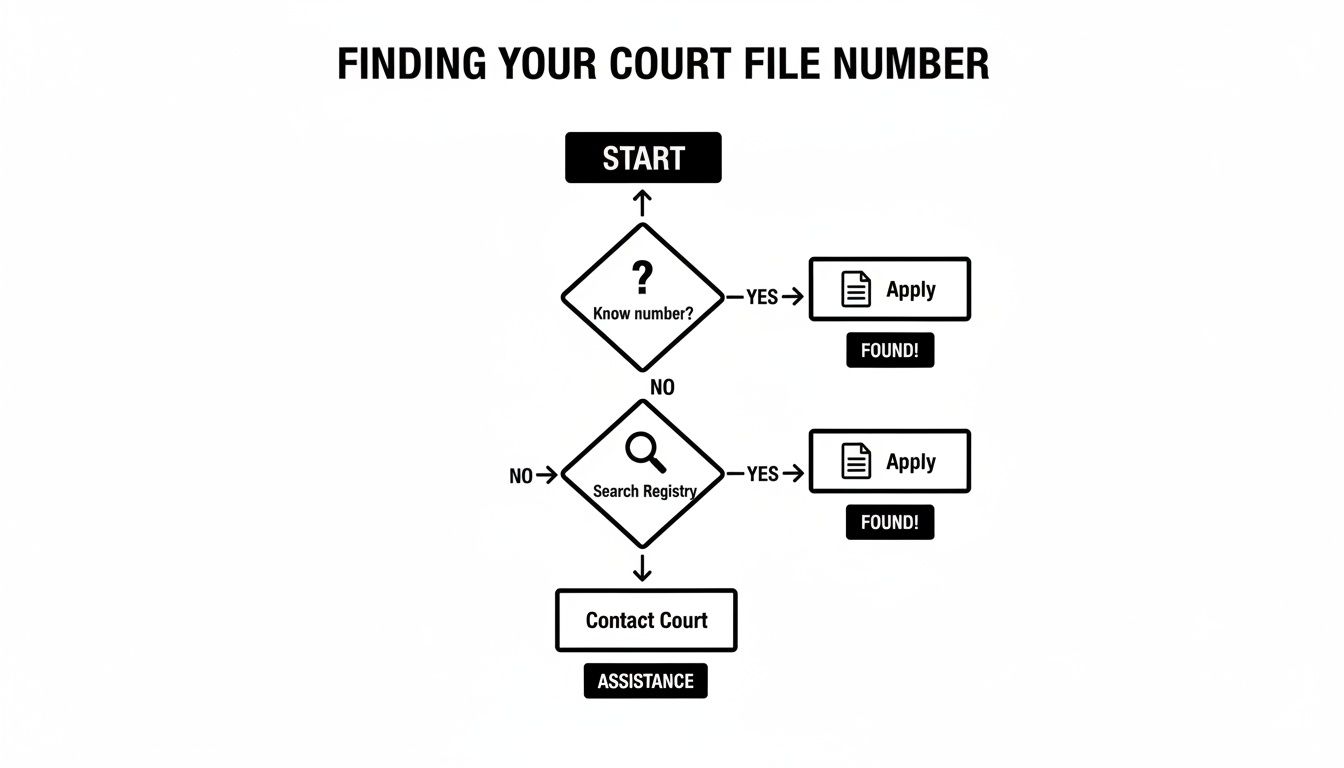
How to Get a Divorce Certificate in Ontario
You’re often asked for a divorce certificate at a moment when life is already moving fast. A new marriage licence application is underway. Immigration paperwork is due. An employer, pension administrator, or government office wants official proof that your divorce is final. Then the confusion starts. You may already have court papers, so why isn’t that enough?
In Ontario, the answer usually comes down to the difference between the document that granted the divorce and the document that confirms it is final. That distinction matters under the federal Divorce Act, including the waiting period before a divorce becomes effective. The good news is that getting the certificate is usually manageable if you apply the right way, through the right court, with the right information.
For people in Brampton, Mississauga, Toronto, and across the GTA, the process is more practical than dramatic. Most problems come from filing at the wrong courthouse, using inconsistent details, or choosing a method that doesn’t match your timeline. If you’re still at the earlier stage of ending the marriage itself, this guide on how to get a divorce in Canada may help before you request the certificate.
Your Guide to Getting a Divorce Certificate in Ontario
A divorce certificate is the court-issued proof that your divorce has taken legal effect. It’s the document many institutions want when they need simple confirmation that you are no longer legally married.
A lot of people mix it up with the divorce order. That’s understandable. The divorce order is the court’s decision in the divorce case. The certificate is closer to the final proof that the process has reached the finish line.
Think of it this way. The order is the court record that says the divorce was granted. The certificate is the document you usually show to third parties who don’t need the whole court file and just want official confirmation that the marriage ended.
For many clients, the stress isn’t legal complexity. It’s timing. They need the document quickly, they aren’t sure which courthouse handled the file, or they only have partial paperwork from years ago. Those are common problems, and they can usually be solved with a careful application and the right records.
Practical rule: Before you submit anything, match every name, date, and file detail to the court documents you already have. Small mismatches cause the biggest delays.
Understanding Your Divorce Certificate Versus a Divorce Order
A common GTA problem looks like this. Someone books a new wedding date, goes to ServiceOntario or a marriage licence office, and learns the divorce order they brought is not the document being asked for. That mistake costs time, and in Brampton and Toronto the practical difference matters because court counter access, file retrieval, and processing flow are not always the same from one courthouse to another.
A divorce order is the court document that says the judge granted the divorce. It sits within the court file and may be accompanied by other documents dealing with support, parenting, or property, depending on how the case was resolved.
A divorce certificate is the short court-issued proof that the divorce has already taken legal effect. It is usually the document third parties want because it confirms the marriage has legally ended, without requiring them to review the full file.

Why the waiting period matters
The divorce does not usually become effective on the day the order is signed. There is usually a waiting period before it takes effect, unless the court orders otherwise. Until that effective date passes, the certificate is generally not available.
People often get tripped up at this stage. They have a signed order and assume the process is finished. Legally, the finish line is the date the divorce takes effect.
That timing issue also affects how you should apply. If the order is recent, an in-person trip to the courthouse may not help if the divorce is not yet effective. If the divorce became final long ago, an online, mail, or in-person request may all work, but the speed and convenience can differ depending on whether the file is in Brampton, downtown Toronto, or an older court location with archived records.
Why the distinction matters in practice
Use the right document for the right job.
A divorce order is often enough if you or your lawyer need to confirm what the court decided in the case. A divorce certificate is usually the better document when a marriage licence office, pension administrator, or government office wants simple proof that the divorce is final.
In practice, I tell clients to check the exact wording of the request before they spend time attending a courthouse. Some offices will accept only the certificate. Others may accept the order if it clearly shows the effective date. Asking first can save you a wasted trip, especially if you are deciding between attending the Brampton courthouse in person or sending a request for a Toronto file by mail.
What details actually matter
The court must be able to identify the correct divorce file. If you still have the divorce order, start there. It usually contains the courthouse name, court file number, and date the order was granted.
If your paperwork is incomplete, focus on the details that help staff locate the file accurately:
- Court location: Brampton, Toronto, or the specific courthouse that granted the divorce
- Court file number: Often the fastest way to pull the record
- Year of divorce: Helps narrow the search
- Full legal names used in the case: Use the names exactly as they appeared in court
For divorces started under Ontario court process after the late 1960s, file details matter far more than people expect. A request that says only “Toronto divorce around 20 years ago” is much harder to process than one that identifies the exact courthouse and file number.
If you are not yet at the certificate stage and still need to start the court process itself, review this guide on how to apply for divorce in Ontario.
Practical advice: if you are unsure whether you need the order or the certificate, ask the institution requesting it before you apply. That one phone call often saves more time than choosing between online, mail, or in-person service.
Eligibility and Information Needed Before You Apply
A lot of delay happens before the request is even sent. Someone finds an old divorce order, remembers the year roughly, submits the application, and then learns the court cannot match the file with confidence. In the GTA, I see this often with former spouses who moved after the divorce and are no longer sure whether the case was finalized in Brampton, Toronto, Newmarket, or another courthouse.
Eligibility is usually straightforward. One of the former spouses named in the divorce file can request the certificate, and in some cases a lawyer or other authorized representative can do it for them. The harder part is giving the court enough accurate information to pull the right file on the first try.
Start with your documents, not your memory.
The details you should collect first
Gather the information that identifies the court file clearly:
- Full legal names of both spouses: Use the names exactly as they appeared in the divorce case.
- Court file number: If you have it, include it. This is often the quickest way for staff to locate the record.
- Date or year the divorce was granted: Even an exact year helps narrow the search.
- Courthouse location: You need the court that granted the divorce.
- Copy of the divorce order, if you still have it: It helps confirm the file number, date, and court location.
Accuracy matters more than people expect. A small mismatch in a surname, a guessed year, or the wrong courthouse can slow the request or force you to start again.
That point becomes more important if the original divorce was a joint divorce application in Ontario, because clients sometimes assume either spouse’s later address or current city changes where the record is kept. It does not. The record stays tied to the court file and the courthouse that issued the divorce.
Older files require more care
Older divorce records can involve a different search process. Some historical files are held through archival channels rather than handled the same way as newer court records. For more recent divorces, the practical starting point is usually the courthouse that granted the divorce. As noted earlier, federal record-tracking information may also help if the divorce was granted after the late 1960s and key file details have been lost.
If your divorce is older, expect retrieval to take more effort. That is especially true if you only know the city and approximate decade. A request for "a Toronto divorce from the early 1980s" gives court staff very little to work with. A request with the exact court file number, full names, and date is far easier to process.
A quick check before you submit
Before you apply, compare what you plan to submit against any court document already in your possession.
Confirm these points:
- Do both names match the court record exactly?
- Do you know the courthouse that granted the divorce?
- Do you have the correct file number, or a reliable way to find it?
- Have you verified the date instead of estimating it?
Treat this as a court record request, not an informal search. That mindset saves time whether you later choose to apply online, send the request by mail, or attend the correct GTA courthouse in person.
Choosing Your Application Method Online Mail or In-Person
A Brampton client often calls with the same problem. They need the certificate quickly, assume any nearby courthouse can issue it, then find out the divorce was granted in Toronto and the request has to be tied to that original court file. At that point, the best method is not just a paperwork choice. It is a time and stress choice.
In Ontario, you can apply online, by mail, or in person. Each route can work. The right one depends on where the divorce was granted, how complete your file details are, and how quickly you need the document.
In the GTA, courthouse location changes the practical answer. A Toronto divorce certificate request cannot be issued over the counter in Brampton because Brampton is closer. The request must be handled through the court that granted the divorce, as noted earlier and in this Ontario divorce certificate guide. That is why GTA applicants often save time by choosing online filing or attending the correct courthouse directly.

Online application
Online filing is usually the most practical choice for people who already have the file number, divorce date, and correct court location. Ontario uses Justice Services Online through a My Ontario Account, and the documents must be uploaded in PDF or Word format.
This method works well for GTA applicants who want to avoid traffic, parking, security screening, and courthouse counter hours. If your divorce was granted in downtown Toronto, online filing often saves more time than driving in, finding parking, waiting to be served, and then learning a clerk still needs time to process the request.
It also gives you a clear submission record. That matters if you are working against a travel deadline, a remarriage timeline, or a request from another government office.
Mail application
Mail is still available, but it is usually the slowest and least forgiving option.
The issue is not just postal delivery. If anything is missing, such as the wrong court location, an incomplete payment, or a mismatch in names, you lose more time because the correction cycle happens through outgoing mail, intake review, and another round of mailing. For straightforward files, mail can be fine. For uncertain files, it is often the method that creates the longest delay.
Mail usually makes sense in three situations:
- Travel is difficult: You cannot reasonably get to the issuing courthouse.
- You prefer paper: You want a physical copy of everything you send.
- Your file details are complete: You already know the exact names, date, and court information.
If any of those details are uncertain, online or in-person filing is usually easier to manage.
In-person application
In-person filing is often the best option when timing is tight and the correct courthouse is within reach.
For Brampton and Peel clients, this can be a very practical route if the divorce was granted locally and you can attend during service hours. Staff may be able to flag a basic problem right away, which is helpful if you are under pressure and want to avoid the back-and-forth that happens with mail. In some cases, in-person service can move faster than the other methods, but that depends on the courthouse, the day, and whether the file is readily available.
Toronto courts and Brampton courts do not always move at the same pace. Toronto locations often deal with heavier volume. Brampton can be more convenient for Peel files, but convenience only helps if Brampton is the court that issued the divorce. That distinction matters a lot in the GTA, and many generic guides skip over it.
Choose in person when urgency is the priority and you can get to the issuing courthouse. Choose online when you want a documented process without the trip.
What tends to work best in the GTA
Clients often ask whether Brampton is faster than Toronto. Sometimes yes. Sometimes no. Court volume, staff availability, and the age of the file all affect what happens in real life.
The better question is which method gives you the best chance of getting the request right the first time.
A practical way to decide is this:
- Choose online if you have the correct file details, want a written submission trail, and do not want to attend court.
- Choose in person if the need is urgent and the issuing courthouse is realistically accessible.
- Choose mail if speed is less important and you are confident the package is complete.
If you are still sorting out the divorce process itself, especially whether both spouses can file together, this guide on a joint divorce application in Ontario may help.
Comparing Divorce Certificate Application Methods in Ontario
| Method | Best For | Typical Processing Time | Key Requirement |
|---|---|---|---|
| Online | People with complete file details who want convenience and fewer avoidable errors | Acceptance is reviewed within a defined administrative window, with full timing depending on the court | My Ontario Account and properly completed digital documents |
| People who prefer paper filing and don’t need the fastest route | Usually slower because of delivery and handling | Complete package sent to the courthouse that granted the divorce | |
| In-person | People with urgent needs and access to the correct courthouse | Can be faster, depending on courthouse operations | Attendance at the specific court that issued the divorce |
One firm option some clients use for help with the process is Badesha Law, which handles divorce-related family law matters in Brampton and the GTA, including guidance on document requests tied to divorce files.
Navigating Fees and Processing Times in 2026
A common GTA scenario goes like this. Someone in Brampton needs a divorce certificate quickly because a wedding date, pension paperwork, or travel booking is coming up. They assume the fee is the main issue. In practice, the bigger issue is usually processing time, and that changes depending on whether the request goes online, by mail, or directly to the courthouse that granted the divorce.
Ontario’s fee for a divorce certificate application is $25, and that fee applies whether you apply online, in person, or by mail, according to the Ontario government page on getting copies of family law court documents. Payment options include Mastercard, Visa, debit card, or cheque or money order payable to the Minister of Finance through the approved process on that page. Eligible applicants may also use a court fee waiver certificate.

What timing looks like in real life
Official timelines are useful, but they are not guarantees.
Ontario’s public guidance says online applications typically receive confirmation of acceptance within five business days, and full processing is completed in one to three weeks. Some in-person applications can be processed the same day, depending on the courthouse. Mail-in applications usually take longer because delivery, intake, and payment handling add extra steps.
The part generic guides often miss is the local court reality. A person dealing with the Brampton courthouse may have a different experience from someone whose divorce was issued in downtown Toronto. Court volume, counter service, staffing, and the age of the file all affect timing. There is no dependable public chart that tells you, week by week, which GTA courthouse is moving faster. Treat the published timeline as a baseline, not a promise.
The trade-off between online, mail, and in-person filing
Online filing is often the best balance of speed and convenience if your file details are accurate and complete. You get immediate proof of submission, and you avoid mailing delays.
In-person filing can be the fastest option for some clients, especially where urgency is real and the correct courthouse is reasonably accessible. I often tell clients in the GTA to think about geography before they think about speed. If your divorce was granted in Brampton and you live nearby, attending there may make sense. If the file is in Toronto and getting downtown will cost you most of a workday, online filing may be the better choice even if same-day service is theoretically possible at the counter.
Mail is usually the slowest route. It can still be appropriate if urgency is low and the package is complete, but it gives you the fewest chances to correct a problem quickly.
The mistakes that stretch the timeline
Delay often starts with a small mismatch between the form and the court record.
The online system has a five-business-day acceptance window for review of Form 36B. If the form is incomplete or incorrect, the application is rejected, the $25 fee is refunded, and you have to submit again. That restart matters more than the refund if you are working against a deadline.
The errors that cause the most trouble are familiar:
- Legal names that do not match the court record
- Wrong divorce finalization date
- Incorrect court file number
- Sending the request to the wrong courthouse
- Relying on memory instead of checking the actual divorce order first
Save the online confirmation screen or take a screenshot as soon as you submit. If you later need to follow up on timing, that record helps.
If you are budgeting for more than the certificate itself, this guide to Ontario divorce costs and court fees helps separate the certificate fee from the broader expense of getting divorced in the first place.
Common Application Errors and How to Avoid Delays
A common GTA problem looks like this. Someone divorced in Brampton years ago now lives in downtown Toronto, submits a request to the wrong court, then loses time correcting a mistake that had nothing to do with the divorce itself.
That is how delays usually happen.
Most certificate requests stall because the form does not match the court record exactly, or because the request goes to the courthouse that is easiest to reach rather than the courthouse that granted the divorce. I see this often with former Peel Region residents who now work or live closer to Toronto. The convenience of filing from where you are now does not change where the court file is held.

The errors that cause the most delay
Some mistakes look minor but stop the application cold.
- Name differences: The legal names on the request must match the court record. A middle name, spelling variation, or post-divorce name change can create a problem if the file says something else.
- Wrong court location: If the divorce was granted in Brampton, the request belongs with that court file, not at a Toronto counter just because it is closer to home.
- Wrong date: People often use the date they separated or the date they attended court, instead of the date shown on the divorce paperwork.
- File number errors: One wrong digit or letter can be enough to prevent staff from finding the record quickly.
- Using memory instead of documents: Old emails, invoices, and handwritten notes are less reliable than the order itself.
Online, mail, and in-person requests all have this in common. Court staff work from the existing record. They do not rewrite the application to fix a near match.
A practical way to catch problems before you file
Put the application beside your divorce order and compare them line by line. Slow is faster here.
Check these points before you submit:
- Match every name exactly as it appears on the court record
- Use the court file number character by character
- Confirm the divorce date from the actual order, not from memory
- Send the request to the courthouse that granted the divorce
- Keep a copy of the form, receipt, and any submission confirmation
If you are applying online, save the confirmation screen as soon as you submit. If you are applying by mail, keep proof of delivery. If you are going in person to a GTA courthouse, bring a copy of the order with you so you can correct small issues before leaving the counter.
That last point matters more in practice than many guides admit. At some courthouses, an in-person visit gives you a better chance to spot an obvious filing problem right away. Mail gives you no such opportunity, and online filing can still mean waiting for the application to be reviewed before a mismatch is flagged.
When the problem is not just the certificate request
Sometimes the certificate application reveals a larger issue with the file itself. The order may contain an error. The divorce may not be clearly final on the record. There may also be unfinished family law issues tied to the old case.
That happens more often than people expect, especially where support, disclosure, or corollary relief was never fully cleaned up. If your file still touches financial issues, it can help to review related documents such as the Form 13.1 financial statement used in Ontario family law cases.
If the court record is wrong, or if you are under pressure to remarry by a certain date, do not assume a simple re-submission will fix everything. A short legal review at that stage can save weeks of back-and-forth.
When You Need More Than Just the Certificate
A divorce certificate solves one problem. It proves the divorce is final in Ontario. It does not solve every issue that can surface after separation or after a prior divorce.
One common example is a foreign divorce. If your divorce was granted outside Ontario or outside Canada, an Ontario court does not issue an Ontario divorce certificate for that foreign proceeding. In many remarriage and immigration situations, the main issue is not getting an Ontario certificate. It is proving that the foreign divorce is valid for Canadian legal purposes.
Another example is a file where the court record itself contains an error. If the names or dates in the underlying order are wrong, the certificate process may stop until the record is corrected. That can require more than an administrative request.
Situations where legal advice is worth getting
Some files deserve legal review early, before you spend time chasing the wrong document.
Consider getting advice if:
- Your divorce happened outside Canada: You may need an opinion letter rather than an Ontario certificate.
- You can’t confirm whether the divorce is final: A certificate request won’t fix uncertainty in the underlying status.
- The order appears inaccurate: Clerical or substantive errors may need correction first.
- You’re remarrying soon: Tight deadlines leave little room for rejected applications.
- Your divorce file intersects with unresolved support, parenting, or property issues: The certificate may be only one part of what needs attention.
A practical final word
Most Ontario divorce certificate requests are straightforward when the file information is accurate and the application method matches the urgency. The difficulty usually isn’t the law. It’s choosing the correct courthouse, using exact details, and avoiding an error that forces you to start over.
That’s especially true in the GTA, where travel time, courthouse access, and local practice realities can change what the most efficient option looks like. If the request is routine, a careful application may be all you need. If the request is tied to a foreign divorce, a record problem, or a time-sensitive remarriage or immigration matter, it’s sensible to get legal help before you lose more time.
If you need help with a divorce certificate request, a foreign divorce opinion letter, or a broader family law issue in Brampton or the GTA, contact Badesha Law for clear guidance on the next step.