

How to Get Full Custody in Ontario: A Practical Guide
When you're fighting for your child's future, the phrase "full custody" feels like the ultimate goal—a clear, final win. But in Ontario's family courts today, that term is a bit of a relic. The law has evolved, and understanding the new language, as outlined in Canada's Divorce Act and Ontario's Children's Law Reform Act, is the first step toward building a winning strategy.
If you want to be the parent making all the major decisions, you have to prove to a judge that this arrangement is in the absolute best interests of your child. This isn't about what you want or what the other parent deserves. It’s about showing you can provide a uniquely stable, safe, and nurturing environment that the other parent simply cannot.
And that requires a mountain of proof.
What “Full Custody” Really Means in Ontario Today

The legal system doesn’t really talk about "custody" anymore. Instead, the courts operate under the framework of Canada's Divorce Act and Ontario's Children's Law Reform Act, which split the old idea of custody into two very specific parts.
Getting this distinction right is crucial. It sets realistic expectations and helps you focus on what really matters in your case.
Understanding Modern Custody Terms in Ontario
To make sense of court documents and legal advice, you need to know the official language. The old terms are still used in everyday conversation, but they won’t appear in a judge's final order.
This table breaks down the shift from traditional ideas to the current legal reality.
| Traditional Term | Current Ontario Legal Term | What It Really Means for Your Child |
|---|---|---|
| Full Custody | Sole Decision-Making Responsibility | One parent has the final say on all major life decisions like school, healthcare, and religious upbringing. |
| Joint Custody | Joint Decision-Making Responsibility | Both parents must agree on major decisions together. This requires a high level of communication and cooperation. |
| Access | Parenting Time | This is the physical schedule detailing when the child is in each parent's care. It’s separate from who makes the decisions. |
| Primary Care | Primary Residence | This refers to the parent with whom the child lives most of the time. This parent often receives child support. |
Thinking in terms of decision-making and parenting time helps clarify your goals and shows the court you understand the modern legal framework.
Decision-Making Responsibility vs. Parenting Time
These two concepts are the bedrock of modern parenting orders.
Decision-Making Responsibility: This is about who has the authority to make critical choices for your child—things like their education, major medical treatments, and religious upbringing. What people call "full custody" is now legally known as sole decision-making responsibility.
Parenting Time: This is simply the schedule of when your child is in each parent's care. It’s the day-to-day routine.
It’s entirely possible for one parent to have sole decision-making power while the other parent still enjoys a generous and clearly defined parenting schedule. The court's default position is that a child benefits from a meaningful relationship with both parents, as long as it's safe.
You can learn more about how these arrangements work in our detailed guide on the differences between shared and joint custody.
When Is Sole Decision-Making Responsibility Actually Granted?
Ontario courts start from a place of encouraging co-parenting. The default belief is that two involved parents are better than one. Because of this, getting sole decision-making responsibility is the exception, not the rule, and it demands a powerful, evidence-based case.
A judge will only award sole decision-making responsibility when shared parenting is proven to be completely unworkable or actively harmful to the child. This isn't about punishing one parent; it's about protecting the child's well-being above all else.
This high standard means you can't just say the other parent is difficult. You have to provide concrete proof. While statistics have shifted over time, the modern focus is on creating a plan that works for the child, not picking a "winner."
To succeed, you have to meticulously gather evidence—school records, medical histories, emails, text messages, and witness statements—that paint a clear picture of you as the consistently stable, capable, and child-focused parent. A family lawyer can guide you on exactly what proof is needed to meet this high bar, often starting with a free consultation.
Meeting the Best Interests of the Child Test

Every single decision a family court judge in Ontario makes about your child’s life boils down to one powerful legal standard: the best interests of the child. This isn't just a vague idea; it's a specific legal test laid out in both the federal Divorce Act and Ontario’s Children’s Law Reform Act.
When you're trying to figure out how to get full custody, your entire case must be built around proving that sole decision-making is the only outcome that truly serves your child’s needs. Your personal feelings or conflicts with the other parent are secondary. The court’s lens is focused entirely on the child’s world.
This means you have to shift your perspective from what you want to what your child needs—and then gather the hard evidence to prove it.
The Key Factors a Judge Considers
The family law acts give judges a checklist of factors they must consider. They won't just pick one or two; they look at the complete picture your evidence paints. Think of each factor as a chapter in the story of your child's life and your role in it.
The main considerations include:
- The Child’s Needs: This covers everything from emotional and psychological well-being to their physical health. If a child requires specialized medical care or therapy, for example, they need a parent who is organized and diligent in managing those appointments and treatments.
- The Child's Views and Preferences: If a child is mature enough to express their own wishes, the court will listen. A 14-year-old’s opinion will naturally carry more weight than a 7-year-old’s, but it’s a factor at any age where it can be reasonably determined.
- Emotional Ties: The judge will look at the love, affection, and emotional bonds between the child and each parent. They'll also consider relationships with siblings, grandparents, and other important people in their life.
- Stability of the Home Environment: Courts value consistency. The parent who can provide a stable, predictable home life, school routine, and community connection often has a much stronger position.
- History of Family Violence: The Divorce Act now explicitly requires courts to consider any history of family violence, which includes physical, sexual, psychological, and financial abuse.
The Primary Caregiver Argument
One of the most powerful arguments in any custody case is establishing yourself as the primary caregiver. This is the parent who has, historically, been more responsible for the child's day-to-day life.
Who takes the child to doctor’s appointments? Who goes to parent-teacher interviews? Who arranges daycare, packs lunches, and helps with homework? Documenting your consistent involvement in these routine but critical tasks provides tangible proof of your central role in your child’s life.
Expert Tip: Keep a detailed calendar or journal. Note every appointment, school event, and extracurricular activity you manage for your child. This isn't just a list; it’s a powerful piece of evidence that demonstrates your unwavering commitment and ability to provide a stable life.
The Friendly Parent Rule
A crucial—and often misunderstood—part of the best interests test is the "friendly parent" rule, also known as the "maximum contact principle." The court will assess each parent's willingness to support and encourage the child’s relationship with the other parent.
This can feel completely counterintuitive when you are seeking sole custody. However, actively undermining or obstructing the child's time with their other parent can severely damage your case, unless there are proven safety concerns like family violence or substance abuse. A judge wants to see that you can put your child’s need for both parents ahead of your own personal conflict.
For a deeper dive into how judges weigh all these factors, you might be interested in our article on how courts decide child custody. Understanding the court's mindset is the first step toward building a case that aligns with it. In the end, meeting the best interests test is about telling a compelling, evidence-backed story where your child is the hero, and you are their most reliable and dedicated protector.
Building a Strong Case for Sole Decision-Making Responsibility
To convince a judge that giving you sole decision-making responsibility is what’s best for your child, you need to build a case brick by brick with credible, organized evidence. Your word against the other parent’s simply isn’t enough. The goal is to paint a clear picture for the court, showing that you are the stable, consistent, and capable parent your child depends on.
Emotional arguments and recounting past fights often get lost in a courtroom, but documented facts are hard to ignore. This means shifting your focus from who was right or wrong in a disagreement to methodically collecting the proof that supports your position. Every piece of evidence should serve one purpose: demonstrating that your child's well-being is best protected when you have the final say.
Documenting Your Role as the Primary Caregiver
One of the most powerful arguments you can make is that you are, and have always been, the child's main caregiver. This isn't about downplaying the other parent's role but about proving your consistent, hands-on involvement in the day-to-day details of your child's life.
Start by creating detailed logs that show a clear pattern of care.
- A Parenting Journal: Document the daily routines—who makes lunches, helps with homework, handles bedtime, and manages discipline. Make notes of important events, conversations, and any parenting time the other parent misses.
- Communication Records: Save everything. Emails, text messages, and app communications with the other parent should be saved and organized chronologically. This can show your efforts to co-parent effectively or, on the other hand, reveal a pattern of conflict or uncooperativeness from the other side.
- Detailed Calendars: Keep a calendar marking every single doctor's appointment, parent-teacher interview, and extracurricular activity you manage. This visual proof quickly establishes you as the go-to parent for your child’s needs.
These records aren’t just for you; they can be organized and presented as evidence to create a powerful story of your deep involvement.
Gathering Impactful Third-Party Evidence
What other people say about your parenting can carry enormous weight in court. Objective, third-party evidence from professionals who are part of your child’s life gives the judge an unbiased perspective that is difficult to challenge.
Think about who interacts with your child regularly and can speak to their well-being while in your care.
- School Records: Report cards, attendance records, and emails from teachers can highlight your child's academic progress and, just as importantly, your involvement in their education.
- Medical and Dental Records: These documents prove that you are attentive to your child's physical health. A letter from your family doctor or a child psychologist can be especially influential if there are specific health or wellness concerns.
- Letters of Support: Ask people like teachers, coaches, daycare providers, or even trusted family friends to write letters detailing their observations of your parenting and your positive relationship with your child.
A short letter from a teacher noting that you are the only parent who consistently attends school meetings can be far more persuasive than hours of your own testimony. These independent voices validate your claims and add serious credibility to your case.
Before you start collecting documents, it helps to have a clear checklist. This table breaks down what you need and, more importantly, why it helps your case.
Your Evidence Gathering Checklist
| Type of Evidence | Specific Examples to Gather | Why This Strengthens Your Case |
|---|---|---|
| Parenting Involvement | Parenting journal, communication logs (texts, emails), calendars marking appointments you managed, school contact forms listing you as primary. | Establishes you as the consistent, hands-on caregiver who manages the child’s daily life and needs. |
| Child's Well-Being | Report cards, attendance records, letters from teachers or coaches, medical and dental records. | Provides objective proof that the child is thriving and well-cared for under your primary care. |
| Financial Stability | Pay stubs, tax returns, bank statements, completed Form 13.1 Financial Statement. | Demonstrates your ability to provide a stable home and meet the child's financial needs. |
| Parental Fitness | Letters of support from credible third parties (teachers, doctors), proof of completion of parenting courses, clean police background check. | Builds a picture of you as a responsible, stable, and fit parent capable of making sound decisions. |
| Concerns About Other Parent | Police reports, criminal record checks, photos/videos of unsafe conditions or behaviour, witness statements about substance abuse or neglect. | Provides concrete, verifiable proof to back up any serious allegations you are making. |
Having this evidence organized and ready will make the process smoother and your case much stronger from the very beginning.
Demonstrating Stability and Sound Judgment
A judge needs to feel confident that you can provide a safe and stable environment. This goes beyond just physical safety—it includes your financial and emotional stability as well.
Your financial situation is a key piece of the puzzle. The court must be satisfied that you can provide for your child's basic needs. You'll be required to submit a detailed financial statement, and it’s critical that it's filled out with complete accuracy. You can learn more about this by reviewing our guide on how to complete a Form 13.1 Financial Statement.
Beyond your finances, your choice of witnesses is crucial. You need to select people who have firsthand knowledge of your parenting skills. A credible witness is someone who can give specific examples, not just general praise. For instance, a neighbour who has seen you patiently playing with your child in the backyard every day offers far more value than a relative who lives in another city and only sees you on holidays.
Addressing High-Stakes Situations
Often, a push for sole decision-making responsibility comes from serious concerns about the other parent's behaviour. If your case involves issues like family violence, substance abuse, or serious mental health problems that impact parenting, the burden of proof is very high, and the evidence you present must be concrete.
Making allegations without proof will get you nowhere. You must provide specific, verifiable evidence to protect your child.
- For Family Violence: Gather any police reports, photos of injuries or property damage, medical records, and statements from anyone who witnessed the abuse. A restraining order or peace bond is an extremely powerful piece of evidence.
- For Substance Abuse: Collect evidence like police records for DUIs, photographs, or testimony from witnesses who have directly observed the behaviour. If there's enough initial evidence, the court can order drug or alcohol testing.
- For Mental Health Issues: If a parent's mental health condition is negatively impacting their ability to care for the child, medical records or a formal report from a professional can be submitted as evidence.
Presenting strong evidence like police reports or a therapist's notes can significantly influence the outcome in your favour.
Navigating the Ontario Family Court Process
Stepping into the Ontario family court system for the first time can feel like you've been dropped into a maze. The language is foreign, the steps are confusing, and the stakes for your family couldn't be higher. But if you can get a handle on the key stages of the journey, the process becomes far more predictable and a lot less overwhelming.
The entire system is built to move your case from a point of conflict to a final resolution, whether that happens through an agreement you reach or a decision made by a judge. Your path begins when you formally start a court case and moves through a series of mandatory meetings designed to solve as many issues as possible without needing a full-blown, expensive trial.
Kicking Off Your Case: Filing an Application
Your legal journey toward sole decision-making responsibility officially starts when you file a document called a Form 8 Application (General) with the court. This is the document that launches your family law case. Inside, you'll lay out your personal details, your relationship history with the other parent, and—most importantly—the specific orders you’re asking the judge to make about decision-making and parenting time for your child.
Once this form is filed with the court, it has to be "served" on the other parent. This is the formal step of giving them a copy, which puts them on notice that a court case has begun and gives them a strict deadline to file their own response.
The First Appearance and Case Conference
After your application is filed and served, your first major court dates will be the First Appearance and then a Case Conference. These are not trials where you argue your case with evidence. Think of them as management meetings with a judge to get the case organized.
- First Appearance: This is a very brief, procedural check-in. A court clerk, and sometimes a judge, will just confirm that both you and the other parent have filed your initial documents correctly so the case can move forward.
- Case Conference: This meeting is far more substantial. Here, you, the other parent, and your lawyers will meet with a judge to pinpoint the exact issues you disagree on, talk about any potential for settlement, and map out a schedule for the next steps. It's a critical chance to narrow the conflict and get some early feedback from a judge.
To get a better sense of this crucial meeting, you can learn more about what happens at a family law Case Conference in our detailed guide.
The Role of the Office of the Children's Lawyer
In high-conflict custody battles or when there are serious worries about a child’s well-being, the court might bring in the Office of the Children's Lawyer (OCL). This is an independent government body that provides a lawyer to represent the child directly.
An OCL lawyer will conduct a thorough investigation, which could involve meeting with your child, both parents, teachers, and even doctors. They will then write a detailed report for the court with recommendations on what parenting arrangement they believe is truly in the child’s best interests.
An OCL report isn't the final word, but it carries immense weight with a judge. A positive recommendation from the OCL can be one of the most persuasive pieces of evidence you can have when you're seeking sole custody.
Motions for Temporary Orders
The full court process can be painfully slow, sometimes taking more than a year to get to a final trial. Since children need stability now, not a year from now, you can file a motion to ask a judge for a temporary order. This asks for sole decision-making and a specific parenting schedule to be put in place right away, and that order will stand until a final decision is made.
Winning a motion for temporary orders is a huge strategic advantage. It creates a "status quo"—a routine for the child—that a judge may be very hesitant to disrupt later on.
Looking Beyond the Courtroom: Alternatives to Litigation
Going to trial isn’t the only way to get a full custody arrangement. In fact, the court system heavily encourages parents to settle their disputes outside of the courtroom whenever they can. These alternative dispute resolution (ADR) methods are almost always faster, cheaper, and far less stressful than a court battle.
Here’s a look at the core steps involved in building a strong case, whether you’re heading to court or sitting down at a negotiation table.
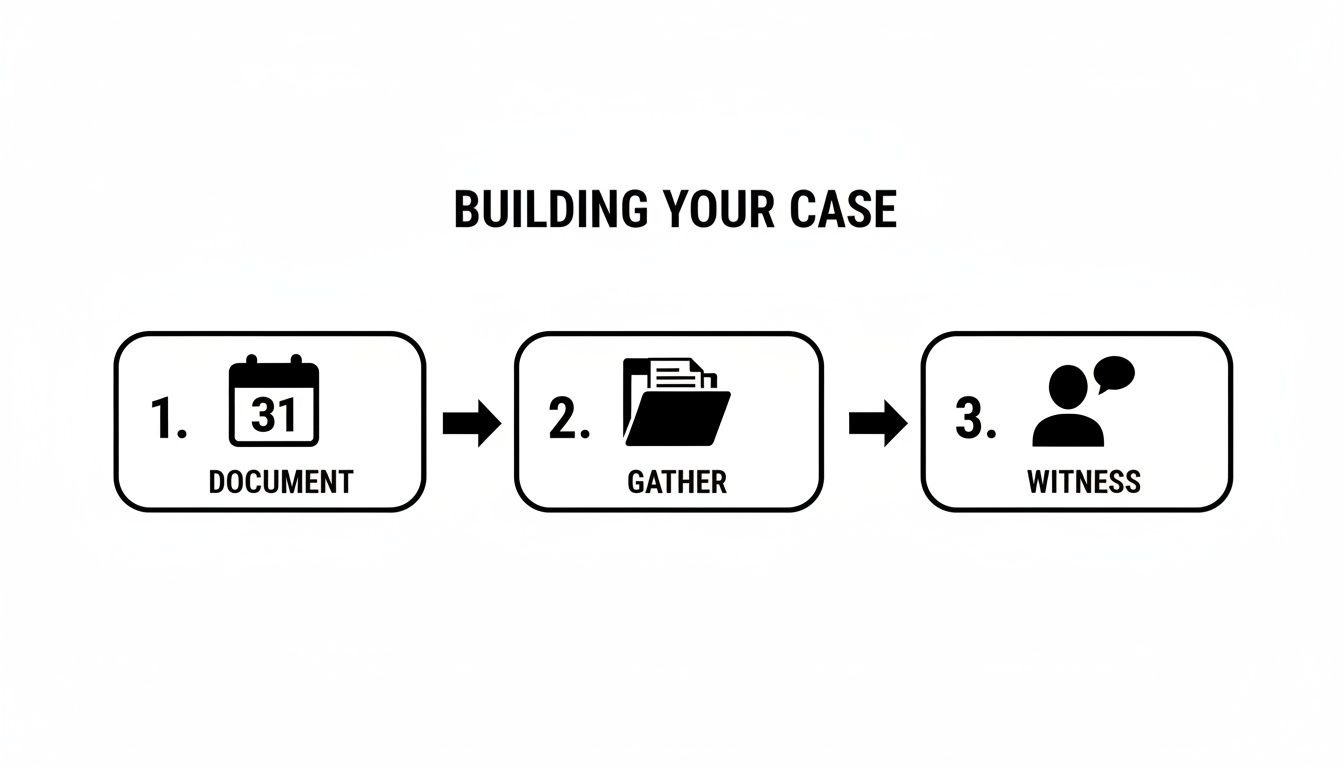
This process shows the essential groundwork you need to do: documenting your role as a parent, gathering proof, and lining up witnesses who can back up your claims.
Two of the most common alternatives in Ontario are:
- Mediation: You and the other parent sit down with a neutral third-party mediator who helps you negotiate an agreement you can both live with. The mediator doesn't make decisions for you; they just help you communicate and find common ground.
- Collaborative Family Law: In this process, both parents and their specially trained lawyers sign an agreement promising to resolve all the issues without ever setting foot in court. It’s a team-based approach focused on open communication and finding creative solutions.
If you can reach a full agreement using one of these methods, your lawyer can draft it into a legally binding Separation Agreement. This gives you the sole decision-making arrangement you were aiming for, but without the cost and conflict of a trial.
Why You Need an Experienced Family Lawyer
It’s tempting to think you can handle your own custody case to save money. But some fights have stakes that are just too high to go it alone. Knowing when to switch from representing yourself to hiring a professional is one of the most important calls you’ll make in the entire process.
Certain red flags immediately signal you’re stepping into complex legal territory where a lawyer isn’t just an option—it’s essential. If your case has any of the following elements, trying to navigate it yourself is a massive risk to your child’s future.
When Self-Representation Is Too Risky
The family court system has its own world of intricate rules, procedures, and unspoken expectations. One tiny misstep, like missing a deadline or filing the wrong form, can have devastating consequences for your case.
You absolutely need professional legal representation if your situation involves any of these:
- Serious Allegations: If there are accusations of family violence, neglect, or substance abuse from either side, the case gets complicated fast. You need a lawyer who knows how to properly present evidence to back up your claims and dismantle false ones.
- A High-Conflict Co-Parent: If the other parent is combative, refuses to communicate rationally, or has already hired their own aggressive lawyer, you’ll be at a huge disadvantage trying to face that alone.
- Involvement of the Children's Aid Society (CAS): As soon as the CAS gets involved, the stakes skyrocket. Their reports and investigations carry immense weight with a judge, and you need an advocate who understands how to work with the society and protect your rights.
- Complex Financial Issues: When things like business assets, hidden income, or significant investments are part of the picture, an experienced lawyer is crucial to make sure nothing is missed and the outcome is fair.
Here’s the reality: a judge expects your case to be presented in a specific, legally sound way. An experienced lawyer knows how to frame your story, organize your proof, and make arguments that align with the Children's Law Reform Act and actually resonate with the court.
The Tangible Value a Lawyer Brings
Hiring a family lawyer is about so much more than just having someone speak for you in court. It’s about leveraging their expertise at every single stage to build the strongest possible case for sole decision-making responsibility.
An experienced lawyer gives you critical advantages:
- Navigating Complex Court Rules: They make sure every single document is filed correctly and on time, manage all the back-and-forth with the opposing lawyer, and ensure you follow every procedural rule to the letter.
- Drafting Persuasive Affidavits: Your affidavit is your sworn written evidence—it's the heart of your case. A lawyer knows how to craft this document to tell a compelling story, highlighting your strengths as a parent while presenting the facts clearly and powerfully.
- Making Compelling Arguments: In court, a lawyer can effectively cross-examine witnesses, object to improper evidence, and present your case to the judge in a professional, structured manner that people representing themselves often struggle to achieve.
- Strategic Negotiation: The truth is, most cases settle before a trial. A skilled negotiator can often secure your goal of sole decision-making through a well-drafted separation agreement, saving you the incredible stress and expense of a court battle.
Protecting Your Child's Future in Brampton and the GTA
At Badesha Law, we know that seeking sole decision-making responsibility comes from a deep-seated need to protect your child. Our client-focused approach, serving Brampton, Mississauga, and the wider GTA, is built on giving you clear, honest guidance. We focus on what matters most to the court: your child's safety, stability, and overall well-being.
Your journey starts with simply understanding your options. A free consultation can give you the clarity you need to figure out the right next steps. We'll listen to your story, explain your legal position, and outline a practical strategy to achieve your goals, whether that’s through smart negotiation or strong advocacy in court. Protecting your child's future is the most important job you have—and you don’t have to do it alone.
Common Questions About Full Custody in Ontario
Pursuing sole decision-making for your child naturally brings up a lot of urgent questions. The stakes feel incredibly high, and the legal system can be confusing when you're under stress. Here are some straightforward answers to the things parents most often ask when trying to figure out how to get full custody.
Can My Child Decide Who to Live With in Ontario?
This is a big one, and the answer isn't a simple yes or no. A child's wishes are definitely an important factor a judge will consider, but they are never the only factor. The real key is how much weight a judge gives their opinion, which almost always comes down to their age and maturity.
A teenager's clearly expressed preference is going to carry a lot of influence in court. A younger child's view, while still important, won't be the deciding vote on its own. The court’s job is to balance what the child wants with all the other "best interests" factors, like which home offers the most stability and safety.
To get a clear picture without putting the child in the middle of a loyalty conflict, a judge will often ask for an assessment from the Office of the Children's Lawyer (OCL). This provides a neutral, expert way to present the child's views to the court.
How Much Does It Cost to Fight for Full Custody?
The cost of a custody case can vary wildly, and it all boils down to one thing: the level of conflict between you and the other parent. An uncontested agreement, where both of you consent to one parent having sole decision-making, is by far the most affordable route.
On the other hand, a heated court battle that goes through motions, conferences, and a full trial can get incredibly expensive, often running into the tens of thousands of dollars in legal fees.
What drives the cost up? Things like:
- The need for expert reports (like psychological or parenting assessments)
- The number of times you have to appear in court
- How long the entire dispute drags on
At Badesha Law, our first priority is always to explore cost-effective options like mediation. We believe in being completely transparent about potential costs right from the very beginning.
Does Cheating Affect Who Gets Custody?
In nearly all cases, the answer is no. Infidelity doesn’t really factor into custody decisions in Canada. Our family law system is "no-fault," which means the court’s entire focus stays on what is in the "best interests of the child," not on the reasons the parents' relationship ended.
A parent's personal behaviour only becomes relevant if it directly harms their ability to be a good parent or actively puts the child's well-being at risk. For instance, if a parent's new partner has a criminal record or poses a demonstrable danger to the child, that specific situation could absolutely influence a judge's decision. But the act of cheating itself? That won’t be the reason a judge grants or denies sole decision-making.
Can I Move Away If I Get Full Custody?
Even with an order for sole decision-making, you don't get an automatic green light to relocate with your child. You can't just pack up and move a significant distance—especially if it will interfere with the other parent's access and parenting time—without getting their written consent or a court order first.
Under the Divorce Act, you are legally required to give the other parent 60 days formal notice of any planned move. If they object, you’ll have to go back to court and prove that the relocation is genuinely in your child's best interests. A judge will look at many factors, with a major focus on how the move would impact the child's relationship with the other parent.
Understanding these mobility rights is also tied to financial responsibilities. It’s a good idea to review the comprehensive child support laws in Ontario to see how a potential move could impact support payments.
When you are ready to take the next step in securing your child's future, the team at Badesha Law is here to provide the clear, strategic guidance you need. Contact us for a free consultation to discuss your case and learn how we can help you move forward with confidence. https://badeshalaw.ca